Master opal collector terminology: 5 essential terms
Posted by AOD on 15th Apr 2026
Master opal collector terminology: 5 essential terms

TL;DR:
- Precise gemstone terminology helps distinguish opal rarity, value, and authenticity.
- Body tone, play-of-color, brightness, and pattern are essential descriptors for evaluating opals.
- Using shared language improves market transparency, ethical sourcing, and collector confidence.
Not all opals are created equal, and the collectors who understand this most deeply are the ones who speak the language of gemstones fluently. A Lightning Ridge black opal graded N1 with a harlequin pattern occupies an entirely different universe of value from a pale, undifferentiated stone pulled from the same Australian earth. The vocabulary of gemstone collecting isn’t merely academic decoration reserved for experts. It is the living framework through which rarity, beauty, and authenticity are recognized, communicated, and protected. This guide unravels the essential terminology every opal enthusiast needs, with a particular focus on ethically sourced Australian opals that carry both geological wonder and cultural significance.
Table of Contents
- Why terminology matters in gemstone collecting
- Decoding essential opal terminology
- How terminology shapes opal market value
- Putting terminology to work: practical collector tips
- Why mastering terminology transforms your collecting experience
- Discover Australian opals with expert guidance
- Frequently asked questions
Key Takeaways
| Point | Details |
|---|---|
| Learn the essentials | Mastering body tone, play-of-color, brightness, and patterns helps you spot valuable opals. |
| Language drives market value | The right terminology empowers better buying, selling, and authentic collecting. |
| Collect ethically | Knowing and asking about sourcing and standard grading ensures ethical purchases and long-term value. |
| Apply with confidence | Using these terms protects against misleading sales and elevates you in the opal collecting community. |
Why terminology matters in gemstone collecting
Precise language is the backbone of any serious collecting discipline, and opals demand it more than almost any other gemstone. Unlike diamonds, which follow the globally standardized 4Cs framework, opals are assessed through a richer, more nuanced vocabulary that captures their living, shifting nature. Two collectors standing before the same stone might describe it in completely different ways if they don’t share a common terminology, and that gap in language can translate directly into a gap in perceived value.
For opal collectors, the stakes are especially high. Understanding opals’ value factors requires fluency in terms like body tone, play-of-color, brightness, and pattern. Each of these descriptors carries weight in the marketplace. A seller who uses them correctly signals expertise and transparency. A buyer who understands them can distinguish a genuinely rare specimen from an overpriced average stone.
“For opals, key collector terminology includes body tone (N1 jet black to N9 translucent white; N1-N4 black opals most valuable), play-of-color (diffraction flashes), brightness, and patterns.”
Ethical sourcing adds another layer to this need for shared language. When a seller claims a stone is “ethically mined from Lightning Ridge,” that phrase carries specific implications about labor practices, environmental responsibility, and chain of custody. Without standardized terminology, these claims become vague marketing rather than verifiable facts. The collector community benefits enormously when everyone operates from the same definitional foundation.
Misunderstanding terms can lead to costly mistakes. Consider these common pitfalls:
- Confusing body tone with play-of-color, leading to overpaying for a bright stone with a poor base
- Misidentifying a doublet (a layered composite stone) as a solid opal
- Treating potch (colorless opal) as a defect rather than a natural host material
- Overlooking how how opals get their color through silica diffraction, not pigmentation
With the importance of precise language established, let’s break down the key terms every opal enthusiast should know.
Decoding essential opal terminology
Now that you know why proper terminology is important, let’s explore the essentials so you can describe and evaluate opals like a seasoned collector.
Body tone is the starting point for any opal assessment. It describes the underlying darkness or lightness of the stone, independent of any color play. The scale runs from N1 (jet black, the rarest and most coveted) through to N9 (translucent white). Black opals rated N1 through N4 are the most prized because the dark background makes their spectral colors appear dramatically vivid, like fireworks against a midnight sky.
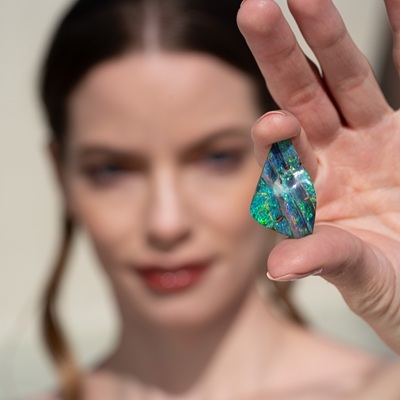
Play-of-color is the phenomenon that makes opals unlike any other gem on earth. It refers to the kaleidoscopic flashes of spectral color produced when light diffracts through the microscopic silica spheres arranged within the stone. The more vivid, broad, and directionally consistent the play-of-color, the more valuable the opal. Understanding opal play-of-color is essential for any serious collector.

Brightness is graded on a scale from B1 (vivid, almost luminous) to B7 (dull, barely perceptible). This grading reflects how powerfully the play-of-color asserts itself, particularly in lower light conditions. A stone with a B1 or B2 brightness rating will hold its fire even under dim indoor lighting, while a B6 or B7 stone may only sparkle convincingly under direct sunlight.
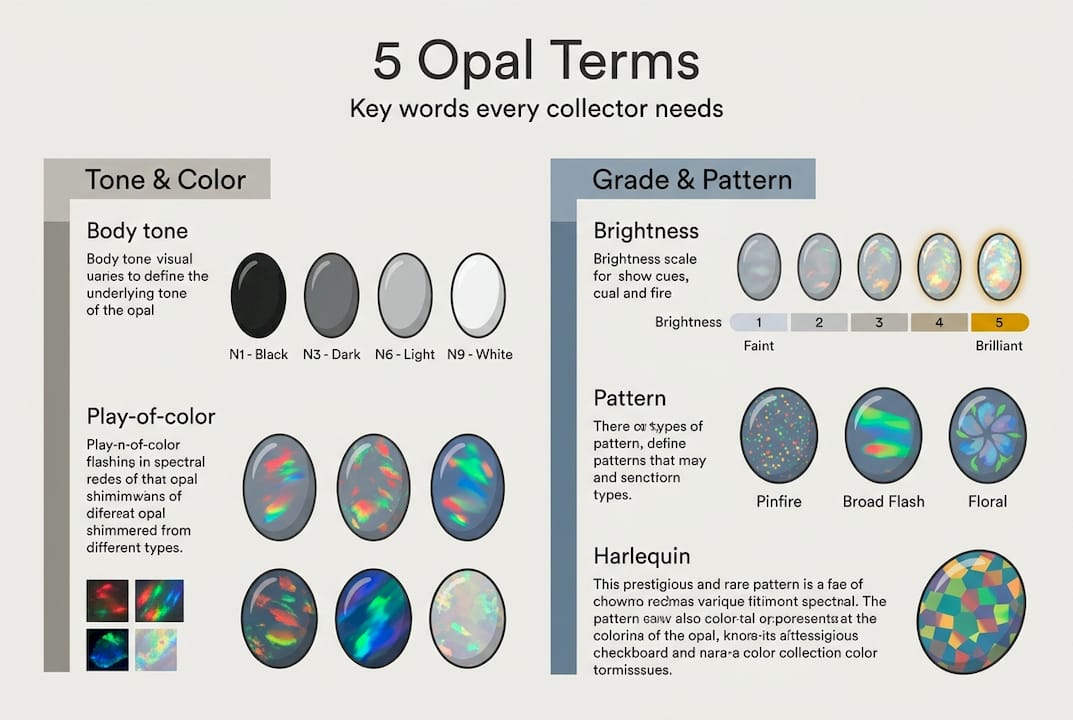
Pattern refers to the arrangement of color within the stone. Opal patterns such as harlequin and pinfire affect both collectability and value significantly.
| Pattern | Description | Rarity | Collector value |
|---|---|---|---|
| Harlequin | Checkerboard mosaic of broad color blocks | Extremely rare | Highest |
| Rolling flash | Broad sweeping waves of color | Uncommon | Very high |
| Pinfire | Tiny, closely spaced color dots | Common | Moderate |
| Ribbon | Parallel bands of color | Uncommon | High |
To evaluate an opal systematically, follow these steps:
- Assess the body tone first, using the N1 to N9 scale
- Observe the play-of-color from multiple angles and light sources
- Grade the brightness under both strong and low light
- Identify the pattern type and note its coverage across the stone
- Cross-reference your findings with guides on rare opal patterns and what is opal pattern
Pro Tip: Always rotate an opal slowly under a single light source before making any assessment. Patterns and brightness grades can shift dramatically with just a few degrees of movement, revealing qualities invisible from a static viewing angle.
How terminology shapes opal market value
Understanding these terms is more than just academic. Here’s how terminology influences prices and collector decisions in the real world.
The connection between precise grading language and market pricing is direct and measurable. N1-N4 black opals command higher prices, while patterns like harlequin amplify value to extraordinary levels. A stone with an N1 body tone, B1 brightness, and a true harlequin pattern can fetch prices that are ten to twenty times higher than an average opal of similar size. That multiplier exists entirely because of how the stone is described and verified.
| Grade combination | Approximate value range | Key driver |
|---|---|---|
| N1, B1, harlequin | $5,000 to $50,000+ per carat | Rarity and pattern |
| N2, B2, rolling flash | $1,000 to $8,000 per carat | Strong body tone |
| N5, B3, pinfire | $200 to $800 per carat | Average quality |
| N8, B5, no pattern | $10 to $100 per carat | Common crystal opal |
When terminology is misapplied, the market suffers. Sellers who describe an N5 stone as a “black opal” mislead buyers and erode trust across the community. This is why collectors who understand what makes black opal rare are better protected against inflated pricing.
Ethical provenance is also woven into this language framework. Stones from Lightning Ridge, Coober Pedy, and Queensland carry geographic designations that signal specific geological characteristics and mining standards. These terms aren’t just marketing. They are quality indicators tied to the opal color meanings and geological conditions unique to each region.
Key market realities tied to terminology include:
- Stones described with full grading data (body tone, brightness, pattern) sell faster and at stronger prices
- Collectors who request specific grading avoid the most common pricing traps
- Provenance language tied to named Australian regions adds verifiable value
- Examples of rare opals consistently show that terminology accuracy predicts investment performance
Statistic spotlight: A harlequin-patterned N1 black opal can command prices exceeding $15,000 per carat, compared to an average opal priced at $50 to $150 per carat. The difference is almost entirely communicated through grading language.
Putting terminology to work: practical collector tips
Armed with these definitions, you’re ready to engage the marketplace. Here’s how collectors apply this knowledge effectively.
The most successful collectors treat terminology as a practical tool, not just a theoretical framework. When browsing listings or visiting dealers, they ask specific, grading-based questions rather than relying on subjective impressions. Standardized terminology is key for verifying authenticity and value, and the collectors who use it consistently make more informed, confident decisions.
Here’s a practical sequence for evaluating any opal purchase:
- Request the body tone rating (N1 to N9) in writing from the seller
- Ask for the brightness grade (B1 to B7) and the conditions under which it was assessed
- Identify the pattern type and ask whether it covers the full face of the stone or only a portion
- Request documentation of ethical sourcing, including the mine of origin and any third-party certifications
- Cross-check the stone’s description against opal rarity indicators to confirm the claims align with the price
Pro Tip: If a seller cannot or will not provide a body tone or brightness grade, treat that as a significant red flag. Reputable dealers of genuine Australian opals are proud to share this information because it supports the stone’s value.
Watch out for these common language traps in the market:
- “Black opal” used loosely to describe any dark-toned stone, including lower-grade N5 or N6 specimens
- “Rare pattern” applied to pinfire or common formations to inflate perceived value
- “Australian opal” without specifying the region, which may obscure quality differences between fields
- Vague brightness claims like “very bright” without a B-scale reference
Understanding what distinguishes rare opals from average specimens comes down to this precise language. Collectors who master it don’t just buy better stones. They also contribute to a more transparent, ethical marketplace where genuine rarity is recognized and rewarded.
Why mastering terminology transforms your collecting experience
Here is the perspective that most collecting guides won’t tell you: the collectors who build the most remarkable collections are not always the ones with the sharpest eye for beauty. They are the ones who learned to speak the language of gemstones with precision and confidence.
Beauty is subjective. A stone that takes your breath away may not hold its value over time if its grading descriptors don’t align with market standards. But a collector who can articulate exactly why an opal is extraordinary, using the shared vocabulary of body tone, brightness, and pattern, can recognize value that others overlook and make the case for it persuasively.
This matters beyond personal investment. Articulate collectors drive ethical trade. When buyers consistently demand proper grading language and provenance documentation, sellers are held to higher standards. The entire community benefits. As seen in rare opals in practice, the most celebrated finds in Australian opal history were recognized precisely because someone had the language to describe what they were seeing. Mastering terminology isn’t just about buying smarter. It’s about seeing more clearly.
Discover Australian opals with expert guidance
Ready to put your new vocabulary to work in the world of Australian opals? The journey from terminology to treasure becomes far more rewarding when you have access to stones that are graded, described, and sourced with complete transparency.

Australian Opal Direct offers a curated collection of ethically sourced, earth-mined Australian opals from Lightning Ridge, Coober Pedy, and Queensland, each described with the precise grading language this guide has outlined. Every piece comes with direct-miner provenance, free shipping, complimentary insurance, and a 90-day warranty. Whether you are searching for a harlequin-patterned black opal or a vivid crystal specimen, you’ll find stones that speak the language of genuine rarity. Explore the collection and let the terminology guide your eye toward something truly extraordinary.
Frequently asked questions
What is the difference between body tone and play-of-color in opal terminology?
Body tone describes the underlying darkness or lightness of the stone on a scale from N1 (jet black) to N9 (translucent white), while play-of-color refers to the spectral rainbow flashes produced by light diffracting through silica spheres inside the gem. Both are distinct grading criteria that independently affect an opal’s value.
Why are harlequin patterns so valuable for opal collectors?
Harlequin is the rarest and most valuable opal pattern because it displays a symmetrical checkerboard mosaic of broad, vivid color blocks that cover the full face of the stone, a formation so uncommon that even experienced miners may go years without finding one.
How can I ensure an opal is ethically sourced?
Ask sellers for specific mine-of-origin documentation and request certifications from recognized Australian mining operations that follow responsible environmental and labor practices. Reputable dealers will provide this information readily and without hesitation.
What does ‘brightness’ mean in opal grading?
Brightness is graded on a scale from B1 (the most vivid, almost self-luminous display) to B7 (dull, with barely visible color play), measuring how powerfully and consistently an opal’s play-of-color asserts itself across different lighting conditions.
Recommended
- Master must-know opal terminology for confident collecting - Australian Opal Direct
- How Opals Are Valued – What Every Collector Needs - Australian Opal Direct
- Grading opal quality: expert guide for collectors 2026 - Australian Opal Direct
- Indicators of Opal Rarity: Key Signs for Collectors - Australian Opal Direct