Gemstone rarity explained: What makes Australian opals valuable
Posted by AOD on 12th May 2026
Gemstone rarity explained: What makes Australian opals valuable

TL;DR:
- Gemstone rarity is rooted in natural scarcity, formation conditions, and limited supply, not merely beauty or uniqueness. Australian opals exemplify true rarity through their geological formation over millions of years, geographic confinement, and challenging mining processes. Prioritizing body tone, provenance, pattern, and genuine natural origin enhances collection value and resilience against market trends.
Few subjects create more confusion among collectors than gemstone rarity. A stone can blaze with color, command attention across a room, and still be scientifically commonplace. Conversely, a gem of understated beauty may represent millions of years of geological fortune and decades of mining effort, making it genuinely scarce. Australian opals sit at the fascinating intersection of these truths, where kaleidoscopic brilliance meets real, measurable rarity. Understanding the difference is not just academic; it shapes every meaningful decision a serious collector makes.
Table of Contents
- What does gemstone rarity really mean?
- How natural gemstones become rare: The science and story
- Opal body tone: The benchmark for rarity and value
- What most collectors get wrong about rarity: Expert insights
- How to apply rarity factors in your collection
- Why real rarity is more rewarding than chasing trend or color
- Find truly rare opals for your collection
- Frequently asked questions
Key Takeaways
| Point | Details |
|---|---|
| Natural rarity explained | Gemstone rarity is defined by natural formation over millions of years, making certain gems much scarcer than others. |
| Body tone is key | For Australian opals, the N1–N9 scale for body tone is a main factor in judging rarity and value. |
| Rarity vs. beauty | A gemstone’s beauty and rarity aren’t always linked; a dazzling stone can be common, while a duller one might be truly rare. |
| Avoid collector pitfalls | Judge body tone and play-of-color independently to avoid overpaying or misgrading collectibles. |
| Apply expertise when buying | Use rarity benchmarks and check provenance when shopping for investment-worthy opals. |
What does gemstone rarity really mean?
Rarity is one of the most misused words in the gemstone world. Collectors often apply it to anything beautiful, unusual, or personally appealing, but in professional gemology, rarity has a precise meaning rooted in scarcity, formation conditions, and supply constraints.
True rarity means that a stone exists in genuinely limited quantities within the earth, due to the extraordinary combination of conditions required for its creation. Beauty is subjective and can be replicated. Rarity cannot. A synthetic sapphire may be visually indistinguishable from a natural one, yet the latter is far rarer because natural gemstones take millions of years to form under precise geological circumstances that cannot simply be manufactured on demand.
It is also important to separate rarity from uniqueness and from value. A one-of-a-kind painted stone is unique, but it is not rare in any geological sense. And while rarity often drives value, scarcity alone does not guarantee desirability. A mineral may be extraordinarily rare yet hold little appeal to collectors if it lacks beauty or cultural resonance.
Key distinctions every collector should internalize:
- Rarity refers to limited geological occurrence and constrained natural supply
- Uniqueness refers to individual variation, which even common stones can display
- Beauty is an aesthetic quality that exists independently of how common or scarce a stone may be
- Value is shaped by the intersection of rarity, beauty, craftsmanship, and market demand
Pro Tip: When evaluating a gemstone for your collection, always ask the seller to separate rarity claims from aesthetic ones. A dealer who conflates the two may be prioritizing sales over accuracy.
For collectors wanting to go deeper into practical signals of scarcity, understanding spotting opal rarity is an essential next step in building that discernment.
How natural gemstones become rare: The science and story
With a clear definition of rarity established, we now explore the processes that create true scarcity, especially in natural Australian opals.
Australian opals are not simply beautiful stones. They are the preserved record of an ancient inland sea that once covered much of the continent, its silica-rich waters filtering slowly through layers of sandstone and clay over tens of millions of years. That silica settled in cracks and voids, slowly assembling into the orderly grid of microscopic spheres responsible for opal’s legendary play-of-color. The formation over millions of years required for this process is also why natural rarity commands higher value than synthetics, even when both share overlapping visual properties.
Several factors drive rarity specifically within the Australian opal market:
- Geographic confinement: Over 90% of the world’s precious opals originate in Australia, concentrated in regions like Lightning Ridge, Coober Pedy, and Queensland’s boulder opal fields. Each of these regions produces a geologically distinct type of opal.
- Finite deposits: Unlike farmed resources, opal deposits do not renew on human timescales. Once mined out, a field is gone, permanently reducing the global supply.
- Extreme selectivity of gem-grade material: Even within active opal fields, only a small fraction of extracted material reaches gem quality. The rest is common potch, the colorless or dull variety used as filler.
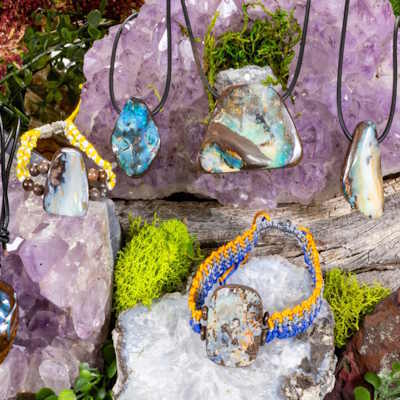
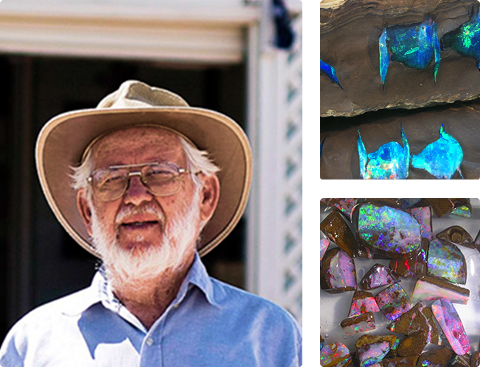
- Mining difficulty: Lightning Ridge black opal fields require deep, labor-intensive tunneling, while Queensland boulder opal demands the splitting of ironstone boulders by hand. Neither process lends itself to industrial-scale extraction.
- Provenance and traceability: Stones with verified origins from specific, well-regarded mines carry additional rarity premiums because documentation of source is itself a scarce commodity.
“Nature does not rush her masterpieces. Each opal carries within it the patience of an entire geological epoch, waiting to be discovered by someone wise enough to recognize what they hold.”
| Factor | Australian opal | Synthetic opal | Other natural gems |
|---|---|---|---|
| Formation time | Millions of years | Days to weeks | Thousands to millions of years |
| Supply limit | Finite, declining | Unlimited | Finite, varies |
| Play-of-color | Natural, unique | Imitated, uniform | Rare/absent |
| Provenance value | High | None | Moderate to high |
| Market rarity premium | Significant | None | Varies by type |
Collectors who want a thorough grounding in what specifically sets these gems apart should explore why Australian opals are rare and the nuanced science behind identifying rare opals in the field.
Opal body tone: The benchmark for rarity and value
Having explained what underpins rarity, we now zoom in on the crucial grading benchmark used by opal collectors: body tone.
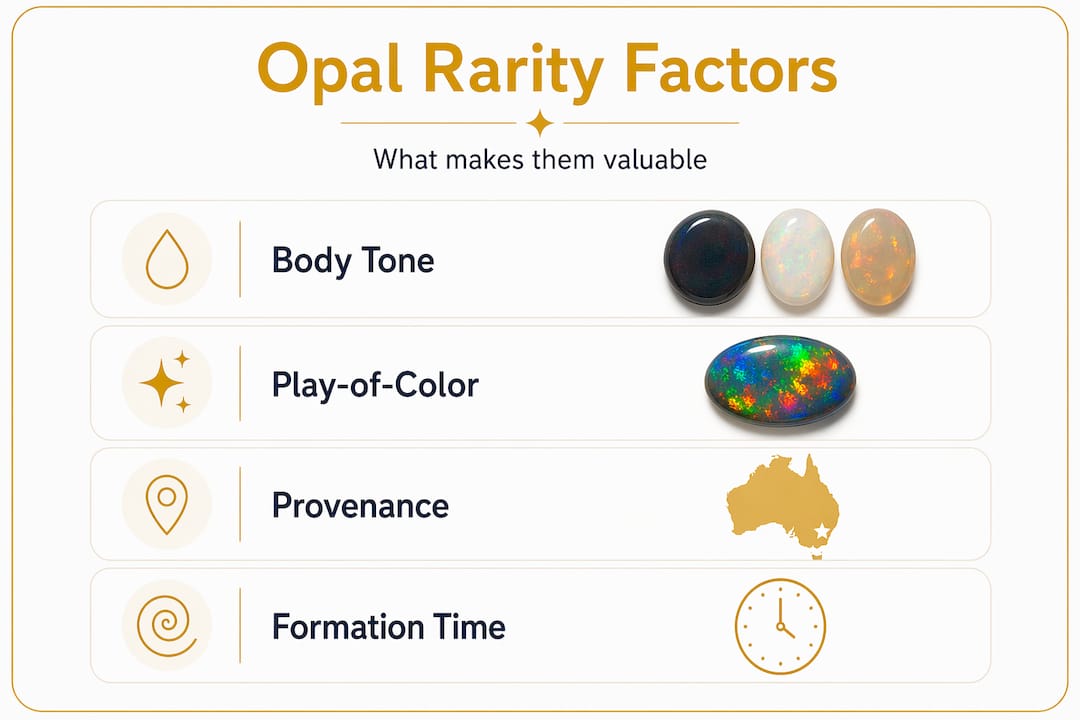
Body tone is the foundation of opal grading, and no concept is more decisive when it comes to assessing both rarity and market value. The industry standard N1 to N9 body tone scale runs from N1, the darkest black, through to N9, the brightest white, with each step representing a measurable shift in background darkness. N1 through N4 classify as black opals. N5 and N6 are dark opals. N7 and N8 are light opals, and N9 is white opal. This graded system is the universal framework for distinguishing opal types and communicating rarity accurately.
Why does background darkness matter so profoundly? Because a darker body tone creates the visual contrast that makes play-of-color appear more vivid and dramatic. An identical pattern of color on a black body versus a white body is not just aesthetically different. It is a fundamentally different stone in terms of rarity and price.
| Body tone | N scale | Opal classification | Rarity level |
|---|---|---|---|
| Black | N1–N2 | Black opal | Extremely rare |
| Near-black | N3–N4 | Black opal | Very rare |
| Dark | N5–N6 | Dark opal | Moderately rare |
| Light | N7–N8 | Light opal | Less rare |
| White | N9 | White opal | Most common |
Black opals from Lightning Ridge, particularly those graded N1 or N2, represent the rarest naturally occurring opal on earth. Demand for stones in this category consistently outpaces supply, and authenticated specimens with strong provenance regularly appear in major auction houses and private collections worldwide.
Pro Tip: Always request a body tone assessment in writing when purchasing a high-value opal. Reputable sellers should be able to assign an N-scale designation and explain how they arrived at it.
Mastering this topic pays dividends throughout your collecting life. A thorough understanding of the opal body tone guide and the framework used in grading opal quality will sharpen your eye and protect your investment decisions.
What most collectors get wrong about rarity: Expert insights
To truly master gemstone rarity, collectors must understand and avoid the most common pitfalls.
The most costly mistake collectors make is conflating play-of-color with body tone. A stone that displays brilliant reds, greens, and blues across its surface can be breathtaking regardless of its body tone. But brilliance alone does not equal rarity. Expert graders follow a critical rule: body tone and play-of-color are evaluated independently, and rarity judgments always begin with the N scale, not the color display.
Consider two stones side by side. Stone A is an N3 black opal with moderate play-of-color showing greens and yellows. Stone B is an N9 white opal with spectacular rolling reds and blues across its entire face. Many novice collectors would gravitate toward Stone B based on pure visual impact. But Stone A is the rarer gem. Its darker body tone places it in a category that represents a fraction of global opal supply, while white opals with vivid color, though beautiful, are comparatively common.
Other misconceptions that trip up even experienced buyers:
- Treated and doublet opals: Some stones are assembled from a thin opal slice bonded to a dark backing, creating the visual impression of a black opal. These are called doublets or triplets and, while attractive, do not carry the rarity premium of solid natural opals.
- Synthetic opals with complex color: Synthetic versions can now replicate the visual appearance of play-of-color convincingly. Without certification and expert examination, a collector may overpay for a laboratory product.
- Provenance assumptions: Not every stone labeled “Lightning Ridge” is authenticated as such. Genuine rarity requires documentation, not just a label.
- Size as a proxy for value: Larger stones attract attention, but a small N1 black opal with vivid, full-spectrum play-of-color will almost always command more value per carat than a large, pale stone with weak color.
Pro Tip: Carry a reference card showing the N scale when attending gem shows or auctions. Comparing a stone’s background against a standardized chart is a fast, reliable first step before any purchase.
Understanding how opals are valued as a layered, multi-factor process is the antidote to these common errors.
How to apply rarity factors in your collection
Now that the subtle details of rarity are clear, it is time to apply these principles when actively collecting or investing.
Natural gemstone scarcity translates into sustained value over time, which is why a well-curated opal collection built on rarity principles tends to appreciate more meaningfully than one assembled purely for visual appeal. Here is how to put those principles into practice.
- Start with body tone: Before assessing color or pattern, determine the stone’s N-scale classification. This is your rarity anchor. N1 to N4 opals belong in a different category than anything lighter.
- Evaluate play-of-color as a secondary factor: Once body tone is established, look for color brightness, coverage across the stone’s face, and spectral range. A stone showing all colors of the spectrum, especially red, is more desirable than one limited to blue and green.
- Verify the formation type: Solid natural opals are worth more than doublets, triplets, or synthetics. Ask for a gemological certificate or at minimum a written statement from the seller confirming the stone is a natural solid.
- Check provenance documentation: Stones from named, reputable fields like Lightning Ridge, Coober Pedy, or Yowah carry added value. Request whatever documentation exists, including miner or dealer receipts.
- Assess the pattern: Rare patterns such as harlequin, rolling flash, or Chinese writing add premiums beyond body tone and color. These patterns occur in a small fraction of all gem-grade stones.
- Preserve and display thoughtfully: Store opals away from extreme heat and low humidity. Use soft, padded cases and avoid prolonged exposure to strong light. When displaying rare specimens, invest in professional settings that communicate their value without compromising them physically.
Pro Tip: When building a collection with long-term value in mind, focus on acquiring fewer, higher-quality stones rather than many mid-grade pieces. One authenticated N1 black opal with strong provenance will outlast dozens of average stones in both market interest and personal satisfaction.
A practical resource for applying this knowledge in real purchasing situations is the expert guide to buying Australian opals, and knowing how to authenticate Australian opals before committing to any purchase protects both your budget and your collection’s integrity.
Why real rarity is more rewarding than chasing trend or color
There is a persistent temptation in collecting, in any field, to follow what is currently fashionable. The gemstone market experiences color trends, regional fads, and waves of enthusiasm driven by celebrity or media attention. In those moments, stones that happen to fit the aesthetic of the season attract inflated interest, and prices reflect that temporary excitement rather than genuine scarcity.
Serious collectors who anchor their decisions in verified rarity rather than trend-chasing build something qualitatively different. A collection assembled around authenticated N1 and N2 black opals, well-documented boulder opals from Queensland, and traceable specimens from storied Lightning Ridge claims becomes a legacy, not simply an accumulation. These are objects that carry geological time, human labor, and cultural meaning within them. Trends fade. Genuine rarity does not.
There is also an intellectual depth that comes with prioritizing rarity. When you understand exactly why a stone is scarce, when you can articulate its body tone, formation type, provenance, and pattern classification, your appreciation of it changes fundamentally. You are no longer just admiring colors dancing across a surface. You are reading the earth’s own handwriting, formed over timescales the human mind struggles to fully grasp.
Rarity-focused collecting is also more resilient to market volatility. Fashion-driven stones can lose appeal quickly when tastes shift. Truly rare stones, particularly those with strong provenance and exceptional body tone, tend to maintain and grow their value across market cycles because the underlying supply constraint does not change. For collectors who want that long-term confidence, spotting rare opals with trained eyes is a skill worth every hour invested in developing it.
Find truly rare opals for your collection
Ready to put your expertise into action and build a truly rare opal collection?
At Australian Opal Direct, every stone in our curated selection is ethically sourced directly from Australian miners in Lightning Ridge, Coober Pedy, and Queensland. We believe that informed collectors deserve full transparency, which is why each piece comes with documentation, provenance details, and honest grading that respects the N-scale standards you now understand.

Whether you are searching for a specimen to anchor a serious collection or a statement piece that carries genuine geological history, our rare Australian opals collection offers stones selected precisely for rarity, not just beauty. And if you want to continue building your grading expertise before purchasing, our detailed resource on opal body tone will take your knowledge even further. Every collector deserves to buy with confidence, and we are here to make that possible.
Frequently asked questions
How is the rarity of an Australian opal determined?
Rarity is judged by natural formation conditions, body tone on the N scale, play-of-color, and documented provenance, with black opals graded N1 to N4 typically representing the rarest category.
Why do natural opals cost more than synthetic ones?
Natural opals form over millions of years under conditions that cannot be replicated on demand, making them inherently scarcer; natural rarity commands higher value than synthetics even when the visual properties appear similar.
What does the N1–N9 opal body tone scale mean?
It is a standardized grading system where N1 indicates the darkest opals and N9 the lightest, with each step affecting both rarity classification and market value significantly.
Can play-of-color make a common opal rare?
Play-of-color enhances desirability and price, but because body tone and play-of-color are graded independently, vivid color alone cannot elevate a light-toned stone to the rarity level of a natural black opal.
Are all Australian opals considered rare?
No. Only specific types, particularly solid black opals graded N1 to N4 from authenticated sources, qualify as truly rare; lighter-toned white opals from Coober Pedy are comparatively more common despite their beauty.
Recommended
- 7 Types of Australian Opals Every Collector Should Know - Australian Opal Direct
- How to Authenticate Australian Opals for Genuine Value - Australian Opal Direct
- Value Factors of Opal: What Drives Worth - Australian Opal Direct
- Why Australian Opals Are Rare—and Why It Matters - Australian Opal Direct