Australian Opal vs. Ethiopian Opal: Which Should You Buy?
Posted by AOD on 13th Aug 2026
Australian Opal vs. Ethiopian Opal: Which Should You Buy?
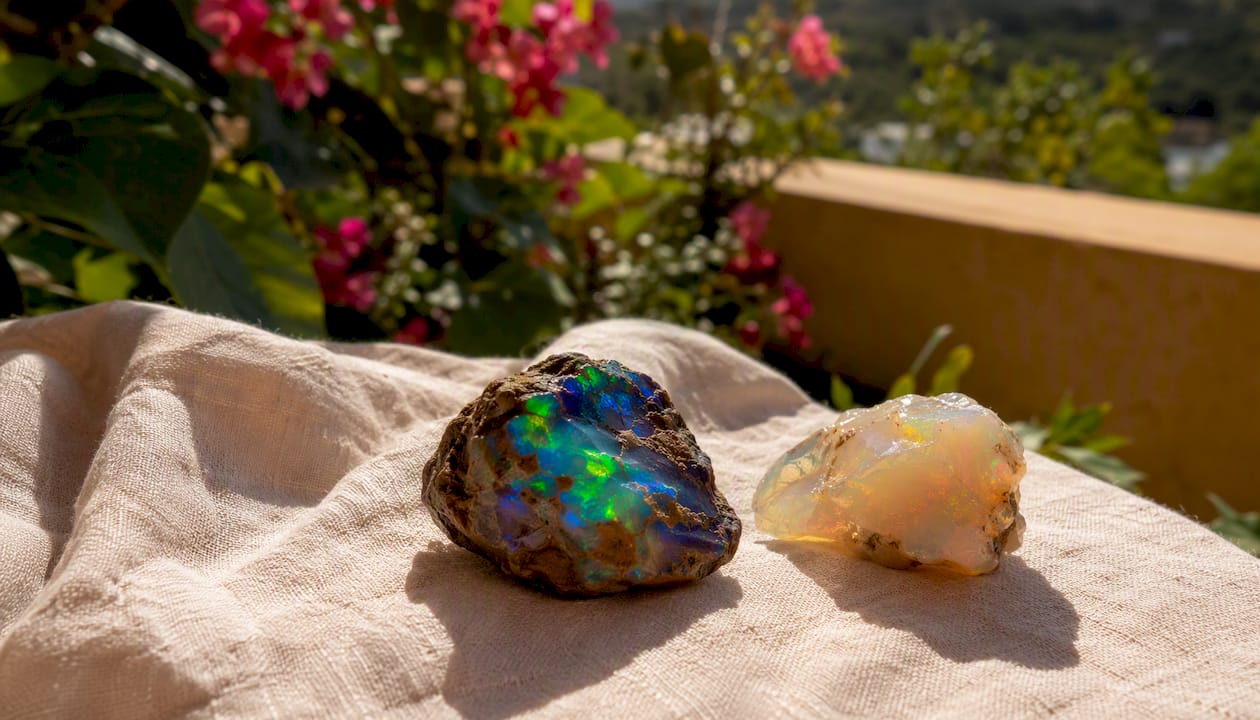
For everyday jewelry and long-term investment, Australian opal is the stronger choice. For dramatic visual impact on a tighter budget, Ethiopian opal delivers extraordinary color at a fraction of the price.
The difference comes down to two fundamentals: how each stone formed, and how it behaves with moisture.
- Australian opal formed in ancient sedimentary basins over millions of years, producing a dense, non-hydrophane material that holds up to daily wear. Geoscience Australia identifies Australia as the world’s dominant source of precious opal, supplying the bulk of global high-value material.
- Ethiopian opal formed volcanically in the Welo and Wollo provinces, creating a porous, hydrophane structure that can absorb up to around 15% of its weight in water, temporarily shifting its appearance and raising long-term stability concerns.
- Price reflects this divide. Lightning Ridge black opal commands premium prices driven by rarity and collector demand; Ethiopian Welo material is widely available and generally more affordable.
- Durability tips decisively toward Australian material for rings and heirloom pieces; Ethiopian opal suits pendants, earrings, and statement jewelry worn occasionally.
Pro Tip: Ask any seller to confirm whether a stone is solid, doublet, or triplet before you discuss price. That single question separates transparent sellers from those worth avoiding.
Key Takeaways
Australian opal’s sedimentary stability and Lightning Ridge’s finite supply make it the stronger choice for daily-wear rings and long-term investment; Ethiopian opal’s volcanic drama and lower price make it ideal for pendants, earrings, and statement pieces worn occasionally.
| Point | Details |
|---|---|
| Durability favors Australian opal | Sedimentary formation produces a non-hydrophane stone suited to daily rings and heirloom pieces. |
| Ethiopian opal requires careful care | Hydrophane structure absorbs moisture and chemicals; remove before washing hands or swimming. |
| Treatments must be disclosed | Ask sellers to confirm solid vs. assembled and whether smoke or resin treatment has been applied. |
| Lab tests protect high-value buys | Request FTIR spectroscopy and specific gravity for any opal purchase above a few hundred dollars. |
| Australianopaldirect for verified Australian material | Offers certified, solid Australian opals from Lightning Ridge, Coober Pedy, and Queensland with a 90-day warranty. |
Sources and further reading
The following authoritative sources informed this comparison and are worth consulting for deeper reading:
- GIA, Opal care and cleaning — The GIA’s buyer-facing guidance on safe cleaning methods, hydrophane sensitivity, and the risks of ultrasonic cleaners for all opal types.
- Australianopaldirect, How to authenticate Australian opals. A practical authentication guide for retail buyers covering observable features, documentation, and red flags.
- Australianopaldirect, How to tell real opal. A buyer-facing guide to spotting assembled stones and treated material, with practical identification steps.
- Australianopaldirect, Opal sourcing tips: 2026 ethical buying guide. A practical ethical sourcing checklist for Australian buyers covering provenance, treatment disclosure, and miner relationships.
Table of Contents
- What is opal, and why does play-of-color matter?
- Australian opal: what makes it so prized?
- Ethiopian opal: volcanic beauty with a caveat
- How do Australian and Ethiopian opals compare side by side?
- How can you tell if an opal is Australian or Ethiopian?
- Caring for Australian and Ethiopian opals
- What drives opal prices in Australia?
- Which opal suits which jewelry setting?
- Treatments, disclosures, and ethical sourcing
- Lab testing and certificates: what to request
- Australianopaldirect: curated Australian opals with full provenance
What is opal, and why does play-of-color matter?
Opal is a hydrated amorphous silica, not a crystalline mineral, which makes it technically a mineraloid. Its signature phenomenon, play-of-color, is the kaleidoscopic dance of spectral hues that shifts as you tilt the stone. Tiny silica spheres arranged in a regular grid diffract white light into its component wavelengths, producing those mesmerizing flashes of red, green, blue, and violet. The size and regularity of those spheres determines which colors appear and how vivid they look.
Before you buy, a handful of terms will serve you well:
- Body tone: the base color of the stone, ranging from black (N1) through dark, mid-gray, light, and white (N9). Darker body tones make play-of-color pop dramatically.
- Play-of-color: the shifting spectral display caused by light diffraction. Brightness, pattern, and color range all feed into value.
- Hydrophane: a porous opal that absorbs water, temporarily becoming more transparent or altering its color. Ethiopian opal is commonly hydrophane; Australian material typically is not.
- Doublet: a thin slice of natural opal bonded to a dark backing to enhance color depth.
- Triplet: a doublet with an additional clear dome on top for protection and magnification.
- Transparency: opals range from opaque to transparent. Crystal opals are transparent or semi-transparent; white opals are opaque with a pale body.
Understanding these terms lets you read a seller’s description critically rather than taking their word on faith.
Australian opal: what makes it so prized?
Formation and why it matters
Australian opal formed in ancient inland sea basins, primarily in South Australia, New South Wales, and Queensland. Silica-rich groundwater percolated through sedimentary rock, depositing silica gel in cracks and cavities over tens of millions of years. That slow, sedimentary process produced a denser, lower-porosity material than volcanic formation allows. The result is a stone that does not absorb moisture, resists structural changes from humidity swings, and holds its color and pattern indefinitely under normal wear conditions.
The major varieties and regions
- Lightning Ridge black opal (New South Wales): The crown jewel of Australian production. A dark body tone, ranging from N1 to N4, makes the play-of-color appear to glow from within. Harlequin and broad-flash patterns from Lightning Ridge are among the most valuable gemstones on earth.
- Coober Pedy white and crystal opal (South Australia): Pale, milky body tones with soft, pastel color play. More affordable than black opal, widely used in silver jewelry, and beloved for its gentle iridescence.
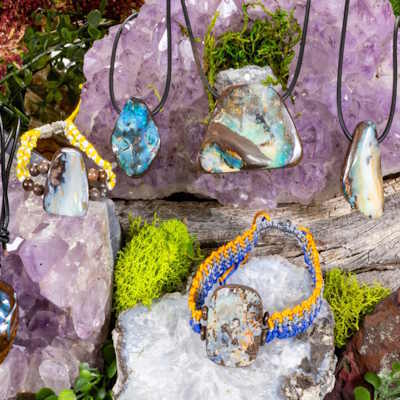
- Queensland boulder opal: Natural ironstone matrix remains attached to the opal seam, creating a stone with a built-in dark backing. The ironstone support makes boulder opal structurally robust and particularly well-suited to rings.
Characteristic features
- Tight, intense color patterns: pinfire (tiny dots of color), harlequin (mosaic-like patches), and rolling flash (broad sweeping color that shifts with viewing angle).
- Hardness of approximately 5.5–6.5 on the Mohs scale, consistent across varieties.
- Non-hydrophane structure: the stone will not change appearance when wet and is far less vulnerable to chemical absorption.
- Higher density than Ethiopian material, which gives a slightly heavier feel in the hand for the same carat weight.
Pro Tip: When buying black opal from Lightning Ridge, ask the seller for a photo taken under a single-point light source (not diffuse studio lighting). Harlequin and pinfire patterns reveal their true character under directional light, and any seller worth their reputation will provide it.
Ethiopian opal: volcanic beauty with a caveat
Origin and structure
Ethiopian opal comes primarily from the Welo (also spelled Wollo) Province in northern Ethiopia, with older deposits from the Shewa region. Volcanic activity deposited silica-rich fluids in rhyolite host rock, producing a more porous, open-lattice structure than sedimentary formation allows. That porosity is the defining trait of Ethiopian opal, and it explains both its visual drama and its care requirements.
Visual character
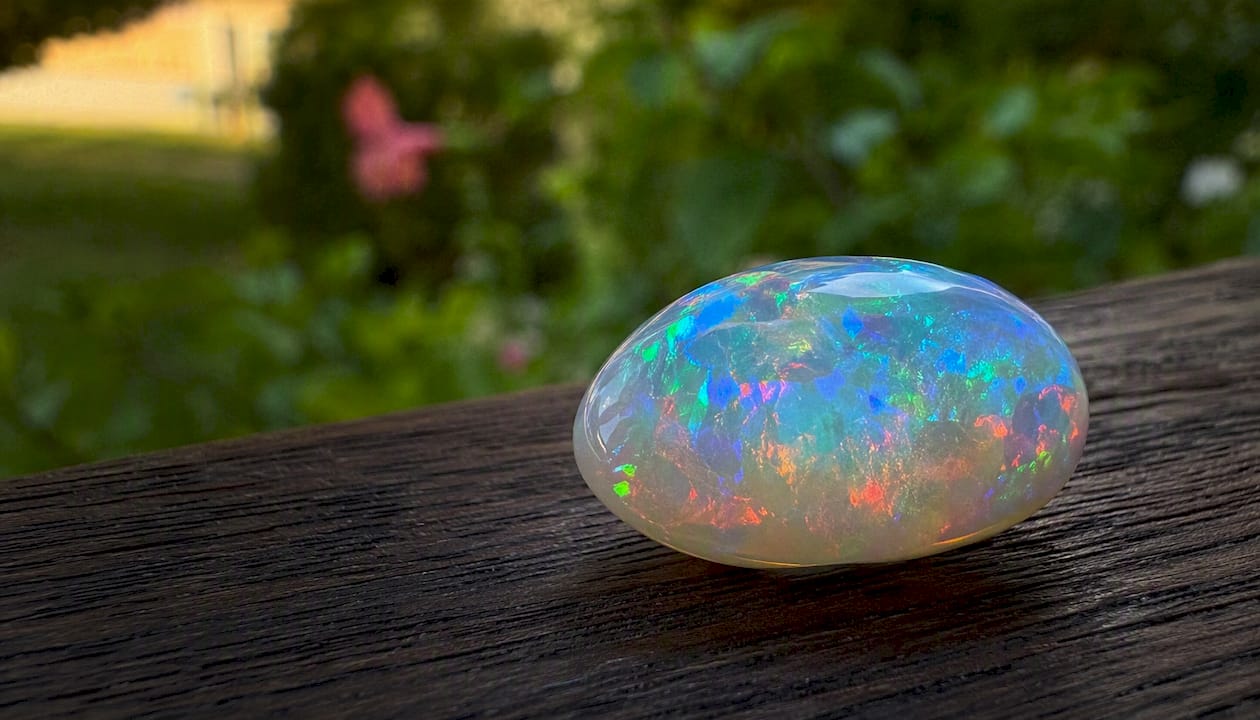
Ethiopian Welo opal is often crystal to semi-transparent, with a “jelly” body tone that gives color flashes an almost three-dimensional, floating quality. Where Australian opal tends toward tight, concentrated patterns, Ethiopian material commonly displays large, watercolor-style sweeping flashes that cover the entire face of the stone. The effect is genuinely spectacular, especially in larger cabochons, and it explains why Ethiopian opal has attracted so many buyers since Welo deposits entered commercial production in the 2000s.
Hydrophane behavior
When an Ethiopian opal absorbs water, its transparency increases and its color can temporarily fade or shift. The stone typically recovers its appearance as it dries, but the process is not risk-free. Oils, lotions, perfumes, and dyes can also be absorbed, and those changes may be permanent. The GIA notes that hydrophane opals are sensitive to liquids and should not be cleaned with ultrasonic cleaners or harsh chemicals.
Hydrophane behavior is a practical trait, not a defect. It makes Ethiopian opal visually unique and gives it that luminous, almost liquid quality. But it demands a different care routine than Australian material, and buyers who wear rings daily should factor that into their decision.
Common treatments and enhancements
Ethiopian opal is subject to several treatments that buyers must understand:
- Smoke/carbon treatment: The stone is wrapped in paper and heated, driving carbon into the pores to darken the body tone and mimic the appearance of black opal. The effect can be convincing but is not permanent, and the treatment must be disclosed.
- Resin stabilization: Porous material is impregnated with resin to reduce hydrophane behavior and improve durability. Stabilized stones are less valuable than untreated material.
- Doublet and triplet assembly: Thin Ethiopian opal slices are bonded to dark backings or capped with clear domes. These assembled stones are legitimate products when disclosed, but they are worth a fraction of solid material.
Undisclosed treatments are the single biggest risk in the Ethiopian opal market. Smoked Ethiopian opal has been sold as natural black opal, sometimes at black-opal prices.
How do Australian and Ethiopian opals compare side by side?
| Dimension | Australian Opal | Ethiopian Opal |
|---|---|---|
| Geological origin | Sedimentary (ancient inland sea basins) | Volcanic (rhyolite host rock, Welo/Wollo Province) |
| Water behavior | Non-hydrophane; stable in moisture | Hydrophane; absorbs up to ~15% of weight in water |
| Typical colors and patterns | Tight pinfire, harlequin, rolling flash; full spectrum | Large sweeping flashes, watercolor-style; crystal/jelly body |
| Durability and stability | Higher structural stability; lower crazing risk | More prone to long-term changes with repeated wetting |
| Common treatments | Doublet/triplet assembly; generally fewer chemical treatments | Smoke/carbon darkening, resin stabilization, doublet/triplet |
| Typical sizes and availability | Moderate supply; premium sizes rare, especially black opal | Widely available; large stones more common |
| Price and resale outlook | Higher prices; strong collector demand for black opal | Generally more affordable; lower resale trajectory |
| Best jewelry use cases | Daily-wear rings, heirloom pieces, investment collections | Pendants, earrings, statement necklaces, occasional-wear rings |
| Identification and testing | Specific gravity ~2.15; non-porous; origin certificate | Porous under microscope; hydrophane test; FTIR for resin |
The most decision-relevant contrasts, distilled:
- Australian opal is the practical choice for rings worn every day and for pieces intended to hold or appreciate in value over time.
- Ethiopian opal offers unmatched visual drama per dollar, making it ideal for pendants, earrings, and statement pieces that are not exposed to daily abrasion or moisture.
- Treatment disclosure separates reputable sellers from risky ones, regardless of origin.
How can you tell if an opal is Australian or Ethiopian?
Knowing the difference before you buy protects you from mislabeled stones and inflated prices. Here is a prioritized checklist.
1. Check the body tone and pattern style. Australian black opal has a naturally dark body tone that makes color appear to glow from within. Ethiopian crystal opal has a transparent or semi-transparent body with a “jelly” quality. Tight, mosaic-style patterns suggest Australian material; large, sweeping watercolor flashes point toward Ethiopian origin.
2. Perform the hydrophane test. Breathe gently on the surface of the stone. If it temporarily fogs or changes color, it is likely hydrophane and therefore probably Ethiopian. Australian opal will not react. You can also observe whether the stone’s transparency shifts under a drop of water. This test is non-destructive and takes seconds.
3. Look for ironstone backing. Queensland boulder opal retains its natural ironstone matrix. If you see a dark, reddish-brown rock host attached to the opal seam, you are almost certainly looking at Australian boulder material.
4. Assess weight and density. Australian opal feels slightly heavier than Ethiopian opal of the same apparent size, due to its denser sedimentary structure. This is a supporting cue, not a definitive test, but it adds to the picture.
5. Request documentation. Ask for an origin certificate or a written statement of provenance from the seller. Reputable sellers dealing in genuine Australian opals will provide this without hesitation. High-resolution photographs taken under multiple lighting conditions also reveal pattern character and body tone more honestly than a single studio shot.
6. Ask about treatments explicitly. Request written confirmation of whether the stone is solid, doublet, or triplet, and whether any chemical or smoke treatment has been applied. The questions to ask opal sellers before purchase include treatment status, origin, and whether a lab report is available.
7. Send expensive stones to a lab. For any purchase above a few hundred dollars, independent laboratory testing is worth the cost. Request:
- Gemological identification (confirming opal species and origin indicators)
- FTIR spectroscopy (detects resin stabilization)
- Microscopic examination (reveals pore structure consistent with hydrophane material)
- Specific gravity measurement (Australian opal typically measures around 2.15; Ethiopian can read lower due to porosity)
Red flag: If a seller describes an Ethiopian opal as “natural black opal” without disclosing smoke treatment, that is a material misrepresentation. Smoked Ethiopian opal and natural Australian black opal are fundamentally different products at fundamentally different price points. Walk away, or request an independent lab report before proceeding.
Caring for Australian and Ethiopian opals
The care gap between these two origins is real and practical. Getting it wrong can permanently alter a stone’s appearance.
Australian opal care
- Clean with a soft, damp cloth and mild soap. Rinse briefly and dry immediately.
- Avoid ultrasonic cleaners and steam cleaners entirely; the vibration and heat can cause crazing in any opal.
- Store away from direct sunlight and heat sources, which can dry out the small amount of water naturally present in opal’s silica structure.
- Doublets and triplets should never be soaked; water can penetrate the adhesive layer and cloud the stone.
Ethiopian opal care
- Keep away from water, lotions, perfumes, sunscreen, and cleaning products. The porous structure absorbs these substances, and oils or dyes may cause permanent discoloration.
- Remove Ethiopian opal jewelry before washing hands, swimming, or any activity involving moisture.
- Store in a dry environment, ideally in a sealed pouch or box away from humidity fluctuations.
- Never soak to clean; wipe only with a dry or very lightly dampened cloth.
Pro Tip: Store Ethiopian opal pieces in a small zip-lock bag with a silica gel packet to maintain a stable, dry microenvironment. Humidity swings are more damaging than consistent dryness.
Failure modes to know
- Crazing: A network of fine surface cracks caused by rapid moisture loss or temperature change. Ethiopian opal is more susceptible due to its porous structure; repeated wetting and drying cycles accelerate the risk.
- Color fade: Smoked or dyed Ethiopian opal can lose its darkened appearance over time, especially with moisture exposure.
- Adhesive failure: In doublets and triplets, prolonged water exposure degrades the bonding layer, causing the stone to cloud or delaminate.
If a stone shows sudden color change or new surface cracks, remove it from wear immediately, store it in stable conditions, and consult a gemologist before attempting any home remedy.
What drives opal prices in Australia?
The main price factors
Australian opal pricing reflects a layered set of variables, and understanding them helps you spot both fair value and inflated claims.
- Body tone: Black opal (N1–N4) commands the highest prices because the dark background intensifies color play. White and crystal opals are more affordable but no less beautiful.
- Play-of-color brightness and pattern: A stone showing red in its palette is more valuable than one showing only blue or green, because red requires the largest silica spheres and is rarest. Harlequin pattern commands a premium over pinfire or rolling flash.
- Carat weight: Price per carat rises steeply for larger, high-quality stones. A 5-carat Lightning Ridge black opal of fine quality is not simply five times the price of a 1-carat equivalent.
- Cutting and polish: A well-cut cabochon that maximizes the stone’s color window and sits at the correct dome height adds measurable value.
- Solid vs. assembled: Solid opals command significantly higher prices than doublets or triplets of the same apparent size. Always confirm which you are buying.
Why Ethiopian opal costs less
Ethiopian Welo deposits entered commercial production in the 2000s, making them a relatively recent addition to the global gem market. The supply is wide, the stones are often large, and the market has not yet built the decades of collector demand that surrounds Lightning Ridge black opal. The prevalence of hydrophane behavior and the frequency of treatments also suppress prices, since buyers rightly apply a discount for stones that require more careful handling and may have undisclosed enhancements.
Resale outlook
Investment-grade Australian black opal from Lightning Ridge has a documented collector market and a long history of price appreciation driven by finite supply and concentrated demand. Ethiopian opal, while visually spectacular, does not yet carry the same resale infrastructure. For buyers thinking beyond the immediate purchase, Australian material offers a more defensible long-term position.
Pro Tip: Request a carat-weight certificate and a written statement confirming solid (not assembled) status before finalizing any Australian opal purchase above a few hundred dollars. These two documents alone let you compare offers on equal terms and protect your investment if you ever resell.
Which opal suits which jewelry setting?
The right stone for a piece of jewelry depends on how often it will be worn, where it will sit on the body, and how much physical contact it will face.
Daily-wear rings
Australian opal, particularly boulder opal with its ironstone backing or a well-cut solid black opal in a protective bezel setting, is the appropriate choice for rings worn every day. The non-hydrophane structure handles incidental water contact, and the denser material resists surface abrasion better than Ethiopian material. Bezel settings, which wrap a metal rim around the stone’s girdle, offer the best protection for any opal in a ring. Prong settings expose more of the stone’s surface and are better reserved for occasional-wear pieces.
Ethiopian opal in a ring is not impossible, but it requires a protective bezel, mindful wear habits, and acceptance that the stone may need more careful monitoring over time.
Pendants and earrings
Both origins shine in pendants and earrings, where physical contact is minimal and moisture exposure is easier to avoid. Ethiopian opal’s large, sweeping color flashes look spectacular in a pendant setting, where the stone hangs freely and catches light from multiple angles. The lower price point also makes Ethiopian opal an attractive choice for statement pendants where size matters visually.
Statement necklaces and collector pieces
For heirloom-quality statement necklaces and collector pieces, Australian black opal or crystal opal from Coober Pedy offers the combination of visual drama and long-term stability that justifies a higher investment. The advantages of Australian opals for jewelry lovers include not just durability but the depth of color that comes from a naturally dark body tone, which no treatment can fully replicate.
Setting and cut considerations
Cabochon cutting is standard for both origins and maximizes play-of-color by presenting a smooth, domed surface to the eye. Transparent Ethiopian crystal opal is occasionally faceted, which creates a different, glittering effect rather than the classic rolling color play. Thin or fragile stones benefit from a bezel or channel setting that distributes pressure evenly; avoid tension settings for any opal.
Treatments, disclosures, and ethical sourcing
Common enhancements and what they mean for value
- Doublet assembly: A thin opal slice bonded to a dark backing (often black potch or ironstone) to enhance color. Legitimate when disclosed; worth a fraction of solid material.
- Triplet assembly: A doublet with a clear quartz or glass dome added on top. More durable than a doublet but further removed from a solid stone in value.
- Smoke/carbon treatment: Ethiopian opal wrapped in paper and heated to drive carbon into pores, darkening the body tone. The treatment is not permanent and must be disclosed. Smoked Ethiopian opal sold as natural black opal is a misrepresentation.
- Resin stabilization: Porous Ethiopian opal impregnated with resin to reduce hydrophane behavior. Detectable by FTIR spectroscopy. Reduces value relative to untreated material.
What reputable sellers should disclose
A trustworthy seller will provide, without being asked twice:
- Written confirmation of origin (Australian region or Ethiopian province)
- Treatment status: untreated, smoked, stabilized, or assembled
- Solid vs. doublet vs. triplet designation
- A lab report or willingness to obtain one for significant purchases
The ethical opal sourcing guide for Australian buyers outlines the provenance documentation that responsible retailers maintain, including direct miner relationships and export records.
Ethical sourcing signals for Australian material
Australian opal mining operates under Australian environmental and labor regulations, and direct miner relationships provide a traceable supply chain from ground to setting. When a retailer can name the mine, the miner, and the region, that specificity is a meaningful trust signal. For Ethiopian material, ask whether the seller can trace the stone to a specific Welo dealer or cooperative, and whether any treatment status has been independently verified.
Lab testing and certificates: what to request
When lab testing is worth it
For any opal purchase above a few hundred dollars, an independent gemological report reduces risk materially. The GIA issues reports for significant opal specimens that confirm species identification and note observable treatments. Australian gem labs and recognized international laboratories can provide origin indicators, porosity assessments, and treatment detection for buyers who need certainty.
Checklist of tests to request
- Gemological identification: Confirms the stone is natural opal (not glass, synthetic, or assembled without disclosure).
- FTIR spectroscopy: Detects resin stabilization in Ethiopian material; a clean FTIR result supports an “untreated” claim.
- Microscopic examination: Reveals pore structure consistent with hydrophane material, surface features of smoke treatment, and adhesive layers in assembled stones.
- Specific gravity measurement: Supports origin assessment; Australian opal typically measures around 2.15, while porous Ethiopian material may read lower.
- Origin statement: Some laboratories provide origin indicators based on inclusion patterns and spectroscopic data, though opal origin determination is more complex than for corundum or beryl.
Independent lab reports are the single most effective tool a buyer has for high-value opal purchases. A reputable seller will welcome the request; a reluctant one is telling you something important. For stones above a few hundred dollars, the cost of a lab report is modest insurance against a much larger mistake.
Trusted authorities
The GIA is the most widely recognized gemological authority globally and its reports carry weight in resale markets. Geoscience Australia provides authoritative data on Australian opal production and regional characteristics. For buyers in Australia, the Gemmological Association of Australia also offers identification services and educational resources.
A note on what I’ve seen matter most
The debate between Australian opal and Ethiopian opal often gets framed as a quality contest, but that framing misses the point. These are two genuinely different materials that excel in different contexts. What I find buyers consistently underestimate is the long-term cost of a wrong match: an Ethiopian opal in a daily-wear ring that develops crazing after two years of hand-washing, or a doublet sold as solid material that clouds when the adhesive fails. The stone itself is rarely the problem. The mismatch between the stone’s properties and its intended use, or the absence of honest disclosure, is where most buyer regret originates.
Australian material’s sedimentary stability makes it the right foundation for pieces meant to last generations. Ethiopian opal’s volcanic drama makes it the right choice for pieces meant to captivate a room. Both are extraordinary. The question is always: what are you asking this stone to do?
Australianopaldirect: curated Australian opals with full provenance
For buyers who have decided that durability, investment potential, and traceable provenance matter most, Australianopaldirect offers a curated collection of genuine Australian opals sourced directly from Lightning Ridge, Coober Pedy, and Queensland miners.

Every piece comes with origin documentation, and the team provides lab reports on request for significant purchases. The 90-day warranty and free shipping within Australia mean you buy with confidence, not guesswork about returns or hidden costs. Custom jewelry design is available for buyers who want a specific stone set to their specifications.
- Solid Australian opals only: black, white, crystal, and boulder varieties
- Certification and treatment disclosure on every stone
- Bespoke design service for rings, pendants, and collector pieces
- 90-day warranty and free Australian shipping
Browse the full collection and shop Australian opal jewelry to find a piece that carries both the beauty and the provenance your investment deserves.
Recommended
- Opal Sourcing Tips: Your 2026 Ethical Buying Guide - Australian Opal Direct
- Opal Origin Regions: A Collector’s Complete Guide - Australian Opal Direct
- Expert Guide to Buying Australian Opals for Collectors - Australian Opal Direct
- How to Select Opal Types for Fine Jewelry Purchases - Australian Opal Direct