Opal Origin Regions: A Collector's Complete Guide
Posted by AOD on 23rd Jun 2026
Opal Origin Regions: A Collector’s Complete Guide
TL;DR:
- Opal origin regions determine a stone’s color, structure, and market value, making knowledge of these areas essential for collectors. Australia, Ethiopia, and Mexico lead global production, each producing distinct opal varieties with unique characteristics and stability profiles. Understanding these differences helps in authenticating, valuing, and properly caring for opals over time.
Opal origin regions are the geographic and geological zones where distinct opal varieties form, and where a stone comes from directly shapes its color, structure, rarity, and market value. Australia, Ethiopia, and Mexico lead global production, each yielding opals with fundamentally different characters. For collectors and enthusiasts, understanding these origins is not a background detail. It is the foundation of informed valuation, authentication, and genuine appreciation.
1. What are the primary opal origin regions in Australia?
Australia produces approximately 95% of the world’s precious opal. That single fact defines the global market. The deposits sit within the Great Artesian Basin, a vast sedimentary formation covering roughly 22% of the Australian landmass, where ancient silica-rich groundwater percolated through sandstone and clay over millions of years.
Three regions dominate Australian production, each yielding a distinct variety:
- Lightning Ridge, New South Wales: The source of black opal, the rarest and most valuable opal type. The dark body tone of Lightning Ridge stones makes their play-of-color appear more vivid and concentrated. A fine black opal from Lightning Ridge can command prices that rival diamonds per carat.
- Coober Pedy, South Australia: Called the “Opal Capital of the World”, Coober Pedy produces white and crystal opals in greater volume than any other location on Earth. The stones tend toward pale body tones with soft, rolling spectral color.
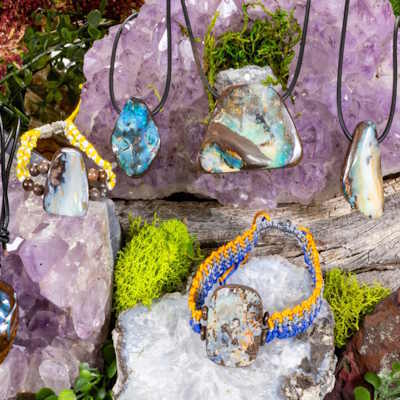
- Queensland boulder opal fields: Queensland produces boulder opal, where precious opal forms within ironstone host rock. The ironstone matrix becomes part of the finished gem, creating a natural backing that intensifies color and adds structural stability.
Australian regional varieties each carry their own grading criteria, price benchmarks, and collector communities. Knowing which region a stone comes from tells you what to expect before you even examine it.
Pro Tip: When buying Australian opal, always ask for the specific mining location, not just the country. “Australian opal” covers a wide range of types and price points. Lightning Ridge, Coober Pedy, and Queensland stones are appraised by different standards.
2. How does Ethiopian opal differ in origin and character?
Ethiopian opal originates from an entirely different geological process. Welo Province deposits, discovered commercially in 2008, form within volcanic rhyolite host rocks rather than sedimentary basins. Silica-rich hydrothermal fluids filled cavities in ancient lava flows, creating stones with exceptional clarity and vivid spectral fire.
The defining characteristic of Ethiopian Welo opal is its hydrophane behavior. Hydrophane means the stone is porous enough to absorb water, temporarily changing its transparency and color. This property requires specific care and affects long-term durability in ways that Australian sedimentary opals do not.
Key distinctions for collectors:
- Body color: Ethiopian opals range from white to transparent, with some displaying a warm honey or amber base tone.
- Play-of-color: The color display can be spectacular, often showing broad, rolling patterns of green, blue, and orange.
- Stability: Because Ethiopian opals are younger in geological terms and more porous, they require more careful handling. Prolonged water exposure or sudden temperature changes can cause cracking.
- Pricing: Ethiopian opals generally trade at lower prices than comparable Australian stones, partly due to their more recent entry into the market and their hydrophane instability.
The 2008 discovery of Welo deposits reshaped the global opal trade. Supply increased significantly, and Ethiopian stones became widely available at accessible price points. For collectors, that accessibility is real, but so is the need to understand the care differences before purchasing.
3. What unique features define Mexican fire opal and its origin?
Mexican fire opal is defined by its body color, not its play-of-color. Formed in volcanic rhyolite and trachyte porphyry, these stones develop their vivid orange, red, and yellow hues from iron-rich hydrothermal fluids that saturated the silica during formation. The result is a gem that glows from within, even without spectral iridescence.
The major mining states are Querétaro, Jalisco, and Hidalgo. Querétaro produces the most prized specimens, including stones with both intense body color and occasional play-of-color, which are exceptionally rare and valuable.
Key characteristics of Mexican fire opal:
- Body color range: Pale yellow through vivid orange to deep red, with the most saturated reds commanding the highest prices.
- Transparency: Many Mexican fire opals are transparent to translucent, making them suitable for faceting rather than cabochon cutting.
- Play-of-color: Less common than in Australian or Ethiopian stones, but when present, it dramatically increases value.
- Cultural heritage: Pre-Columbian civilizations, including the Aztecs, prized fire opal and called it quetzalitzlipyollitli, meaning “the stone of the bird of paradise.” That cultural lineage adds historical depth to every stone.
Mexican fire opal occupies a distinct niche in the collector market. Enthusiasts who prize warm, saturated color over spectral iridescence often prefer these stones to any other variety.
4. Where else in the world are opals found?
Notable opal deposits exist in Brazil, Honduras, the Czech Republic, Slovakia, Hungary, Turkey, and the United States, particularly in Nevada. Each location produces stones with unique characteristics, though none approach Australia’s volume or consistent quality.
| Region | Geological Context | Notable Variety | Collector Significance |
|---|---|---|---|
| Virgin Valley, Nevada, USA | Volcanic, silicified wood | Black opal | Rare, often unstable, highly collectible |
| Honduras | Volcanic basalt | Black matrix opal | Distinctive matrix patterns, limited supply |
| Brazil | Volcanic and sedimentary | Crystal and fire opal | Affordable, good clarity |
| Czech Republic / Slovakia | Sedimentary | White opal | Historical European source, now largely depleted |
| Turkey | Volcanic | Fire opal | Similar to Mexican type, less commercially developed |
Virgin Valley in Nevada deserves special mention. It produces black opals with color rivaling Lightning Ridge stones, but the gems are notoriously unstable and prone to cracking as they dry out. Most Virgin Valley opals are kept in water or glycerin to preserve them, making them more of a collector’s curiosity than a jewelry stone.
5. How does geological formation affect opal quality and stability?
The geological origin of an opal is not just a geographic label. It determines the stone’s physical structure, stability, and the quality of its play-of-color. Sedimentary Australian opals are more stable and less porous than volcanic Ethiopian or Mexican stones. That stability translates directly into durability and lower maintenance for the collector.
Play-of-color itself is a function of silica sphere size and uniformity. High-quality precious opal requires uniform silica sphere ordering, a rare geological condition that develops over millions of years. The color produced depends on sphere diameter. Red play-of-color corresponds to the largest silica spheres, approximately 300–350 nanometers in diameter, making red-dominant Australian opals the rarest and most valuable of all.
Volcanic opals form faster and in less controlled conditions. The silica spheres are often less uniform, which produces beautiful color but less predictable stability. Hydrophane Ethiopian opals absorb water and change transparency temporarily, a behavior that requires collectors to store and clean them differently from Australian stones.
Pro Tip: Never soak an Ethiopian opal in water or cleaning solution. The hydrophane structure will absorb the liquid, potentially causing internal stress fractures as the stone dries. Wipe gently with a damp cloth instead.
The geological “serendipity” of uniform silica ordering in sedimentary deposits explains why Australian stones consistently outperform volcanic opals in long-term value retention. Formation time matters. Opal formation requires millions of years for just centimeters of precious material to develop, which is why fine specimens from any region are genuinely rare.
Key Takeaways
The most important fact in opal collecting is this: origin region determines not just where a stone came from, but what it is, how it behaves, and what it is worth.
| Point | Details |
|---|---|
| Australia dominates global supply | Australia produces 95% of precious opal, primarily from Lightning Ridge, Coober Pedy, and Queensland. |
| Geological origin shapes stability | Sedimentary Australian opals are more stable than volcanic Ethiopian or Mexican stones. |
| Red play-of-color signals rarity | Red-dominant opals require the largest silica spheres and are the rarest and most valuable type. |
| Ethiopian opal needs special care | Hydrophane Welo opals absorb water and must be cleaned and stored differently from Australian stones. |
| Origin knowledge drives authentication | Knowing a stone’s specific mining region is the first step in verifying authenticity and assessing fair value. |
Why origin knowledge changed how I look at every opal
I spent years admiring opals purely for their visual drama, the way colors dance and flicker across the surface like light through a prism. What shifted my perspective was learning that the same visual effect can come from stones with radically different geological histories, and that those histories carry real consequences for value and longevity.
The most common mistake I see among newer collectors is treating “Australian opal” as a single category. It is not. A white opal from Coober Pedy and a black opal from Lightning Ridge are as different as a ruby and a garnet. They share a country of origin and little else in terms of rarity, pricing, or care requirements.
Ethiopian Welo opals are genuinely beautiful, and their accessibility has brought many new collectors into the market. But I have seen collectors overpay for Ethiopian stones because they compared them visually to Australian prices without accounting for the hydrophane instability. That is a costly misunderstanding. The reasons gemstone origins matter go far beyond geography. They explain the stone’s behavior in your hands, in your jewelry, and in your collection over decades.
My honest advice: learn the geology before you fall in love with the color. The color will still be there. The knowledge will protect your investment.
— Renee
Authentic Australian opals, sourced with full origin transparency
Collectors who understand opal origin regions know exactly what to ask for. Australianopaldirect was built for that level of discernment.

Australianopaldirect specializes in ethically sourced, earth-mined opals from Lightning Ridge, Coober Pedy, and Queensland, with direct-miner relationships that eliminate middlemen and guarantee origin authenticity. Every piece in the collection carries the geological story of its specific Australian source. Whether you are drawn to the kaleidoscopic brilliance of a black opal or the soft luminescence of a white crystal stone, you can browse the full Australian opal collection with confidence in what you are buying. Free shipping, complimentary insurance, and a 90-day warranty back every purchase.
FAQ
What are the main opal origin regions in the world?
The primary opal origin regions are Australia, Ethiopia, and Mexico. Australia accounts for approximately 95% of global precious opal production, with key deposits at Lightning Ridge, Coober Pedy, and Queensland.
Why is Australian opal more valuable than Ethiopian opal?
Australian sedimentary opals are more stable, less porous, and formed over a longer geological timeframe than Ethiopian volcanic opals. The uniform silica sphere ordering in Australian stones produces more consistent play-of-color and greater long-term durability.
What is hydrophane opal and which region produces it?
Hydrophane opal is a porous variety that absorbs water and temporarily changes transparency and color. Ethiopian Welo opal, sourced from volcanic rhyolite deposits in the Welo Province, is the most widely traded hydrophane opal in the market today.
Does the mining location affect an opal’s price?
Yes, significantly. A black opal from Lightning Ridge commands far higher prices than a white opal from Coober Pedy or a fire opal from Querétaro, even if all three display strong play-of-color. Origin region sets the baseline for valuation before any other quality factor is assessed.
Are there opals found in the United States?
Virgin Valley in Nevada produces black opals with vivid color comparable to Lightning Ridge stones. Most are unstable and prone to cracking when they dry, which limits their use in jewelry and makes them primarily a collector’s specimen rather than a commercial gem.
Recommended
- Opal Provenance: Ensuring Authenticity and Ethical Value - Australian Opal Direct
- How to Distinguish Opal Origins for Authentic Jewelry - Australian Opal Direct
- Opal types explained: The collector’s complete guide - Australian Opal Direct
- Build a Gemstone Collection: The Expert Guide to Australian Opals - Australian Opal Direct