Responsible Jewelry Explained: Choosing Ethical Luxury
Posted by AOD on 7th May 2026
Responsible Jewelry Explained: Choosing Ethical Luxury

TL;DR:
- Responsible jewelry relies on transparent standards like RJC certification, which involves independent third-party audits. Chain of custody documentation tracks precious metals from mine to retail, but does not guarantee gemstone provenance or responsible mining practices. Buyers should demand specific, verifiable documentation and questions to ensure genuine, ethical sourcing beyond marketing claims.
Every luxury buyer has encountered the word “ethical” stitched seamlessly into a jeweler’s marketing copy, glowing softly beside photographs of lustrous gems and gleaming settings. Yet for Australian buyers seeking genuine, earth-mined opals from storied regions like Lightning Ridge or Coober Pedy, that single word rarely tells the whole story. What lies beneath the language matters enormously, because the distance between a well-crafted marketing claim and a truly traceable, responsibly sourced piece of jewelry can be vast. This guide maps that distance, offering a clear-eyed look at the standards, documentation, and ground-level practices that separate genuine responsibility from polished rhetoric.
Table of Contents
- Defining responsible jewelry: Standards, audits, and what it means
- Understanding chain of custody and materials: What traceability shows (and what it doesn’t)
- Responsible opal sourcing in Australia: Beyond the certificate
- Checking authenticity vs. responsibility: How to spot the difference as a buyer
- Why responsible jewelry is about transparency, not just tick-boxes
- Find authentic, responsibly sourced Australian opals
- Frequently asked questions
Key Takeaways
| Point | Details |
|---|---|
| Define responsible jewelry | Look for independently audited standards and transparent sourcing practices, not just buzzwords. |
| Understand chain of custody | COC guarantees traceability for precious metals but doesn’t extend to all gemstones like opals. |
| Assess local sourcing | Australian opal buyers should verify ethical mining, rehabilitation, and regulatory compliance. |
| Differentiate claims | Authenticity certificates do not always equal responsible practices—check both. |
| Seek transparency | Request documentation and ask specific questions to ensure your jewelry meets true ethical standards. |
Defining responsible jewelry: Standards, audits, and what it means
The word “responsible” feels intuitive but can be frustratingly slippery without a governing framework behind it. In the jewelry industry, a range of certifications and standards exist, yet one stands above the rest in international credibility and reach.
The Responsible Jewellery Council (RJC) is the central authority setting international benchmarks for the sector. According to its published criteria, a common benchmark for responsible jewelry is the RJC standards and auditing system, which includes the Code of Practices (COP), Chain of Custody (COC), and, for eligible members, a Laboratory Grown Material Standard (LGMS). Each of these addresses a different layer of the supply chain, and understanding what each covers is critical for any informed buyer.
For a deeper grounding in day-to-day purchasing choices, this ethical jewelry practices guide for Australian buyers is worth exploring alongside the framework below.
A key truth every buyer should internalize: Not all terms like “sustainable” or “ethical” are regulated by law or attached to a binding standard. RJC certification involves independent third-party audits, but a brand that simply uses the word “ethical” in its copy may have no formal accountability at all. Words are free; audits are not.
Here is how the three primary RJC standards compare at a glance:
| Standard | Scope | What it covers | What buyers should expect |
|---|---|---|---|
| Code of Practices (COP) | All RJC members | Business ethics, human rights, labor, environment, safety | Baseline responsible business conduct across the member’s operations |
| Chain of Custody (COC) | Voluntary for RJC members | Traceability of precious metals from mine to retail | Documented, audited flow of gold, silver, and platinum through the supply chain |
| Laboratory Grown Material Standard (LGMS) | Eligible members only | Synthetic or lab-grown gem materials | Assurance of truthful disclosure and responsible production for lab-created stones |
Third-party audits are the mechanism that converts these written standards into genuine accountability. Without an independent auditor verifying compliance, a brand’s self-declaration holds little weight. When evaluating any jeweler, buyers should ask whether their certification is externally audited and by whom.
Understanding chain of custody and materials: What traceability shows (and what it doesn’t)
Having established the framework for responsible jewelry, let’s look closer at one of its most critical tools: traceability through the supply chain.

Chain of custody certification is designed to track the flow of precious metals from the point of extraction all the way through processing, manufacturing, and retail. The RJC Chain of Custody Standard describes COC as specifically about traceability of precious metals through the jewelry and watch supply chain, giving customers assurance of sourcing and processing from mine to retail. Importantly, it is described as voluntary even for RJC members, which means that not every certified brand will carry COC documentation.
This distinction matters. A business can hold RJC COP certification, which signals responsible business practices broadly, without having chain-of-custody documentation for the metals in its pieces. For buyers who care about knowing precisely where the gold in their opal ring originated, this gap is not a minor footnote.
Understanding the opal supply chain ethics in Australian sourcing adds another vital layer to this picture, especially as opal falls outside the scope of COC entirely.
What COC does and does not guarantee:
- Does guarantee: Documented chain of material from certified mine or processor through each stage to the final seller
- Does guarantee: Independent audit of that material flow at each participating stage
- Does guarantee: That precious metals in a piece meet the responsible sourcing benchmark set by RJC
- Does NOT guarantee: Gemstone provenance, including opals, colored stones, or diamonds outside the metals framework
- Does NOT guarantee: Responsible mining practices at sites that are not covered by COC participation
- Does NOT guarantee: Environmental rehabilitation at source mines unless separately documented
Here is a practical breakdown of how COC scope compares to materials that fall outside it:
| Material | COC coverage | What buyers must verify separately |
|---|---|---|
| Gold (recycled or mined) | Yes, if COC certified | Mine site practices, if virgin mined |
| Silver | Yes, if COC certified | Same as gold |
| Australian opals | No, outside COC scope | Provenance, mining title compliance, rehabilitation |
| Colored gemstones generally | No | Country of origin, mining conditions, labor practices |
| Lab-grown gems | Covered under LGMS, not COC | Energy source, disclosure accuracy |
Pro Tip: When speaking to a jeweler about their responsible sourcing, ask them to name the specific standard they hold and whether their documentation covers gemstones as well as metals. If the answer defaults to vague language about “ethical practices,” request the actual certification number and auditing body.
Responsible opal sourcing in Australia: Beyond the certificate
Traceability is one piece, but truly responsible jewelry requires considering how stones like Australian opals are sourced and managed on the ground.
Australia produces some of the world’s most prized opals, and the country’s regulatory environment does provide a meaningful framework for responsible extraction. However, not all mining operations are created equal, and even within Australia, buyers need to know how to evaluate claims against the regulatory backdrop.
For luxury buyers focused on genuine opals, an “ethical and responsible” lens often includes regulated mining and rehabilitation obligations, particularly in opal-producing regions. In NSW, the government’s framework for small-scale opal titles explicitly focuses on compliance, safety education, and rehabilitation obligations as core requirements for licensees. This means miners operating legitimately under these titles must meet standards that go beyond simply extracting stone and moving on.
The significance of rehabilitation: Mine site rehabilitation, the obligation to restore land after extraction, is one of the most measurable indicators of whether an opal mining operation takes its environmental responsibilities seriously. A seller who can reference their miner’s compliance history offers something far more concrete than a “sustainably sourced” sticker.
Steps Australian opal buyers should take to verify ethical sourcing:
- Ask for the region and mining title type. Lightning Ridge (NSW), Coober Pedy (South Australia), and Queensland fields each operate under different regulatory frameworks. Knowing the origin region is the first step toward understanding which rules apply.
- Request documentation of mining title compliance. Licensed small-scale opal miners in NSW, for example, must comply with rehabilitation and safety standards. Ask whether the seller’s mining partners hold current, compliant titles.
- Inquire about direct-miner relationships. Sellers who source directly from miners reduce the number of intermediaries who might obscure provenance. Fewer hands between mine and market generally means more traceable material.
- Look for evidence of rehabilitation practices. This might be photographic documentation, a compliance certificate from the relevant state mining authority, or a narrative from the miner about how land is restored post-extraction.
- Cross-reference the opal’s claimed origin with its visual characteristics. An experienced gemologist or a trusted retailer can often verify that a stone’s color profile, brightness, and body tone align with its stated source region.
Pro Tip: Look for evidence of local mine site rehabilitation or government compliance certifications, not just country of origin labeling. “Australian opal” tells you little about how or by whom it was extracted, whereas documented compliance with a named state mining framework tells you considerably more.
Checking authenticity vs. responsibility: How to spot the difference as a buyer
Even evidence-backed claims have limits. To truly shop responsibly, buyers need to distinguish between a gem’s authenticity and the practices behind it.
These two qualities, authenticity and responsibility, are frequently conflated in marketing materials, but they address entirely different questions. Authenticity asks: Is this gem genuine, and is it what the seller says it is? Responsibility asks: Was this gem sourced in a way that respected people, communities, and the environment? A stone can be genuinely Australian and still come from a poorly managed mine. Conversely, a responsibly operated mining site might produce gems that are later mislabeled in the retail chain.
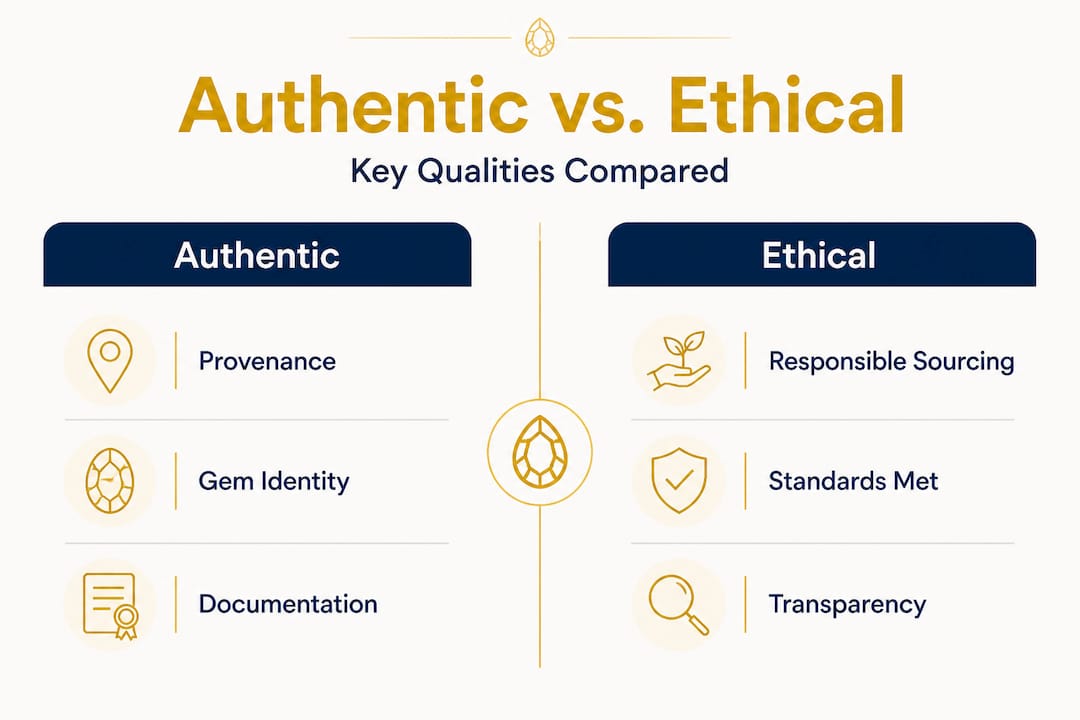
The RJC’s published criteria make this nuance explicit: “responsible” is not the same as “provenanced or authentic.” Documentation and audits can verify certain claims, such as traceability and responsible practices, but responsible outcomes can still vary by material, manufacturing route, and the specific standards a seller uses. This is a sobering acknowledgment from within the industry’s own governing body.
For buyers, understanding opal provenance and ethical value as distinct but complementary concepts is essential. Similarly, knowing how to authenticate Australian opals provides the other half of the picture.
What documentation actually proves, and what it does not:
- A gemological certificate proves: The stone’s identity, species, weight, dimensions, and sometimes country of origin (though origin determination for opals varies by lab)
- A gemological certificate does NOT prove: That the mine it came from was operated responsibly or that workers were treated fairly
- RJC COP certification proves: That the certified member’s business operations meet responsible practice standards
- RJC COP certification does NOT prove: That a specific stone in a specific piece has a clean, traceable mining history
- Direct-miner provenance documentation proves: That the seller has a relationship with an identified, named mining source
- Direct-miner provenance documentation does NOT prove: That the named mine holds all relevant regulatory compliance unless separately verified
Pro Tip: Always ask about both origin (provenance) and standards met (responsibility). Do not assume that because a piece carries an authenticity certificate it was also responsibly sourced, nor that a “responsibly sourced” claim tells you anything definitive about the stone’s geographic origin.
Why responsible jewelry is about transparency, not just tick-boxes
After years of observing how the market for Australian opals operates, one pattern stands out above all others: buyers who feel genuinely confident in their purchases are those who asked uncomfortable questions and received specific, documented answers. Not those who accepted warm assurances at face value.
The RJC’s own guidance acknowledges that marketing terms like “ethical” or “sustainable” can be ambiguous, and that standards frameworks exist precisely to convert those broad claims into auditable requirements. The logical implication for buyers is to treat any sweeping claim as a starting point, not a conclusion, and to request evidence of specific standard participation or equivalent audit and traceability documentation.
There is a deeper layer here too. Even within the responsible jewelry umbrella, impact trade-offs exist depending on whether a material is mined or lab-grown, and on the energy and labor systems that sit behind each. A lab-grown gem produced using coal-powered electricity carries its own environmental story. A mined gem from a small-scale Australian operation with full rehabilitation compliance tells a different but equally complex narrative. Neither story is simply “good” or “bad.” Both require interrogation.
For opal buyers specifically, this complexity is sharpened by the fact that opals fall outside COC coverage and that the gemstone supply chain remains, globally, less formalized than precious metals. This is not a reason for despair. It is a reason to favor sellers with transparent, documented direct-miner relationships, verifiable compliance histories, and the willingness to answer detailed questions. The expert collectors buying guide at Australian Opal Direct offers a practical companion for this more searching kind of due diligence.
Real responsibility is not a certificate pinned to a wall. It is a practice, a culture of honesty between miner, seller, and buyer that must be renewed with every transaction.
Find authentic, responsibly sourced Australian opals
For buyers ready to apply these standards in practice, choosing a trusted supplier makes the responsible jewelry journey far simpler.

Australian Opal Direct connects collectors and connoisseurs directly with earth-mined opals from Lightning Ridge, Coober Pedy, and Queensland, bringing the mine’s story to your hands without the opacity of a long middleman chain. Every piece in the collection is selected with an eye toward genuine provenance, transparent sourcing, and the kind of natural play-of-color that no synthetic gem can replicate. From rings and pendants to custom-designed pieces, the goal is jewelry that carries its history with honesty. Browse the curated collections and discover what truly responsible opal luxury looks and feels like.
Frequently asked questions
How do I know if my jewelry is truly responsible?
Request specific documentation showing which standards are met, such as RJC COP or COC certification, and ask for evidence of third-party audits or local compliance records rather than relying on marketing language alone.
Does chain of custody apply to gemstones like opals?
Chain of custody certification is specifically designed for precious metals, so for gemstones like opals, buyers must seek separate provenance documentation or evidence of mining title compliance within the relevant Australian regulatory framework.
What is the difference between ethical and authentic jewelry?
Authentic jewelry is verified as genuine through provenance or gemological documentation, while ethical jewelry also demonstrates it meets auditable standards for responsible sourcing, labor practices, and environmental stewardship, which authenticity alone does not address.
Can opal buyers in Australia trust claims of sustainable mining?
Buyers should look beyond marketing promises and seek evidence of compliance with Australian regulations, particularly rehabilitation obligations in NSW and equivalent frameworks in South Australia and Queensland, as these represent the most concrete, verifiable indicators of responsible practice.
Recommended
- Ethical Jewelry Practices Explained: Guide for Australian Buyers - Australian Opal Direct
- What defines high jewelry? The key elements of true luxury - Australian Opal Direct
- Artisan-Crafted Jewelry: Authenticity & Ethics Guide - Australian Opal Direct
- Luxury gemstone standards explained: Expert guide for collectors - Australian Opal Direct
- Top ethical jewellery trends for a sustainable 2026 – blackwellonline
- Why choose ethical accessories: timeless, responsible luxury – San Rocco Italia