Luxury gemstone standards explained: Expert guide for collectors
Posted by AOD on 15th Apr 2026
Luxury gemstone standards explained: Expert guide for collectors
TL;DR:
- Colored gemstones are graded primarily on color, with clarity, cut, and weight being secondary factors.
- Australia produces the world’s most prized opals, valued for their play-of-color and unique patterns.
- Lab reports help verify authenticity, but personal evaluation and provenance are crucial for luxury investments.
Luxury gemstone grading is far more nuanced than most collectors initially realize. While diamonds follow a well-known numeric system, the world of colored gemstones, and especially Australian opals, operates on a different plane entirely. There is no single universal scale that governs how a ruby, emerald, or opal is assessed. Graded primarily on color, clarity, cut, and carat weight, colored stones place color above all other criteria. Understanding these distinctions is not just academic. For serious collectors and connoisseurs, it is the foundation of every intelligent acquisition.
Table of Contents
- Understanding luxury gemstone grading fundamentals
- How luxury grading works for colored gemstones
- Expert nuances: How to evaluate gemstones for luxury investment
- Australian opals: The benchmark for luxury and authenticity
- The uncomfortable truth about luxury gemstone standards
- Invest in authentic luxury: Australian opals from trusted experts
- Frequently asked questions
Key Takeaways
| Point | Details |
|---|---|
| Color dominates grading | For colored gemstones, color is the most significant factor, far outweighing other criteria. |
| Descriptive grading standards | Grading luxury colored gems relies on descriptive, lab-based reports rather than universal numeric scales. |
| Expert viewing conditions matter | Evaluating gemstones under proper lighting and multiple angles is key for accurate assessment. |
| Australian opal authenticity | Australian opals are prized for quality and are rigorously authenticated through lab reports and provenance. |
| Collectors need judgment | Investment-grade gems demand blending lab evidence with expert evaluation and personal judgment. |
Understanding luxury gemstone grading fundamentals
Every serious collector eventually confronts the same realization: grading a diamond and grading a colored gemstone are fundamentally different disciplines. Diamonds follow the GIA’s standardized 4Cs with clear numeric grades. Colored gemstones, however, resist such tidy categorization because their beauty is rooted in a far more subjective quality: color.
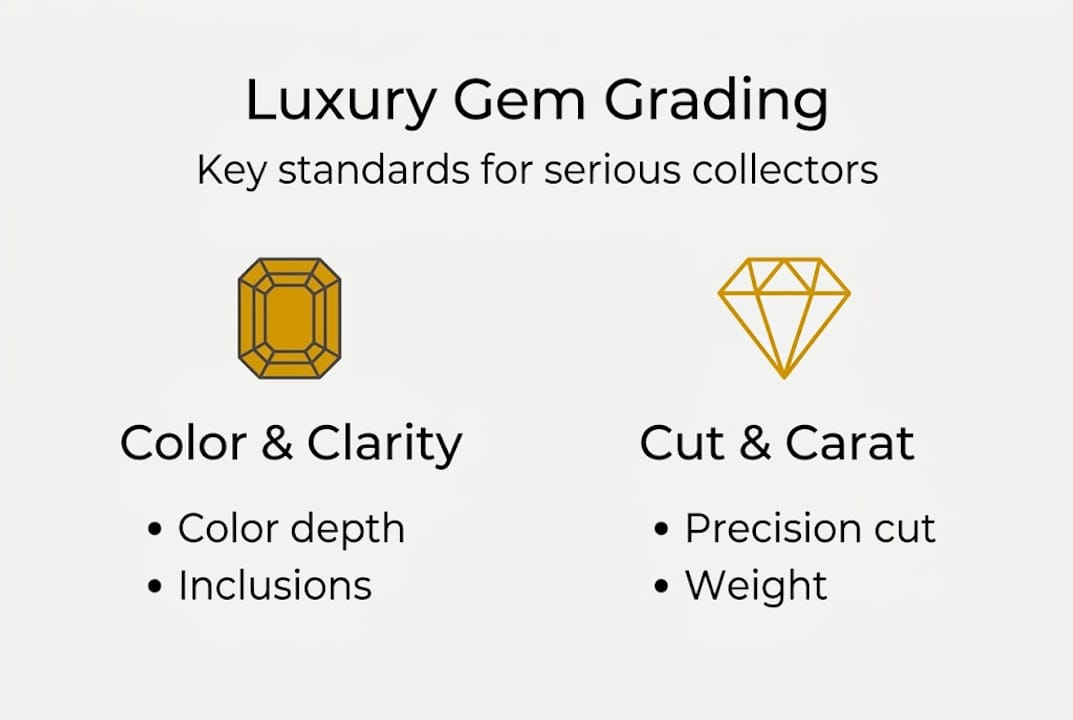
The four pillars of gemstone grading are:
- Color: Evaluated by hue (the dominant color family), tone (lightness to darkness), and saturation (intensity). For colored stones, this single criterion can account for the majority of a gem’s value.
- Clarity: Refers to the presence of inclusions or blemishes. Unlike diamonds, many colored gems are expected to carry some inclusions, and their impact on value depends on visibility and type.
- Cut: Determines how well the stone’s shape and facets interact with light. A masterful cut can elevate a stone with modest color into something genuinely luminous.
- Carat weight: The physical mass of the stone, though rarity at certain sizes can amplify value exponentially.
For colored gemstones, color is paramount and no amount of exceptional clarity or cut can compensate for weak, washed-out, or uneven color. This is why two rubies of identical carat weight can differ in value by tens of thousands of dollars based on color saturation alone.
“An excellent cut can enhance otherwise modest stones, but it cannot manufacture the inner fire that only nature provides.”
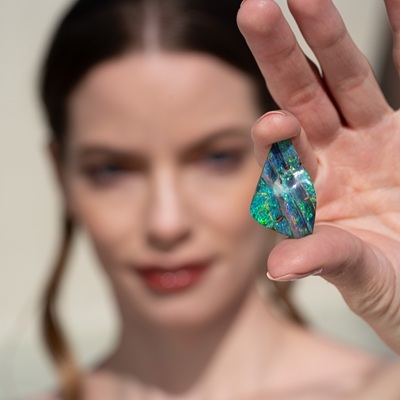
Understanding opals’ luxury value requires appreciating how their grading diverges even further from standard colored stone criteria. Opals do not simply display color. They generate it dynamically, shifting and dancing as the viewing angle changes. This phenomenon, known as play-of-color, introduces entirely new grading dimensions. When pricing opal jewelry, these unique characteristics must be weighed with particular care.
How luxury grading works for colored gemstones
With the basics covered, it becomes essential to understand how colored gemstones are evaluated outside clear-cut numeric scales. The absence of a universal standard is both a challenge and an opportunity for informed collectors.
No universal numerical scale exists for colored gems. Instead, grading is largely descriptive, relying on trained gemologists to articulate what they observe. The GIA, for example, issues identification and origin reports rather than assigning a single quality score. This approach prioritizes transparency about a stone’s characteristics without reducing its beauty to a single number.
The Gübelin Gem Lab takes a more structured approach with its proprietary rating system, scoring gems from 75 to 100 across multiple quality dimensions. This scale offers greater comparability between stones, which many investment-focused collectors find valuable.
Comparison of major grading approaches:
| Feature | GIA System | Gübelin System |
|---|---|---|
| Scale type | Descriptive/qualitative | Numerical (75 to 100) |
| Origin reporting | Yes | Yes |
| Investment comparability | Moderate | High |
| Widely recognized | Yes | Yes (luxury tier) |
| Colored gem focus | Broad | Specialized |
For collectors building a portfolio, lab reports from recognized institutions serve several functions:
- They provide an independent, authoritative record of the stone’s characteristics.
- They confirm geographic origin, which can significantly affect market value.
- They serve as documentation for insurance, resale, and estate purposes.
- They offer a degree of protection against misrepresentation in the marketplace.
A grading guide can help collectors interpret these reports, but the real skill lies in understanding what the descriptive language actually means for a specific stone type. For opals, this is especially true. Reviewing opals quality grading in detail reveals how attributes like directionality and pattern complexity add layers of value that no single number can fully capture. Knowing how to choose opal gemstones with confidence requires familiarity with both lab systems and the opal-specific criteria that sit beyond them.
Expert nuances: How to evaluate gemstones for luxury investment
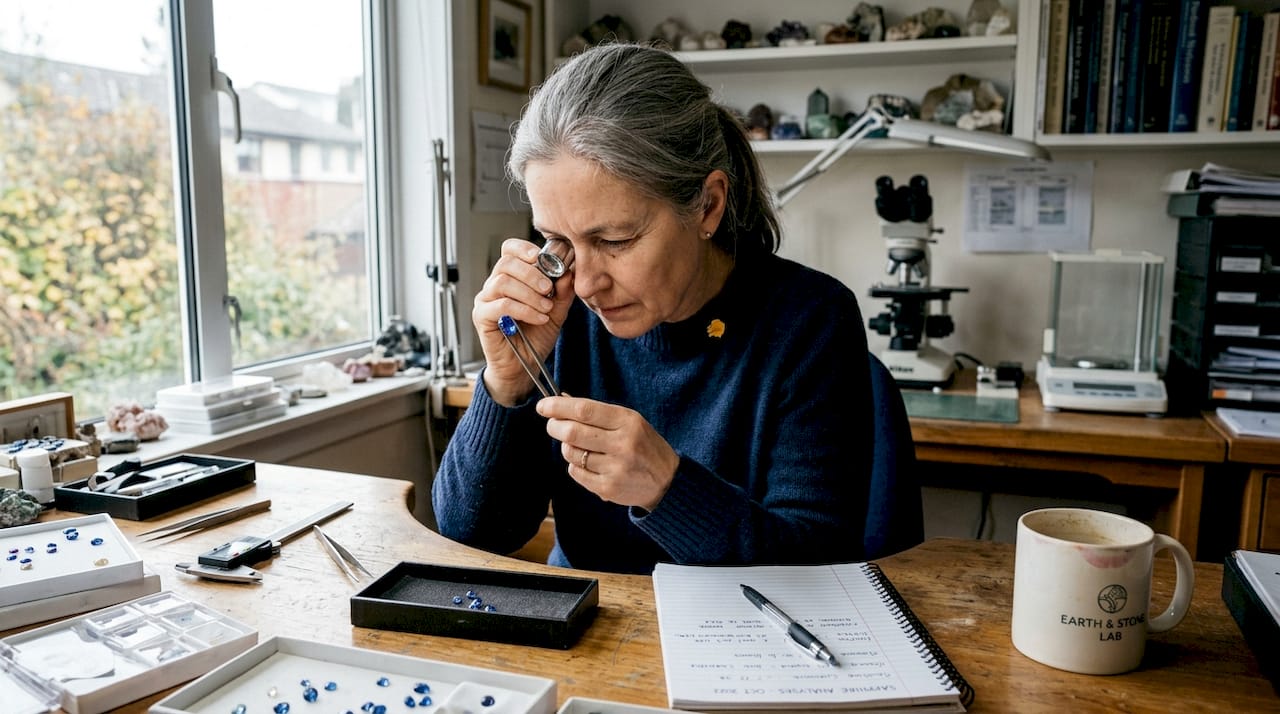
Lab grading provides a foundation, but the most experienced collectors know that the true evaluation happens in person, under the right conditions. The way a stone behaves under different lighting and from different angles tells a story no certificate can fully narrate.

Pro Tip: Always view colored gemstones under north-facing daylight before making a significant purchase. This neutral, consistent light source reveals true color saturation without the distorting warmth of incandescent bulbs or the harshness of direct sunlight.
For opals specifically, viewing under multiple lights and angles is not optional. It is the only way to assess directionality, which refers to whether the play-of-color is visible from a broad range of positions or only from a narrow sweet spot. A stone that blazes with color from every angle commands a significant premium over one that only performs when held at a precise tilt.
Key evaluation practices for investment-grade gemstones:
- Lighting variety: Assess under daylight, fluorescent, and incandescent light to understand how the stone performs across real-world conditions.
- Multiple viewing angles: Rotate the stone slowly to observe how color shifts, intensifies, or fades.
- Inclusion mapping: Note where inclusions sit relative to the stone’s face-up position. Inclusions beneath the table are more impactful than those near the girdle.
- Cut assessment: Evaluate whether the cut maximizes color return. A poorly cut stone wastes nature’s work.
- Comparative context: Whenever possible, view the stone alongside comparable specimens to calibrate your perception.
Balancing the 4Cs for investment purposes means recognizing that different collectors prioritize differently. A museum-quality collector may prize color above all else, accepting minor inclusions for extraordinary saturation. An investor focused on resale may weight lab certification and origin documentation more heavily. When selecting opal gems, understanding your own priorities sharpens every decision. Knowing how to present and display opal jewelry also matters, since presentation affects perceived value at every stage of ownership.
Australian opals: The benchmark for luxury and authenticity
With practical expert grading advice established, collectors seeking authentic luxury naturally turn to Australian opals as the benchmark. No other gemstone on earth combines geological rarity, visual dynamism, and cultural heritage quite so completely.
Australia produces approximately 95% of the world’s precious opals, with Lightning Ridge, Coober Pedy, and Queensland representing the most celebrated sources. Each region yields stones with distinct personalities: the inky black opals of Lightning Ridge, the translucent crystal opals of Coober Pedy, and the bold boulder opals of Queensland each carry their own grading language.
For opals, directionality and viewing conditions are central to any serious assessment. The key grading attributes collectors should evaluate include:
- Play-of-color: The spectral display of shifting hues caused by light diffracting through silica particle arrays. Broad, vivid, and evenly distributed play-of-color commands the highest premiums.
- Pattern: Named patterns like harlequin, rolling flash, and pinfire each carry distinct market values. Harlequin, with its mosaic of large color patches, is among the rarest and most prized.
- Body tone: Ranges from N1 (jet black) to N9 (crystal clear). Darker body tones create greater contrast for the play-of-color to perform against.
- Clarity: Transparency and freedom from sand, potch, or crazing (a network of fine cracks) significantly affect both beauty and durability.
Australian opal grading attributes at a glance:
| Attribute | Premium indicator | Value impact |
|---|---|---|
| Play-of-color | Broad, vivid, multi-directional | Very high |
| Pattern | Harlequin, rolling flash | Very high |
| Body tone | N1 to N4 (dark to black) | High |
| Clarity | Free from crazing and sand | High |
| Provenance | Documented Lightning Ridge origin | Moderate to high |
Authenticity verification is non-negotiable for investment-grade pieces. Provenance documentation and lab identification reports confirm both origin and natural status, distinguishing earth-mined stones from synthetics or treated specimens. Exploring grading opals in depth and understanding authentic opal origins are essential steps before any significant acquisition.
The uncomfortable truth about luxury gemstone standards
Here is something the industry rarely states plainly: even the most prestigious grading labs operate within the limits of human perception and professional judgment. Grading is descriptive and inherently subjective, meaning two equally qualified gemologists can reach different conclusions about the same stone.
This is not a flaw in the system. It is the nature of beauty itself. The mistake collectors make is treating lab reports as absolute verdicts rather than expert opinions rendered at a specific moment in time. Market conditions, cultural trends, and collector preferences all shift what a grade actually means in practice.
For Australian opals, this reality is especially vivid. A stone’s provenance, the story of its extraction, and even the way it is presented can influence perceived value as powerfully as any certificate. We have seen stones with modest lab descriptions command extraordinary prices because their play-of-color spoke directly to a collector’s sensibility in a way no document could quantify.
The wisest approach blends rigorous lab documentation with personal evaluation, trusted dealer relationships, and an honest understanding of the market. Exploring resources on authentic gemstone gifting reveals how provenance and presentation together create value that transcends the grade on any certificate. Grading is your compass. Your own informed eye is the destination.
Invest in authentic luxury: Australian opals from trusted experts
Applying grading knowledge is most rewarding when you have access to stones that genuinely reflect the standards you have learned to recognize. The difference between reading about harlequin patterns and holding a Lightning Ridge black opal that displays one is the difference between theory and wonder.
At Australian Opal Direct, every piece in the collection is ethically sourced and earth-mined, with direct-miner relationships that ensure authenticity and transparency at every step. From curated investment pieces to custom-designed jewelry, the selection is built for collectors who understand that true luxury lives in the details. Free shipping, complimentary insurance, and a 90-day warranty mean your investment is protected from the moment you choose your stone.
Frequently asked questions
What are the most important factors when grading luxury gemstones?
Color, clarity, cut, and carat weight are the core grading pillars for luxury gemstones, with color holding the greatest weight for colored stones. Even modest differences in saturation or hue can create dramatic differences in value.
Is there a universal grading scale for colored gemstones?
No universal numerical scale exists for colored gemstones; grading is primarily descriptive and varies between laboratories. Collectors should familiarize themselves with the specific language and approach of the lab whose reports accompany a stone.
How can I ensure authenticity when buying Australian opals?
Seek provenance documentation and lab identification reports from reputable suppliers to confirm that a stone is natural and earth-mined. Established retailers with direct-miner relationships offer an additional layer of assurance.
Why are Australian opals considered the benchmark in luxury gemstones?
Australian opals are the gold standard in authenticity and luxury because of their unmatched play-of-color, geological rarity, and the strict grading criteria applied to stones from regions like Lightning Ridge and Coober Pedy. No other source consistently produces opals of comparable depth and visual complexity.
Recommended
- Luxury gemstone gifting: authenticity, opal value, tips - Australian Opal Direct
- Role of Opals in Luxury Jewelry: Rarity & Value - Australian Opal Direct
- How to Price Opal Jewelry for Authentic Luxury Buyers - Australian Opal Direct
- Grading opal quality: expert guide for collectors 2026 - Australian Opal Direct