Choosing the Perfect Opal: A Collector's Guide to Value
Posted by AOD on 1st May 2026
Choosing the Perfect Opal: A Collector’s Guide to Value
TL;DR:
- Australian origin, especially Lightning Ridge black opals, is crucial for high value and durability.
- Grading factors like body tone, brightness, and pattern determine an opal’s market worth.
- Authenticity and provenance verification are essential to avoid synthetic or treated stones.
Few investments carry the emotional weight of an opal. Unlike diamonds, which follow predictable grading charts, every opal is a singular event of nature, a miniature cosmos of shifting fire locked inside silica and time. The stakes of choosing badly are real: collectors who buy without deep knowledge risk paying premium prices for low-grade or synthetic stones that will never appreciate in value. This guide offers a collector-level approach to understanding origin, grading, authenticity, and pricing so you can walk into any purchase with clarity, confidence, and a trained eye for the extraordinary.
Table of Contents
- Understand opal types and origins
- Opal grading: Body tone, brightness, pattern, and color explained
- How to verify quality and avoid fakes
- Value factors and investment benchmarks
- What most collectors miss about opal value and authenticity
- Find your perfect Australian opal
- Frequently asked questions
Key Takeaways
| Point | Details |
|---|---|
| Origin matters | Australian opals—from Lightning Ridge and Coober Pedy—are prized for durability, beauty, and investment value. |
| Grading is essential | Body tone, brightness, pattern, and color spectrum all determine an opal’s true quality. |
| Test for authenticity | Avoid fakes by checking for natural inclusions and demanding reputable certification. |
| Prioritize quality | A small, high-grade opal is almost always superior in value to a larger, lower-quality one. |
| Collect with confidence | Understanding grading and buying only from trusted sources lets you collect authentic opals with certainty. |
Understand opal types and origins
The first truth seasoned collectors absorb is this: not all opals are created equal, and where a stone comes from shapes nearly everything about its desirability and worth. Australia produces the world’s most prized opals, and each of its key mining regions delivers a distinctive character.
Lightning Ridge in New South Wales produces the finest black opals on earth, while Coober Pedy in South Australia yields elegant white and crystal opals, and Queensland’s boulder country delivers richly patterned ironstone-backed gems. When you understand these distinctions through distinguishing opal origins, you immediately sharpen your ability to evaluate any stone presented to you.
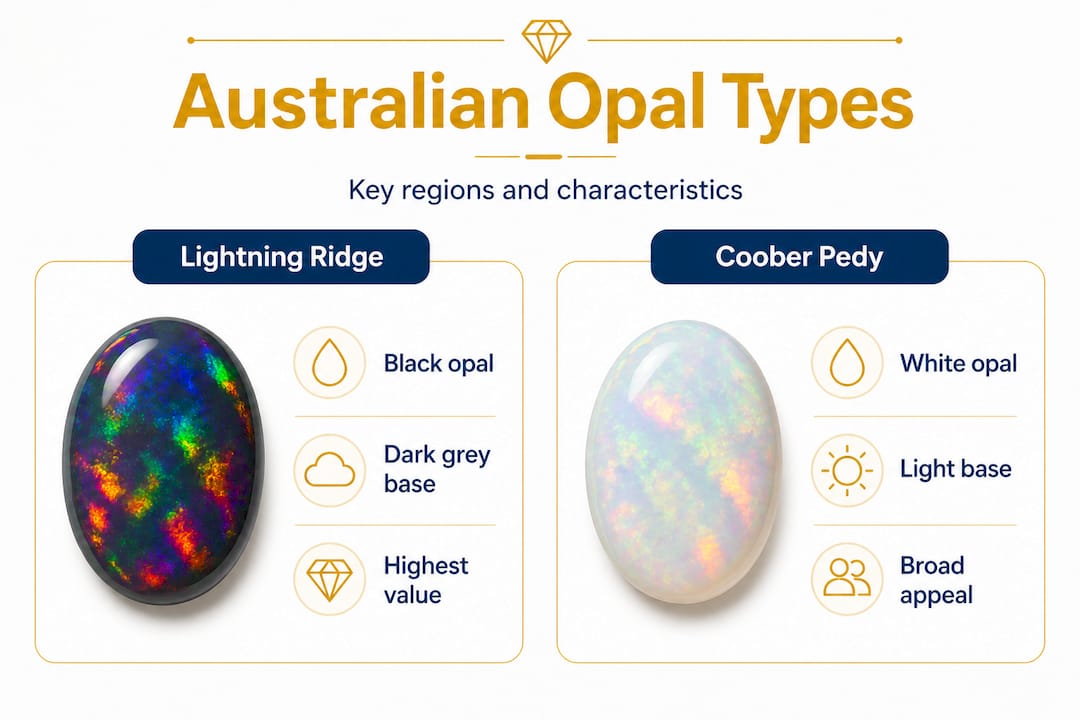
The three major Australian opal types
Knowing the types before you buy is non-negotiable for collectors. Here is a quick reference:
| Opal type | Key origin | Color base | Relative value |
|---|---|---|---|
| Black opal | Lightning Ridge, NSW | Dark gray to jet black | Highest |
| White/crystal opal | Coober Pedy, SA | White to translucent | Moderate |
| Boulder opal | Queensland | Ironstone matrix | Moderate to high |
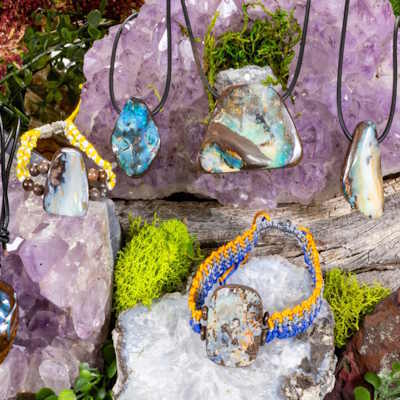
Each type has its own grading language and collector community. Black opals command the highest prices because the dark body tone creates a dramatic contrast that makes the play-of-color appear vivid and luminous. Crystal opals are prized for their transparency, which allows light to dance through the stone from multiple angles. Boulder opals, formed when precious opal fills cracks in ironstone host rock, often display sweeping, landscape-like patterns that make each stone genuinely one of a kind.
Beyond Australia, Ethiopian hydrophane opals have flooded the market in recent years. While visually striking, Australian opals are more stable because of their sedimentary origin and low porosity, whereas Ethiopian hydrophane opals absorb water readily and are less durable over time. For collectors focused on long-term value, this distinction matters enormously, and it is one of the core advantages of Australian opals that experts consistently emphasize.
Key reasons collectors prioritize Australian opal origin:
- Geological stability translates directly into long-term durability and wearability
- Established provenance from named mines adds auction and resale credibility
- Centuries of cutting and trading expertise concentrated in Australian supply chains
- Regulatory and ethical sourcing standards are better documented in Australian mining regions
When you are selecting opal types for a serious collection, locking in origin first narrows your choices intelligently and protects you from overpaying for stones with uncertain backgrounds.
Opal grading: Body tone, brightness, pattern, and color explained
Once origin and type are clear, collectors shift attention to grading, the objective language that transforms an emotional purchase into a reasoned investment. Australian opals use a precise grading vocabulary that you can learn and apply immediately.
Body tone
Body tone is the foundation of opal grading. The scale runs from N1 (jet black) to N9 (light white), with N1 through N4 considered the black opal range and the most valuable. A darker body tone makes play-of-color appear more vivid because the contrast between the background and the floating colors is greater. The opal body tone scale is the single most important number on a grading report.
Brightness
Brightness measures the intensity of the play-of-color and runs from B1 (brilliant) to B7 (dull), with higher brightness grades increasing value exponentially rather than linearly. A stone rated B1 or B2 appears to glow from within, as if lit by an internal fire. The difference between a B2 and a B4 can represent thousands of dollars per carat at auction.
How to judge each grading criterion step by step
- Evaluate body tone in natural daylight by placing the stone face-up on a neutral white background, then a black background, and noting the difference in color intensity.
- Assess brightness by rotating the stone slowly under a single incandescent light and observing whether the colors remain vivid across all viewing angles.
- Identify the dominant pattern across the face of the stone, looking for organized geometric shapes rather than small, disconnected flashes.
- Map the color spectrum from red through orange, yellow, green, blue, to violet, and note whether red and orange appear prominently.
- Check directional color play by tilting the stone along multiple axes; a premium stone maintains brilliance even at oblique angles.
Pattern and color spectrum
Patterns are among the most poetic attributes of any opal. Harlequin (large diamond patches), Chinese writing, and flagstone patterns are the most desirable, while pinfire, which shows only tiny pinpoints of color, ranks as the least valuable pattern type. Harlequin opals are so rare that genuine examples appear at auction only a few times each year.
Color sequence matters equally. Red is the rarest and most valuable color, followed by orange, then green, blue, and finally violet. A stone displaying the full spectrum, red through violet simultaneously, is considered ideal and commands a significant premium. Even a strong red flash on an otherwise modest stone can lift its value considerably.
Pro Tip: Always examine an opal under at least three different light sources, natural daylight, incandescent, and LED, because certain stones hide red or orange tones that only emerge under warm lighting. A stone that reveals hidden fire under incandescent light is often undervalued in natural light conditions.
| Grade factor | Best rating | Worst rating | Impact on value |
|---|---|---|---|
| Body tone | N1 (jet black) | N9 (light white) | Foundational |
| Brightness | B1 (brilliant) | B7 (dull) | Exponential |
| Pattern | Harlequin | Pinfire | Significant |
| Color spectrum | Red/full spectrum | Single blue or violet | High |
How to verify quality and avoid fakes
Grading knowledge protects you from overpaying for mediocre stones. But the opal market also carries a distinct hazard that many buyers underestimate: the presence of synthetic, treated, or misrepresented stones. Recognizing them before purchase is a collector’s most critical practical skill.
Steps to assess opal clarity and integrity
- Examine for crazing, the network of fine surface cracks that signal moisture loss or instability. Crazing, inclusions, and potch coverage significantly reduce both beauty and durability; high clarity and structural stability are essential.
- Look at transparency and internal layers under magnification. Premium opals show clean, uninterrupted color bars with no gray or cloudy patches obscuring the play-of-color.
- Check the potch layer, the colorless or gray opal base, for excessive coverage across the face of the stone, which diminishes the color window.
- Test stability by asking the seller about the stone’s history and storage conditions. Opals that have been stored in water to “protect” them may be masking dehydration issues.
- Request and review a certification document from a recognized gemological laboratory before finalizing any significant purchase.
How to spot fakes and synthetics
Reputable sellers provide certification, and you should avoid any opal showing suspiciously perfect uniformity of pattern across its entire surface, or a columnar internal structure visible under magnification, both hallmarks of synthetic material. Natural opals always have slight irregularities because nature does not produce perfect geometric patterns at scale.
Common red flags that signal a fake or low-quality opal:
- Perfectly uniform grid-like patterns without any natural variation
- Unusually lightweight feel compared to similarly sized natural stones
- Doublets or triplets sold as solid opals without disclosure
- Sellers unable to provide country of origin documentation
- Prices dramatically below known market benchmarks for the stated grade
Collector’s caution: The opal market is one of the few gemstone categories where even experienced buyers can be deceived. A convincing synthetic or a well-constructed opal doublet presented as a solid stone can cost thousands in a mistake. Always buy from dealers who back their stones with written certification, and treat authenticating Australian opals as a non-negotiable step, not an optional formality. Every serious opal jewelry selection begins with confirmed authenticity.
Pro Tip: Even a small, high-quality solid opal with exceptional body tone and brightness will hold and grow in value far better than a large, flawed, or treated stone. Size is satisfying to the eye but grading drives long-term worth.
Value factors and investment benchmarks
Understanding how grading criteria translate into actual market prices transforms a collector from a buyer into a strategist. The opal market rewards knowledge directly and punishes guesswork.
At the top of the market, AAAA-grade black opals range from roughly $300 to $10,000 per carat, with truly exceptional specimens reaching $20,000 per carat or beyond when combined with large size and flawless presentation. Larger stones at the same grade carry exponential rather than linear price increases because the rarity of size and quality combining is statistically rare.
Opal value benchmark table
| Category | Grade | Approximate price range per carat |
|---|---|---|
| Black opal (top) | AAAA | $3,000–$20,000+ |
| Black opal (fine) | AAA | $500–$3,000 |
| Crystal opal (top) | AAAA | $150–$1,500 |
| Boulder opal (fine) | AAA | $100–$800 |
| White opal (top) | AA | $30–$200 |
The most important insight from these benchmarks is that a small, N2 body tone, B1 brightness, harlequin-patterned black opal from Lightning Ridge at one carat can outperform a five-carat white opal in both current price and future appreciation. Collectors who understand opal investment principles consistently prioritize grade over size.
What drives appreciation over time:
- Stable, certified origin from named Australian mining regions
- Dark body tone combined with high brightness grades
- Rare or unusual patterns, particularly harlequin, which are genuinely scarce
- Clean, unmodified stones with no treatments or structural repairs
- Stones from known collections or reputable auction records
Lightning Ridge black opal facts reveal that production from this iconic field has been declining for years, making certified Lightning Ridge stones an increasingly finite resource. Scarcity, combined with rising global collector interest, creates the conditions for sustained price appreciation.
What most collectors miss about opal value and authenticity
Most opal buyers, even experienced ones, are drawn primarily to visual flash. The dramatic first impression of a stone, its showy burst of color seen under a dealer’s focused lamp, can override the careful analysis that actually determines long-term value. This is one of the most reliable traps in the opal market.
Here is the uncomfortable truth: a stone that dazzles under a spotlight but fades directionally, showing color only from a narrow viewing angle, is genuinely less valuable than one with quieter but omnidirectional color coverage. Many collectors mistake intensity in one direction for overall quality, and they pay accordingly. Pattern rarity and consistent color across all viewing angles matter more than the peak performance of a single dazzling flash.
There is also a psychological dimension to opal buying that deserves acknowledgment. Because every opal is unique, collectors often convince themselves that a mediocre stone is special simply because no other stone looks exactly like it. This is factually true but strategically dangerous. Uniqueness is a feature of all opals, not a proxy for quality. Grading criteria exist precisely to cut through the fog of uniqueness and deliver an objective measure of worth.
Provenance documents and authenticity certificates increase a stone’s value beyond the stone itself. Auction houses and serious collectors pay measurable premiums for opals accompanied by detailed mine-of-origin records, prior collection histories, and certified grading reports. A stone without documentation is worth whatever the moment’s emotion suggests. A stone with verified provenance is worth what the market confirms.
The long view, supported by auction records across two decades, shows that investment-grade Lightning Ridge black opals and top Queensland boulder opals have consistently outperformed many traditional gemstone categories. The wisdom embedded in an expert opal guide rooted in real market data is this: buy the best grade you can afford, confirm every claim in writing, and trust origin above all else.
Find your perfect Australian opal
The knowledge you have built here is only as powerful as the source you choose to buy from. Australian Opal Direct connects collectors directly with ethically sourced, earth-mined opals from Lightning Ridge, Coober Pedy, and Queensland, each accompanied by transparent documentation and the kind of provenance storytelling that serious buyers deserve.

Every stone in our curated collection is selected for authenticity, stability, and collector-grade quality. Our direct-miner relationships eliminate the middlemen who inflate prices and obscure origin, which means you receive genuine value at every price point. Whether you are searching for a vivid black opal ring, a luminous crystal opal pendant, or a custom-designed piece that honors a stone’s singular character, our expert team offers guidance at every stage. Browse our authenticated opal collection and discover a stone that carries not just beauty, but a verified story.
Frequently asked questions
What is the most valuable type of Australian opal?
Lightning Ridge black opal, especially with a dark body tone of N1 to N4 and high brightness, consistently commands the highest prices in both retail and auction markets worldwide.
How do I tell if an opal is real or synthetic?
Look for certification from reputable sellers and avoid any stone showing perfect pattern uniformity or columnar internal structures, which are hallmarks of synthetic production rather than natural formation.
Are Australian opals better than Ethiopian opals?
Australian opals are significantly more stable due to their sedimentary origin and low porosity, making them the preferred choice for collectors focused on durability and long-term investment potential.
Why does opal pricing vary so much by size and color?
AAAA-grade black opals can reach $20,000 per carat or more because rarity of color, size, and clarity combine exponentially, meaning small but top-grade stones frequently outperform larger specimens of lesser quality.
What is the best way to store and care for opals after purchase?
Store opals in a soft, padded box away from direct sunlight and extreme temperature fluctuations, and avoid prolonged exposure to water or harsh chemicals to preserve the stone’s structural stability and play-of-color over time.
Recommended
- Opal Value Explained: A Complete Collector’s Guide - Australian Opal Direct
- How to Select Opal Types for Fine Jewelry Purchases - Australian Opal Direct
- How Opals Are Valued – What Every Collector Needs - Australian Opal Direct
- Expert Guide to Buying Australian Opals for Collectors - Australian Opal Direct