Why limited edition jewelry holds lasting value and allure
Posted by AOD on 14th May 2026
Why limited edition jewelry holds lasting value and allure
TL;DR:
- Scarcity significantly increases value in jewelry by creating a sense of historical significance and exclusivity. Genuine rarity stems from natural constraints like limited materials and craftsmanship, unlike manufactured scarcity, which is driven by marketing. Australian opals exemplify authentic limited editions due to their geological rarity and unique natural properties.
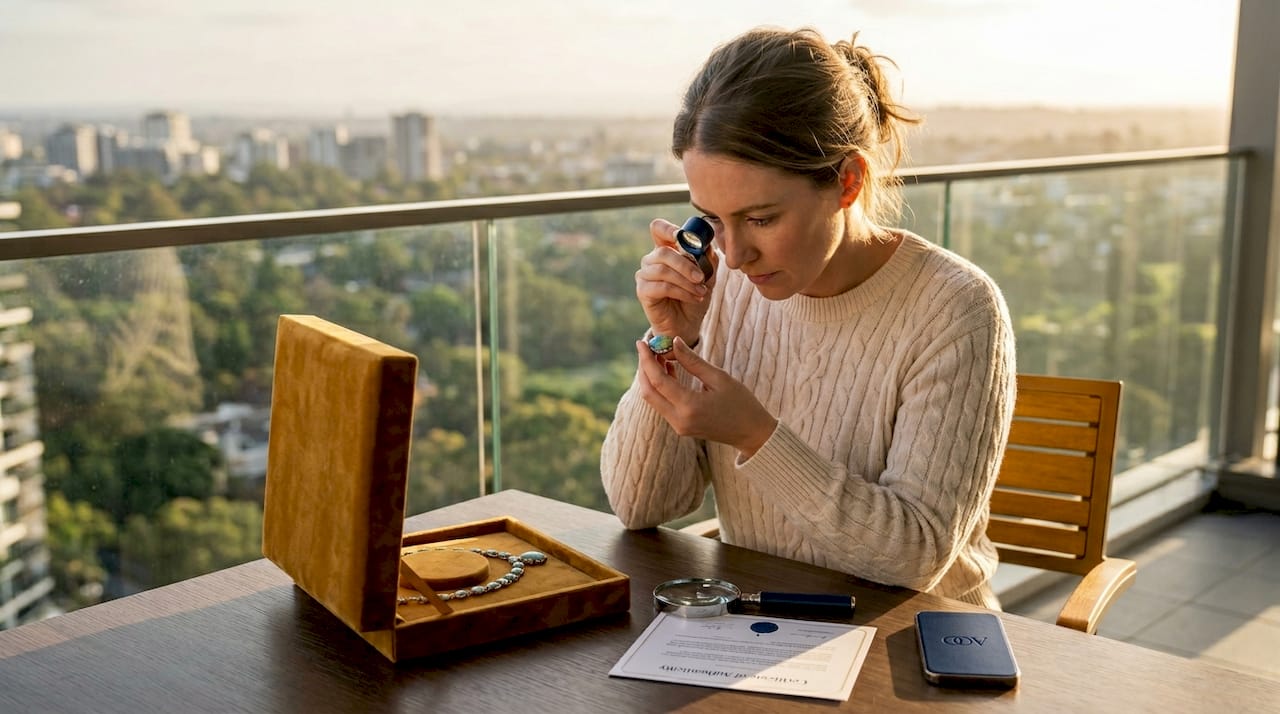
There is a persistent suspicion among seasoned collectors: that “limited edition” is little more than a marketing badge, a device designed to manufacture urgency and inflate prices on pieces that are, at their core, ordinary. Yet scarcity acts as an informational cue about value and urgency, guiding buyers toward desirability without requiring them to evaluate quality from first principles. For those who seek genuinely rare Australian opal jewelry, understanding the real mechanisms behind limited editions is not just useful. It is essential to collecting wisely, investing confidently, and owning pieces whose allure endures far beyond the moment of purchase.
Table of Contents
- How scarcity drives value in limited edition jewelry
- Real vs. manufactured rarity: What collectors should know
- Australian opal: The ultimate case for authentic limited editions
- What actually preserves luxury: Beyond rarity alone
- Why conventional wisdom about limited editions falls short
- Explore authentic limited edition opal jewelry
- Frequently asked questions
Key Takeaways
| Point | Details |
|---|---|
| True scarcity drives value | Limited edition jewelry holds lasting appeal and worth when scarcity comes from genuine, natural constraints. |
| Not all limits are equal | Buyers should distinguish real supply caps from marketing-driven artificial limitations to ensure long-term value. |
| Australian opals stand out | The rarity of natural Australian opals makes them ideal for authentic limited editions prized by collectors. |
| Prestige is multifactor | Craftsmanship, ethical sourcing, and brand heritage combine with rarity to create enduring investment value. |
How scarcity drives value in limited edition jewelry
When a jeweler releases a piece in a numbered run of twenty, or opens appointments for a single capsule collection, something remarkable happens in the mind of a prospective collector. The perception of the piece transforms. It is no longer simply a beautiful object. It becomes an artifact with a fixed place in history, a thing that cannot be reproduced once its edition is exhausted.
This shift is rooted in behavioral economics. Scarcity functions as a heuristic, a mental shortcut that signals worth and compresses the decision window. When supply is visibly finite, urgency rises and perceived worth climbs alongside it. This is not manipulation. It is a natural human response to finiteness, one that has shaped trade in precious objects since antiquity.
“Restricted access leads people to infer desirability and value; timed availability compresses decision windows, making the choice feel consequential rather than casual.” — The Aesthetic Mind
For collectors of luxury jewelry, these triggers are especially potent. Consider how the world’s most coveted gemstone houses limit annual production of certain stone-set pieces, or how auction records for authenticated rare items consistently outpace those for mass-produced equivalents. The data reinforces what collectors already feel intuitively.
| Scarcity mechanism | Example in jewelry | Collector effect |
|---|---|---|
| Numbered edition runs | Rings issued as “1 of 30” with engraved serial | Strengthens provenance and resale clarity |
| Appointment-only access | Private previews of capsule opal collections | Elevates perceived exclusivity and ownership pride |
| Timed release windows | 48-hour availability on a single pendant design | Compresses decision cycle, boosts urgency |
| Material-driven caps | Pieces dependent on a single mined stone lot | Authentic, irreproducible scarcity |
| Artisan-limited crafting | Pieces requiring hundreds of hours of hand setting | Natural production ceiling reinforces rarity |
The psychological triggers that most reliably move collectors include:
- Fear of permanent unavailability, which activates loss aversion more powerfully than the promise of gain
- Social signaling value, since owning a numbered piece confers a story no later buyer can replicate
- Investment reasoning, where finite supply supports the expectation of future value growth
- Aesthetic uniqueness, the quiet knowledge that no other buyer owns an identical piece
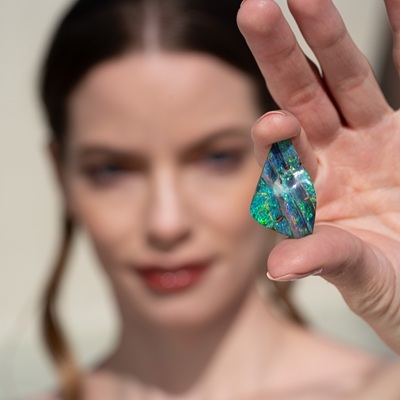
Understanding opal’s place in this value dynamic deepens the picture considerably, because opal’s play-of-color, the phenomenon by which diffracted light dances across a matrix of silica spheres, is never truly repeated from stone to stone. Every opal is, in this sense, a natural limited edition of one.
Real vs. manufactured rarity: What collectors should know
With an understanding of how scarcity drives value, it is vital to distinguish meaningful rarity from mere marketing. This distinction separates informed collectors from those who pay premium prices for pieces whose “limited” status evaporates the moment demand justifies a second run.
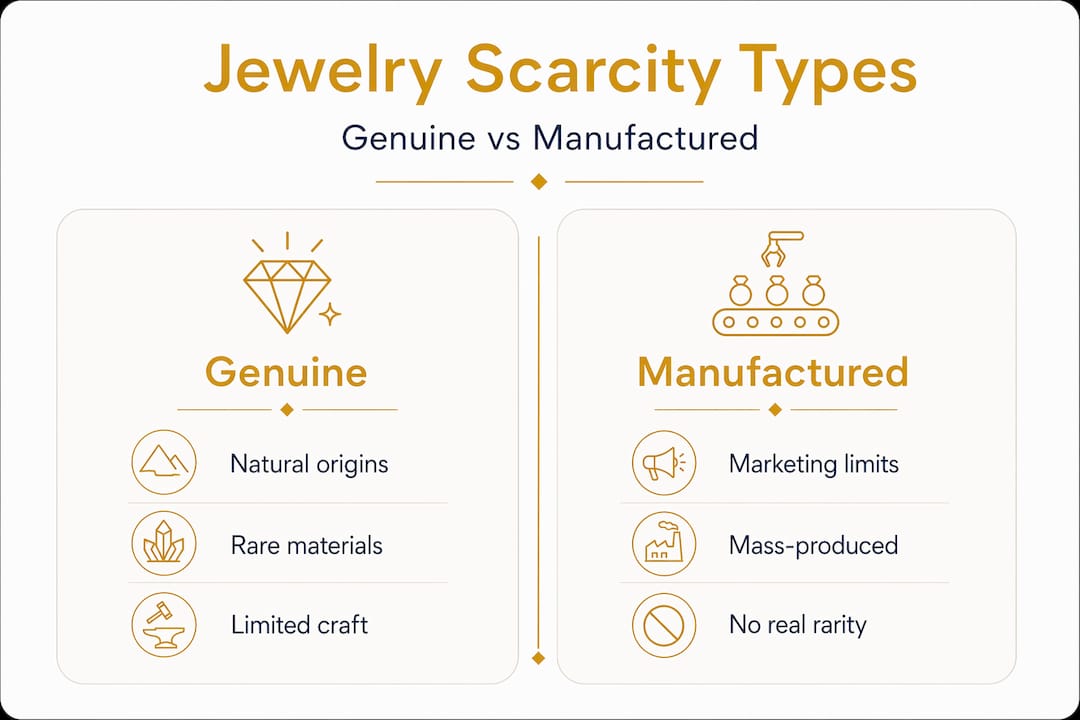
Scarcity can be genuine or manufactured. Genuine scarcity arises from real production constraints: finite natural materials, labor-intensive craftsmanship that physically limits output, or a single parcel of stone that cannot be replicated. Manufactured scarcity, by contrast, is a marketing construct. A brand may declare a piece “limited” without any binding production cap, then quietly issue additional stock when demand warrants it.
The collector implications of this distinction are significant:
| Criteria | Genuine scarcity | Manufactured scarcity |
|---|---|---|
| Source of limitation | Natural material or craft constraints | Brand declaration only |
| Traceability | Mine records, artisan certification, numbered certificates | Vague or absent documentation |
| Resale behavior | Value tends to hold or grow over time | Value may stagnate or decline if further stock appears |
| Collector trust | High, supported by provenance | Variable, dependent on brand reputation |
| Price premium | Justified by authentic rarity | Potentially inflated relative to real supply |
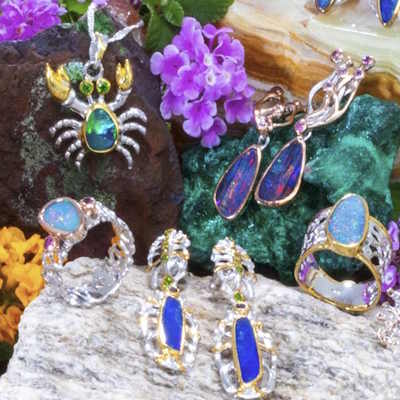
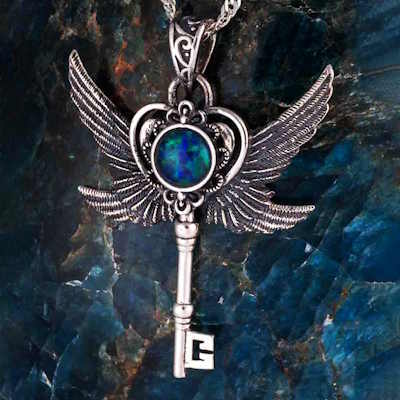
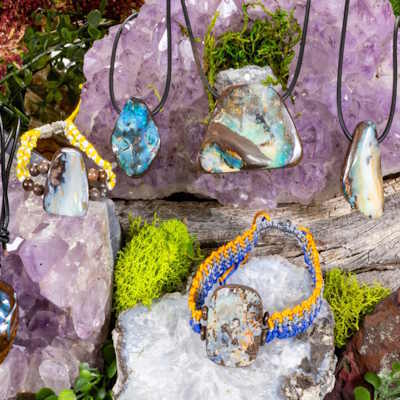
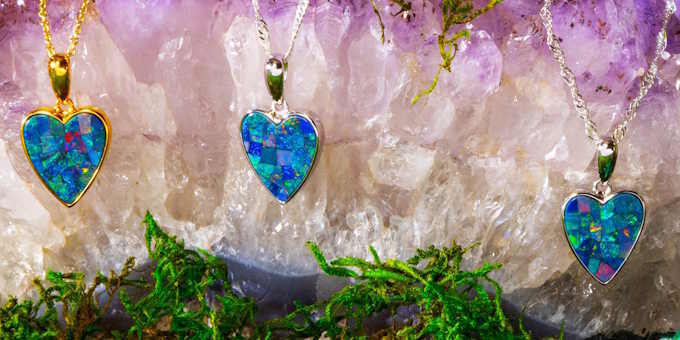
Buyers who take artisanship and ethics in jewelry seriously will recognize that the most trustworthy limited editions are those where both the raw material and the making process impose natural limits. A pendant featuring a Lightning Ridge black opal of exceptional color saturation cannot be duplicated, because the specific stone, with its particular pattern of rolling fire and deep blue-green spectral flash, will never exist again.
Here are four steps every serious buyer should follow to verify an edition’s legitimacy:
- Request the edition certificate. A legitimate limited edition piece carries a numbered certificate of authenticity, ideally with details of total edition size, the date of issue, and the craftsperson or studio responsible.
- Trace the material source. For opal jewelry, ask for documentation linking the stone to a specific mine and parcel. Reputable sellers maintain these records as a matter of course.
- Verify the production constraint. Ask the seller to explain, specifically, why the edition is limited. A genuine answer references material supply, crafting time, or a closed stone parcel. A vague answer references “exclusivity” without substance.
- Research secondary market behavior. Check whether earlier editions from the same maker have held or grown in value over time. A track record of resale strength is the most honest proxy for true scarcity.
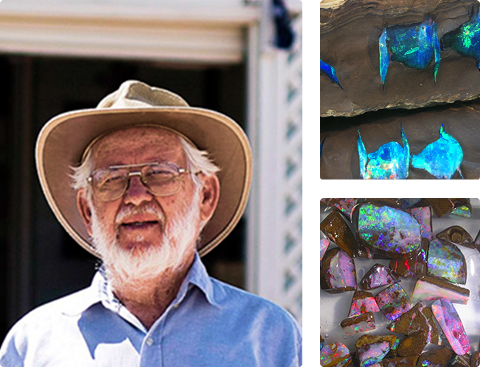
Pro Tip: Many buyers focus exclusively on the certificate and overlook the miner or artisan relationship behind the piece. Asking whether the seller works directly with the source, whether mine or studio, is often more revealing than any document. Direct relationships are the single strongest indicator of genuine supply limits, because they mean the seller cannot simply reorder when stock runs low.
For collectors building a serious portfolio, the authentic opal collector guide offers a deeper framework for evaluating individual stones and the editions built around them.
Australian opal: The ultimate case for authentic limited editions
Now that you know how to spot real versus manufactured scarcity, consider why Australian opal represents perhaps the clearest example of authentic limited luxury in the jewelry world today.
Australian opals form through a geological process that took tens of millions of years and depended on a narrow confluence of silica-rich groundwater, arid sedimentary basins, and the precise chemistry of ancient inland seas. The fields at Lightning Ridge in New South Wales, Coober Pedy in South Australia, and the Queensland boulder opal deposits are not simply mines. They are the planet’s remaining reservoirs of a phenomenon that cannot be engineered, accelerated, or replicated elsewhere in equivalent quality.
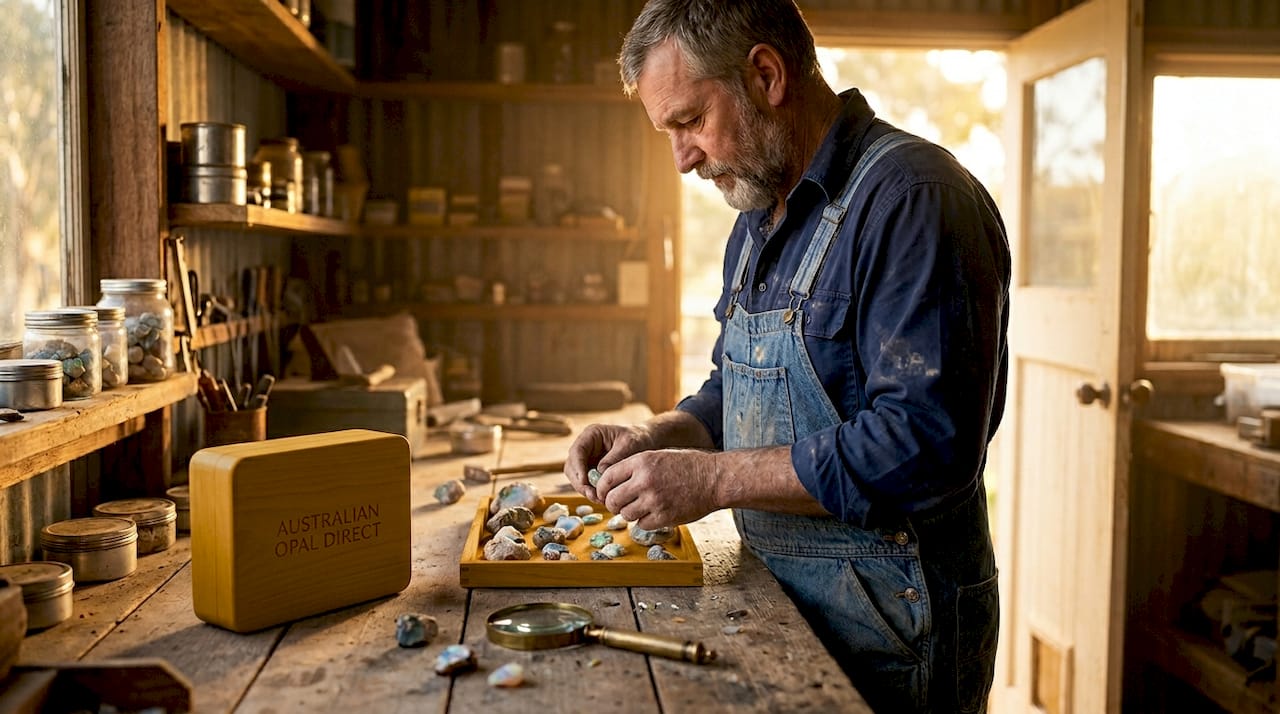
When limited editions are executed with real supply caps, such as numbered pieces, small capsule releases, and controlled access, brands can reduce choice overload and increase the perceived permanence of each piece. For opal jewelry, the supply cap is not a brand decision. It is a geological fact. Once a particular parcel of stones is cut and set, those specific patterns of spectral fire cease to exist in raw form. The limited edition is written into the stone itself.
Collectors prize limited edition opal pieces for a constellation of reasons:
- Irreproducible play-of-color, where each stone’s internal light show is as individual as a fingerprint
- Geological age, with Australian opals frequently dating to the Cretaceous period, roughly 65 to 100 million years old
- Cultural and spiritual resonance, recognized by the Dreamtime traditions of Aboriginal Australians as a stone of creation and vision
- Finite regional supply, since the world’s major opal fields are finite and gradually depleting with each season of mining
- Artisan investment, because exceptional stones attract master setters whose craft time is itself a natural edition limit
- Global prestige, with Australian opal recognized internationally as the finest quality, commanding the highest premiums among connoisseurs
Understanding opals’ role in luxury makes clear why the stone occupies a singular position. Unlike diamonds, where grading systems create a degree of commodity pricing, each opal is evaluated as a unique specimen. Two stones of identical weight, origin, and body tone will still differ in ways that make direct comparison nearly impossible. This inherent individuality is the foundation of genuine limited edition value.
Pro Tip: When evaluating a limited edition opal piece for sustainability credentials, look specifically for disclosure of the mining method (underground hand mining at Lightning Ridge, for instance, has a dramatically lower environmental footprint than open-cut extraction) and whether the seller can name the miner or mining family. Sustainable opal sourcing is not simply an ethical preference. It is also a value indicator, since ethically traceable pieces carry stronger provenance documentation and greater collector confidence. To understand precisely what makes black opal rare at a geological level, the specifics of its dark body tone and the silica sphere patterning that produces its signature spectral drama are worth exploring in depth.
What actually preserves luxury: Beyond rarity alone
Having explored why scarcity matters, it is critical to understand what else separates a merely rare piece from a truly coveted luxury asset. Rarity is the floor, not the ceiling, of lasting value.
“Rarity strategies help preserve prestige even as access expands, but the overall effect is entangled with other signals such as brand power and pride-of-ownership dynamics, rather than rarity working in isolation.” — Journal of Marketing research, 2024
This entanglement is worth sitting with. A stone pulled from a depleted Lightning Ridge parcel is genuinely rare. But its value as a luxury asset depends equally on how it was set, by whom, in what metal, with what level of craft documentation, and within what narrative of provenance and ownership history. Rarity without these compounding factors produces curiosity. Rarity with them produces hallmarks of high jewelry, the kind of pieces that appreciate in both monetary and personal significance over a lifetime.
Luxury research suggests rarity strategies function best when layered with additional value signals. For collectors, this means evaluating four critical factors alongside scarcity:
- Craftsmanship depth. How many hours of skilled hand labor went into the piece? Is the setting technique documented? Master bezel setting around a high-domed opal cabochon requires a level of skill that adds intrinsic, verifiable value independent of the stone itself.
- Heritage narrative. Does the piece carry a meaningful story? A pendant whose stone was mined by the same family for three generations, set by an artisan with documented awards, and certified by a recognized gemological body carries a narrative that multiplies emotional and financial worth.
- Ownership documentation. The full chain of custody, from mine to cutter to setter to first owner, is increasingly the difference between a piece that holds value and one that does not. Serious collectors treat documentation as inseparable from the jewelry itself.
- Material integrity. Is the metal as considered as the stone? High-karat gold settings protect opal’s relatively soft structure and signal that the maker viewed the entire piece, not just the gem, as worthy of serious investment. For specific strategies on building an opal collection that compounds in value, expert investment tips for Australian opals offer a practical framework.
Why conventional wisdom about limited editions falls short
The most common mistake we observe among buyers entering the opal and luxury jewelry market is what might be called label chasing: the habit of treating the words “limited edition” as a sufficient condition for quality and value, rather than as a starting point for inquiry. This mistake is understandable. The marketing language around luxury jewelry is designed to evoke exactly this response, to short-circuit scrutiny through the emotional power of scarcity signals.
But the Australian opal market, precisely because it deals in genuinely finite natural material, offers a revealing counterexample. Buyers who have chased marketing narratives around “limited” opal pieces without verifying provenance have sometimes found that the stones, while beautiful, carry no documentation connecting them to a specific mine, parcel, or miner. Without that thread, the piece is rare in the way that any anonymous antique is rare: interesting, but difficult to value with confidence.
Conversely, collectors who have prioritized provenance, direct-miner relationships, and craft documentation over marketing language have consistently built collections that retain and grow in value. The lesson is not that limited edition labeling is worthless. It is that the label should prompt deeper questions, not replace them.
Brand and heritage matter enormously, but only when they are paired with genuine supply constraints. A renowned maker’s name on a piece whose “limited” status is purely declarative adds prestige without adding scarcity. A less prominent maker whose work is constrained by the finite output of a single mining season and documented craft process may offer far superior long-term value. The discerning collector learns to read both signals simultaneously. Understanding how to approach pricing authentic luxury opal in this light is a skill that separates thoughtful investors from impulse buyers, regardless of budget.
Explore authentic limited edition opal jewelry
The principles in this guide are most powerful when applied to real pieces with verified provenance. Every insight into scarcity, craftsmanship, and lasting value finds its clearest expression in a stone pulled from Lightning Ridge or Coober Pedy, set by skilled hands, and documented from the moment it left the earth.
At Australian Opal Direct, every limited edition piece in the collection is backed by direct-miner relationships that remove intermediaries and ensure the provenance chain is unbroken from source to setting. Ethically sourced, earth-mined, and crafted with the attention that genuinely finite material deserves, these pieces represent what the best of this guide describes: authentic scarcity, compounded by artisan skill and transparent documentation. Explore the Australian Opal Direct collection and discover pieces whose rarity is written not in marketing copy, but in the geology of this ancient, luminous land.
Frequently asked questions
What defines a limited edition jewelry piece?
A limited edition jewelry piece is one produced in a restricted quantity, often supported by a numbered or certificate system. True limited editions are backed by real material or crafting constraints, not merely brand declarations.
How can I spot if a limited edition label is just a marketing tactic?
Check for official edition numbers, transparent supply details, and reputable certification. Buyer due diligence matters because vague or open-ended labeling, without documentation of a genuine production cap, is the clearest red flag.
Why do Australian opals make ideal limited edition jewelry?
Australian opals are exceptionally limited due to natural geological rarity, meaning every true edition is genuinely scarce. Real supply caps for opal jewelry are dictated by the finite and irreplaceable nature of the stone itself, not by marketing strategy.
Does rarity alone guarantee investment value for jewelry?
No. Rarity strategies preserve prestige most effectively when combined with craftsmanship, brand legacy, ownership documentation, and a compelling provenance narrative. Rarity is the foundation, but lasting value is built on all four pillars together.
Recommended
- Limited edition opal benefits: value and authenticity - Australian Opal Direct
- What defines high jewelry? The key elements of true luxury - Australian Opal Direct
- Role of Opals in Luxury Jewelry: Rarity & Value - Australian Opal Direct
- 7 Key Benefits of Opal Jewelry for Discerning Collectors - Australian Opal Direct