White Opal Value: A Buyer's Guide to Price and Quality
Posted by AOD on 18th Aug 2026
White Opal Value: A Buyer’s Guide to Price and Quality
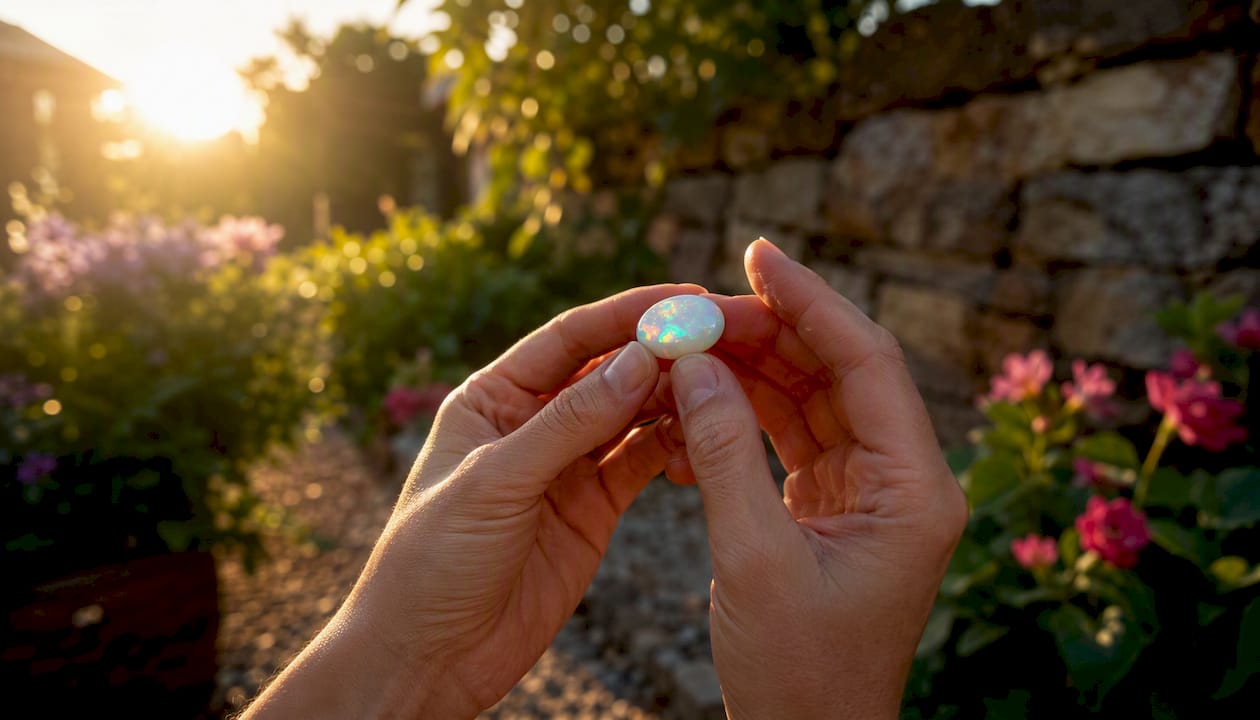
Expect to pay a wide range for loose white opal, with brightness driving the price more than any other single factor. A milky-bodied stone with a dull, sleepy face can sit near the bottom of that range, while a small, vividly patterned specimen with strong flash can rival material several times its weight. The GIA identifies brightness, pattern, body tone, and clarity as the primary levers of value, and a seller like Australianopaldirect prices its own stones against those exact criteria rather than carat weight alone.
Finished jewelry runs higher than the loose-stone figures above once metal, labor, and setting enter the equation. Before you look at a single stone, check three things:
- Brightness — how much light bounces back at you across the face of the stone
- Pattern — whether the color play reads as broad, directional flashes or scattered pinpoints
- Body tone — where the background sits on the N1 (black) to N9 (white) scale
Key Takeaways
White opal value hinges primarily on brightness and pattern quality, not carat weight, with prices ranging from roughly $10 to over $1,000 per carat depending on grading factors.
| Point | Details |
|---|---|
| Brightness rules the price | A stone’s light reflection matters more than its size when buyers and appraisers set value. |
| Price bands span widely | Commercial white opal runs $1–$30/carat, while fine and exceptional stones exceed $300–$1,000/carat. |
| Pattern type shifts value | Harlequin and broad flash patterns command more than pinfire at equal brightness levels. |
| Provenance adds confidence | Documented Coober Pedy or Andamooka origin supports a modest premium and buyer trust. |
| Australianopaldirect verifies before selling | The retailer works directly with Australian miners and checks solid construction and provenance on every stone. |
Table of Contents
- What Determines White Opal Value?
- What Grading Factors Actually Move the Price?
- Does Origin Affect What a White Opal Is Worth?
- How Do You Spot a Doublet, Triplet, or Treated Stone?
- How Do You Estimate a Specific Stone’s Value?
- Three Worked Examples of White Opal Pricing
- Why Vibrancy Beats Size in Opal Valuation
- Further Reading on Opal Valuation
- Frequently Asked Questions
What Determines White Opal Value?
Price bands for white opal cluster into four rough tiers, and the gap between the bottom and top of that range is larger than almost any other colored gemstone category. Commercial-grade material with weak or absent play-of-color often sells for modest amounts per carat. Step up to ordinary jewelry-quality opal with visible but modest flash, and the price moves into a mid-range level. Fine material with strong, consistent brightness commands higher prices, and truly exceptional stones with wall-to-wall color and near-perfect transparency can exceed that ceiling.
- Commercial tier: $1–$30/carat, muted or patchy color, often used in lower-cost fashion jewelry
- Mid-range tier: $50–$300/carat, visible pattern with moderate brightness
- Fine tier: $300–$1,000/carat, vivid multicolor flash across most of the face
- Exceptional/collector tier: $1,000+/carat, rare pattern combinations with exceptional brightness and clarity
That per-carat number describes the loose stone, not what you will pay at checkout for a finished ring or pendant. Setting a stone in 18-karat gold, adding pavé accents, and paying a jeweler’s labor can double or triple the retail price compared to the raw material cost. A $400 loose opal might become an $900 finished ring once you account for the band, prongs, and craftsmanship, and that markup is standard across the jewelry trade, not a sign of overpricing.
Here is the part that trips up new buyers: these tiers overlap constantly. A vivid 1-carat stone with broad multicolor flash can genuinely outprice a lackluster 5-carat stone, because brightness and pattern matter more to the eye, and to the market, than sheer bulk. Price guides consistently warn against using carat weight as a shortcut for value.
Pro Tip: If you’re getting a stone appraised, expect the appraisal value to sit closer to replacement or insurance cost, which often runs higher than what you’d pay buying the same stone retail. That gap confuses a lot of first-time sellers who assume their appraisal number is what a buyer will actually pay.
What Grading Factors Actually Move the Price?
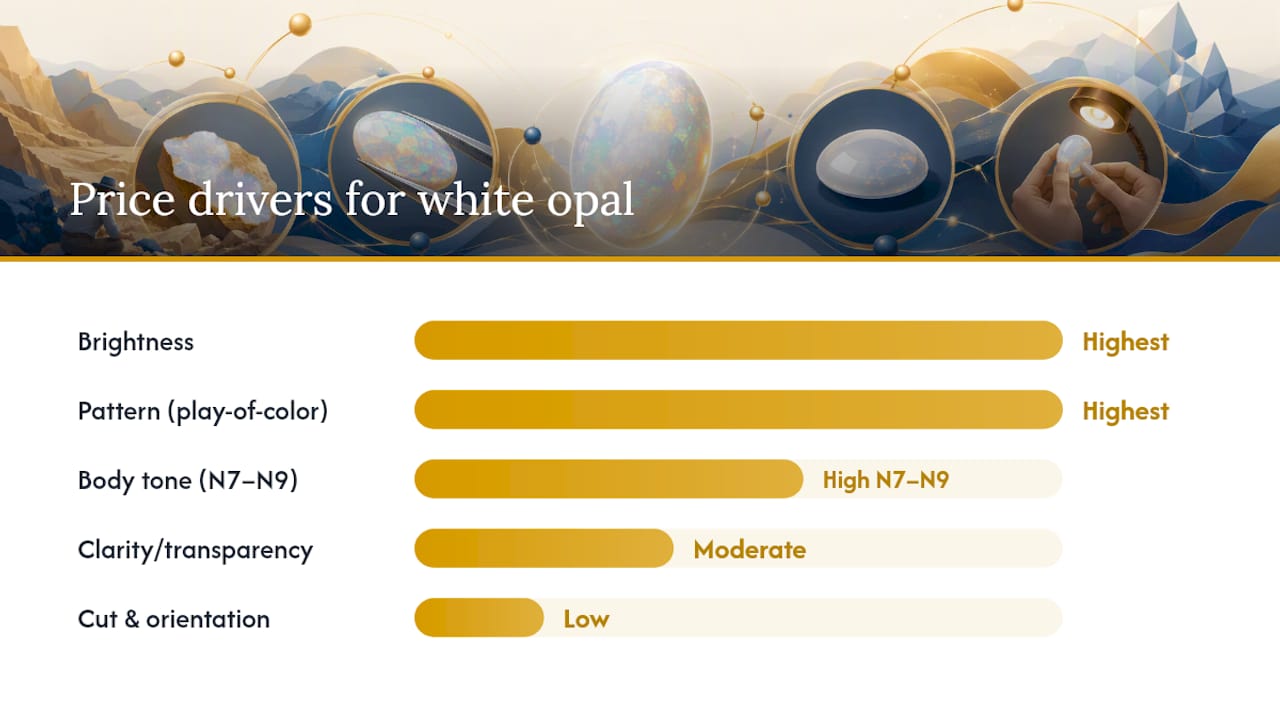
Six factors interact to set a white opal’s price, and understanding how they layer on top of each other matters more than memorizing any single number.
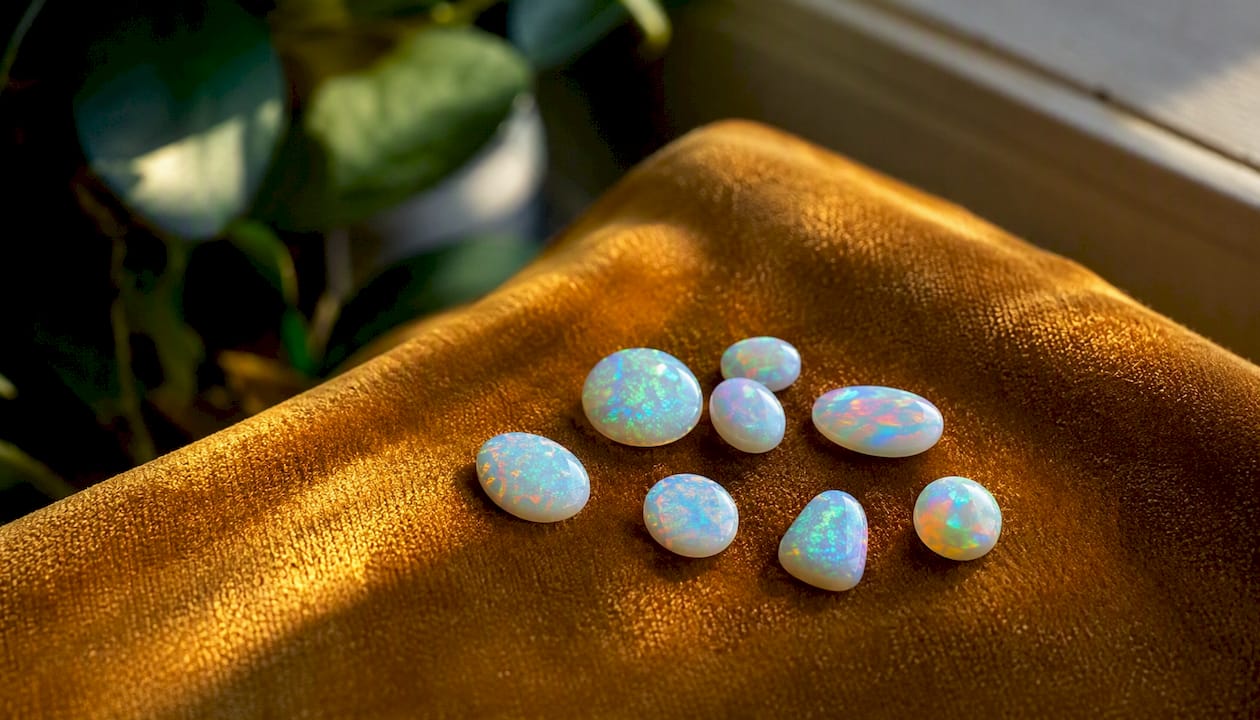
Brightness sits at the top of that list. Because white opal has a light, often milky background rather than the dark canvas of black opal, there is no natural contrast to make color pop. The GIA treats brightness as the foundation everything else builds on: a stone can have a gorgeous pattern, but if it doesn’t reflect light with intensity, the pattern reads as faint and washed out. Practitioners describe white opal as a value spectrum defined almost entirely by contrast, or the lack of it, and a potch backing or cloudy body kills both the visual impact and the durability of the stone.
Play-of-color breaks down into pattern type, coverage, and directionality, and each pattern carries its own market reputation:
- Harlequin: broad, angular patches of color in a mosaic-like arrangement, among the rarest and most valuable patterns
- Broad flash: large sheets of color that shift as the stone moves, highly desirable
- Ribbon: color arranged in flowing bands, attractive but less prized than harlequin or broad flash
- Pinfire: small, dense points of color, common and generally the most affordable pattern type
Coverage matters just as much as pattern type.
Body tone runs on the N1 through N9 scale, with N1 representing jet black and N9 representing pure white. White opal typically falls in the N7 to N9 range. A stone toward N7 will generally show its play-of-color with more punch than one at N9, because even a small amount of darkness in the background gives color something to contrast against.
Clarity and transparency come next. Cracks, cloudiness, or included sand grains reduce both the stone’s beauty and its structural integrity, since white opal already sits at a modest Mohs hardness of 5.5 to 6.5. Cut and orientation determine how much of that pattern the cutter managed to preserve and present toward the viewer, and carat weight matters, but it’s the last factor on this list for a reason.
Consider how much a single variable shifts the estimate. Take two 2-carat white opals priced hypothetically at $150 per carat as baseline mid-range material. Improve the brightness alone from moderate to vivid, and that same stone can jump into the $300 to $500 per carat fine tier, nearly tripling total value without changing weight, pattern, or body tone at all. Swap a pinfire pattern for a harlequin at equal brightness, and you’d expect a similar jump. Weight rarely produces that kind of leverage.
Pro Tip: Always examine a stone under natural daylight and from at least three angles before forming an opinion on brightness. Indoor lighting, especially warm incandescent bulbs, can flatten a stone’s color play and make a genuinely fine opal look mediocre, while direct sun can make a mediocre stone look temporarily brilliant.
Does Origin Affect What a White Opal Is Worth?
Origin can add a premium, but it never overrides visual quality. Coober Pedy in South Australia is the world’s most significant source of white opal, and Geoscience Australia documents it as the historical center of that production. Andamooka, also in South Australia, produces white and crystal opal with its own distinct character, sometimes showing higher clarity in the base material. Lightning Ridge in New South Wales is renowned primarily for black opal, though white material occasionally surfaces there too, and Queensland’s fields contribute boulder opal, a different category entirely built on ironstone backing.
Knowing a stone’s origin gives buyers confidence in provenance and helps confirm it hasn’t passed through unreliable hands, and a documented Coober Pedy or Andamooka origin can support a modest price premium over unattributed material of equal visual quality.
That said, origin takes a back seat the moment visual quality diverges sharply. A dull, low-brightness stone from a famous field will not outprice a vivid, well-patterned stone of unknown origin. White opal also sits in a different rarity tier than black or boulder opal: solid gemstones with strong play-of-color are the most precious material overall, regardless of type, and white opal’s broader supply keeps its price ceiling generally lower than top-tier black opal, even though exceptional white specimens still command real premiums.
- Coober Pedy: dominant white opal source with a wide range of quality
- Andamooka: known for crystal and white opal with good base clarity
- Lightning Ridge: primarily black opal production, white opal less common
- Queensland fields: known for boulder opal on ironstone, a distinct valuation category
How Do You Spot a Doublet, Triplet, or Treated Stone?
A doublet is a thin slice of natural opal glued to a dark backing material, usually potch or black plastic, to simulate the contrast of higher-value black opal. A triplet adds a clear cap, typically quartz or glass, over that same sandwich for protection and added shine. Both sell for a fraction of what solid opal commands, because you’re paying for a sliver of gem material stretched over cheap backing.
Watch for these warning signs before you buy:
- A perfectly flat, uniform dark backing visible when you view the stone from the side
- A visible seam or glue line running around the girdle of the stone
- Unnatural, glassy shine on the surface that suggests a quartz or resin cap
- A price that seems too low for the apparent size and brightness on display
- No willingness from the seller to provide lab documentation or a return policy
Some sellers also apply smoke or sugar treatments to enhance apparent contrast, or substitute synthetic opal (a lab-grown material with a regular, honeycomb-like pattern under magnification) for the real thing. The GIA notes that all such assembled stones, treatments, and synthetics must be disclosed, and their absence from a listing is itself a red flag.
For anything beyond casual costume jewelry, ask for a lab report confirming solid versus assembled construction, a written disclosure of any treatment, and documented provenance from an ethical source. A reputable dealer will provide this without hesitation.
Pro Tip: If a seller can’t tell you whether a stone is solid, a doublet, or a triplet, treat that as a decline signal, not a detail to sort out later.
How Do You Estimate a Specific Stone’s Value?
Follow this sequence to build a defensible estimate before you ever contact a professional appraiser:
- Photograph the stone from multiple angles under natural daylight, since documented images matter more for a remote valuation than carat weight alone.
- Grade brightness on a simple low, medium, high, and exceptional scale based on how much light returns from the face.
- Identify the pattern (harlequin, broad flash, ribbon, or pinfire) and estimate what percentage of the face shows color.
- Note the body tone using the N1–N9 reference scale, and check for cracks, cloudiness, or inclusions.
- Place the stone in a price tier using the bands above as a starting estimate per carat.
- Adjust for carat weight, cut quality, and any provenance documentation, applying a modest premium for a known Coober Pedy or Andamooka origin.
- Compare against recent retail listings or auction results for stones with similar characteristics.
- Set a target price, whether you’re buying or selling, with a reasonable range rather than a single fixed figure.
The math itself stays simple: multiply your estimated per-carat tier price by the carat weight, then add a percentage for certification or provenance documentation if it applies, and add jeweler markup separately if you’re pricing a finished piece rather than a loose stone.
Before contacting a dealer or appraiser, have these questions ready: Is this stone solid, doublet, or triplet? What is the documented origin? Has any treatment been applied? Can you provide a lab report? What is the basis for this valuation, replacement cost, retail, or wholesale? A dealer’s willingness to answer plainly tells you almost as much as the answers themselves.
Three Worked Examples of White Opal Pricing
That places it firmly in the fine tier, roughly $300 to $500 per carat. At the midpoint of $400, the stone estimates to $480 total.
That lands in the mid-range tier, around $75 to $150 per carat. At $100 per carat, the stone estimates to $400 total, roughly the same as the much smaller, brighter Example 1 stone, which illustrates exactly why brightness outweighs weight.
Example 3: The large dull stone. A 10-carat white opal with weak, patchy play-of-color and a milky N9 body tone falls into the commercial tier, perhaps $5 to $20 per carat. At $12 per carat, the total estimate comes to $120, less than a tenth the size of Example 1’s stone despite weighing over eight times as much.
Setting any of these stones into a finished ring adds metal, labor, and design costs on top of the loose-stone figure, often significantly increasing the retail price depending on the complexity of the piece.
Why Vibrancy Beats Size in Opal Valuation
Experienced gemologists consistently emphasize that background brightness and clarity determine how well a stone’s play-of-color actually reads, and that vibrancy tends to matter more than raw carat size when the market forms its opinion of a stone.
The brightness and clarity of the background set the stage for how well play-of-color reads in white opal. Vibrancy often matters more than raw carat size when estimating market desirability.
Australianopaldirect builds its own grading practice around that same principle, working directly with miners in Coober Pedy and Lightning Ridge rather than through layers of wholesalers. That direct relationship means every stone can be traced back to its source, verified for solid construction, and photographed under consistent lighting before it ever reaches a listing.
- Direct miner relationships that support verified provenance for every stone
- In-house grading against brightness, pattern, body tone, and clarity criteria
- Certification checks to confirm solid construction before sale
- Photographic documentation from multiple angles to support remote buyer confidence
If you want a deeper look at how Coober Pedy material varies in quality across that field, the differences show up quickly once you start comparing brightness side by side.
Why This Guide Exists
Accurate valuation protects both sides of a transaction. Buyers deserve to know what they’re actually paying for, and sellers, especially collectors sitting on stones passed down for generations, deserve a fair price grounded in real grading criteria rather than guesswork. Australianopaldirect works directly with miners across South Australia’s opal fields, and that origin connection shapes how we think about every stone that crosses our desks.
Get a Professional Read on Your White Opal
A grading checklist gets you close, but a trained eye catches nuance that’s easy to miss on your own, particularly around pattern coverage and subtle treatment signs. Australianopaldirect offers appraisal support and certificate verification alongside its collection of loose stones and custom jewelry, so whether you’re buying your first white opal or trying to price one you already own, you can get a grounded answer instead of a guess.
The team works directly with miners in Coober Pedy and Lightning Ridge, which means every piece comes with verified provenance rather than a vague “Australian origin” claim. That matters when you’re trying to justify a price, whether you’re the buyer or the seller.
- Free shipping and complimentary insurance on qualifying orders
- 90-day warranties on finished jewelry pieces
- Custom design options for setting a loose stone you already own
Pro Tip: Before requesting a valuation, photograph your stone in natural daylight from the front, side, and at a slight tilt. Those three images alone will speed up any remote assessment significantly.
Reach out through Australianopaldirect for a free estimate or to arrange a formal appraisal on a stone you’re looking to buy, sell, or have custom set.
Further Reading on Opal Valuation
- GIA’s opal quality factors — cover brightness, pattern, body tone, and clarity in professional grading detail.
- Geoscience Australia’s opal resources — document Coober Pedy, Lightning Ridge, and other producing regions.
Frequently Asked Questions
What is white opal worth per carat? White opal typically ranges from $10 to $1,000 or more per carat, with commercial-grade material at the low end and fine, vivid stones commanding the top of that range. Brightness and pattern quality determine where a specific stone falls.
How do you tell white opal from crystal opal? White opal has an opaque to semi-translucent milky body, while crystal opal is more transparent, letting you see further into the stone. Crystal opal with strong play-of-color often prices higher than white opal of similar pattern quality because the transparency adds visual depth.
Does a certificate increase white opal value? A lab report confirming solid construction and disclosing any treatment builds buyer confidence and can support a modest price premium, particularly for higher-value stones. It matters most when you’re buying remotely or reselling later.
Is white opal from Coober Pedy more valuable than other sources? Documented Coober Pedy origin can add a premium tied to provenance and trust, but visual quality, brightness, pattern, and clarity still outweigh origin when the two conflict. A dull Coober Pedy stone will not outprice a vivid stone from elsewhere.
Why do two similar-sized white opals sell for very different prices? Brightness and pattern coverage vary enormously even between stones of identical weight and origin, and those factors drive price far more than carat weight does. A vivid 2-carat stone can easily outprice a dull 5-carat stone.