Understanding opal color layers: science, origins, and value
Posted by AOD on 15th Apr 2026
Understanding opal color layers: science, origins, and value
TL;DR:
- Opal colors result from light diffraction by microscopic silica spheres, not pigments.
- Natural formation processes create unique internal layer arrangements causing distinct color patterns.
- Precious opal exhibits vivid, shifting play-of-color due to highly ordered sphere structures, unlike common or fire opal.
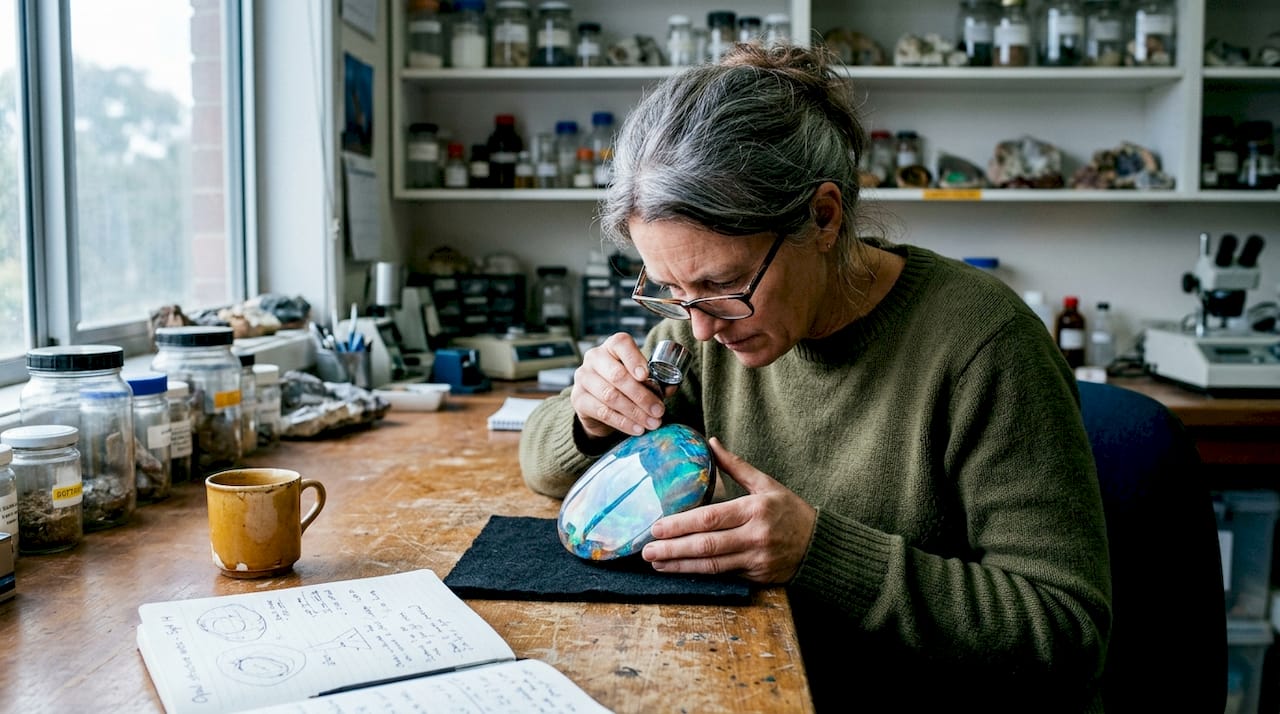
Most people assume that opal’s breathtaking colors come from pigments locked inside the stone, much like the dye in a fabric or the ink on a page. That assumption, while intuitive, misses something far more extraordinary. Opal color is a purely physical phenomenon, born from the interaction of light with microscopic architecture hidden within the gem. Australian opal facts reveal that no two stones share the same internal geometry, which is why no two opals ever look quite alike. This guide traces the journey from the silica-sphere science that creates those luminous layers, through the ancient geology of Australian opal fields, to the practical knowledge collectors use when assessing rarity and value.
Table of Contents
- The science behind opal color layers
- How and where opal color layers form in nature
- Comparing precious, common, and fire opal color effects
- How color layers influence value and collector appeal
- Why natural variability in opal color layers still surprises the experts
- Explore authentic Australian opals and deepen your knowledge
- Frequently asked questions
Key Takeaways
| Point | Details |
|---|---|
| Color layers by diffraction | Opal’s vibrant color layers result from light diffusing through perfectly arranged silica spheres. |
| Rarity of red bands | Red and multi-hued color layers are rare due to larger spheres settling at the base during formation. |
| Value for collectors | Opals with thick, vibrant, and multi-colored layers command the highest value and desirability. |
| Natural unpredictability | Even with synthetic techniques, nature’s unique imperfections make each high-quality opal genuinely one-of-a-kind. |
The science behind opal color layers
At first glance, an opal looks like a stone that has swallowed a rainbow. The reality is even more poetic. Opal color layers occur due to diffraction of light by ordered stacks of microscopic silica spheres packed in precise, repeating grids inside the gem. When white light enters the stone, these grids act like a natural diffraction grating, bending and separating wavelengths into the spectrum of colors that collectors call play-of-color.
The size of those spheres governs which color you see. Small spheres, roughly 150 nanometers in diameter, diffract short wavelengths and produce violet and blue flashes. Medium spheres, around 200 nanometers, yield green and yellow. Larger spheres, closer to 250 to 350 nanometers, bend the longer wavelengths that produce orange and red. This size-to-color relationship is precise and predictable, yet the arrangement of spheres across an entire stone is never perfectly uniform, which is exactly what makes each opal a singular work of natural art.
The mechanism responsible is Bragg diffraction, the same principle that governs how X-rays scatter through crystal lattices. It is not thin-film interference, a distinction that matters to gemologists because it explains why the color shifts so dramatically as the viewing angle changes. For the play-of-color to be vivid rather than muted, the spheres must be arranged with extraordinary regularity across thousands of repeating layers.
“The ordered structure of silica spheres in precious opal functions as a three-dimensional photonic crystal, producing spectral colors through constructive interference rather than any form of pigmentation.”
Below is a comparison of how the three main opal categories differ in structure and appearance:
| Opal type | Sphere arrangement | Play-of-color | Typical appearance |
|---|---|---|---|
| Precious opal | Highly ordered, uniform grids | Vivid, shifting layers | Translucent to opaque, spectral flashes |
| Common opal | Disordered or absent | None | Milky, waxy, uniform body color |
| Fire opal | Absent or minimal | Rare to none | Transparent, warm orange to red body |
Understanding the opal play-of-color explained at this structural level transforms the way you look at every stone. What appears to be a spontaneous burst of color is actually the product of millions of years of geological patience.
How and where opal color layers form in nature
Understanding the internal structure leads us to the natural geological story of how opal color layers are created. Australia’s opal fields sit within ancient Cretaceous-era sedimentary basins, where shallow inland seas once covered vast stretches of the continent. As those seas receded, silica-rich groundwater percolated through sandstone and eventually became trapped in cracks and voids within the rock. Over millions of years, the water evaporated slowly, leaving behind the silica spheres that would eventually self-organize into the layered structures we prize today.
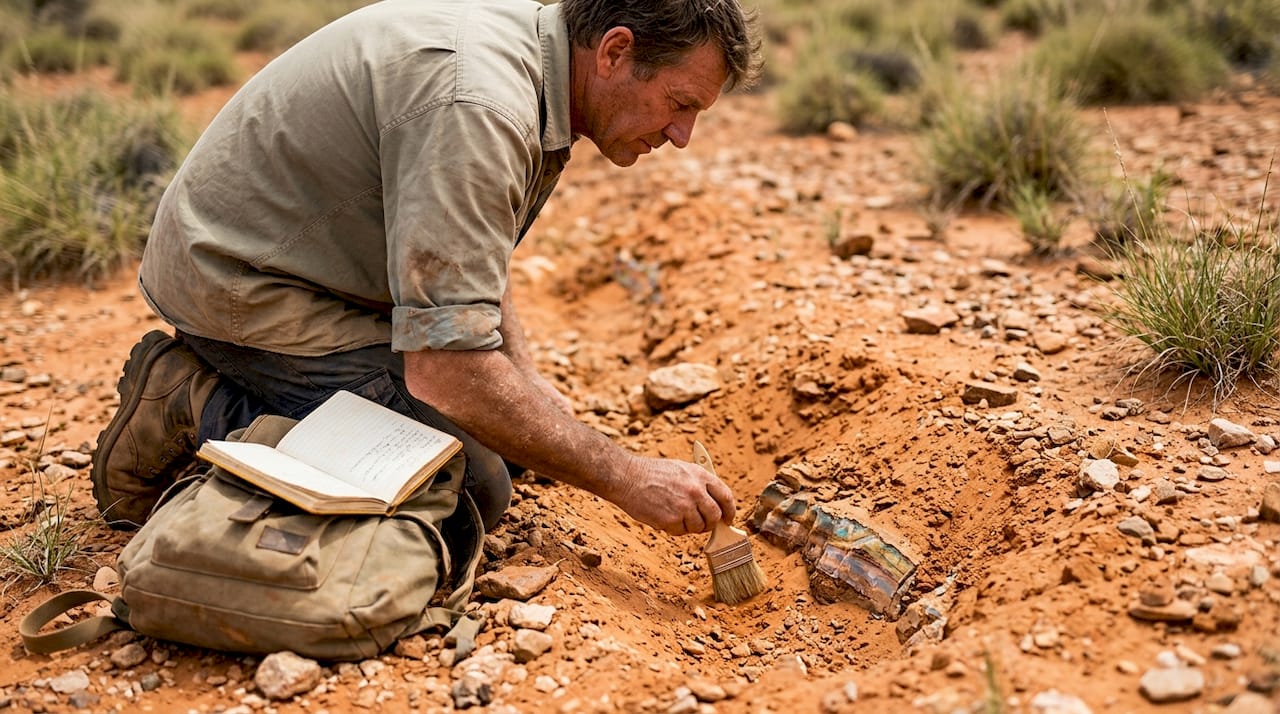
Gravity plays a surprisingly decisive role in the color sequence. Color layers form as silica spheres settle and harden in veins, with larger spheres sinking to the base and smaller spheres rising toward the surface. This settling process means that a single opal seam can display a gradient from red and orange at its deepest point to green, blue, and violet closer to the surface. It is geology writing color in stone, one sphere at a time.
The table below maps sphere size to the resulting color, giving collectors a practical reference:
| Sphere diameter (approx.) | Resulting color |
|---|---|
| 150 nm | Violet / blue |
| 180 nm | Blue / green |
| 200 nm | Green / yellow |
| 230 nm | Yellow / orange |
| 250 to 350 nm | Orange / red |
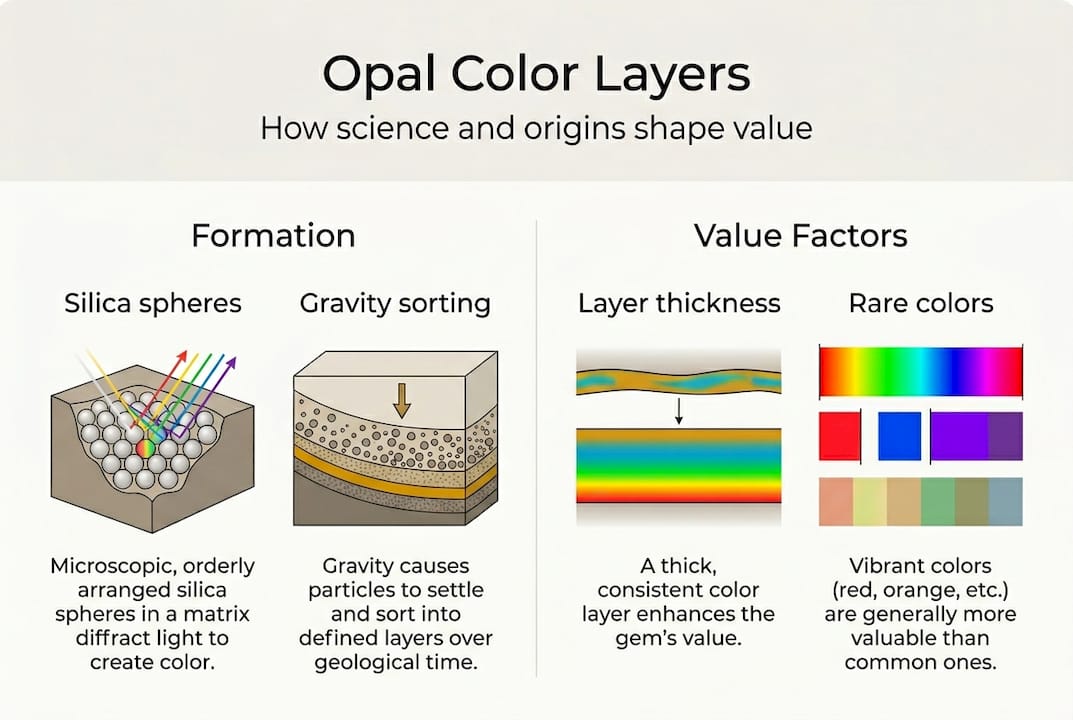
The rarest colors, particularly the deep crimson and scarlet reds, require the largest spheres to settle in near-perfect alignment. That combination of size and order rarely occurs, which is why red-dominant layers command the highest admiration among collectors. Lightning Ridge opals are especially celebrated for producing those red and multicolored layers against a dark body tone, a contrast that amplifies the brilliance of every flash.
Environmental conditions during formation also shape the final meaning of opal colors within the stone. Temperature fluctuations, mineral impurities, and the specific chemistry of the host rock all influence how uniformly the spheres pack together. This is why opals from different regions, Lightning Ridge, Coober Pedy, and Queensland, each carry a distinct visual signature.
Pro Tip: When evaluating an opal, look for thickness and continuity in the color layer. A thin or patchy layer may produce beautiful flashes, but a thick, uninterrupted band of play-of-color signals a stone with both rarity and lasting visual impact.
Comparing precious, common, and fire opal color effects
Now, it’s important to know why some opals dazzle with color layers while others remain muted. The answer lies entirely in whether the silica spheres inside the stone achieved the precise ordering needed to diffract visible light.
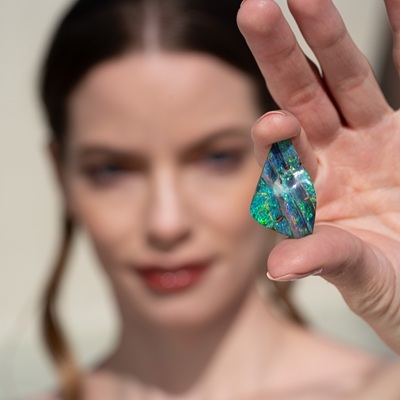
Precious opal is the collector’s benchmark. Its spheres are packed into a three-dimensional photonic crystal structure, meaning light is diffracted in multiple directions simultaneously. The result is a stone where colors appear to shift, rotate, and cascade as the viewing angle changes. Those shifting layers are not on the surface; they live deep within the gem, giving precious opal its characteristic depth and luminosity.
Common opal, sometimes called potch in the Australian mining tradition, forms when silica spheres deposit without achieving any meaningful order. Common opal lacks the organized sphere structure needed for play-of-color, producing instead a milky, waxy, or resinous appearance. Potch is not without beauty, but it does not carry the spectral layers that define collector-grade material. Interestingly, potch often forms alongside precious opal in the same seam, acting as a natural backdrop that can enhance the visual contrast of the color layer above it.
Fire opal occupies a fascinating middle ground. Its warm, transparent body color, ranging from honey yellow through vivid orange to deep red, comes from trace iron oxide content rather than sphere diffraction. GIA precious opal research confirms that fire opal may occasionally show faint play-of-color, but it is rarely the layered spectral display found in precious opal.
Here is a quick reference for distinguishing the three types:
- Precious opal: Highly ordered silica spheres, vivid multi-directional play-of-color, high collector value
- Common opal (potch): Disordered spheres, no play-of-color, milky or opaque appearance, low collector value
- Fire opal: Body color from iron oxide, transparent to translucent, little to no layered play-of-color, valued for body color alone
Understanding these distinctions helps you appreciate why opal color meanings are so deeply tied to the internal architecture of the stone rather than its surface appearance.
Pro Tip: When shopping for opals, ask to view the stone under different light sources and angles. True layered play-of-color in precious opal will shift and deepen as you rotate the gem. A stone that looks the same from every angle is likely common opal or a simulant.
How color layers influence value and collector appeal
With clear differences in opal types established, let’s look at how color layers impact what collectors and jewelers prize most. Value in the opal world is not simply about size or clarity; it is about the richness, rarity, and complexity of the color layers themselves.
Red and multicolored layers are the rarest and most sought-after, commanding significant premiums over stones that display only blue or green. A stone that cycles through the full visible spectrum, from violet through red, in a single play-of-color display is considered a pinnacle find. Such stones are sometimes described as exhibiting “rolling fire,” where the color appears to move like a living flame as the gem shifts in the light.
Black opals from Lightning Ridge’s rare geology are the most celebrated examples of this phenomenon. The dark body tone of black opal acts like a velvet backdrop, making every color layer appear more saturated and vivid than it would against a pale or white background. This contrast effect is why black opals consistently achieve the highest prices per carat in the global gemstone market.
Here is a numbered framework collectors use to assess color layer quality:
- Hue range: Does the stone show a single color or a full spectral range? More hues mean greater rarity.
- Layer thickness: Thicker, more continuous color layers indicate a longer, more stable formation process.
- Brightness: A vivid, high-brightness layer visible in indirect light is more valuable than one that only appears under direct illumination.
- Pattern: Rolling, floral, and harlequin patterns are rarer and more prized than simple directional flashes.
- Body tone: Darker body tones amplify color contrast, increasing perceived brilliance and value.
The opal gemstone selection process used by experienced buyers always begins with the color layer, because no other factor so directly reflects the geological rarity and natural artistry of the stone.
Why natural variability in opal color layers still surprises the experts
Science has given us a remarkably clear picture of how opal color layers form, yet even the most experienced gemologists will tell you that each new stone still holds the capacity for surprise. Synthetic opals can replicate the ordered sphere structure with impressive precision. Synthetic opals replicate patterns but lack the natural variability that makes earth-mined stones genuinely one of a kind. A laboratory can control sphere size and packing density, but it cannot reproduce the millions of years of geological pressure, chemical variation, and environmental flux that shape a natural opal.
That unpredictability is not a flaw. It is the very quality that keeps collectors returning, because no catalog or database can fully prepare you for what a new stone might reveal. The subtle imperfections in natural sphere arrangement create micro-variations in color that shift differently under candlelight than under sunlight, under fluorescent light than under a jeweler’s loupe. These are the qualities that make opals in luxury jewelry so enduringly compelling.
We believe the most honest thing we can say about opal color layers is this: understanding the science deepens the wonder rather than diminishing it. Knowing that a red flash represents the rarest sphere size, settled perfectly over millions of years, makes that flash feel less like luck and more like a message from deep geological time.
Explore authentic Australian opals and deepen your knowledge
If the science and geology of opal color layers have sparked your curiosity, the next natural step is to see these principles alive in real stones. There is no substitute for holding a Lightning Ridge black opal and watching its red layers ignite under different light sources.
At Australian Opal Direct, every stone in the collection is ethically sourced and earth-mined, with direct relationships to Australian miners ensuring authenticity and transparency. Whether you are beginning your collecting journey or refining a connoisseur’s eye, the opal gemstone selection guide offers practical frameworks for applying everything you have learned here. Explore the curated collections and let the color layers speak for themselves.
Frequently asked questions
What causes different layers of color in opal?
Ordered silica spheres create play-of-color by diffracting light at specific wavelengths, with sphere size determining which color each layer produces. The more uniform the stacking, the more vivid and defined each color band appears.
Why are reds and multicolored layers in opal so rare?
Red layers require the largest silica spheres, which must settle in near-perfect alignment during formation, a geological event that occurs far less frequently than the conditions needed for blue or green layers.
Do common and fire opal have color layers like precious opal?
Common opal lacks play-of-color entirely due to disordered sphere structure, while fire opal derives its warm body color from iron oxide rather than sphere diffraction and rarely displays true layered spectral effects.
Can synthetic opals replicate natural color layering?
Synthetic opals can mimic the structural play-of-color with precision, but they lack natural variability in sphere arrangement, meaning the subtle, shifting micro-variations that define genuine earth-mined opals cannot be fully reproduced in a laboratory setting.
Recommended
- Why opal transparency is highly valued by collectors - Australian Opal Direct
- Value Factors of Opal: What Drives Worth - Australian Opal Direct
- What Makes Black Opal Rare: Origins and Value Revealed - Australian Opal Direct
- How Opals Get Their Color: Science and Rarity Revealed - Australian Opal Direct