Mine-to-Market Opal: How Authentic Australian Gems Reach You
Posted by AOD on 4th May 2026
Mine-to-Market Opal: How Authentic Australian Gems Reach You
TL;DR:
- Mine-to-market opals are fully traceable from their Australian mine to final jewelry, ensuring authenticity and ethical sourcing. This standard significantly increases their value, collector confidence, and supports responsible mining practices. Verifying provenance through certificates and direct relationships with miners is essential for authenticating these rare, ethically sourced gems.
Not every opal carries the same story. While casual buyers may see an iridescent stone and assume all opals are created equal, experienced collectors understand that origin, traceability, and the hands that shaped a gem define its true worth. Mine-to-market opals represent a fundamentally different standard: one where every stage of a gem’s journey, from the ancient sedimentary depths of Lightning Ridge to the jeweler’s bench, is documented, authenticated, and honored. This guide breaks down what mine-to-market truly means, why it matters for collectors, and how to make sure every opal you acquire carries the full weight of its remarkable origin.
Table of Contents
- Defining mine-to-market opal: What does it really mean?
- The mine-to-market journey: From earth to showcase
- Mine-to-market versus mass-market opals: Why it matters
- How to verify and buy authentic mine-to-market opals
- Why true mine-to-market opals are changing gemstone collecting
- Discover authentic mine-to-market Australian opals
- Frequently asked questions
Key Takeaways
| Point | Details |
|---|---|
| Mine-to-market opal defined | Mine-to-market opals are fully traceable from the mine to the final jewelry piece, ensuring authenticity. |
| Provenance drives value | Documented origin and ethical sourcing make these opals more valuable and desirable to collectors. |
| Verification is essential | Collectors should always demand provenance documents and use tech-aided verification methods. |
| Tech shapes the market | Advances like blockchain and satellite monitoring are key to futureproofing authentic opal collecting. |
Defining mine-to-market opal: What does it really mean?
The term “mine-to-market” does exactly what it promises. It describes an opal whose entire journey is traceable, without interruption, from the specific mining site where it was unearthed to the retail piece placed before a buyer. This is not a marketing phrase casually attached to any opal sold online. It is a verifiable standard of provenance, one that separates extraordinary gems from ordinary stones lost in anonymous supply chains.
To appreciate why this matters, consider the alternatives. Mass-market opals frequently pass through multiple undisclosed wholesalers, aggregators, and resellers across several countries before reaching a jewelry counter. By that point, their geographic and ethical origins are largely untraceable. Assembled opals, which include doublets (a thin opal layer bonded to a dark backing) and triplets (an opal slice sandwiched between a backing and a clear dome), are engineered to simulate the depth and brilliance of solid stones. Lab-created opals, while visually similar, are grown synthetically and carry none of the geological narrative or collector value of earth-mined gems.
Australia produces roughly 95% of the world’s precious opals, with celebrated regions including Lightning Ridge in New South Wales, Coober Pedy in South Australia, and the Queensland boulder opal fields. The specific geology of each region imprints uniquely on every stone. A black opal from Lightning Ridge, forged in ancient marine sediment and carrying the deepest play-of-color observed in the gem world, is fundamentally unlike anything that can be replicated in a laboratory or sourced from an undocumented overseas mine. Understanding opal provenance is therefore inseparable from understanding value.
Mine-to-market vs. other opal types at a glance:
| Opal type | Traceability | Authenticity | Collector value |
|---|---|---|---|
| Mine-to-market solid | Full, documented | Fully earth-mined | Highest |
| Mass-market solid | Little or none | Unverified origin | Variable |
| Doublet/Triplet | Rarely disclosed | Assembled, not solid | Lower |
| Lab-created | Manufacturer only | Synthetic | Minimal for collectors |
Collectors who prioritize the ethical sourcing guide will also note that mine-to-market standards speak directly to environmental and labor practices. Responsible Australian opal miners operate under strict licensing and rehabilitation requirements, a sharp contrast to informal overseas operations where extraction conditions are rarely monitored. Emerging technologies are beginning to reinforce this accountability at a structural level: blockchain and satellite technology are emerging for traceability in small-scale opal mining, allowing provenance claims to be recorded immutably and verified independently.
The mine-to-market journey: From earth to showcase
Having established what mine-to-market means, let’s follow the journey of an opal from earth to your hands. Each stage in this passage is a checkpoint, preserving the integrity that collectors prize and ensuring that no value is lost or obscured along the way.
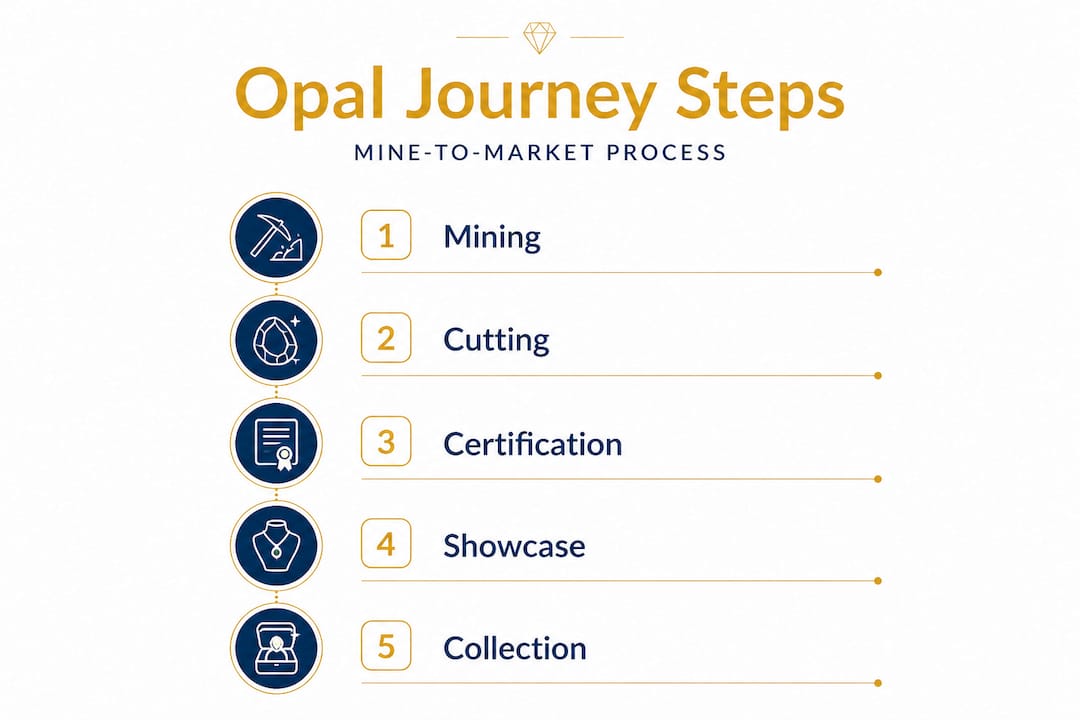
The six stages of an authentic mine-to-market opal:
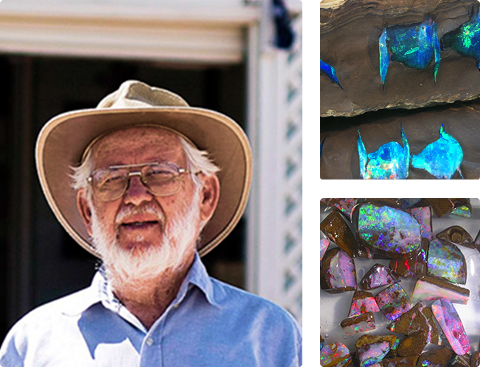
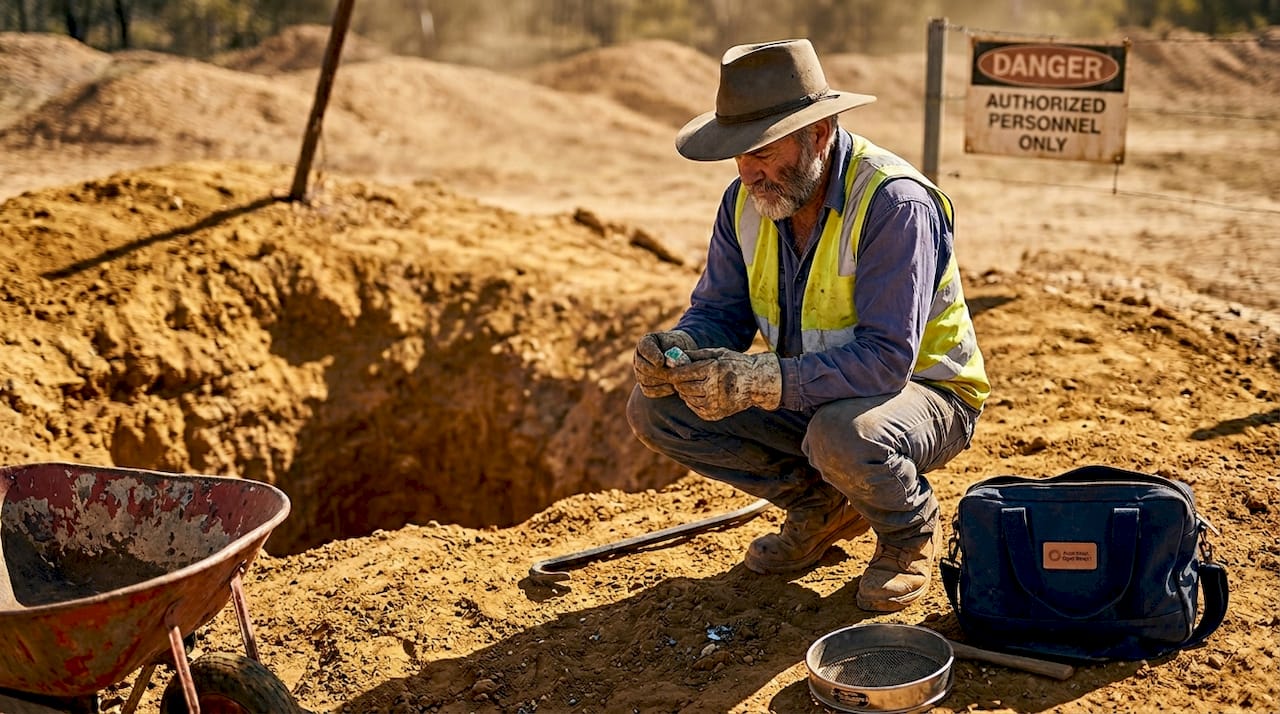
- Mining Experienced opal miners, often working small family operations, extract rough opal material from seams within sandstone or ironstone host rock. At Lightning Ridge, miners follow “opal dirt” several meters underground, often by hand.
- Sorting and grading Rough material is sorted on-site by the miner or a trusted associate. Gem-quality material is separated, photographed, and logged before it leaves the mining lease.
- Cutting and polishing Skilled lapidaries, many of whom have decades of experience shaping the unique silica matrix of precious opal, cut each stone to maximize its play-of-color. This is an art form requiring intimate knowledge of the gem’s internal structure.
- Gemological certification Reputable certifiers examine the finished stone, confirming natural origin, species (boulder, crystal, black, white), and the absence of treatments or assembled construction. Certificates become part of the stone’s permanent record.
- Jewelry creation Certified stones are set into silver or gold by craftspeople who understand opal’s specific vulnerabilities. Bezel and rub-over settings are commonly chosen to protect the gem’s edges while allowing maximum light to illuminate its colors.
- Verified retail The finished piece is offered to the buyer with complete documentation, linking the jewel back to its source mine, miner, and certification body.
How value grows through the mine-to-market chain:
| Stage | Value indicator | Notes |
|---|---|---|
| Rough mining | Base value by weight/potential | Heavily influenced by color and brightness |
| Cut and polished | Value increases 2x to 5x | Dependent on lapidary skill and color pattern |
| Certified | Value increases further | Certification reduces buyer risk |
| Jewelry setting | Retail premium applied | Craftsmanship and metal quality add worth |
| Documented provenance | Collector premium added | Traceability commands measurable market premium |
The Australian opal supply chain is more nuanced than most buyers realize. One fact that many collectors overlook: the documented relationship between a miner and a lapidary is itself a form of provenance. When you can name the hands that cut your stone, its story becomes personal as well as financial.

Pro Tip: Always request the name of the lapidary or cutting house alongside gemological certificates. A stone with a named cutter is significantly harder to replicate with a treated or substitute gem, adding an additional layer of authenticity beyond formal documentation. Learning more about the authentication of Australian opals will help you ask precisely the right questions.
It is also worth noting that small-scale mining faces generational decline as younger Australians move toward urban careers, making the stones currently emerging from veteran miners an increasingly finite resource.
Mine-to-market versus mass-market opals: Why it matters
Understanding the journey sets the stage for seeing why provenance changes everything. When you place a mine-to-market opal beside a mass-market alternative, the difference is not always immediately visible to the untrained eye. Yet the implications for value, resale potential, and collector integrity are profound.
Verified mine-to-market opals from Lightning Ridge regularly command premiums of 30% to 150% above unverified stones of comparable visible quality. This is not simply sentiment. It reflects the reduced risk buyers accept when provenance is documented, and it accounts for the ethical assurance that no unverified exploitation occurred along the supply chain.
Collector risks with mass-market opal purchases:
- Receiving an assembled doublet or triplet represented as a solid stone
- Purchasing a treated opal (smoke treated, resin filled, or sugar and acid processed) without disclosure
- Buying a stone from undisclosed overseas origins, potentially including conflict-affected or environmentally destructive mining operations
- Overpaying for stones that carry no verifiable gemological certification
- Near-zero resale value due to absence of provenance documentation
- Exposure to legal and reputational risk if reselling or gifting misrepresented gems
The emotional value dimension is equally real. A collector who knows their black opal was hand-dug by a third-generation miner in Lightning Ridge possesses something irreplaceable. That narrative is part of the stone’s identity, and it travels with the gem through every future transaction. Comparisons between Australian opal jewelry consistently show that documented pieces achieve higher auction and private sale results than equivalent stones sold without records.
“Traceability and provenance are increasingly vital for market value — new technology is supporting this shift, enabling collectors to make purchases with confidence previously reserved for diamonds and colored sapphires.”
This shift is reshaping buyer expectations across the premium gem market. Collectors who understood provenance early are now positioned as both ethical pioneers and shrewd investors.
How to verify and buy authentic mine-to-market opals
Now that you know why mine-to-market opals hold greater value, here is how you can make sure your next piece is the real deal. Verification is not complicated once you know what to look for, and the process rewards even first-time buyers with lasting confidence.
Step-by-step guide to verifying mine-to-market provenance:
- Request a gemological certificate from a recognized body such as the Gemmological Association of Australia or an accredited independent gemologist. The certificate should confirm the stone is natural, untreated, and Australian in origin.
- Ask for mining location specifics. A reputable seller will name the mining region and, ideally, the lease or registered mining operation. Vague answers like “Australian opal” without specifics are a yellow flag.
- Verify the seller’s direct-miner relationships. Dealers who purchase directly from miners rather than through aggregators can provide miner names, mine identifiers, and rough-stone photographs that trace back to extraction.
- Examine provenance documentation yourself. A complete mine-to-market record includes rough-stone images, cutter identification, gemological certification, and retail invoice linked to the same stone.
- Use technology where available. Blockchain and satellite monitoring are making mine-to-market authentication more reliable, and forward-thinking retailers are beginning to offer digital provenance records that can be independently verified.
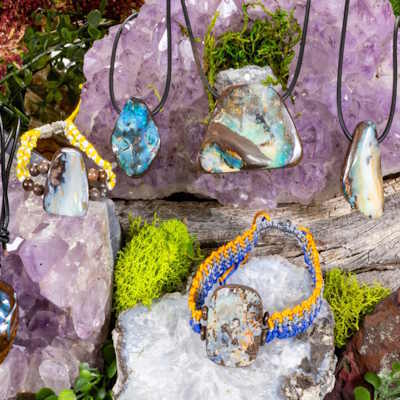
- Cross-reference the stone’s appearance with regional characteristics. Black opals from Lightning Ridge exhibit a characteristic dark body tone that amplifies spectral play-of-color. Boulder opals from Queensland carry visible ironstone host rock on their backs. Knowing how to distinguish opal origins helps you validate what documentation claims.
Pro Tip: Before finalizing any significant purchase, ask your seller three direct questions: “Can you name the miner or mine?”, “Is there a gemological certificate for this specific stone?”, and “Can I see the rough-stone or pre-cut photograph?” A seller with nothing to hide will answer all three without hesitation. The collector’s authenticity guide offers additional questions worth keeping in your back pocket for auction situations and estate purchases.
Red flags to watch for when shopping opals online or abroad:
- No gemological certificate or vague certification language
- Prices dramatically below known market rates for the stated opal type
- Refusal to specify mining region or direct-miner source
- Generic product photography that appears computer-enhanced
- Sellers unable to explain the difference between doublet, triplet, and solid opal
- No documented return or warranty policy
Why true mine-to-market opals are changing gemstone collecting
The conversation around mine-to-market opals is not simply about documentation. It signals a broader transformation in how collectors relate to the objects they acquire, and in how the gem industry measures worth beyond carat weight and color grades.
For decades, the premium gem world operated on implicit trust and dealer reputation. A collector bought a ruby because a respected jeweler said it was Burmese; they accepted a sapphire as untreated based on a certificate from a familiar name. That model is being fundamentally disrupted. Buyers today, particularly those entering the collector market with investment intent, demand verifiable evidence rather than inherited trust. Opal, perhaps because of its deeply individual nature and the intimate scale of its mining community, has emerged as an unexpected leader in this movement toward radical transparency.
What most industry articles miss is the human dimension of this shift. The small-scale mining community faces generational decline, with veteran miners aging out and fewer young Australians willing to undertake the physically demanding work of underground opal extraction. This is not a distant abstraction. It means that the extraordinary stones currently surfacing from fields like Lightning Ridge represent a finite, closing window in geological and human history. When collectors purchase mine-to-market opals with full provenance, they are participating in the preservation of that living tradition, not merely acquiring an asset.
The long-term outlook is genuinely hopeful when technology enters this picture. Blockchain and satellite-enabled traceability systems can bind a stone’s physical identity to an immutable digital record, making forgery and misrepresentation structurally more difficult. For luxury jewelry investment, this creates conditions where Australian opal could achieve the same institutional credibility currently enjoyed by investment-grade diamonds. The collectors who understand this convergence of rarity, ethics, and technology today are likely to look prescient within a decade.
We believe deeply that ethical jewelry practices are not a trend but a permanent recalibration of what premium collecting means. The opal’s ancient fire was born of time, pressure, and pure geological accident. Honoring its origin is simply the right way to bring it into the world.
Discover authentic mine-to-market Australian opals
Ready to apply your knowledge and experience the beauty of mine-to-market opals firsthand? Knowing the difference between documented provenance and anonymous sourcing changes how you look at every opal piece you encounter, and it sharpens the satisfaction of owning something genuinely irreplaceable.

At Australian Opal Direct, every stone in the collection is ethically sourced directly from Australian miners, with traceable origins spanning Lightning Ridge, Coober Pedy, and Queensland’s boulder fields. The team maintains direct relationships with miners and lapidaries, ensuring that the provenance documentation accompanying each piece is complete and verifiable. Whether you are building a serious collection or searching for a singular piece of jewelry, expert guidance is available to help you find the opal whose story resonates with your own.
Frequently asked questions
What makes an opal ‘mine-to-market’?
A mine-to-market opal is fully traceable from its source mine to the final jewelry piece, ensuring authenticity and ethical practices at every stage. Emerging blockchain and satellite tools are strengthening this traceability standard across small-scale Australian mining operations.
How can I verify if an opal is truly mine-to-market?
Always request certified provenance documents and look for sellers who can name the miner, the mining region, and the lapidary involved. Blockchain and satellite monitoring are making this kind of mine-to-market authentication increasingly accessible and reliable for buyers.
Is mine-to-market opal more valuable than mass-market opal?
Yes, mine-to-market opals typically command significant premiums due to guaranteed authenticity, documented ethical sourcing, and the collector confidence that provenance provides. As traceability becomes vital to market valuation, this premium is only expected to grow.
What risks exist with buying non-traceable opals?
Non-traceable opals may be synthetic, treated, or assembled without disclosure, directly undermining both monetary value and collector reputation. With small-scale mining facing generational challenges, the absence of traceability makes distinguishing genuine earth-mined stones from substitutes increasingly difficult.
Recommended
- How to Authenticate Australian Opals for Genuine Value - Australian Opal Direct
- How to Market Opal Jewelry for Maximum Impact Online - Australian Opal Direct
- Ethical opal sourcing: your guide to authentic Australian gems - Australian Opal Direct
- Opal Provenance: Ensuring Authenticity and Ethical Value - Australian Opal Direct