The Real Role of Artisanship in Jewelry Today
Posted by AOD on 25th May 2026
The Real Role of Artisanship in Jewelry Today
TL;DR:
- Artisanship in jewelry ensures durability, cultural preservation, and ethical sourcing beyond superficial aesthetics. Recognizing authentic handcrafted pieces involves examining craftsmanship details, fitting, and interior finishes to distinguish them from mass-produced items. Genuine artisan jewelry retains higher value over time and signals a commitment to cultural and material integrity, unlike craft-washed brands that exploit the language without supporting fair practices.
Jewelry has always been more than adornment. Yet most conversations about it stop at the surface, at color, at sparkle, at price. The role of artisanship in jewelry runs far deeper than visual appeal. It determines structural longevity, carries the weight of cultural memory, and signals whether a piece was made with genuine care for materials and makers alike. Whether you are a crafter sharpening your practice, a designer building a collection, or a consumer making a meaningful purchase, understanding what artisanship actually means changes how you see, choose, and value every piece you encounter.
Table of Contents
- Key Takeaways
- The role of artisanship in jewelry: what it actually means
- Craftsmanship and the structure of quality
- Ethics and the artisan’s mark
- Cultural memory woven into every piece
- How to recognize genuine artisanship when you buy
- My perspective on artisanship’s irreplaceable place
- Discover artisan opals made with purpose at Australianopaldirect
- FAQ
Key Takeaways
| Point | Details |
|---|---|
| Artisanship goes beyond aesthetics | Skilled handcrafting determines durability, repairability, and structural integrity alongside visual beauty. |
| Craftsmanship signals ethical sourcing | A jeweler who cares about finishing details is likely maintaining transparency throughout the supply chain. |
| Cultural heritage lives in handmade pieces | Artisan jewelry preserves regional techniques and design vocabularies threatened by mass production. |
| Handcrafted pieces hold their value | Ethically crafted jewelry retains 75 to 95 percent of its value over a decade. |
| Recognizing true artisanship empowers buyers | Knowing what to examine, including prong work, solder joints, and interior finishing, helps you invest wisely. |
The role of artisanship in jewelry: what it actually means
Artisan jewelry is not simply jewelry made by hand. The word “artisan” implies a practitioner who has internalized a craft so deeply that each decision, from metal gauge to stone orientation, flows from accumulated knowledge rather than mechanical instruction. The difference between an artisan piece and a machine-made one is not always visible at first glance. It lives in the weight of the metal, the way light falls across a setting, the subtle asymmetries that tell you a human being was present throughout.
Machine-made jewelry begins with a mold or a CNC-cut form. Thousands of identical units emerge from the same template. Artisan jewelry begins with intention. The maker selects each material, considers each stone’s particular play-of-color or surface character, and shapes the metal to serve that specific gem. That process yields pieces that cannot be replicated precisely, even by the same artisan working twice.
Here is what distinguishes genuinely handcrafted artisan jewelry from mass-produced alternatives:
- Unique materiality: Each stone is selected individually, not sorted by batch algorithm.
- Custom fit: Settings are shaped around the specific gemstone, not standardized to accommodate any stone of a given diameter.
- Visible hand: Subtle tool marks, slight variations in surface texture, and proportional judgments all carry the maker’s presence.
- Repairability: Because the piece was built by human hands, a skilled jeweler can open, adjust, and restore it with precision.
- Narrative: The piece has a traceable origin, a person who made it, a place where it was created.
The handmade jewelry significance extends into customization as well. Artisans can adapt designs to honor personal meaning, cultural symbols, or specific gemstone characteristics in ways that no production line accommodates.
Craftsmanship and the structure of quality
The beauty of an artisan piece is inseparable from its structure. Handcrafted jewelry’s integrity depends on consistent metal thickness, clean solder joints, and settings tailored exactly to each gemstone’s shape. These are not cosmetic concerns. They are engineering decisions that determine whether a ring survives decades of daily wear or fails within years.
Gemstone settings offer the clearest window into a jeweler’s skill. Prong work, bezel construction, pavé, and channel setting each require balancing security, visual alignment, light exposure, and protection of the stone’s most vulnerable edges. Custom prong shaping protects gemstones far better than the mechanical bending used in mass production, where prongs are often bent into approximate position rather than sculpted to cradle a specific stone. This distinction matters enormously for precious or rare stones, including opals, whose play-of-color depends on the angle and security of the setting.
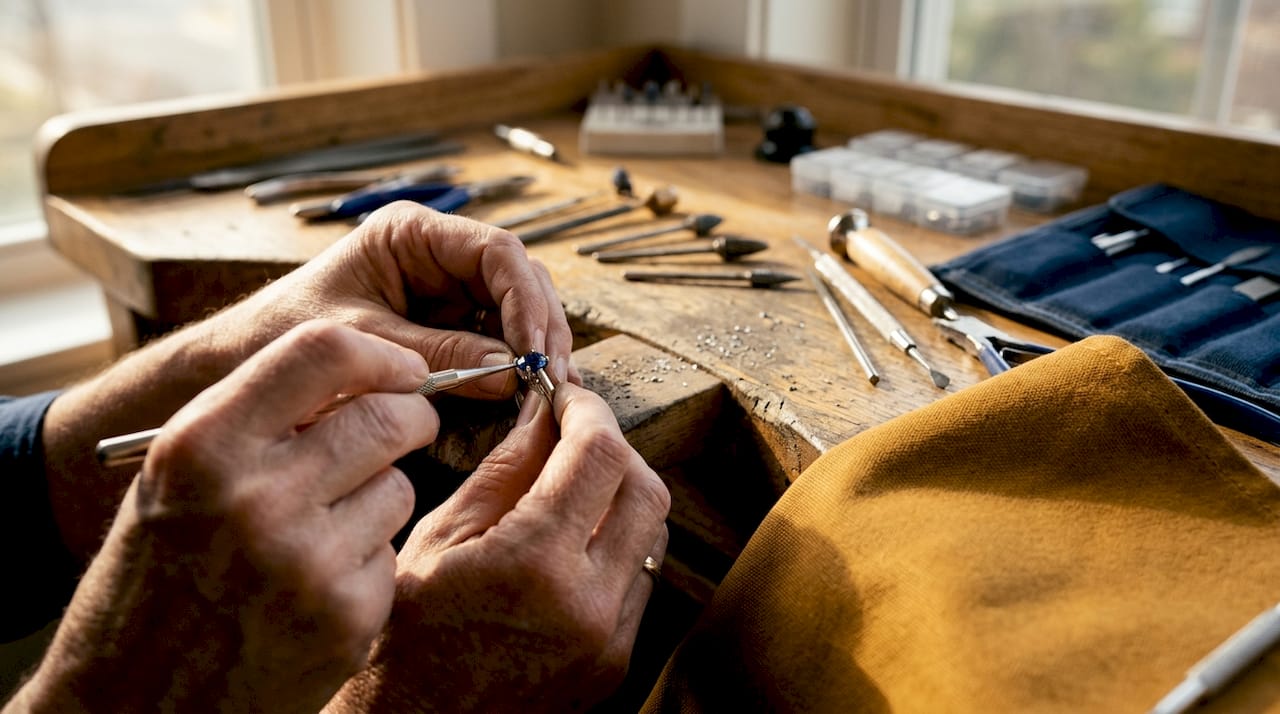
Finishing is where artisan quality becomes most legible, even inside the piece where no one looks. The interior of a ring shank, the back of a bezel, the underside of a pendant: a conscientious artisan finishes these surfaces because quality is a habit, not a performance.
The practical advantages of artisan craftsmanship over mass production include:
- Structural longevity: Thicker, precisely worked metal resists deformation and stress fractures.
- Heirloom repairability: A jeweler can re-tip prongs, re-polish surfaces, and reset stones in handmade pieces without destroying the original form.
- Lower long-term costs: Pieces that last decades require less replacement investment than mass-produced items that fail within a few years.
- Stone security: Custom-fitted settings reduce the risk of loosening or loss over time.
Handcrafted ethical jewelry retains between 75 and 95 percent of its value over ten years, a figure that reflects both durability and the growing market recognition of genuine craftsmanship as an asset.
Pro Tip: When evaluating any artisan piece, turn it over. Examine the interior surfaces and the back of every setting. Rough, unfinished interiors signal shortcuts. A jeweler who finishes what no one sees is a jeweler who takes the whole process seriously.
Ethics and the artisan’s mark
One of the most underappreciated dimensions of the importance of craftsmanship in jewelry is what it signals about the supply chain. A jeweler who labors over fine finishing details is almost certainly applying the same attentiveness to material sourcing and maker compensation. The reverse is equally telling. Sloppy execution usually reflects a broader culture of cutting corners.
Meticulous finishing inside a piece correlates strongly with ethical sourcing practices. This is not coincidence. Artisans who respect their materials tend to trace those materials carefully. Jewelers who honor the labor embedded in each piece tend to pay the people who contributed to it fairly. Craftsmanship, in this sense, is a proxy for values.
The challenge is craft-washing. As consumer demand for handmade pieces grows, some brands deploy the language of artisanship without ensuring fair treatment of the makers behind their products. They photograph handtools and rustic workbenches while the actual production runs through underpaid workers or automated processes elsewhere. Recognizing authentic artisanship protects you from funding practices you would otherwise reject.
Ways to verify genuine ethical artisanship:
- Ask where and by whom the piece was made. Vague answers are a warning sign.
- Request information about material sourcing. Genuine artisans often know their suppliers personally.
- Look for certifications or partnerships with recognized ethical sourcing organizations.
- Support local artisan studios where the supply chain is short and verifiable.
- Cross-reference the quality of the physical piece with the claims made about its origins.
Pro Tip: When shopping online, look for brands that name their artisans or their sourcing regions specifically. “Handcrafted in Australia using Lightning Ridge opals” carries more verifiable weight than “artisan-inspired” or “handcrafted-style.”
You can explore what ethical sourcing in jewelry looks like in practice to better understand the standards worth holding brands to.
Cultural memory woven into every piece
Artisan jewelry is one of humanity’s oldest forms of cultural transmission. Long before written records, communities expressed identity, belief, and belonging through the forms they cut, cast, and shaped in metal and stone. That tradition has not ended. It has simply become less visible against the volume of machine-made goods competing for attention.
Handmade pieces preserve regional design vocabularies and artisanal knowledge that globalization steadily erodes. When an Australian goldsmith sets a Lightning Ridge black opal using techniques passed down through decades of practice, that piece carries something no factory in Shenzhen can replicate. It holds a relationship to place, to material knowledge, to the specific optical character of earth-mined Australian stones.
Training artisans in rare crafts, including glyptics, filigree, and granulation, can take five to ten years. That timeline underscores how irreplaceable skilled artisans are and how much is lost when their knowledge disappears without transmission to younger practitioners. The role of creativity in jewelry and the parallel sacred weight of craft tradition extends well beyond any single object.
“The human hand introduces subtle, balanced variations that convey emotion in ways no machine can replicate.” Alexa Abitbol’s observation about high jewelry captures something that applies just as powerfully to every artisan piece made with genuine attention.
Demand for hand-finished, meaningful jewelry has grown steadily over thirteen years, driven by a cultural hunger for objects that carry intentionality rather than simply price. Consumers are increasingly drawn to pieces that feel like they were made for someone, not for the market.
How to recognize genuine artisanship when you buy
Knowing what to look for transforms you from a passive buyer into an informed one. The signs of genuine craftsmanship combine the visible and the invisible, and learning to read both protects your investment.
Here is a practical sequence for evaluating any piece:
- Examine the interior. Run a finger along the inside of a ring shank. Smooth, even finishing indicates attention throughout the process, not just on display surfaces.
- Inspect the prongs. Each prong should sit flush against the stone’s girdle, not simply bent over it. Uneven or gapped prongs signal machine bending rather than hand shaping.
- Check the solder joints. Clean, invisible solder lines indicate skilled metalworking. Lumpy or uneven joins suggest rushed or unskilled work.
- Ask about the process. A genuine artisan can describe every stage, from raw material to finished piece, and will do so with evident knowledge and pride.
- Understand the hybrid option. Hybrid ateliers blend CNC machinery with hand finishing, offering precision geometry with artisan refinement. Ask which parts are handmade and which are machine-assisted. Transparency here is a good sign.
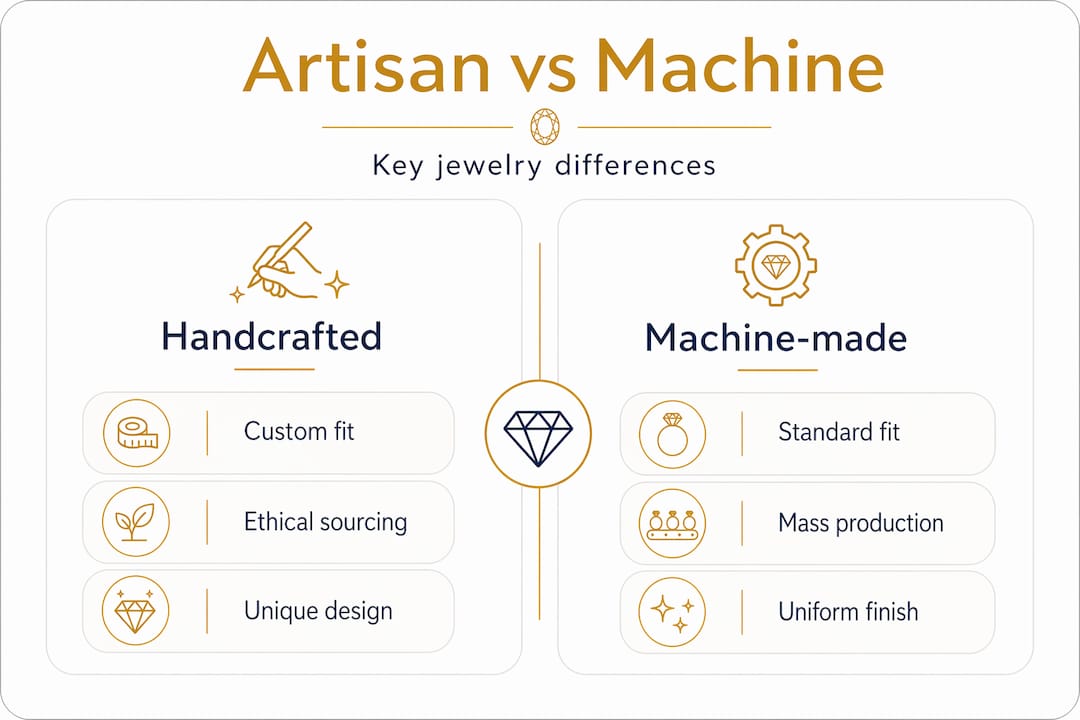
The comparison below clarifies how handcrafted pieces differ across several dimensions:
| Dimension | Handcrafted artisan | Machine-made |
|---|---|---|
| Stone setting fit | Custom-shaped to each stone | Standardized to a size range |
| Interior finishing | Hand-polished throughout | Often rough or unfinished |
| Repairability | High, retains structural logic | Low, often requires full replacement |
| Uniqueness | One of a kind or very limited | Identical across production run |
| Value retention | 75 to 95% over ten years | Depreciates rapidly |
| Ethical traceability | Usually high when genuine | Difficult to verify |
Craftsmanship influences durability, uniqueness, and ethical traceability in ways that machine-made jewelry cannot replicate. Understanding this table before any significant purchase gives you language and criteria to use in every conversation with a jeweler.
My perspective on artisanship’s irreplaceable place
I have spent years looking closely at artisan-made pieces alongside mass-produced ones, and the difference that strikes me most forcefully is not visible quality. It is emotional weight. When I hold a piece made by someone who knew the stone, who chose it personally and shaped metal around its particular character, I feel that presence. There is a responsiveness in the object itself.
What I find most concerning in today’s market is the normalization of craft-washing. Brands have learned the vocabulary of artisanship without always earning it. I think about the artisans whose skills represent a decade of learning, whose work involves not just technical mastery but cultural stewardship, and I feel the gap between genuine craft and its imitation acutely.
My honest advice: invest in fewer pieces, chosen with more care. A single artisan-made opal pendant, set by a goldsmith who traced the stone from a specific Australian mine, will outlast and outlove a drawer full of machine-made pieces purchased impulsively. The long-term economics favor it too, as the value of skilled artisans shows up eventually in resale, repairability, and the simple fact that you never want to stop wearing the piece.
What working closely with artisan jewelry has taught me is that valuing process as much as product is not romantic sentiment. It is clear-eyed appreciation for what makes something genuinely worth having.
— Renee
Discover artisan opals made with purpose at Australianopaldirect

Australianopaldirect was built on exactly the principles this article explores. Every opal in their collection is earth-mined from legendary Australian regions including Lightning Ridge, Coober Pedy, and Queensland, and each piece is crafted by skilled jewelers who understand the specific optical character of each stone. The brand works directly with miners, which means the supply chain is short, traceable, and transparent.
For those drawn to artisan-crafted opal jewelry that honors both traditional making and ethical sourcing, Australianopaldirect offers custom design services alongside curated collections. Explore their full range of handcrafted opal rings, pendants, and earrings and experience the difference that genuine artisanship makes in every stone they set.
FAQ
What is the role of artisanship in jewelry quality?
Artisanship determines the structural integrity, finishing quality, and long-term durability of a piece. Custom stone settings, clean solder joints, and hand-polished surfaces all result from skilled artisan practice and cannot be replicated by mass production.
How does handmade jewelry preserve cultural heritage?
Handmade jewelry maintains regional design vocabularies and artisan techniques that are at risk of disappearing through globalization. Crafts like glyptics or traditional filigree can take up to ten years to master, making each trained artisan a carrier of irreplaceable cultural knowledge.
Can you tell if jewelry is truly handmade just by looking?
You can identify genuine craftsmanship by examining interior surfaces, prong work, and solder joints. Subtle asymmetries and custom-fitted settings indicate human involvement, while uniform, unfinished interiors often signal machine production.
Why does artisan jewelry hold its value better than mass-produced pieces?
Handcrafted ethical jewelry retains 75 to 95 percent of its value over ten years, according to research from Eternal Carat. The combination of repairability, uniqueness, and quality materials means artisan pieces depreciate far more slowly than mass-produced alternatives.
What is craft-washing and how do you avoid it?
Craft-washing occurs when brands use the visual language of handmade traditions without ensuring fair treatment of their artisans or genuine handcraft processes. Avoid it by asking specific questions about who made the piece, where, and with what materials, and by favoring brands that name their artisans and sourcing regions explicitly.
Recommended
- Artisan-Crafted Jewelry: Authenticity & Ethics Guide - Australian Opal Direct
- What Is Handcrafted Opal Jewelry and Why It Matters - Australian Opal Direct
- Signature opal jewelry techniques for unique, ethical pieces - Australian Opal Direct
- Role of Opals in Luxury Jewelry: Rarity & Value - Australian Opal Direct