Jewelry Buyers: Why Opal Can Be Worth Far More Than Mother of Pearl
Posted by AOD on 13th Sep 2026
Jewelry Buyers: Why Opal Can Be Worth Far More Than Mother of Pearl
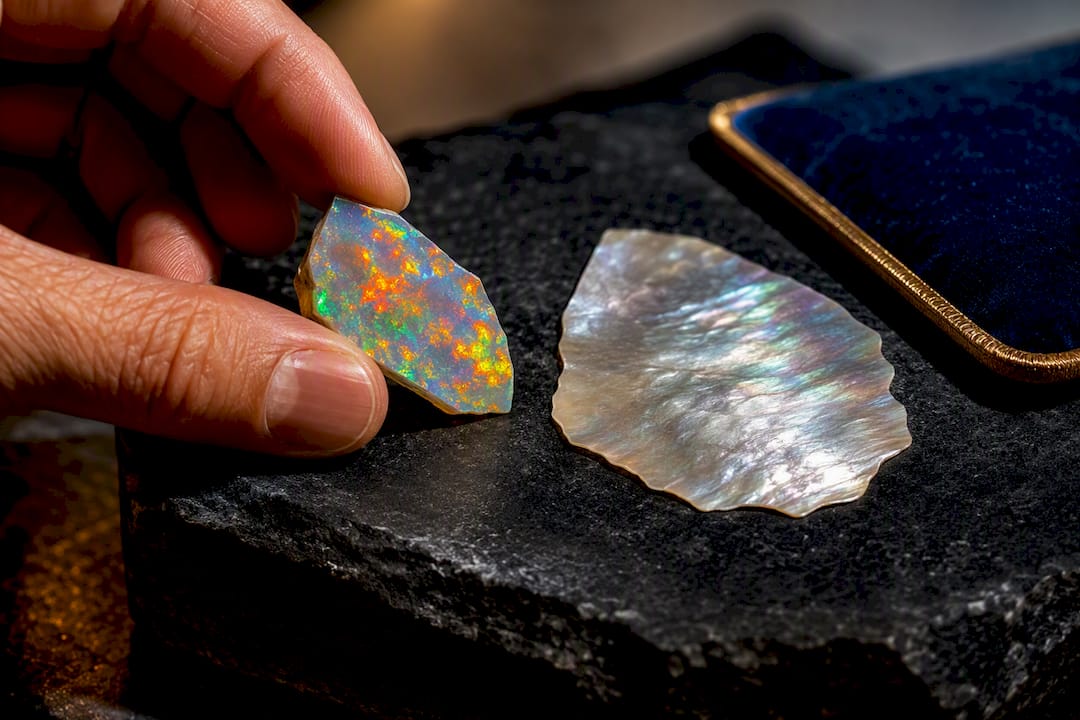
Opal is a mineraloid prized for its play-of-color; mother of pearl, or nacre, is an organic shell material prized for its iridescent sheen. Choose opal when you want a one-of-a-kind, kaleidoscopic statement piece, and choose mother of pearl when you want an affordable, delicate material for inlay-style jewelry. The two are worlds apart in origin and toughness, and knowing that difference will change how you shop, wear, and care for either one.
TL;DR:
- Opal is moderately hard and sensitive to dryness and temperature fluctuations, requiring careful, protective setting and humid storage.
- Mother of pearl is softer, more prone to scratches and damage from acids and abrasives, and needs gentle cleaning and storage away from hard gems.
- Genuine opal displays distinct, shifting spectral color patches, while mother of pearl exhibits a uniform, iridescent glow across its surface.
- Black and dark Australian opals with strong play-of-color are highly valuable, unlike mother of pearl, whose price depends on luster and craftsmanship.
- Buying opal directly from verified sources reduces risks of mislabeling and untreated stones, especially for rare and high-quality specimens.
Table of Contents
- Opal vs Mother of Pearl at a Glance
- What Is Opal, Exactly?
- What Is Mother of Pearl?
- Durability: Which Gem Can Take a Hit?
- How Opal and Mother of Pearl Actually Look Different
- Where Each Gem Fits in Jewelry, and Why the Price Tags Differ
- Caring for Opal and Mother of Pearl the Right Way
- How to Tell Opal and Mother of Pearl Apart
- Why Sourcing Matters as Much as the Stone Itself
- Matching the Gem to the Life You Actually Live
- Shop Ethically Sourced Australian Opal Direct From the Source
- Sources Behind This Comparison
- FAQ
Opal vs Mother of Pearl at a Glance
Before you fall for either gem’s shimmer, it helps to see the two side by side.
- Origin: Opal forms underground as hardened silica gel; mother of pearl grows inside living oysters and abalone as a shell lining.
- Optical effect: Opal flashes discrete spectral colors (play-of-color); mother of pearl glows with a soft, sheet-like iridescence across its whole surface.
- Hardness: Opal has an intermediate hardness on the Mohs scale, generally rated as moderately soft for a gemstone; nacre is softer, making it more prone to surface scratching.
- Typical uses: Opal anchors rings, pendants, and statement necklaces; mother of pearl appears in watch dials, buttons, inlay work, and beaded strands.
- Care demands: Opal fears dry heat and sudden temperature swings; mother of pearl fears acids, perfume, and abrasive knocks.
Both materials reward careful handling, but for very different reasons, which is exactly why lumping them together as “similar-looking gems” does either one a disservice.
What Is Opal, Exactly?
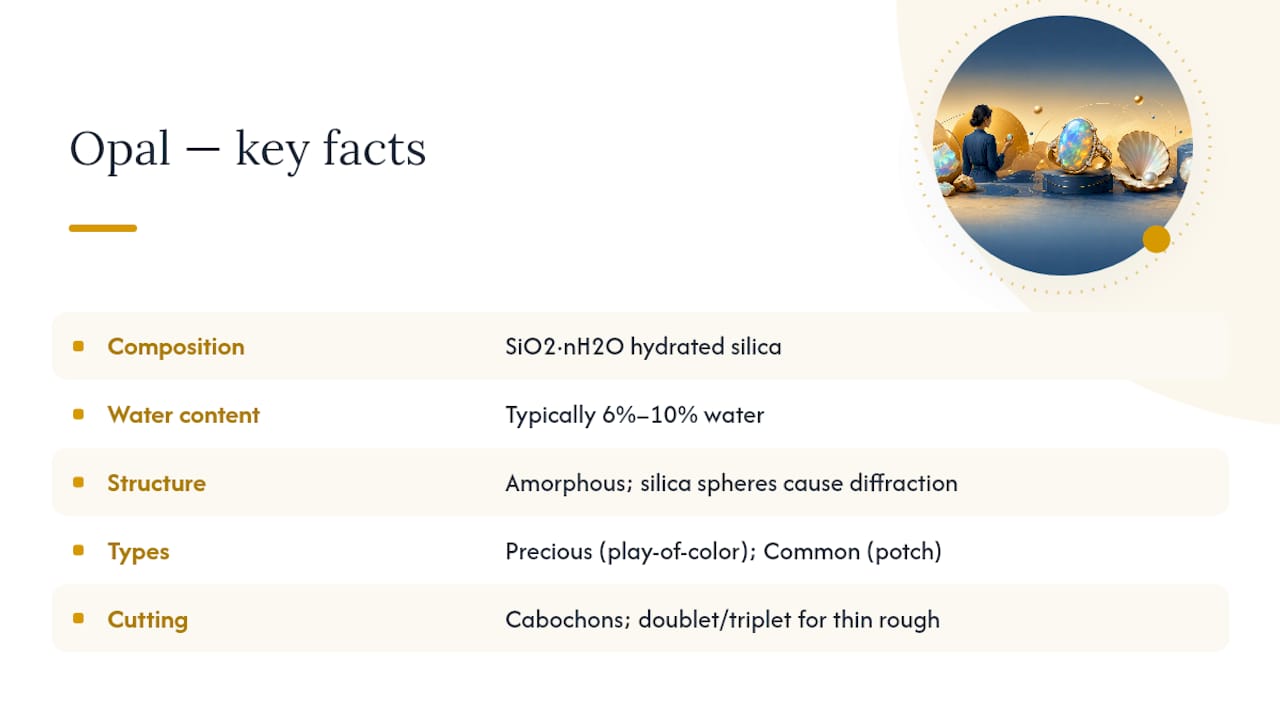
Opal is not a crystal in the traditional sense. It is a hydrated amorphous form of silica, chemically written as SiO2·nH2O, and it typically holds between 6% and 10% water locked into its structure. That water is not decorative. It is structural, and it is also the reason opal behaves so differently from harder, drier gemstones once it leaves the ground.
Gemologists split opal into two broad camps: precious opal, which shows play-of-color, and common opal (sometimes called “potch”), which does not. Within precious opal you will find black opal, prized for its dark body tone that makes color flashes pop; boulder opal, which retains slivers of its ironstone host rock; and fire opal, known for warm orange and red base tones rather than a rainbow display. Australia produces a large majority of the world’s commercial precious opal, with black and boulder varieties closely tied to its opal fields.
The magic trick behind play-of-color comes down to physics, not pigment. Microscopic silica spheres inside precious opal stack into a semi-ordered grid, and light diffracts as it passes through the gaps between those spheres, splitting into the spectral flashes collectors chase. That structure also dictates how opal gets cut. Because the color-bearing layer can be thin, cutters shape most opal into cabochons rather than faceted stones, and thinner rough sometimes becomes a doublet or triplet to protect and stretch the material further.
What Is Mother of Pearl?
Mother of pearl has nothing to do with mineral crystallization. It is nacre, an organic-inorganic composite that mollusks, most commonly oysters and abalone, secrete in fine layers to line the inside of their shells. The material is built from aragonite platelets bound together by a thin protein matrix, and it is the same substance that forms the outer coating of a pearl itself.
That layered microstructure is what makes nacre glow instead of simply reflecting light like polished stone. Light bounces between the microscopic aragonite sheets, and interference between those reflected waves produces the soft, shifting sheen you see across a shell surface, an effect closer to the rainbow slick on a soap bubble than to opal’s pinpoint color flashes.
Jewelers use mother of pearl in flat and gently domed forms: watch dials, button blanks, beaded necklaces, and inlay accents set into wood, metal, or other shell. Its predictable, sheet-like appearance makes it a favorite for designers who need consistent, repeatable material across a production run, something opal, with its one-of-a-kind patterning, simply cannot offer.
Durability: Which Gem Can Take a Hit?
Hardness numbers only tell part of the story, but they are a useful starting point. Opal measures roughly 5.5 to 6.5 on the Mohs scale, putting it in the same rough territory as glass. Mother of pearl typically falls between 2.5 and 4, softer than a copper coin in some cases, which means it scratches far more easily during ordinary wear.
Scratch resistance is not the whole picture, though. That trapped moisture makes opal sensitive to sudden heat or prolonged dryness, and if it dries out too fast, fine internal fractures called crazing can appear, permanently dulling the stone’s play-of-color. Mother of pearl does not face that particular risk, but its layered structure can chip or delaminate under a sharp knock, even though it tends to resist cracking better than its low hardness score might suggest.
Setting choices should follow from these differences. Opal does best in a protective bezel setting that shields its girdle from impact and limits exposure to extreme temperature. Mother of pearl benefits from settings that keep it away from friction points, like the inside of a ring band or a bracelet clasp, where constant rubbing wears through its delicate surface layers over time.
How Opal and Mother of Pearl Actually Look Different
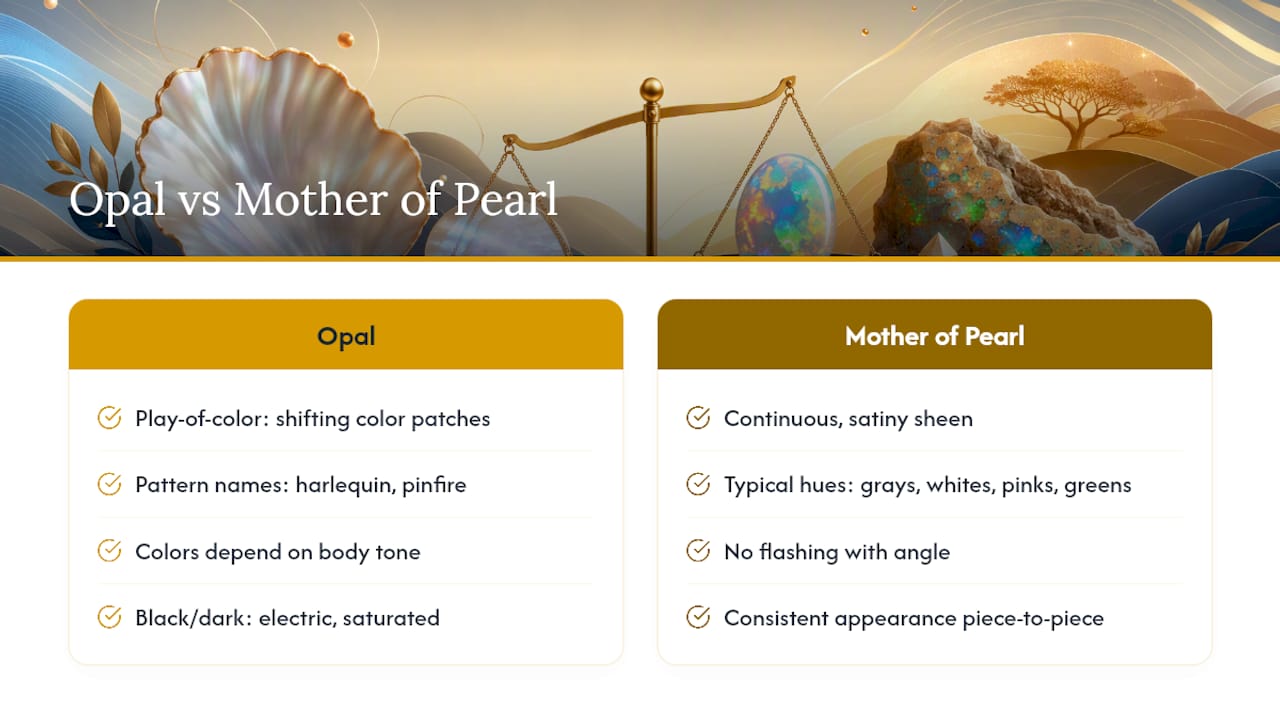
Play-of-color earns its name for a reason: tilt an opal under light and you will see distinct patches of color appear, shift, and vanish as the angle changes. Gemologists even have vocabulary for the patterns, calling a mosaic of angular color patches “harlequin” and a scattering of small, dense flecks “pinfire.” The stone’s body tone matters enormously here. Black and dark-gray body tones make colors look electric and saturated, while lighter “crystal” or “white” opals show softer, more pastel flashes.
Mother of pearl works on an entirely different visual register. Instead of isolated color bursts, it shows a continuous, satiny sheen that drifts across cool grays, silvery whites, pale pinks, and sometimes soft greens, depending on the mollusk species. There is no flashing or hidden color waiting to appear from a different angle. It simply glows.
Construction changes what you see, too. A solid opal shows color from within the stone itself, while a doublet, a thin slice of opal glued to a dark backing, or a triplet, which adds a domed quartz or plastic cap on top, can deepen apparent color or add durability but also flattens some of the natural depth a solid stone shows. Mother of pearl, being flat or gently domed and rarely layered with foreign material, displays its sheen consistently regardless of backing, which is part of why it reads as more uniform, piece to piece.
Where Each Gem Fits in Jewelry, and Why the Price Tags Differ
Opal earns its place as a centerpiece stone. Cabochon-cut opals headline rings, pendants, and statement necklaces where the play-of-color can do the talking. Mother of pearl plays a supporting role more often than not, appearing in inlay work, watch dials, beaded strands, and accent pieces where a consistent, calming shimmer suits the design better than a bold focal point.
Value drivers split just as sharply. Black opal with strong, saturated play-of-color and red flash sits among the most valuable gem material by weight, precisely because that combination is rare and body tone contrast is difficult to find in nature. Mother of pearl’s price, by contrast, tracks luster and craftsmanship rather than rarity. High-grade nacre with even color and minimal blemishes costs more, but the material itself remains widely available, keeping prices modest even at the top end. Treatments matter for both: doublets and triplets bring opal’s look within reach of more buyers but should always be sold as composite, not solid, opal, since that distinction directly affects long-term value. If you want a deeper breakdown of how those constructions compare, our doublet vs triplet opal guide walks through the tradeoffs buyer by buyer.
Caring for Opal and Mother of Pearl the Right Way
Good care habits differ enough between these two materials that treating them the same way risks damaging one or the other.
For opal:
- Keep it away from direct heat, hot water, and prolonged sun exposure, which can accelerate drying and crazing.
- Skip ultrasonic cleaners and harsh chemical solvents entirely; a soft cloth dampened with lukewarm water is enough.
- For long-term storage, a lightly humid environment helps preserve the stone’s internal moisture balance.
For mother of pearl:
- Avoid contact with perfume, hairspray, and household acids, all of which etch and dull the nacre surface.
- Clean with mild soap, warm water, and a soft cloth, then dry immediately rather than air-drying.
- Store pieces away from harder gems and metal jewelry that could scratch the surface during storage.
Keep opal and mother of pearl pieces in separate, padded compartments or individual soft pouches rather than tossed together in one jewelry box. If you already notice fine surface cracks on an opal or lifting layers on a shell piece, stop cleaning it yourself and take it to a jeweler experienced with organic and hydrated gem materials.
Pro Tip: If you own an older or particularly valuable opal showing the earliest hint of surface crazing, resist the urge to polish it. Experienced conservators favor stable, controlled humidity storage over aggressive repair, since prevention protects far more of the stone’s original color than any fix applied after the damage appears.
For a broader look at pairing care routines across gem types, the guide on caring for opals and pearls together covers storage habits worth adopting for a mixed jewelry collection.
How to Tell Opal and Mother of Pearl Apart
A trained eye can usually separate the two in seconds, and you can train yours with a short checklist:
- Move the piece under a light source. Opal reveals distinct color flashes that shift position as you tilt it; mother of pearl shows a continuous sheen that glides smoothly without isolated color bursts.
- Look for a mosaic or fleck pattern. Genuine play-of-color breaks into patches (harlequin, pinfire, or similar); a uniform sheet of shimmer points to nacre.
- Check the edges for layering. A visible seam or a dark line running through the stone’s profile usually signals a doublet or triplet rather than solid opal.
- Compare weight and feel. Opal feels slightly heavier and glassier; mother of pearl feels lighter and has a subtly ridged or grainy surface texture under close inspection.
- Examine for a flat backing. A hidden dark backing or a domed clear cap glued over color is the clearest sign of a composite opal, not a natural solid stone.
When the visual cues leave you uncertain, ask the seller for a gemological certificate or lab report before you buy. Our opal jewelry buyer’s guide breaks down exactly what a legitimate certificate should include.
Why Sourcing Matters as Much as the Stone Itself
Knowing the physics behind play-of-color only helps you so much if the seller behind the counter cannot verify where the stone came from. Some retailers build their collections around direct relationships with miners working the fields of Lightning Ridge, Coober Pedy, and Queensland, regions responsible for a majority of the world’s precious opal supply. That direct-sourcing model matters because it cuts out the layers of resale where mislabeling and undisclosed treatments tend to creep in.
Some sellers include services such as free shipping, complimentary insurance, and a warranty protection period to give buyers recourse if a stone does not meet expectations. For readers weighing which cut or style suits their taste, the opal jewelry selection guide is a useful next stop before committing to a piece.
Matching the Gem to the Life You Actually Live
Durability should drive your decision more than looks alone. An opal ring worn daily on a hand that washes dishes and grips steering wheels needs a protective bezel and a wearer willing to skip the ultrasonic cleaner forever. Mother of pearl suits earrings, pendants, and inlay pieces that see gentler handling, since its scratch-prone surface punishes rough treatment fast.
There is also a quieter, sentimental difference worth naming. Opal carries the feel of something singular, a fragment of geological accident that will never repeat itself. Mother of pearl carries a calmer, more understated presence, the kind of material that complements rather than competes for attention.
— Renee
Shop Ethically Sourced Australian Opal Direct From the Source
If this comparison has you leaning toward opal’s one-of-a-kind color play, buying direct from the source removes the guesswork that comes with resale markets and unverified listings. Some sellers source directly from miners in Lightning Ridge, Coober Pedy, and Queensland, supplying rings, pendants, and loose gemstones with documentation tracing their origin.

Some orders include free shipping, complimentary insurance, and warranties, helping buyers confirm whether a stone matches its listing upon arrival. Collectors chasing a rare black or boulder opal, or anyone wanting a custom-designed setting built around a specific stone, can browse the current collection and start a custom order directly at Australianopaldirect.
Sources Behind This Comparison
This comparison draws on gemological references and design industry sources, including the Gemological Institute of America’s opal reference material, the Australian Museum’s overview of opal formation and Australian opal supply, and Britannica’s entry on opal’s physical properties. Readers wanting a deeper technical dive into nacre structure can also consult general mineralogy references on mother of pearl composition.
FAQ
Who should not wear mother of pearl?
Anyone who regularly applies perfume, hairspray, or lotion right before dressing should be cautious, since those chemicals etch and dull nacre’s surface over time. People with physically demanding jobs involving frequent hand contact with hard surfaces should also avoid mother of pearl rings, given its low scratch resistance.
Who should not wear opal?
People who work with harsh cleaning chemicals, spend long hours in direct sun and heat, or frequently use ultrasonic jewelry cleaners should think twice about opal rings, since dryness and sudden temperature swings raise the risk of crazing. Opal suits wearers willing to remove it before manual labor or hot showers.
Are opals worth more than pearls or mother of pearl?
Rare precious opals, particularly black opal with strong play-of-color, rank among the most valuable gem materials by weight, far exceeding typical mother of pearl pricing. Mother of pearl’s value stays comparatively modest since it tracks luster and craftsmanship rather than rarity.
How can you tell if something is genuine mother of pearl?
Genuine mother of pearl shows a continuous, sheet-like iridescent sheen rather than isolated color flashes, along with a subtly grainy texture under close inspection. If a piece shows discrete color bursts that shift with the angle of light, you are likely looking at opal or an imitation material instead.
Can you wear opal and mother of pearl together?
Yes, opal and mother of pearl pair well visually and pose no chemical risk to each other when worn together, though they need separate care routines and storage compartments to prevent the harder opal from scratching the softer nacre.








