Opal Varieties: A Complete Guide for Collectors
Posted by AOD on 10th Jul 2026
Opal Varieties: A Complete Guide for Collectors
TL;DR:
- Opal varieties are mainly distinguished by body tone, play-of-color, and origin, creating diverse visual effects.
- Darker tones like black opal are more valuable due to their vivid color contrast, while Australian regions produce the most distinctive stones.
Opal varieties are defined by three core factors: body tone, play-of-color, and geological origin. These factors create a gemstone family unlike any other, ranging from the milky softness of white opal to the electric fire of black opal from Lightning Ridge. Natural opals split into two primary categories: precious opals, which display iridescent play-of-color, and common opals, which do not. Understanding this distinction is the first step toward making confident choices as a collector or jewelry buyer.
1. What are the main opal varieties and their characteristics?
The world of opals is richer and more varied than most collectors initially realize. Each type carries its own visual signature, geological story, and value profile.
Black opal
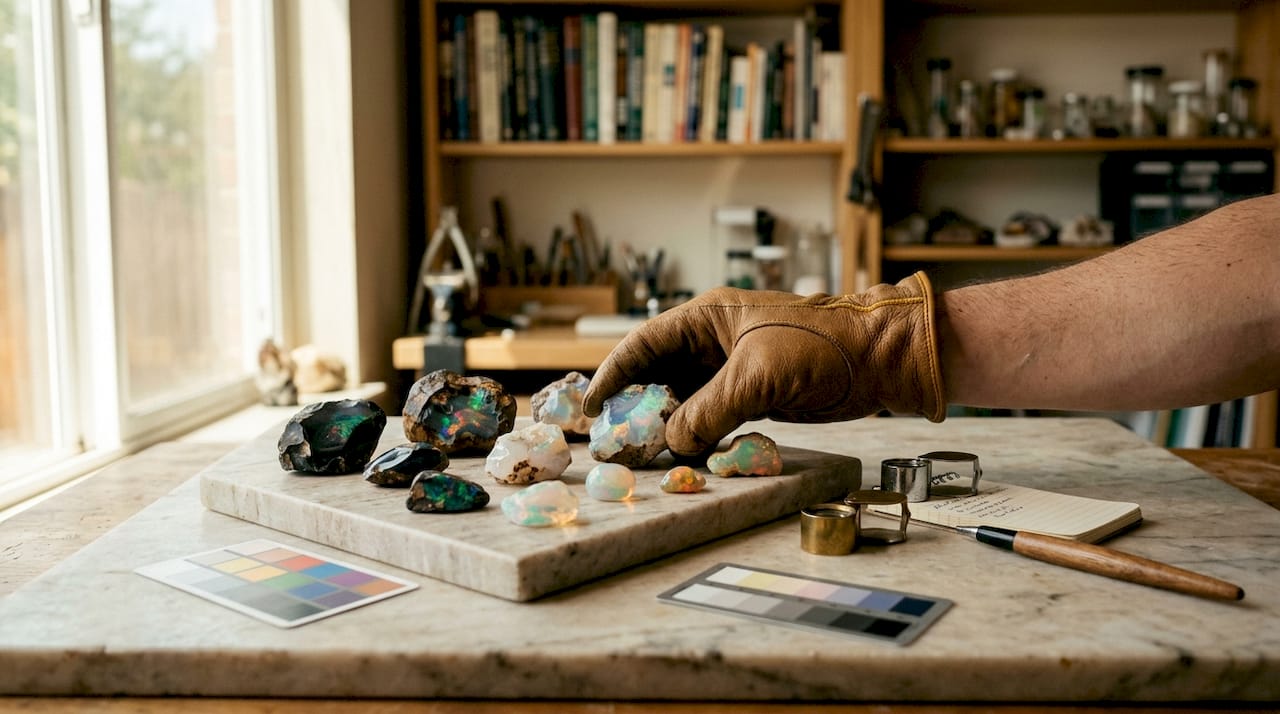
Black opal is the rarest and most valuable natural opal variety, prized for its dark body tone that ranges from N1 to N4 on the industry grading scale. That dark background acts like a velvet canvas, making every flash of color appear more vivid and saturated. Lightning Ridge in New South Wales, Australia, produces the finest specimens in the world. A top-grade black opal with a harlequin pattern can command prices that rival diamonds.
White opal
White opal is the most widely recognized variety and the most accessible for new collectors. Its body tone falls between N7 and N9 on the grading scale, giving it a soft, milky appearance. The play-of-color is present but appears more pastel and diffuse compared to black opal. Coober Pedy in South Australia is the world’s leading source of white opal.
Boulder opal
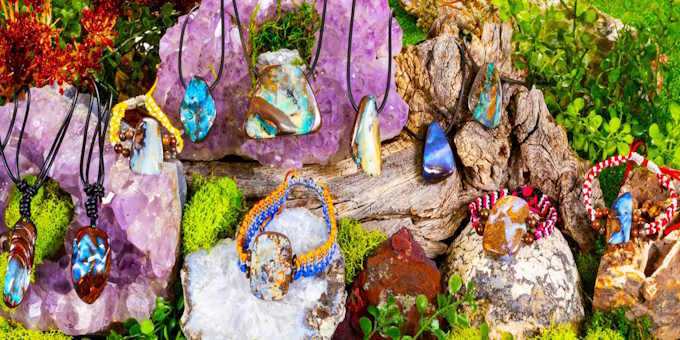
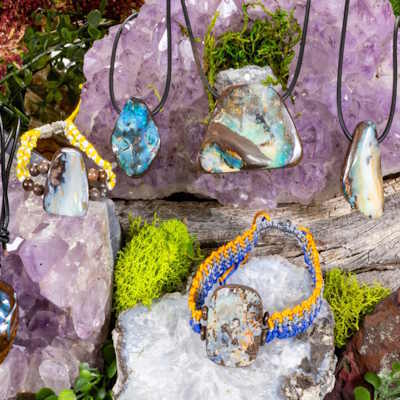
Boulder opal’s ironstone host rock remains permanently attached to the gem, creating a natural dark backing that intensifies color contrast. This structural bond also makes boulder opal one of the most durable varieties available, far less prone to cracking than thinner opal slabs. Queensland, Australia, is the primary source. The ironstone matrix often creates striking visual contrasts between the warm brown host rock and the vivid color veins running through it.
Crystal opal
Crystal opal is transparent to semi-transparent, allowing light to pass through the stone and illuminate its color play from within. This internal glow gives crystal opal an almost otherworldly quality, as if the colors are suspended in glass. It can display any body tone and is found across multiple Australian mining regions. The transparency makes inclusions and pattern clarity especially visible, so quality grading is particularly exacting.
Fire opal
Fire opal is unique among opals because its intense warm body color, ranging from yellow to deep orange-red, allows it to be faceted like a traditional gemstone. Most opals are cut as cabochons, but fire opal’s transparency makes faceting possible and often desirable. Mexico’s Querétaro region is the definitive source. Fire opal can display play-of-color, but many specimens are valued purely for their vivid body color.
Common opal
Common opal varieties such as Peruvian blue and pink opal lack play-of-color but carry their own distinct appeal through rich, solid hues. Peruvian blue opal, for example, displays a soft turquoise tone that makes it a favorite in artisan jewelry. These stones are often undervalued by buyers focused solely on iridescence. Their color saturation and relative affordability make them excellent choices for statement pieces.
Pro Tip: If you want the visual drama of black opal without the price, look for semi-black opal with a body tone of N4 or N5. The color play is still striking, and the cost is significantly lower.
2. How do patterns, play-of-color, and body tone shape opal value?
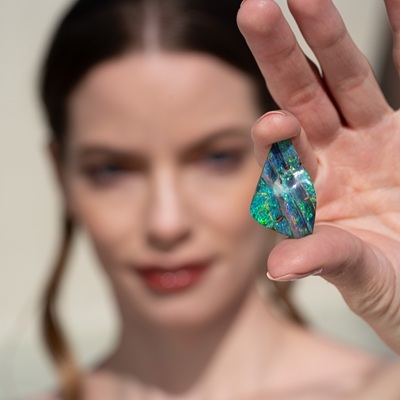
Play-of-color is the optical phenomenon that defines precious opal. It occurs when light diffracts through a microscopic lattice of silica spheres arranged in a regular pattern inside the stone. The result is a shifting, kaleidoscopic display of spectral color that changes as the viewing angle changes.
Play-of-color patterns in opals include pinfire, harlequin, flame, and peacock, each producing a distinct visual effect. Pinfire shows small, closely spaced dots of color. Harlequin displays broad, angular patches of color and is the rarest and most coveted pattern. Flame produces sweeping bands of color that appear to move across the stone. Peacock combines blue and green tones in a broad, rolling display.
The opal body tone scale runs from N1 to N9, with N1 being the darkest black and N9 being pure white. Darker body tones increase color contrast, making play-of-color appear more vivid and saturated. This is why black opal commands the highest prices. A stone with a harlequin pattern on an N2 body tone is worth dramatically more than the same pattern on an N8 body tone.
| Body tone | Scale range | Effect on color play | Typical variety |
|---|---|---|---|
| Black | N1–N4 | Maximum contrast, most vivid | Black opal |
| Dark | N4–N6 | Strong contrast, rich color | Semi-black opal |
| Light | N6–N8 | Softer, pastel color display | White opal |
| White | N8–N9 | Diffuse, gentle iridescence | White/crystal opal |
Understanding body tone is the single most useful skill you can develop as an opal buyer. Two stones with identical patterns can differ in price by an order of magnitude based on body tone alone.
3. What geographical sources produce the most distinctive opals?
Australia produces 97% of the world’s opals, and its regional varieties are the global benchmark for quality. That dominance shapes the entire market, from pricing to grading standards.
Key opal-producing regions and their signature varieties include:
- Lightning Ridge, New South Wales: The world’s only significant source of gem-quality black opal. Stones from this region set the standard for body tone and pattern quality.
- Coober Pedy, South Australia: The global capital of white opal production, supplying the majority of the world’s light-tone precious opal.
- Queensland: The home of boulder opal, where ironstone-rich geological formations create the conditions for this uniquely durable variety.
- Mintabie and Andamooka, South Australia: Sources of crystal opal and semi-black opal, prized by collectors for their transparency and color depth.
- Querétaro, Mexico: The definitive source of fire opal, producing stones with body colors from pale yellow to deep blood orange.
- Welo, Ethiopia: An emerging source of crystal and hydrophane opal with vivid color play. Ethiopian Welo opals have gained significant collector attention since the early 2000s.
- Peru: Known for blue and pink common opals, which are valued for their soft, even color and use in artisan and fashion jewelry.
Pro Tip: When buying opals described as “Ethiopian,” ask whether the stone is hydrophane. Hydrophane opal absorbs water and can temporarily lose its color play when wet. This is not a defect, but it is something every buyer should know before purchasing.
Ethiopian opals represent one of the most exciting developments in the gem world in recent decades. Their vivid color play and relative affordability have made them a genuine alternative to Australian crystal opal for collectors working within a budget. Australianopaldirect focuses on ethically sourced Australian varieties, but understanding the full global picture helps you appreciate why Australian stones remain the industry standard.
4. What care and handling do different opal varieties require?
Opal is a hydrated silica mineral, meaning it contains water as part of its chemical structure. Proper opal care requires avoiding heat, chemicals, and impact because these factors can cause cracking, crazing, or color loss. The specific care requirements vary meaningfully between varieties.
Care considerations by variety:
- Black opal: Durable relative to other precious opals, but still sensitive to sharp impacts. Store separately from harder gemstones to avoid scratching.
- White opal: More prone to crazing (surface cracking) than black or boulder opal, particularly in dry climates. Avoid prolonged exposure to direct sunlight or heating vents.
- Boulder opal: The most durable variety due to its ironstone backing. Suitable for rings and bracelets that receive daily wear. Cleaning with mild soap and water is safe.
- Crystal opal: Requires gentle handling. Its transparency makes any surface damage immediately visible. Avoid ultrasonic cleaners entirely.
- Fire opal: Fire opal dries out and cracks in extreme conditions, making it unsuitable for settings that expose the stone to temperature extremes. Store in a slightly humid environment or with a damp cloth in a sealed container.
- Common opal: Generally more stable than precious opal, but still sensitive to harsh chemicals. Clean with a soft, damp cloth only.
Pro Tip: The best setting for a precious opal in a ring is a bezel setting, which wraps a metal rim around the stone’s edge. This protects the opal from side impacts far better than a prong setting, which leaves the stone exposed.
Choosing the right variety for the right jewelry type matters as much as choosing the right stone. If you want to learn more about selecting opals for fine jewelry, matching the stone’s durability to its intended use is the first decision to make.
Key takeaways
The most important principle in understanding opal varieties is that body tone and play-of-color together determine both visual beauty and market value, with darker tones consistently producing the most dramatic results.
| Point | Details |
|---|---|
| Two primary categories | All opals are either precious (with play-of-color) or common (without iridescence). |
| Body tone drives value | The N1–N9 scale shows that darker tones amplify color play and increase gem value. |
| Australia leads production | Australia supplies 97% of the world’s opals, with Lightning Ridge and Coober Pedy as the top sources. |
| Boulder opal is the most durable | Its ironstone backing makes it the best choice for everyday jewelry like rings and bracelets. |
| Fire opal is uniquely facetable | Unlike most opals, fire opal’s transparency allows it to be cut with facets like a traditional gemstone. |
What I’ve learned from years of watching collectors choose opals
A perspective from Renee
Most collectors come to opals through black opal. They see a Lightning Ridge stone under good lighting, and nothing else ever quite measures up again. I understand that completely. But I’ve watched many buyers walk past extraordinary crystal opals and stunning boulder pieces because they were fixated on the rarest category.
The truth is that the opal world rewards curiosity. A well-chosen boulder opal with a rolling flame pattern can be more visually arresting than a mediocre black opal with a flat, lifeless color display. Pattern and color saturation matter more than category alone. A stone that moves you is worth more than a stone that merely ranks well on a grading chart.
I also think buyers underestimate common opals far too often. A piece of Peruvian pink opal set in gold has a quiet, confident beauty that precious opal cannot replicate. Not every piece of jewelry needs to announce itself. Sometimes the most sophisticated choice is the one that surprises people who look closely.
My practical advice: learn the body tone scale before you spend anything significant. Once you can read a stone’s tone at a glance, you will never overpay for a light-tone stone marketed as something rarer. That single skill protects your investment and sharpens your eye for genuine quality. For a deeper look at how play-of-color defines quality, understanding the optical science behind the phenomenon changes how you see every stone you encounter.
— Renee
Australianopaldirect: your source for genuine Australian opals
Australianopaldirect specializes in ethically sourced, earth-mined Australian opals from Lightning Ridge, Coober Pedy, and Queensland. Every stone comes with direct-miner provenance, which means you know exactly where your opal was born.

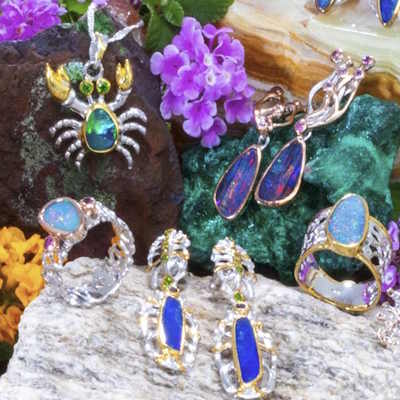
The collection spans all major Australian opal types, from black opal rings to boulder opal pendants and crystal opal earrings. Custom jewelry options are available for collectors who want a specific variety set to their own design. Free shipping, complimentary insurance, and a 90-day warranty come standard on every purchase. If you are choosing a stone for a meaningful occasion, the opal jewelry selection guide at Australianopaldirect walks you through every decision, from body tone to setting style. For those who love pairing gemstones with personal meaning, custom jewelry for meaningful places offers an inspiring look at how sentimental design and gem selection can work together.
FAQ
What is the rarest type of opal?
Black opal is the rarest natural opal variety, defined by a body tone of N1 to N4. The finest specimens come exclusively from Lightning Ridge, New South Wales, Australia.
How many types of opal are there?
The main recognized types include black opal, white opal, boulder opal, crystal opal, fire opal, and common opal. Regional varieties like Ethiopian Welo opal and Peruvian blue opal expand the full list of all opal types considerably.
What is play-of-color in opals?
Play-of-color is the iridescent light display produced when light diffracts through a microscopic silica sphere lattice inside the stone. It is the defining feature of precious opal and does not appear in common opal.
Are synthetic opals worth buying?
Synthetic opals closely mimic natural ones but show more uniform patterns and lack the natural irregularities that make earth-mined stones unique. They are significantly less valuable and should always be disclosed by the seller.
Which opal variety is best for everyday jewelry?
Boulder opal is the best choice for everyday wear because its ironstone backing provides structural strength that other varieties lack. It suits rings and bracelets far better than thinner precious opal slabs.