October Birthstone Meaning: Opal vs Tourmaline, Provenance & Science
Posted by AOD on 25th Sep 2026
October Birthstone Meaning: Opal vs Tourmaline, Provenance & Science

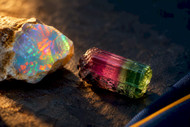
October has two birthstones, and neither is a substitute for the other. Opal, the traditional stone, carries meanings of hope and individuality, its unique play-of-color making each specimen visually singular. Tourmaline, the modern stone, offers a broader color range with meanings tied to hue, pink for love, green for courage, black for protection. Opal marks a 14th wedding anniversary; tourmaline marks an 8th.
TL;DR:
- Black opal from Lightning Ridge is the rarest and most valuable opal, especially for high-quality specimens with vivid play-of-color.
- Tourmaline’s durability at 7 to 7.5 Mohs makes it more suitable for daily wear, with rare varieties like Paraíba commanding prices comparable to fine gemstones.
- The choice depends on whether the recipient prefers the unique, changing pattern of opal or the consistent, specific color symbolism of tourmaline.
- Provenance documentation, especially for Australian opal from key fields, enhances the stone’s meaning and value, while treatment history should be verified before purchase.
- Neither stone is more “correct” as an October birthstone; opal emphasizes uniqueness and origin, while tourmaline focuses on color-specific symbolism and practicality.
Table of Contents
- What Does October Birthstone Meaning Actually Cover?
- Opal Meaning and History
- The Science Behind Opal’s Play-of-Color
- What Opal’s Colors and Types Symbolize
- How Do You Care for and Buy an Opal?
- Tourmaline Meaning and History
- Tourmaline Varieties and Color Symbolism
- Tourmaline Care and Smart Buying Tips
- Opal vs Tourmaline: How to Choose the October Birthstone
- Why Provenance and Sourcing Shape an Opal’s Meaning
- Cultural Significance of October’s Birthstones Around the World
- Common Myths About Opal and Tourmaline, Debunked
- Psychological and Spiritual Meaning Attributed to October’s Stones
- Famous Opals, Tourmalines, and the People Who Wore Them
- Market Value and Rarity: Opal vs Tourmaline
- A Personal Note on Choosing Between These Two Stones
- Where to Find Provenance-Backed Opal
- Sources and Further Reading
- FAQ
What Does October Birthstone Meaning Actually Cover?
Anyone researching “october birthstone meaning” usually lands on one confusing fact first: there isn’t one stone, there are two. Opal has held the October slot for centuries. Tourmaline joined the list in 1912, when the National Association of Jewelers in the United States formalized a modern birthstone calendar alongside the older, traditional one. Both stones remain official, and neither has replaced the other.
That dual status isn’t a marketing gimmick. It reflects a real split in what people want from a birthstone. Opal appeals to those drawn to visual uniqueness and old-world symbolism. Tourmaline appeals to those who want a durable stone with a color they can choose to match a specific meaning. Understanding both histories, geologies, and symbolic traditions is the only way to make sense of what October’s birthstone actually represents, and that is what the rest of this guide covers in depth.
Opal Meaning and History
Opal’s reputation as a symbol of hope and purity is not a recent invention. Ancient writers, including Pliny the Elder, praised opal’s shifting colors as a marvel worth comparing to fire, the deepest blue of the sea, and the violet brilliance of amethyst all at once. That description, written roughly two thousand years ago, still holds up when you look at a fine black opal under direct light.
The GIA traces opal’s historical lore back through Roman and later medieval traditions, where it was frequently associated with hope, purity, and even prophetic power. For much of its history, opal was considered lucky, sometimes even a royal talisman worn to sharpen eyesight or ward off misfortune. That reputation held steady for centuries.
The “unlucky opal” myth that some people still repeat today has a surprisingly specific, and surprisingly recent, origin. It traces to Sir Walter Scott’s 1829 novel Anne of Geierstein, in which an opal talisman is linked to a character’s death. The superstition caught on in Victorian England and stuck, even though it has no basis in the older historical record. Worth remembering:
- Opal was regarded as a lucky, even sacred, stone for most of recorded history.
- The unlucky association is a 19th-century literary invention, not ancient lore.
- Opal’s core symbolic thread across centuries is hope, purity, and a kind of quiet truth telling.
- As the 14th anniversary stone, opal traditionally marks a milestone of accumulated trust and shared history between two people.
Separating documented history from a novelist’s plot device matters if you’re choosing opal for its meaning rather than avoiding it out of habit. The stone’s real story is a much better one than the myth.
The Science Behind Opal’s Play-of-Color
Opal is a hydrated silica mineraloid, technically not a crystal at all, which sets it apart from almost every other gemstone on a jeweler’s tray. Its most famous trait, play-of-color, comes from microscopic silica spheres stacked in an orderly grid inside the stone. Light diffracts as it passes through and around these spheres, splitting into the flashes of red, green, blue, and violet that make precious opal so distinct.
That structural quirk is also why no two precious opals look alike. The size and spacing of the silica spheres determine which colors appear and how they move as the stone tilts, so each piece carries what is essentially an optical fingerprint. Not all opal shows this effect. Common opal lacks the ordered structure needed for diffraction and appears as a single solid color, while precious opal is the variety prized for its shifting fire.
Within precious opal, several distinct types matter for anyone shopping by meaning or provenance:
- Black opal: dark background tone that makes color flashes appear especially vivid, generally the rarest and most valuable type.
- White opal: lighter background, softer contrast, the most widely available precious opal.
- Boulder opal: thin seams of opal fused to ironstone host rock, prized for unique patterning.
- Fire opal: transparent to translucent orange or red body color, sometimes without play-of-color at all.
- Hydrophane opal: porous varieties that can absorb liquids and change appearance temporarily, requiring extra care.
Australia has been the dominant global source of precious opal since the early 20th century, and Geoscience Australia identifies three fields with genuinely distinct characters: Lightning Ridge for black opal, Coober Pedy for white opal, and Queensland for boulder opal. On the Mohs scale, opal sits at roughly 5.5 to 6, softer than most gems worn daily, a fact that should shape how you set and wear it rather than discourage you from choosing it.
What Opal’s Colors and Types Symbolize
Opal’s visual character does more symbolic work than its color name ever could. A black opal’s deep, almost midnight background against darting greens and reds tends to read as intensity, depth, and protection, an appropriate choice for someone who values discretion paired with quiet drama. White and light opal, by contrast, carry a softer, more approachable symbolism, often chosen for everyday hope and gentle optimism rather than bold statement.
Boulder opal’s connection to its host ironstone gives it a grounded, earthbound symbolism that some buyers find more meaningful than a “purer” stone would offer. It carries the rock it grew in as part of its story. Fire opal, with its warm orange and red tones and often minimal play-of-color, tends to symbolize passion and energy more than the mystery associated with black opal.
Because precious opal’s pattern is genuinely one of a kind, the strongest source of meaning in any given piece is often simply that no one else will ever own its exact twin. That makes opal a natural choice for milestone gifts: a 14th anniversary, a personal turning point, or a piece meant to mark something that will not repeat. Matching stone type to occasion is less about rules and more about which visual character feels right for the person receiving it. Meaning of opal colors is worth exploring further if a specific hue or pattern has already caught your eye.
How Do You Care for and Buy an Opal?
Opal’s relative softness and its water content mean it needs gentler handling than diamond or sapphire, but that shouldn’t scare anyone away from wearing it regularly. A few consistent habits keep an opal looking its best for decades.
- Clean opal with a soft cloth and lukewarm water only; skip ultrasonic cleaners, steam, and harsh chemicals, all of which can crack or cloud the stone.
- Remove opal jewelry before swimming, showering, or using household cleaners, since sudden temperature and chemical changes stress the material.
- Store opal separately from harder gems that could scratch its surface during storage.
- Ask sellers directly whether the opal has been treated, where it was mined, and what warranty or return policy applies to the piece.
- Favor bezel or protective settings over exposed prong settings, especially for rings that see daily wear.
Pro Tip: Ask for documentation tying the stone to a specific field, Lightning Ridge, Coober Pedy, or Queensland. A verified origin does more than satisfy curiosity. It gives the gift a real story, and that story is often what a recipient remembers long after the purchase.
A quick opal quality checklist can help you compare pattern, brightness, and background tone before committing to a piece, especially if you’re new to shopping for precious opal.
Tourmaline Meaning and History
Tourmaline’s name comes from the Sinhalese word toramalli, meaning “stone of mixed colors,” a fitting origin for a gem that occurs in more hues than almost any other mineral on earth. Dutch traders brought tourmaline from Sri Lanka to Europe in the 1700s, and its remarkable color range quickly made it a favorite among collectors and jewelers who had grown used to gems locked into a single expected shade.
Unlike opal, tourmaline doesn’t carry centuries of dense mythology. Its documented lore is thinner, largely because European awareness of the stone is comparatively recent. What developed instead was a symbolism built around its defining trait: variety itself. Tourmaline came to represent creative expression, individuality expressed through color choice rather than through a single unified meaning.
Because a buyer can choose the color that fits their intent, tourmaline’s symbolism split by hue rather than staying singular:
- Pink tourmaline (rubellite) is tied to love, compassion, and emotional openness.
- Green tourmaline is associated with courage, growth, and vitality.
- Black tourmaline (schorl) carries associations with protection and grounding.
- Multicolor varieties, like watermelon tourmaline, are linked to balance and harmony between opposing traits.
Tourmaline officially joined the modern birthstone list in 1912 and now marks the 8th wedding anniversary, which comes before opal’s 14th anniversary. For couples working through the traditional anniversary gemstone sequence, that timing makes tourmaline a practical and symbolically apt choice years before opal comes into play.
Tourmaline Varieties and Color Symbolism
Tourmaline’s color range comes down to trace elements locked into its crystal structure during formation. Manganese produces the pinks and reds of rubellite. Chromium and vanadium create the saturated greens of chrome tourmaline. Copper, found in a rare deposit discovered in Brazil’s Paraíba state, produces the electric blue green that gave Paraíba tourmaline its name and its outsized reputation among collectors. Watermelon tourmaline forms when a crystal grows with a pink core and green exterior, creating a genuinely striking banded effect when cut correctly.
Color-by-color, the symbolism tends to follow intuitive lines. Pink and red varieties lean toward love and emotional connection, making rubellite a popular alternative to more traditional pink gems for engagement or anniversary pieces. Green varieties, chrome tourmaline especially, are linked to courage, strength, and renewal. Black tourmaline carries a long-standing association with protection and grounding, often chosen by people who want a stone with meaning but prefer understated, low-key jewelry.
On the practical side, tourmaline sits at roughly 7 to 7.5 on the Mohs scale, meaningfully harder than opal. That durability makes it a strong choice for rings and bracelets worn daily, situations where opal’s softness demands more caution.
Tourmaline Care and Smart Buying Tips
Tourmaline’s greater hardness makes it more forgiving day to day, but it still deserves routine care rather than none. Warm water and a soft brush handle most cleaning needs; ultrasonic cleaners are usually safe for untreated stones but worth confirming with the seller first, since some treatments react poorly to vibration.
Heat treatment is common in the tourmaline market and widely accepted, typically used to improve color saturation or clarity. Reputable sellers disclose this upfront, and buyers should ask directly if it isn’t mentioned. A few habits make for a smarter purchase:
- Judge color saturation first. Overly light or muddy stones lose most of tourmaline’s visual appeal.
- Check clarity under magnification. Included stones lose brilliance faster than clean ones.
- Confirm the cut maximizes color rather than simply preserving carat weight.
- Request lab documentation for higher-value pieces, particularly Paraíba tourmaline, given how often that name gets misapplied.
For anyone choosing between the two October stones purely on lifestyle grounds, tourmaline is the more practical everyday option. Its hardness handles daily wear better than opal, which is better suited to pieces worn selectively.
Opal vs Tourmaline: How to Choose the October Birthstone
Choosing between opal and tourmaline really comes down to five practical questions, and answering them honestly usually makes the decision obvious.
Symbolic preference. If the appeal is hope, individuality, and a stone that tells a story through its visual uniqueness, opal wins. If the goal is a specific color-driven meaning, love, courage, protection, tourmaline’s range gives you that precision.
Visual character. Opal offers unrepeatable, shifting pattern; no two pieces are alike. Tourmaline offers consistent, predictable color that stays the same every time you look at it. Some people want the surprise. Others want the certainty.
Durability and wearability. Tourmaline’s Mohs 7 to 7.5 makes it the safer daily-wear choice, especially for rings and bracelets exposed to knocks and chemicals. Opal, at 5.5 to 6, rewards more selective wear and protective settings.
Provenance and story. Opal carries a stronger geographic narrative for buyers who care where a stone came from. A piece traceable to Lightning Ridge, Coober Pedy, or Queensland carries a documented origin story that tourmaline, sourced from many countries with less centralized branding, typically can’t match as cleanly.
Price and rarity. Precious opal, particularly black opal, is genuinely scarce, and fine examples command high prices relative to size. Tourmaline’s abundance across many colors keeps entry prices more accessible, though rare varieties like Paraíba compete with opal at the top end of the market.
Quick guidance for common scenarios:
- Choose opal if the recipient values individuality, has a milestone 14th anniversary, or wants a stone whose story includes a specific Australian field.
- Choose tourmaline if the recipient wears jewelry daily, has an 8th anniversary, or wants a specific color tied to a specific meaning.
- Pair both in a set for someone who wants October fully represented rather than choosing one stone over the other.
Neither stone is the “correct” October birthstone. They represent two different, equally valid ways of thinking about what a birthstone should do for the person wearing it.
Why Provenance and Sourcing Shape an Opal’s Meaning
Renee, who covers gemstone history and sourcing, has spent years untangling documented gemstone lore from marketing-driven crystal claims, and the difference matters more with opal than with almost any other stone. Origin isn’t a footnote here. It’s part of the meaning.
Geoscience Australia’s records show Australia became the world’s dominant opal producer in the early 20th century, and the country’s three principal fields each produce a genuinely different stone. Lightning Ridge is the source of the world’s finest black opal. Coober Pedy has defined white opal production for over a century. Queensland’s boulder opal, fused naturally to its ironstone host, offers a texture and pattern unavailable anywhere else.

For a gift meant to carry weight, that kind of documented origin does real work. A stone traceable to a named field connects a recipient to a specific place and a specific mining tradition, not just a generic gem-counter description. Buying direct from miners, rather than through layers of resellers, also tends to preserve that documentation more reliably, since fewer hands touch the provenance record between the ground and the finished piece.
None of this replaces basic buying diligence. Ask about warranty terms and return policies regardless of who you buy from, and treat any origin claim you can’t verify with reasonable skepticism. Provenance only adds meaning when it’s actually documented, not merely asserted. Ethical opal sourcing is worth a closer look if origin matters to your decision as much as appearance does.
Cultural Significance of October’s Birthstones Around the World
Opal’s cultural weight shifts depending on where you look. In ancient Rome, it ranked just below emerald in esteem, a stone associated with hope and foresight rather than caution. Indigenous Australian communities have long-standing relationships with the land that produces the world’s finest opal, though the gem trade as it exists today is a separate, more recent industry built on top of that geography. In parts of the Middle East, folklore once held that opal formed from lightning striking the earth, a poetic explanation for a stone whose color seems to flash with its own internal light.
Tourmaline’s cultural story runs in a different direction, one shaped by trade routes rather than ancient mythology. Its introduction to European markets via Dutch traders in the 1700s made it a symbol of exotic origin and craftsmanship rather than ancestral legend. In some Native American traditions, tourmaline was reportedly used by medicine workers, valued for its perceived ability to distinguish truth from falsehood, though documentation of these specific practices is thin compared to the wealth of Roman-era opal references.
What both stones share, across every culture that has adopted them, is a resistance to a single fixed meaning. Opal’s story changes with the light hitting it. Tourmaline’s story changes with the color a buyer selects. That flexibility is arguably why both stones have endured as October’s dual birthstones rather than one crowding out the other over time.
Common Myths About Opal and Tourmaline, Debunked
The most persistent opal myth, that the stone brings bad luck to anyone born outside October, deserves to be retired for good. As covered earlier, it traces directly to a 19th-century novel, not to any ancient tradition or documented cultural practice. For most of recorded history, opal was considered lucky, even sacred.
A second common misconception treats all opal as fragile to the point of impracticality. Opal is softer than sapphire or diamond, but with sensible care, avoiding heat shock, harsh chemicals, and rough handling, a well-set opal can last generations. Plenty of heirloom opal pieces prove this in practice.
Tourmaline carries its own myths, mostly around its price and rarity. Some assume all tourmaline is inexpensive because certain colors are widely available; that ignores varieties like Paraíba, which command prices that rival fine colored diamonds. Others assume tourmaline lacks “real” symbolism because its lore is more recent than opal’s. Recency doesn’t make a tradition less legitimate, it just makes it younger.
A final misconception applies to both stones: that October birthstone meaning is fixed and singular. It isn’t. Two stones, multiple colors, multiple traditions, one birth month. That complexity is a feature of October’s birthstone story, not a flaw to be resolved.
Psychological and Spiritual Meaning Attributed to October’s Stones
People who wear opal often describe a personal connection to its unpredictability, the sense that a stone which changes character with the light mirrors their own complexity. That’s a documented cultural association rather than a clinical claim, and it’s worth treating it that way. Historical lore ties opal to hope and emotional clarity, themes that show up repeatedly across centuries of writing about the stone, even if no scientific body has measured a psychological effect.
Tourmaline’s attributed benefits split by color, consistent with its broader symbolic pattern. Black tourmaline is widely described in modern wellness circles as grounding or protective, a stone people reach for during stressful periods. Pink tourmaline gets tied to emotional openness and self-compassion. Green tourmaline is linked to renewal and resilience. These associations circulate widely in contemporary crystal-healing communities, but they represent belief and tradition, not clinical evidence, and it’s worth being direct about that distinction.
What is measurable is something simpler: the act of choosing a stone that means something to you, and wearing it as a deliberate reminder, is a documented human behavior with real psychological texture, regardless of whether the mineral itself does anything. A ring chosen for its story can function the same way a photograph or a keepsake does, as a physical anchor for a memory or an intention. That’s a meaningful benefit on its own terms, separate from any claim about the stone’s inherent power.
Famous Opals, Tourmalines, and the People Who Wore Them
Opal’s most famous champion may be Queen Victoria, who wore opal jewelry throughout her reign and gifted opal pieces to her daughters, a habit credited with helping counter the “unlucky opal” superstition circulating in Victorian society at the time. The Andamooka Opal, presented to Queen Elizabeth II in 1954, remains one of the most celebrated Australian opal specimens ever unearthed, a large, uncut stone that toured internationally as a symbol of Australian gemstone craftsmanship.
The Smithsonian’s National Museum of Natural History holds several significant opal specimens in its gem collection, including pieces that trace directly to Australian fields, a testament to how seriously institutions treat documented Australian provenance. Opalized fossils, ancient shells and bones replaced by opal over millions of years, represent one of the more remarkable intersections of paleontology and gemology, and several notable examples originate from New South Wales opal fields.
Tourmaline’s most famous historical episode involves the Chinese Dowager Empress Cixi, who was reportedly so fond of pink tourmaline from California’s Himalaya Mine that she purchased vast quantities of it in the early 1900s, briefly making Californian tourmaline one of the most sought-after gem exports to China. Paraíba tourmaline, discovered in Brazil in the late 1980s, created a modern gem rush of its own, with prices for fine specimens climbing rapidly once jewelers recognized the color’s rarity. Both stories reflect the same pattern: a stone becomes famous when the right person, at the right moment, decides it means something worth paying attention to.

Market Value and Rarity: Opal vs Tourmaline
Precious opal, particularly black opal, ranks among the rarer colored gemstones on the market, and Geoscience Australia notes that high-quality black opal from Lightning Ridge remains genuinely scarce relative to demand. Boulder opal and white opal are more available but still carry meaningful price premiums for strong pattern and vivid color. Because every precious opal is visually unique, pricing depends heavily on subjective pattern quality rather than a standardized grading scale, which makes expert evaluation more important than it is for many other gems.
Tourmaline’s market sits at the opposite end of the availability spectrum for most colors. Green and pink tourmaline are relatively abundant and priced accessibly, which is part of why tourmaline has become a popular entry point for colored-stone collectors. The exception is Paraíba tourmaline, whose neon blue green color and limited Brazilian source material put it in a price bracket that rivals fine sapphire, sometimes exceeding it per carat for exceptional specimens.
Put side by side, rarity in opal is driven by pattern and origin; rarity in tourmaline is driven almost entirely by color variety and saturation. A buyer chasing scarcity for its own sake will find compelling options in both directions, but the reasoning behind that scarcity is fundamentally different, and understanding which kind of rarity matters more to you is often the deciding factor between the two stones.
A Personal Note on Choosing Between These Two Stones
The question people ask most often isn’t really “opal or tourmaline.” It’s “which one will still mean something in twenty years.” Opal tends to win that conversation for buyers who want a piece that ages into a story, something with a documented field of origin they can point to and explain. Tourmaline tends to win for buyers who know exactly which color carries the emotional weight they’re after.
Neither answer is more sophisticated than the other. The right choice depends on matching visual character and care requirements to the person actually wearing the stone, not on which gem sounds more impressive at a dinner party.
— Renee
Where to Find Provenance-Backed Opal
If the sourcing details covered here, field of origin, treatment disclosure, and warranty terms matter to you as much as the stone’s appearance, this business emphasizes sourcing from direct miner relationships tracing back to key Australian opal fields, aiming to ensure the origin story behind each ring or pendant is documented and can be verified before purchase.

Run the same checklist covered earlier, treatment disclosure, origin verification, warranty terms, protective setting, against any piece in the custom opal jewelry collection before you commit. Custom design options may be available for buyers seeking a specific stone and setting, and pieces are offered with documentation intended to provide a meaningful connection to Australian gemstone heritage. Browse the current collection and start narrowing down which field’s character, Lightning Ridge black, Coober Pedy white, or Queensland boulder, speaks to the person you’re buying for.
Sources and Further Reading
Historical and gemological claims in this guide draw on GIA’s published research on opal and tourmaline history, Geoscience Australia’s documentation of Australian opal fields, and EarthSky’s coverage of October birthstone geology. These organizations maintain the most current, publicly accessible records on gemstone formation, provenance, and traditional symbolism for readers who want to dig deeper into any single claim.
FAQ
Why Are There Two Birthstones for October?
October has carried two birthstones since 1912, when the modern birthstone list added tourmaline alongside the traditional stone, opal. Both remain official today, giving buyers a choice between opal’s individuality and tourmaline’s color-specific meanings.
Which Color Is Considered Good for Someone Born in October?
There’s no single “correct” color, since October’s two stones span a wide range. Pink tourmaline is often chosen for love and compassion, green tourmaline for courage, black tourmaline for protection, and opal’s multicolor play-of-color is chosen specifically because it resists being reduced to one shade.
What Is the Official Color of October?
October doesn’t have one official color the way some months do, largely because its two birthstones span such different palettes, opal’s shifting spectrum versus tourmaline’s distinct hues. Many calendars informally associate October with a deep pink or rose tone, reflecting tourmaline’s popular rubellite variety, alongside opal’s iridescent, multicolor identity.
Is October the Rarest Birthstone Month?
October isn’t classified as the single rarest birthstone month, but it does include some genuinely scarce material, particularly black opal from Lightning Ridge, which ranks among the rarer colored gemstones sold today. Tourmaline’s rarity varies dramatically by color, with common green and pink stones widely available and Paraíba tourmaline sitting at the rare, high-value end of the market.
Should I Choose Opal or Tourmaline for an October Birthday Gift?
Choose opal if the recipient values a one-of-a-kind pattern and appreciates a documented Australian origin story; choose tourmaline if they want a specific color tied to a specific meaning and need a harder stone for daily wear. Many buyers resolve the choice by gifting both stones as a set rather than picking one over the other.








