Buy Koroit Boulder Opal With Written Provenance and Photo Checklist
Posted by AOD on 1st Oct 2026
Buy Koroit Boulder Opal With Written Provenance and Photo Checklist

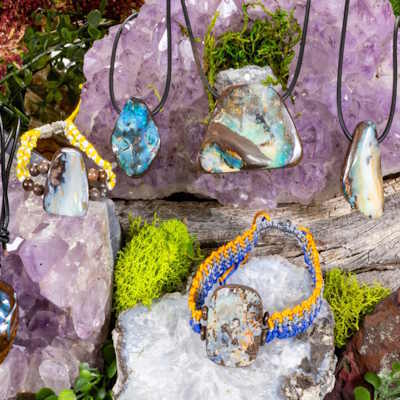
Koroit boulder opal is patterned Queensland boulder opal, formed where thin veils of precious color settle into ironstone. Buy only when a seller discloses origin and treatment in writing and supplies clear, multiple angle photographs, front, back, and edge. Reputable listings pair provenance documentation with honest images of cracks or sand pockets, and some sellers build their Queensland boulder opal offerings around that standard.
TL;DR:
- Genuine Koroit boulder opal must come from a verified Queensland origin with clear documentation and detailed photographs from multiple angles.
- Pattern types like lacework, dendritic, and picture stones significantly influence a piece’s collectible value, with face-up color coverage being more important than weight.
- Buyers should prioritize brightness, color spread, and pattern appeal over size, and be aware that old repairs or cracks can reduce long-term worth.
- It is essential to demand a seller’s disclosure of origin, treatments, and supporting documentation before purchase, especially from specialized, reputable sources.
- Proper setting and handling protect the ironstone-backed opal’s resilience, but avoid impacts and extreme temperature changes to prevent cracking.
Table of Contents
- What Koroit Boulder Opal Is: Origin, Geology, and the Opal Field
- Identifying Features and the Patterns Collectors Prize
- How Koroit Differs From Yowah and Other Queensland Boulder Opals
- What Drives Value: Evaluation Criteria Buyers Should Use
- Authentication and Buying Checklist: What to Demand From a Seller
- Care, Setting, and Jewelry Considerations for Koroit Boulder Opal
- Why Choose a Specialist Seller: Buying With Confidence
- Typical Price Ranges and What Shapes Total Cost
- Recommended Reputable Sources and How to Judge Trustworthiness
- The Buying Process From Selection to Delivery
- Author Perspective: Collecting Koroit, Priorities and Pitfalls
- Where to Browse Provenance-Backed Koroit Boulder Opal
- Authoritative References and Further Reading
- FAQ
What Koroit Boulder Opal Is: Origin, Geology, and the Opal Field
Koroit sits in a remote pocket of South West Queensland, part of the Winton Formation, the same sedimentary sequence that hosts much of the state’s boulder opal. Silica-rich groundwater seeped through cracks and cavities in ancient ironstone over long stretches of geologic time, hardening into precious opal wherever conditions allowed. The result is a partnership between gem and host rock rather than opal existing on its own, which is what separates boulder opal from the solid material found in South Australia.
The field was first worked in 1897, then saw a strong revival through the 1960s and 1970s as miners returned with better equipment and renewed interest. Koroit remains a working field rather than a town, reached by open cut pits and shafts sunk into the ironstone seams.
- Koroit opal forms within ironstone rather than as a freestanding gem.
- The Winton Formation supplies the geological setting for the entire Koroit field.
- Mining has occurred in two main waves, 1897 and the 1960s to 1970s revival.
Identifying Features and the Patterns Collectors Prize
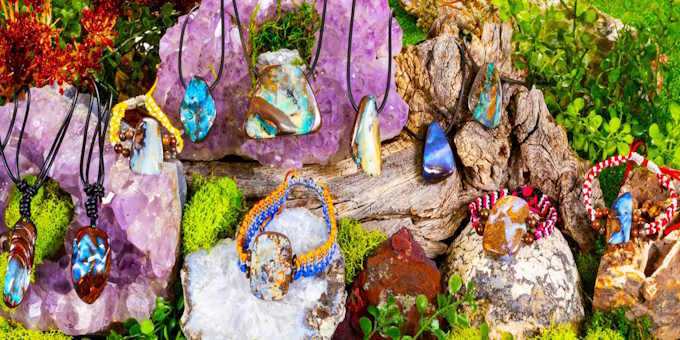
Koroit stones read as small landscapes. Color often appears in lacework webs, ribbon-like bands, dendritic branching that resembles frost on glass, maze patterns, or full picture stones where the play of color forms a recognizable scene across the ironstone face. No two pieces repeat exactly, which is part of the appeal for collectors chasing something singular.
Weight can mislead a buyer who has not learned to look past it. Because the ironstone backing carries much of a stone’s mass, a heavy Koroit piece with a thin seam of color may show less face-up brilliance than a lighter one where the color runs closer to the surface. Brightness and coverage across the visible face matter more than the number on a scale.
- Lacework, ribbon, dendritic, maze, and picture patterns each carry distinct visual character.
- Face-up color coverage, not total weight, drives visual impact.
- Thin seams can look striking in photographs yet vanish under certain light, so multiple images matter.
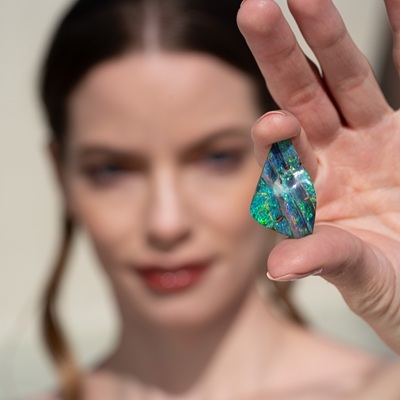
Before buying, request a straight-on shot of the face, an angled shot to catch the play of color, a back view showing the ironstone, and a photo with a coin or ruler for scale.
Pro Tip: Ask the seller to photograph the stone in both direct sunlight and shade; genuine play of color should shift and hold up in both.
How Koroit Differs From Yowah and Other Queensland Boulder Opals
Sellers sometimes use field names loosely, so it helps to know what separates Koroit from its neighbors. Koroit is associated with patterned matrix, picture stones, and opalized wood spread across a broad ironstone face. Yowah, a short distance away, is known for ironstone “nuts,” rounded nodules ranging roughly from 5 millimeters to 200 millimeters across that can hold a kernel of precious opal at their center. Yowah is also a designated fossicking area with local services, while Koroit remains remote and undeveloped.
- Koroit favors expansive matrix and picture patterns; Yowah favors self-contained nut formations.
- Neither field’s material outranks the other; the difference is geological expression, not quality.
- “Queensland boulder opal” is an appropriate label when a seller cannot confirm the specific field but can support the broader regional origin, provided treatments are still disclosed.
When a listing simply says “Queensland boulder opal” without naming Koroit or Yowah, that broader claim can still be honest, as long as the seller discloses what they know and do not know about the specific source.
What Drives Value: Evaluation Criteria Buyers Should Use
Price on a Koroit stone follows a handful of measurable qualities, not marketing adjectives. Brightness and intensity of the play of color matter first: a stone that flashes red or a wide spread of spectral color under normal light commands more interest than one that shows only a narrow flash of green. Coverage across the visible face counts nearly as much: a small window of brilliant color surrounded by bare ironstone will sell for less than a face that glows edge to edge.
Pattern appeal follows close behind, rewarding balance and originality over sheer size. Cut and polish affect how the color reads, while condition issues, hairline cracks, sand pockets, or old repairs, can knock down value regardless of how striking the pattern looks in a photo. The ironstone backing itself plays a role too, since a thick, uneven matrix can make a stone feel heavier than its visible gem material justifies.
- Brightness and color range, especially reds and a wide spectral spread, carry a premium.
- Face coverage matters more than total carat weight.
- Cut, polish, and freedom from cracks or sand pockets protect long-term value.
Retail price ranges for boulder opal vary widely by seller and stone, from smaller pieces in the low hundreds up to significant sums for rare, high-coverage material. Treat any published range as illustrative rather than a fixed price list, since Koroit valuation is ultimately seller and market dependent.
Authentication and Buying Checklist: What to Demand From a Seller
A trustworthy seller will not flinch at these requests. Work through them in order before you commit to a purchase.
- Ask for written disclosure of opal type, field origin, and any treatments, matching the standard set by the Australian Opal Association’s code of ethics.
- Request straight-on and angled photographs, a back view, and a scale reference alongside stated measurements and weight.
- Ask whether the seller can supply supplier or miner documentation supporting the origin claim.
- Confirm the return policy and whether any warranty applies before paying.
- Watch for vague origin language, reluctance to provide extra photos, or evasive answers about treatment. Reading a guide to distinguishing opal origins beforehand helps you spot these gaps quickly, as does reviewing the questions worth asking any gemstone retailer before you send payment.
Pro Tip: If a seller cannot name the specific field with reasonable certainty, insist they at least commit to “Queensland boulder opal” in writing rather than leaving origin unstated.
Care, Setting, and Jewelry Considerations for Koroit Boulder Opal
The ironstone backing gives Koroit boulder opal a practical edge over solid opal: it resists chipping and everyday knocks reasonably well. That resilience has limits, though. Sudden temperature swings and hard impacts can still crack the thin opal seam even when the ironstone itself holds firm, so treat the stone with the same respect you would give any fine gem.
Settings that wrap and protect the edges, full or partial bezels in particular, guard against knocks better than open prong settings, and they suit the often irregular, freeform shapes Koroit stones take, as seen with diamond string bracelets. Gold and silver both work well; the choice comes down to the stone’s color palette and the wearer’s preference.
- Clean with a soft cloth and mild soapy water rather than ultrasonic cleaners or harsh chemicals.
- Store pieces separately to avoid scratching from harder gems.
- Insure a valuable piece, particularly one with a documented field origin.
Why Choose a Specialist Seller: Buying With Confidence
A seller’s proof points matter as much as the stone itself. Direct miner relationships shorten the chain between the ground and your jewelry box, which supports the kind of origin confidence this guide keeps pointing back to. Curated collections, written warranties, and complimentary shipping and insurance are not decoration. They are the practical expression of the same disclosure and documentation habits covered in the authentication checklist above.
Australian Opal Direct built its offering around those habits: direct-miner sourcing, a 90-day warranty, and documentation available on request for pieces including Queensland boulder opal. Ask for that documentation before you buy, every time, regardless of who you are buying from.
Typical Price Ranges and What Shapes Total Cost
Koroit boulder opal pricing moves on the same variables covered above, so two stones of similar size can land at very different prices. A small stone with thin, patchy color and visible ironstone will sit near the low end of any retail range, while a similarly sized piece with full-face brilliant color and a striking pattern climbs well beyond it. Rare picture stones with strong red flash and unusual imagery push toward the top of what any given seller charges.
Total cost extends past the loose stone. Setting a Koroit piece into a ring, pendant, or bracelet adds metal and labor costs on top of the gem price, and a bezel setting built to protect an irregular boulder opal shape typically costs more to fabricate than a simple prong mount for a round gem. Shipping, insurance during transit, and any warranty or certification service can also factor into what you actually pay at checkout, though some sellers fold those into the listed price.
Market fluctuations tie back to supply. Because Koroit remains a small, remote field worked intermittently since its 1960s and 1970s revival, particularly fine rough does not come out of the ground on a predictable schedule, and scarcity in any given year can push prices on the best material higher. Buyers comparing listings should weigh the stone’s brightness, coverage, and condition against the asking price rather than assuming size alone justifies a higher number.
Recommended Reputable Sources and How to Judge Trustworthiness
Trustworthy Koroit sellers share a few habits regardless of size or reputation. They put origin and treatment disclosure in writing rather than leaving it to a verbal assurance, following the standard the Australian Opal Association’s code of ethics lays out for the wider industry. They photograph stones from multiple angles, including the back, and they state dimensions and weight rather than letting a close-up crop hide the true proportions.

A trustworthy seller also welcomes questions. If you ask where a stone came from, how it was cut, or whether it carries any treatment, a straight answer should come back quickly rather than a vague reassurance. Sellers who can point to direct relationships with miners or cutters tend to have an easier time answering those questions with specifics, since the chain of custody is shorter and better documented.
Return policies and warranties round out the picture. A seller confident in what they are selling will typically stand behind it with a clear return window and some form of written guarantee. Reading how to authenticate an opal before you shop gives you a working framework for judging any seller’s claims against the evidence they actually provide, and it is worth applying that framework consistently, whether you are buying a modest ribbon-pattern stone or a significant picture stone.
The Buying Process From Selection to Delivery
Buying Koroit boulder opal online tends to follow a similar arc regardless of seller. It starts with browsing curated listings or requesting pieces that match a particular pattern style, whether that is a bold picture stone or a subtler ribbon pattern suited to a pendant. Once a stone catches your eye, the next step is verification: request the additional photos and documentation covered in the authentication checklist before committing to payment.

After you confirm origin, treatment status, and condition to your satisfaction, most sellers move to a straightforward checkout, followed by preparation for shipping. A loose stone destined for a custom setting may involve an additional design conversation, choosing a metal and mount that suits the stone’s shape, which can add time compared with buying a finished, ready-to-wear piece. Shipping itself is usually the shortest part of the process once the stone or finished piece is ready, particularly when a seller includes insurance on the shipment as standard practice.
Buyers commissioning custom work should expect the longest timeline of any purchase path, since design approval and fabrication take longer than shipping an existing piece. Anyone buying a finished ring, pendant, or a pair of earrings from stock should expect a much shorter wait between checkout and delivery. Whichever path you take, keep any documentation the seller provides, origin disclosure, treatment statements, and warranty terms, in case you need it later for insurance or resale.
Author Perspective: Collecting Koroit, Priorities and Pitfalls
Chase the face-up effect and the paperwork, not the adjectives in a listing. A modest stone with honest documentation and a pattern that genuinely moves you will outlast any purchase made on marketing language alone.
Two things matter most: insist on photos and disclosure before you pay, and buy the pattern you would still want to look at in ten years.
— Renee
Where to Browse Provenance-Backed Koroit Boulder Opal
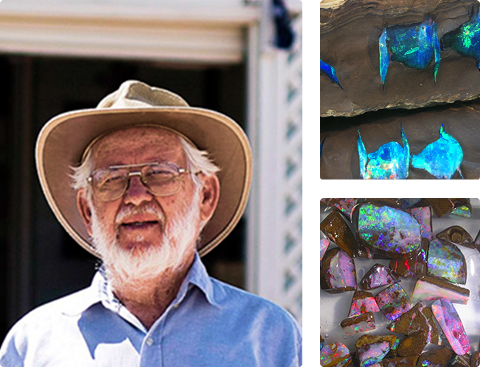
Some specialist sellers source Queensland boulder opal, including Koroit material, through direct-miner relationships that keep the chain of custody short and documented. They may offer warranties and provenance documentation on request, which supports the kind of confidence buyers should seek as described in the authentication checklist.
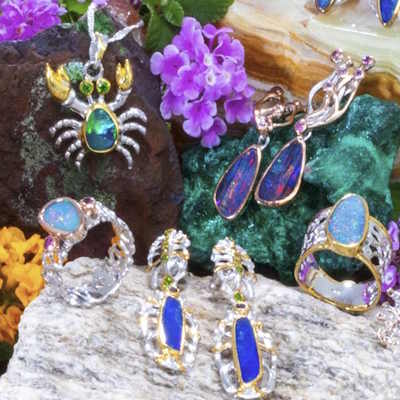
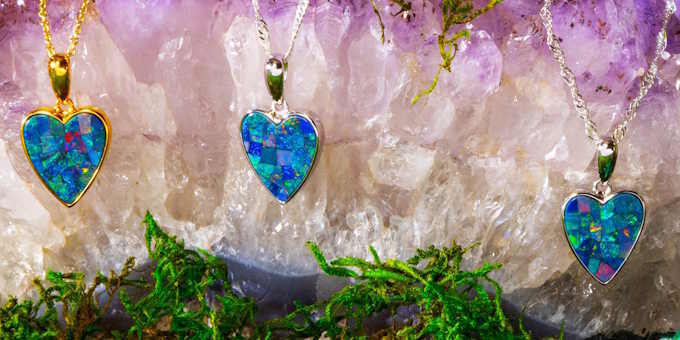
Browse custom hand-crafted opal jewellery to see current Queensland boulder opal listings, or explore finished pieces including opal rings and opal pendants and necklaces built around boulder opal stones. If you want a setting designed specifically to protect an irregular Koroit shape, ask about custom options for gold opal jewellery when you inquire, and request provenance documentation for any stone before you check out.
Authoritative References and Further Reading
- Geological and evaluation guidance on Queensland boulder opal from gemological research bodies.
- Field descriptions distinguishing Koroit from the Yowah fossicking area, sourced from state government resources.
- Disclosure and ethics standards from the Australian Opal Association’s code of ethics, worth reviewing before any purchase.
- Pattern and buying-category distinctions from Queensland opal mining associations.
FAQ
Is boulder opal worth anything?
Yes, boulder opal carries real market value, driven mainly by brightness, color coverage, and pattern rather than size alone. A small stone with vivid, full-face color often sells for more than a larger one with a thin, patchy seam.
What is the difference between opal and boulder opal?
Solid opal exists as a freestanding gem material, typically cut away from any host rock, while boulder opal forms as thin seams and patches within ironstone and is cut with that ironstone still attached as a backing. Koroit boulder opal is a Queensland example of this ironstone-backed formation.
Who cannot wear an opal stone?
There is no scientific or gemological basis for opal being unsafe or unsuitable for any group of wearers. Some folklore and birthstone traditions associate opal with particular months or beliefs, but these are cultural customs rather than physical restrictions on wearing the stone.
What is the rarest opal found in Australia?
Rarity in Australian opal depends on the specific field, pattern, and color combination rather than a single named type. Within Queensland boulder opal, exceptional picture stones and pieces with strong, full-face red flash are among the least common and most sought after by collectors.