Questions to Ask Gemstone Retailers Before You Buy
Posted by AOD on 2nd Jun 2026
Questions to Ask Gemstone Retailers Before You Buy
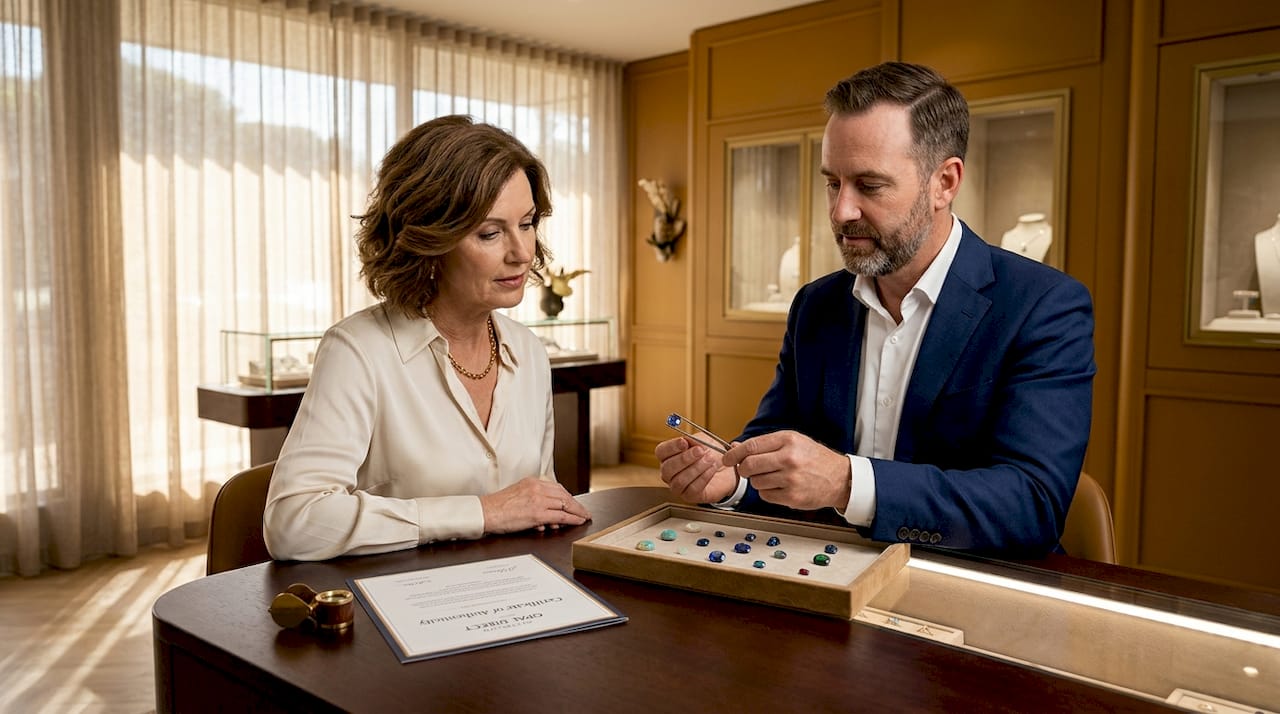
TL;DR:
- Asking for an independent GIA report that details a gemstone’s authenticity, origin, and treatments is crucial for making an informed purchase. Retailers should be transparent about sourcing, disclose lab-grown or treated stones clearly, and offer fair, documented return policies to protect buyers’ investments. Trustworthy responses—prompt, clear, and backed by verifiable documentation—are the best indicators of a retailer’s integrity and reliability.
The most important questions to ask gemstone retailers address five non-negotiable pillars: authenticity, treatment disclosure, independent certification, ethical sourcing, and return policies. A gemstone purchase is not simply an aesthetic decision. It is a financial commitment, and in many cases, an emotional one. Retailers who answer these questions clearly and without hesitation are the ones worth trusting. Those who deflect, generalize, or offer vague assurances are signaling risk. This guide gives you the exact questions to ask, what credible answers look like, and how to use those responses to judge whether a dealer deserves your confidence.
1. Questions to ask gemstone retailers about authenticity and treatment
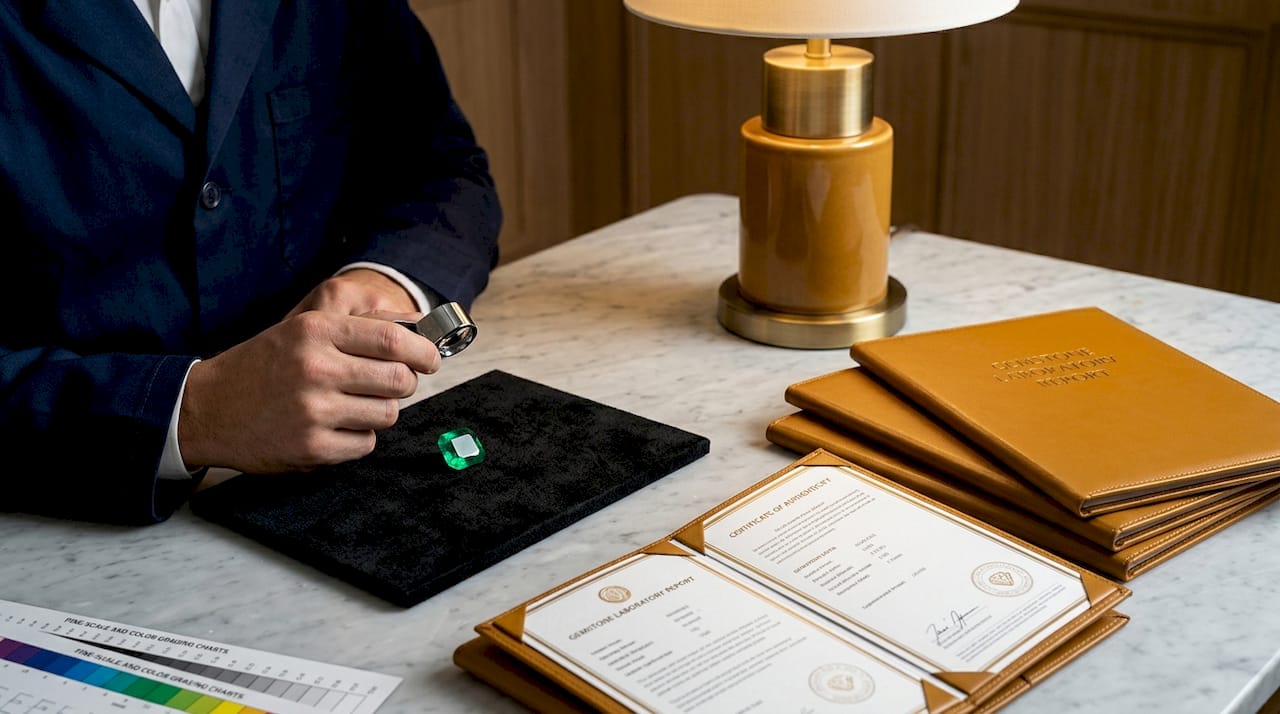
The first and most revealing set of gemstone buying questions centers on whether the stone is natural, lab-grown, or a simulant, and what treatments it has received. These are not optional inquiries. They define the stone’s value, its care requirements, and its long-term insurability.
Ask your retailer directly:
- “Is this stone natural, lab-grown, or a simulant?”
- “What treatments has it received? Heating, fracture-filling, coating, diffusion?”
- “Can you provide written treatment disclosure backed by an independent lab report?”
Treatments are interventions applied to a gemstone after mining to improve its appearance. Heating is the most common, used widely on sapphires and rubies to intensify color. Fracture-filling injects glass or resin into surface cracks. Diffusion introduces color-altering elements into the stone’s surface layer. Each treatment affects durability, value, and how the stone should be cleaned and stored. Written treatment disclosure backed by an independent lab report is the standard a trustworthy retailer meets without hesitation.
Pro Tip: Ask for the exact wording used on the lab report to describe treatment status. Phrases like “no evidence of heat treatment” carry significant weight for pricing and insurance purposes.
2. How to verify gemstone certification and lab reports
Not all certificates are equal. An in-house certificate produced by the retailer themselves carries no independent verification. What you need is a report issued by a recognized gemological laboratory, and the most respected name in that space is the Gemological Institute of America, known as GIA.
When asking about gemstone certification, request:
- The name of the lab that issued the report
- The report number, so you can verify it independently on the lab’s website
- Confirmation that the report corresponds to the exact stone you are purchasing, not a similar one
| Certificate type | Issued by | Reliability |
|---|---|---|
| Independent lab report | GIA, AGL, Gübelin | High: verifiable online, standardized language |
| In-house certificate | The retailer | Low: no independent verification |
| Appraisal document | Appraiser hired by retailer | Medium: depends on appraiser credentials |
Certificates must explicitly state whether a stone is natural or lab-grown and note any treatments to genuinely verify authenticity and value. A document that simply says “genuine gemstone” without specifying origin or treatment status tells you almost nothing. GIA’s online report verification tool allows buyers to cross-reference a report number against the stone’s recorded characteristics. Use it before every significant purchase.
3. Key ethical sourcing questions for gemstone retailers
Ethical sourcing has moved from a niche concern to a mainstream expectation, and the questions you ask in this area reveal a great deal about a retailer’s integrity. The gemstone supply chain is long and often opaque, passing through mining regions, cutting centers, and multiple trading hands before a stone reaches a display case.
Ask your retailer:
- “Where was this stone mined, and can you trace its supply chain?”
- “Are you a member of the Responsible Jewellery Council?”
- “What documentation supports your ethical sourcing claims?”
RJC standards require transparency, monitoring, and accountability across the jewelry supply chain. Membership is not a guarantee of perfection, but it signals a retailer’s commitment to independent auditing and continuous improvement. Blockchain-based traceability tools are also emerging as a way for ethical retailers to demonstrate provenance with greater precision, linking a specific stone to its mine of origin through a verifiable digital record.
“Ethical retailers are distinguished not just by their certifications but by their willingness to openly share sourcing and treatment details.” — The Essential Gemstone Buying Checklist
The Federal Trade Commission’s updated jewelry advertising guidelines require clear, conspicuous disclosure of lab-grown stones, banning misleading claims. Ask whether every product page and checkout process discloses lab-grown or treated status using FTC-compliant language. Vague terms like “eco-friendly” or “responsibly sourced” without supporting documentation are red flags, not reassurances. For a deeper look at how retailers should communicate these claims, the Australianopaldirect guide on sustainable jewelry practices offers a useful framework.
4. Questions that clarify return, refund, and warranty policies
Return and refund policies are buyer protections, not afterthoughts. For high-value gemstone purchases, especially those made online, the terms of a return policy can mean the difference between recovering your investment and absorbing a significant loss.
Before committing to a purchase, work through these questions in order:
- What is the return window, and does it apply to all items or only select categories?
- What condition must the item be in to qualify for a return? Unworn, in original packaging?
- Who covers return shipping costs, and is the item insured during transit?
- Are custom-made or sale items excluded from the standard return policy?
- Is the refund issued as cash, store credit, or exchange only?
Some sellers allow full refunds for 30 days, while others charge restocking fees or limit returns to store credit. That distinction matters enormously when you are spending hundreds or thousands of dollars on a single piece. A retailer who offers a 90-day return window with covered shipping insurance is communicating confidence in their product. One who limits returns to seven days with no shipping coverage is shifting risk onto the buyer.
Pro Tip: Request the return policy in writing before purchasing, not after. Screenshot or save the policy page at the time of purchase in case terms change.
5. How to use retailer responses as a trust and value assessment tool
The quality of a retailer’s answers is itself a form of due diligence. Trustworthy dealers answer questions directly and quickly. They provide documentation without being asked twice. They welcome scrutiny because they have nothing to hide.
Watch for these signals when evaluating a retailer’s responses:
- Direct answers: A credible retailer names the lab, provides the report number, and explains treatment status in plain language.
- Speed of response: Delays or deflections on basic questions about certification or sourcing are warning signs.
- Consistency: Cross-check what the retailer tells you verbally or via email against what appears on the product page and invoice.
- Documentation: Every claim about quality, origin, or treatment should be backed by a document you can independently verify.
- Price alignment: If a stone is priced significantly below market value for its stated quality and certification, question why.
Seller vetting guidance consistently identifies clarity and speed of response as the most reliable indicators of retailer trustworthiness. Document every exchange. Save emails, screenshots of product pages, and copies of any certificates provided. If a dispute arises, this paper trail is your most valuable asset. For a focused look at evaluating opal sellers specifically, the Australianopaldirect resource on asking opal sellers the right questions walks through this process in detail.
6. Questions about gemstone origin and rarity
Origin is one of the most significant value drivers in the colored gemstone market, and it is a question many buyers forget to ask. A Kashmir sapphire, a Burmese ruby, or a Lightning Ridge black opal from New South Wales commands a premium not just for its beauty but for the geological rarity of its source. The same species of stone from a different deposit can differ dramatically in value.
Ask your retailer:
- “What is the geographic origin of this stone, and is it documented on the lab report?”
- “Does the origin affect the price, and how?”
- “Is this stone from a region known for a particular quality characteristic?”
GIA and other leading labs can include origin determinations on their reports for certain stone types, though this is not always standard. For opals, origin is particularly meaningful. Earth-mined Australian opals from Lightning Ridge, Coober Pedy, and Queensland carry distinct play-of-color characteristics that lab-created alternatives cannot replicate. A retailer who knows their stones will speak to origin with specificity and enthusiasm, not hesitation.
7. Questions about gemstone grading and quality factors
Understanding how a stone is graded gives you the vocabulary to compare options and assess whether a price is fair. The four primary quality factors for colored gemstones are color, clarity, cut, and carat weight, though color carries the most weight in most species.
Ask your retailer to explain:
- “How is this stone graded for color, and what grade does it carry?”
- “Are there visible inclusions, and do they affect durability?”
- “Who cut this stone, and was it cut to maximize color or carat weight?”
Cutters sometimes sacrifice ideal proportions to preserve carat weight, which inflates the stone’s weight-based price while reducing its visual brilliance. A well-cut stone that loses some weight in the process is almost always the better purchase. For collectors seeking luxury gemstone standards, understanding the relationship between cut quality and final appearance is one of the most underappreciated aspects of gemstone buying.
Key takeaways
Asking the right questions before purchasing a gemstone is the single most effective way to protect your investment and align with ethical sourcing values.
| Point | Details |
|---|---|
| Prioritize lab reports | Request an independent GIA report with explicit natural or lab-grown status and treatment notes. |
| Verify ethical sourcing | Ask for RJC membership and supply chain documentation, not just marketing language. |
| Scrutinize return policies | Confirm the return window, conditions, shipping coverage, and refund type in writing before buying. |
| Use response quality as a signal | Direct, fast, documented answers indicate a trustworthy retailer; vague responses signal risk. |
| Ask about origin | Geographic origin affects value significantly and should appear on the lab report for premium stones. |
Why the first question you ask reveals everything
From my experience working closely with gemstone buyers and retailers, the single most telling moment in any transaction is the response to the very first question about a lab report. I have seen buyers accept vague reassurances and later discover their “natural” sapphire was glass-filled or their “untreated” ruby had been heated to a degree that cut its value by half. The GIA principle of “when in doubt, get a lab report” is not just advice. It is the clearest line between an informed purchase and an expensive mistake.
Ethical sourcing transparency matters just as much to me now as certification does. I have watched the industry shift in the past decade, and buyers who ask about RJC membership and supply chain traceability are no longer considered difficult. They are considered serious. Retailers who welcome those questions have earned their reputation. Those who bristle at them have told you everything you need to know.
Clear return policies have saved buyers I know from real financial harm. A 90-day window with insured return shipping is not a luxury. It is a baseline standard for any retailer confident in their product. If a retailer cannot offer that, ask why. The answer will be instructive.
Trust your instincts. If something feels evasive or inconsistent, walk away. The right stone, from the right source, will always be worth waiting for.
— Renee
Discover authentic Australian opals with full transparency
At Australianopaldirect, every stone comes with clear treatment disclosure, documented sourcing from renowned Australian mining regions including Lightning Ridge, Coober Pedy, and Queensland, and direct-miner relationships that remove the opacity of multi-step supply chains.

The policies here reflect the standards this article describes: a 90-day warranty, complimentary shipping insurance, and straightforward return terms. Whether you are drawn to the kaleidoscopic brilliance of a black opal or the warm fire of a boulder opal, you will find stones whose stories are fully told. Browse the curated opal collections or reach out directly for expert guidance on choosing a piece that meets every standard covered in this guide.
FAQ
What is the most important question to ask a gemstone retailer?
Ask for an independent lab report from a recognized institution like GIA that explicitly states whether the stone is natural or lab-grown and discloses any treatments. This single document answers the most critical questions about authenticity and value.
How do I know if a gemstone certificate is legitimate?
A legitimate certificate comes from an independent gemological lab, not the retailer. Verify the report number directly on the issuing lab’s website. In-house certificates issued by the seller carry no independent verification.
What does “treated” mean for a gemstone’s value?
A treatment is any process applied after mining to improve a stone’s appearance, such as heating, fracture-filling, or coating. Treated stones are generally worth less than untreated stones of equivalent appearance, and some treatments affect durability and care requirements.
What ethical sourcing questions should I ask gem dealers?
Ask whether the retailer holds Responsible Jewellery Council membership, whether they can trace the stone’s supply chain to its mine of origin, and whether all lab-grown or treated stones are disclosed using FTC-compliant language on product pages and at checkout.
What return policy should I expect from a reputable gemstone shop?
A reputable retailer offers a clearly defined return window of at least 30 days, covers return shipping costs, insures the item during transit, and issues refunds in cash rather than store credit only. Custom or sale items may carry different terms, so always confirm in writing before purchasing.
Recommended
- Essential questions to ask opal sellers for authentic jewelry - Australian Opal Direct
- Opal Gemstone Selection Process: A Step-by-Step Guide - Australian Opal Direct
- Opal Jewelry Gifting Guide: Select, Customize, and Present - Australian Opal Direct
- How to Pick Opal Jewelry: Expert Steps for Gemstone Lovers - Australian Opal Direct