Defining Premium Gemstone Cuts: A Collector's Guide
Posted by AOD on 3rd Jun 2026
Defining Premium Gemstone Cuts: A Collector’s Guide
TL;DR:
- A premium gemstone cut maximizes light reflection, brilliance, and fire through precise facet arrangements and proportions.
- Assessment relies on grading systems like GIA for round brilliants and advanced tools such as GCAL 8X for fancy shapes, emphasizing performance over brand names.
A premium gemstone cut is defined by the precise arrangement of facets and proportions that maximize a stone’s light return, brilliance, and fire. This is not a matter of personal taste alone. It is a measurable, gradable quality that separates a stone that radiates kaleidoscopic brilliance from one that sits flat and lifeless in the light. For collectors and enthusiasts, defining premium gemstone cuts means understanding the grading systems behind that radiance, from the GIA’s rigorous round brilliant standards to the GCAL 8X program’s advanced multi-factor evaluation for fancy shapes. Le Vian’s gemologists describe a premium cut as the stone’s very “life,” its capacity to interact with light in ways that no color or carat weight can replicate.
What criteria define a premium cut for round brilliant gemstones?
The round brilliant is the benchmark against which all other cuts are measured. With approximately 58 facets refined over more than a century, it represents the most scientifically optimized geometry in gemstone cutting. Le Vian describes it as an engineering masterpiece, and that description holds up under scrutiny.
The GIA assigns an overall cut grade to round brilliant diamonds on a scale from Excellent to Poor. That grade is built from five distinct components:
- Brightness: the total internal and external white light reflected from the stone
- Fire: the dispersion of light into the spectrum of colors visible to the eye
- Scintillation: the pattern of light and dark areas and the sparkle produced when the stone moves
- Weight ratio: the relationship between the stone’s diameter and its carat weight
- Durability: the structural integrity of the girdle and other vulnerable facet junctions
What makes this system particularly demanding is its logic of constraint. A premium cut must excel across all five components, because the overall grade is capped by the lowest-scoring factor. A stone with extraordinary fire but a weak weight ratio cannot achieve an Excellent grade. This means a truly premium round brilliant is a comprehensive achievement, not a stone that compensates in one area for weakness in another.
Polish and symmetry are graded separately by GIA and do not directly cap the overall cut grade. However, they contribute meaningfully to perceived quality. A stone with Excellent cut but only Good polish will show microscopic surface imperfections that dull its interaction with light. Collectors who understand this distinction read GIA reports with far greater precision than those who stop at the overall grade.
“The premium cut is about the stone’s life and interaction with light rather than purely technical specs or paper grades.” — Le Vian gemologists, via Vogue
Pro Tip: When reviewing a GIA report for a round brilliant, check all three grades: overall cut, polish, and symmetry. A stone graded Excellent/Excellent/Excellent represents the true ceiling of premium cut quality.
How are premium cuts assessed for fancy shapes?
Fancy shapes, including oval, cushion, pear, emerald, and Asscher cuts, present a fundamental challenge: GIA does not assign an overall cut grade to any of them. This is not an oversight. The geometric variability across fancy shapes makes a single standardized grading system extraordinarily difficult to construct. Two cushion cuts with identical 4Cs can look completely different in terms of light return, pattern, and visual weight.
For fancy shapes, GIA evaluates polish and symmetry separately, which gives collectors a partial picture of quality. But polish and symmetry alone cannot tell you whether a cushion cut suffers from the bowtie effect, a dark shadow across the center caused by poor proportioning, or whether an oval distributes light evenly across its surface.
This gap in standardization is where advanced grading innovations are beginning to fill the void. The GCAL 8X Cushion Cut Grade evaluates eight distinct factors: polish, proportions, optical brilliance, fire, scintillation, optical symmetry, shape aesthetics, and additional performance metrics. This system, developed by GCAL by Sarine, represents a significant step toward quantifying what collectors have historically had to assess by eye.
For collectors evaluating fancy shapes without access to GCAL 8X certification, the following methods provide the most reliable assessment:
- Proportion analysis: Review table percentage, depth percentage, and length-to-width ratio against established ideal ranges for the specific shape.
- ASET imaging: Angular Spectrum Evaluation Tool images reveal how a stone captures and returns light from different angles, exposing dead zones invisible to the naked eye.
- IdealScope imaging: This tool highlights light leakage in red and white, making it easy to identify poorly proportioned stones.
- Light performance video: View the stone under multiple lighting conditions, including direct, diffused, and mixed light, to observe fire and scintillation behavior.
- Shape-specific symmetry review: For fancy shapes, symmetry includes the alignment of the culet, the evenness of the outline, and the balance of facet patterns across the stone’s axis.
| Evaluation method | Best used for | What it reveals |
|---|---|---|
| GIA polish/symmetry grade | All fancy shapes | Surface quality and facet alignment |
| GCAL 8X grade | Cushion cuts | Eight-factor optical performance score |
| ASET imaging | All shapes | Light capture and leakage zones |
| IdealScope imaging | Round and fancy shapes | Light return efficiency |
| Proportion analysis | All shapes | Depth, table, and ratio optimization |
What are the key premium gemstone cut types?
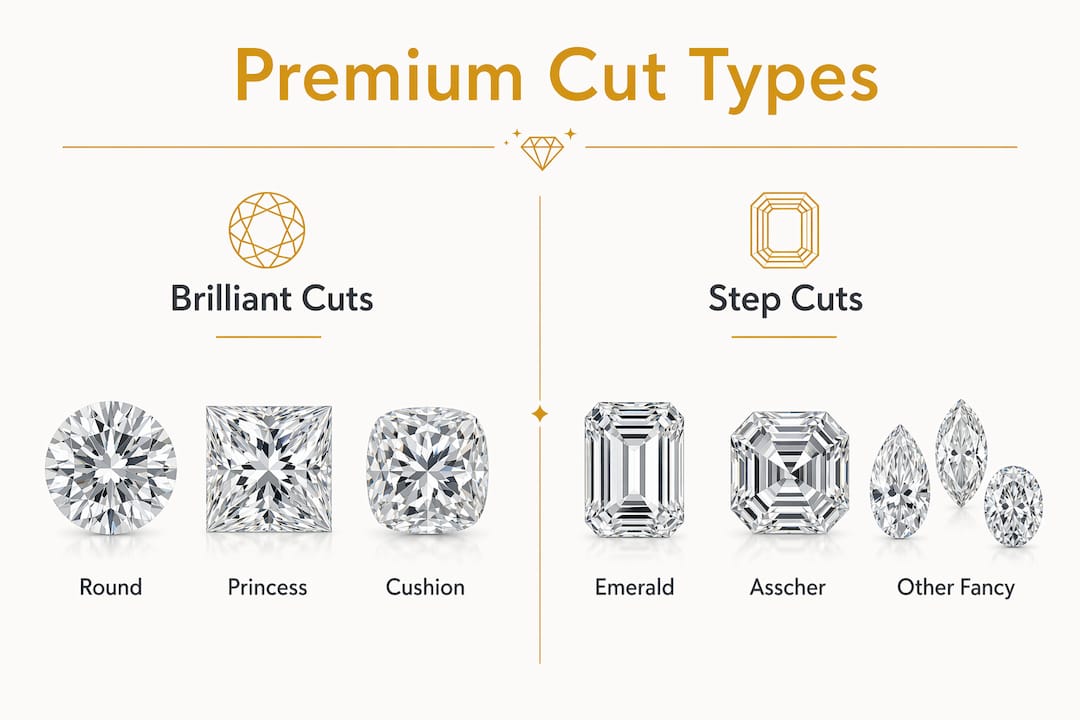
Understanding the best gemstone cutting styles requires recognizing that different cuts prioritize different optical effects. The round brilliant maximizes brilliance and fire simultaneously. Step cuts like the Asscher and emerald cut trade some fire for a different kind of beauty: architectural luster, long parallel reflections, and a hall-of-mirrors depth that rewards the patient observer.
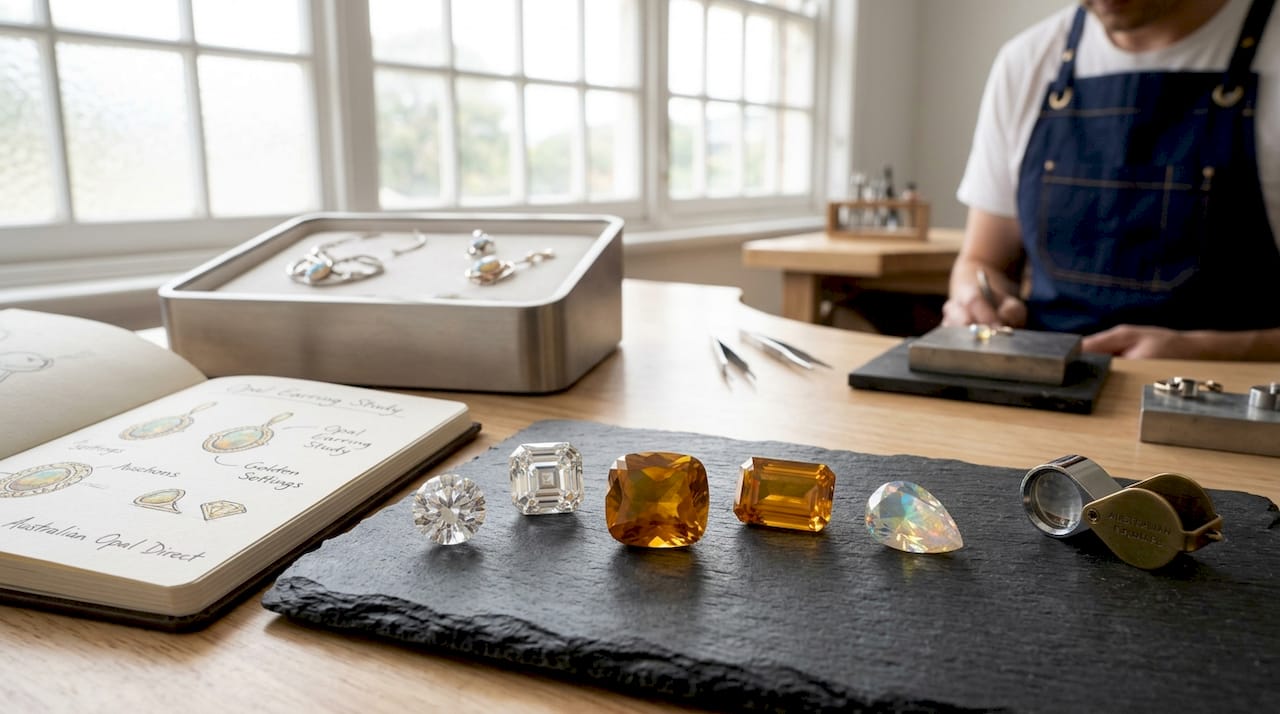
The Asscher cut, developed in 1902 by the Royal Asscher Diamond Company in Amsterdam, is one of the most demanding cuts in terms of clarity requirements. Its broad, open facets reveal inclusions far more readily than brilliant-cut facets, which scatter light and mask imperfections. A well-executed Asscher produces a distinctive concentric windmill pattern of reflections at its center, a visual signature that collectors recognize immediately. The Royal Asscher, a proprietary 74-facet variation, adds additional facets to the crown and pavilion to increase brilliance while preserving the step-cut character.
Pro Tip: For step cuts like the Asscher or emerald, prioritize VS1 clarity or higher. The open facet structure acts like a window into the stone’s interior, and inclusions that would be invisible in a brilliant cut become focal points in a step cut.
Brilliant cuts beyond the round, including princess, cushion, and pear shapes, offer collectors a range of unique gemstone cut designs with varying light behavior. The princess cut, with its sharp corners and modified brilliant facet pattern, delivers fire comparable to a round brilliant in a square silhouette. The cushion cut, beloved for its soft corners and pillow-like outline, produces a warmer, more romantic light pattern that many collectors find deeply appealing. The pear shape, sometimes called the teardrop cut, combines the brilliance of a round with the elongated elegance of a marquise, creating a stone that appears larger per carat than almost any other shape.
Proprietary facet architectures deserve careful scrutiny. The Royal Asscher’s 74-facet design commands a price premium, and that premium reflects both optical performance and branded exclusivity. Collectors should distinguish proprietary claims from objectively measured optical performance. A branded cut name does not automatically confer superior light return. The only reliable test is visual performance under varied lighting, supported by independent grading documentation.
How can collectors choose and verify premium cuts?
The single most important principle in how to choose gemstone cuts is this: prioritize cut quality over carat weight. A smaller stone with an Excellent cut will appear larger, brighter, and more vibrant than a heavier stone with a mediocre cut. Carat weight is a measure of mass. Cut quality is a measure of beauty.
Collectors who understand luxury gemstone standards approach verification with a structured process:
- Read the full grading report: For round brilliants, check overall cut, polish, and symmetry. For fancy shapes, note that no overall cut grade exists and rely on supplementary tools.
- Request light performance imaging: ASET and IdealScope images should be standard requests for any stone above a certain investment threshold. Reputable dealers provide these without hesitation.
- Watch the stone in motion: Static photography cannot capture scintillation. A premium cut reveals itself in movement, as light breaks across the facets in shifting patterns of white and spectral color.
- Scrutinize proportion data: For round brilliants, table percentages between 54% and 58% and depth percentages between 59% and 62.3% fall within ranges associated with Excellent cut grades. Fancy shapes have shape-specific ideal ranges worth researching before purchase.
- Separate branding from performance: A proprietary cut name is a marketing asset. Optical performance is a measurable reality. The two do not always align.
Pro Tip: Ask any dealer for a video of the stone rotating under a single-point light source. This is the most revealing test of scintillation quality and will expose dead zones or uneven light distribution that static images conceal.
Understanding gemstone cut quality factors also means recognizing that personal aesthetic preference is a legitimate part of the equation. A collector drawn to the quiet, contemplative beauty of a step cut is not making an inferior choice to one who prefers the explosive brilliance of a round brilliant. Premium status is defined by technical excellence within the chosen cut style, not by a hierarchy of styles.
Key takeaways
Premium gemstone cuts are defined by comprehensive optical performance across brightness, fire, and scintillation, verified through grading reports, proportion analysis, and light performance imaging rather than carat weight or brand names alone.
| Point | Details |
|---|---|
| Round brilliant grading | GIA grades five components; the overall grade is capped by the lowest-scoring factor. |
| Fancy shape challenge | GIA assigns no overall cut grade to fancy shapes; use ASET imaging and GCAL 8X for assessment. |
| Step cut clarity demands | Asscher and emerald cuts require VS1 or higher clarity due to their open, revealing facet structure. |
| Cut over carat | A smaller stone with Excellent cut outperforms a heavier stone with poor proportions in brilliance and apparent size. |
| Proprietary vs. performance | Branded cut architectures command premiums; always verify optical performance independently. |
Why premium cut standards matter more than ever in 2026
The conversation around premium gemstone cuts has shifted considerably in recent years, and I find that shift genuinely exciting. For most of the twentieth century, collectors relied almost entirely on GIA reports and the trained eye of a trusted dealer. That was sufficient for round brilliants, where GIA’s grading system is rigorous and well-understood. For fancy shapes, it was always a more uncertain art.
What I find most compelling about the current moment is the emergence of tools like the GCAL 8X system, which begins to bring the same rigor to cushion cuts that GIA brought to round brilliants decades ago. This matters enormously for collectors because cushion cuts are among the most popular fancy shapes on the market, and their optical variability is extraordinary. Two cushions with identical certificates can look worlds apart in person.
My honest observation, after years of working with gemstone collectors, is that the most sophisticated buyers have always known that a certificate is a starting point, not a conclusion. The stone’s life under light is the final arbiter. What is changing is that technology is catching up with that intuition, giving collectors quantitative tools to confirm what their eyes already sense. I expect the next five years to bring similar multi-factor grading systems to oval and pear shapes, which will further transform how collectors evaluate and price these gems.
The collectors who thrive in this environment are those who combine the discipline of reading grading data critically with the connoisseurship to trust their own perception of a stone’s beauty. Neither alone is sufficient. Together, they form the foundation of genuinely informed collecting.
— Renee
Discover premium gemstone cuts at Australianopaldirect
Australianopaldirect brings the same commitment to optical excellence and authentic craftsmanship to every piece in its collection. Whether you are drawn to the kaleidoscopic play-of-color in a Lightning Ridge black opal or seeking guidance on how light performance principles apply to opal cutting, the team at Australianopaldirect offers both the stones and the expertise to support your collecting journey. Explore the curated selection of ethically sourced Australian opals, read in-depth guides on opal jewelry investment, and connect with specialists who understand that a premium stone is defined by what it does with light. Browse the full collection at Australianopaldirect and experience the difference that genuine cut quality makes.
FAQ
What does “premium gemstone cut” mean?
A premium gemstone cut refers to a facet arrangement and set of proportions that maximize a stone’s brightness, fire, and scintillation. GIA defines this rigorously for round brilliants through a five-component grading system ranging from Excellent to Poor.
Why doesn’t GIA grade fancy shape cuts overall?
GIA does not assign an overall cut grade to fancy shapes like oval, cushion, or pear because the geometric variability across these shapes makes a single standardized system impractical. Collectors should use ASET imaging, proportion analysis, and tools like the GCAL 8X grade for cushion cuts instead.
What is the GCAL 8X Cushion Cut Grade?
The GCAL 8X Cushion Cut Grade evaluates eight factors including polish, proportions, optical brilliance, fire, scintillation, and optical symmetry to provide a standardized performance score for cushion cuts. It represents the most advanced multi-factor grading system currently available for fancy shapes.
Should I prioritize cut over carat weight?
Cut quality should take priority over carat weight in almost every purchasing decision. A smaller stone with an Excellent cut will appear larger and more brilliant than a heavier stone with poor proportions, delivering greater visual impact and long-term value.
How do I spot a truly premium cut in person?
Watch the stone rotate under a single-point light source and observe whether scintillation is even and lively across the entire surface. Dead zones, uneven patterns, or a pronounced bowtie shadow in fancy shapes indicate proportioning problems that no certificate grade can fully offset.
Recommended
- Luxury gemstone standards explained: Expert guide for collectors - Australian Opal Direct
- Master opal collector terminology: 5 essential terms - Australian Opal Direct
- Key features of opal investment pieces: a collector’s guide - Australian Opal Direct
- Build a Gemstone Collection: The Expert Guide to Australian Opals - Australian Opal Direct