Collector-Grade Opal: What to Demand Before You Pay Over $2,000
Posted by AOD on 18th Sep 2026
Collector-Grade Opal: What to Demand Before You Pay Over $2,000
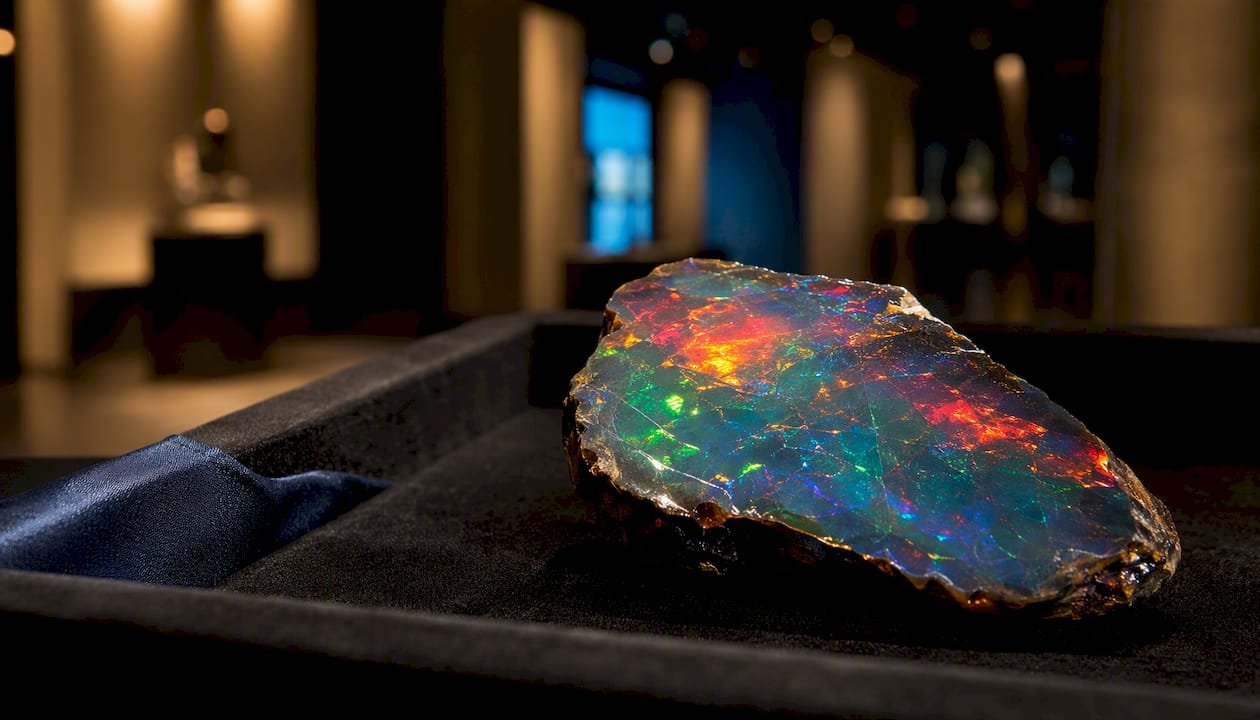
Collector-grade opal is any solid opal that combines vivid, high-brightness play-of-color (B1 to B2), a dark body tone (typically N1 to N4 for black opal), rare and well-defined patterning, intact stability with no crazing, and documented provenance. Australian black and boulder opals meet this bar most consistently. Before paying a premium, demand lab-grade documentation, multi-angle video, and a written return policy.
TL;DR:
- Collector-grade opal features vivid brightness levels of B1 to B2 and dark body tones of N1 to N4, with rare, well-defined patterns like harlequin for premium pricing.
- Proper lab reports should specify the opal’s type, body tone, brightness, origin, and treatment status, serving as a technical fingerprint for valuation and authenticity.
- Australian black opal from Lightning Ridge and boulder opal from Queensland are the most coveted regions, with provenance and documented origin significantly boosting market confidence.
- High-value stones must be free of crazing, larger than five carats, and exhibit full-face pattern coverage to command top prices; size alone does not guarantee value.
- Verify authenticity with face-up and side-profile photos, videos, gemological reports, and, for purchases over $2,000, independent certification to avoid buying doublets, triplets, or synthetic opals.
Table of Contents
- What Is Collector Grade Opal, Technically Speaking?
- How Do You Read a GAA or GIA-Style Opal Report?
- Which Opal Varieties and Regions Do Collectors Prize?
- How Much Is a Collector-Grade Opal Worth?
- How Do You Spot a Doublet, Triplet, or Synthetic Opal?
- What Should You Demand Before Buying a High-Value Opal?
- How Do You Preserve a Collector-Grade Opal Long-Term?
- An Editor’s View on Sourcing Collector-Grade Opal
- Ready to Add a Collector-Grade Opal to Your Collection?
- References for Grading and Valuation Standards
- FAQ
What Is Collector Grade Opal, Technically Speaking?
Play-of-color sits at the top of every serious grading conversation, and GIA’s own buyer guidance treats it as the primary quality factor, ahead of body tone, pattern, clarity, cut, and carat weight. Not all flashes of color carry equal weight, either. Red and orange fire outranks yellow and green, which in turn outranks blue, and a stone that shows full-spectrum color across its face commands far more respect than one flashing a single hue in a corner.
Brightness is graded B1 through B7, with B1 representing a brilliant, almost electric flash visible even in dim light. A B1 to B2 stone reads as luminous from across a room; a B5 or B6 stone needs direct light angled just right to show any fire at all. That gap is where most of the price difference between a “nice opal” and a museum piece lives.
Pattern matters almost as much. Harlequin, the mosaic-like arrangement of angular color blocks, draws the steepest premiums because it is genuinely rare. Broadflash, ribbon, and pinfire patterns follow behind, each valued for how evenly and dramatically they cover the stone’s face.
Body tone runs N1 through N9, and N1 to N4 defines black and dark opal, the material collectors chase hardest. A dark background makes play-of-color pop the way a black velvet backdrop makes a diamond sparkle harder. Size and structural integrity round out the picture: a clean, crack-free stone over five carats is exponentially rarer than a one-carat equivalent, and even a hairline crazing fracture can gut a stone’s value overnight.
Consider two stones side by side: a three-carat black opal with N2 body tone, B2 brightness, and a broadflash red pattern will often outsell a much larger seven-carat crystal opal with washed-out blue-green color and B5 brightness. Collectors pay for visual impact first, size second.
Quick reference: the traits that separate collector-grade from decorative-grade opal
- Brightness graded at the highest levels, not merely described as “bright”
- Body tone in the darker ranges classified as black or dark opal
- Full-face pattern coverage rather than isolated flashes
- Zero visible crazing or internal fracturing under magnification
- Size that holds its color and pattern integrity, not just raw carat count
How Do You Read a GAA or GIA-Style Opal Report?
The Opal Association’s classification system, adopted broadly across major gem labs since being recommended in 1997, standardized the body tone (N1 to N9) and brightness (B1 to B7) scales that now anchor most professional opal descriptions. A proper lab report should read like a technical fingerprint of the stone, not a marketing paragraph.
Look for these specific elements on any certificate before you trust it:
- Type designation: solid, doublet, or triplet, stated explicitly and never buried in fine print
- Body tone grade: a specific N-number, not a vague word like “dark” or “medium”
- Brightness grade: a specific B-number, ideally paired with a description of pattern coverage
- Origin statement: field or region of origin where verifiable
- Treatment disclosure: confirmation of no artificial color enhancement or backing
- Stability comments: any noted risk of crazing or moisture sensitivity
Lab reports have real limits worth knowing. Play-of-color assessed face-up under standardized lighting can look different from how the same stone performs under a jeweler’s loupe or in natural daylight, and photographs compress that further. A report is a strong signal, not a replacement for seeing the stone move under your own eyes or a trusted video. If a certificate skips origin, uses vague color language instead of numeric grades, or omits a brightness rating entirely, treat that as a warning sign rather than an oversight.
Which Opal Varieties and Regions Do Collectors Prize?
Provenance shapes desirability almost as much as the visual attributes themselves, and Lightning Ridge black opal sits at the top of most serious collections. Its dark ironstone-adjacent body tone, dramatic pattern contrast, and genuine scarcity have made it the benchmark against which other black opal gets measured.
Boulder opal, largely from Queensland, tells a different story. Thin veins of opal form within ironstone host rock, and rather than cutting that matrix away, cutters often leave it intact, which adds durability and a distinctive two-tone aesthetic collectors have come to prize in its own right.
Coober Pedy produces primarily crystal and white opal, material that only reaches true collector status when brightness and pattern are exceptional enough to overcome the lighter body tone’s natural disadvantage against play-of-color.
A brief caution on sourcing outside Australia: Ethiopian opal is frequently hydrophane, meaning it absorbs water readily and can change appearance, crack, or craze when exposed to moisture in ways Australian material typically does not. That stability gap matters enormously for anyone building a long-term collection rather than buying for short-term display.
- Lightning Ridge: black opal, N1 to N4 tones, the deepest pattern contrast available
- Queensland: boulder opal, ironstone matrix, added durability and distinctive banding
- Coober Pedy: crystal and white opal, collector-grade only at exceptional brightness
- Ethiopia: hydrophane opal, striking color but different stability profile
Documented chain of custody, tying a stone back to a specific field or even a specific mine, builds market confidence and often supports a real price premium over an otherwise identical but undocumented stone.
How Much Is a Collector-Grade Opal Worth?
Price tracks a short list of drivers: body tone, brightness, pattern rarity, the presence of red or orange hues, size, and stability. Miss any one of these and the price ceiling drops fast, no matter how strong the others are.
Illustrative market bands give a rough sense of scale, though every stone is genuinely unique enough that these ranges should be treated as orientation rather than a price sheet. White and crystal opal of decorative quality typically trades for relatively low amounts per carat. Boulder and dark opal of good quality generally commands moderate to high per-carat prices. Strong black opal with solid pattern and brightness attains significantly higher per-carat prices, with the rarest museum-grade pieces reaching the highest auction values.
Statistic to remember: a small, brilliant red harlequin black opal will typically outprice a much larger blue-only white opal, even when the size difference is dramatic. Collectors pay for visual impact first, size second.
Per-carat comparisons can genuinely mislead here. A five-carat stone with even color distribution isn’t automatically worth five times a one-carat stone with the same grades. Uniqueness and total visual impact drive value in ways that resist simple multiplication, which is exactly why two stones with identical N and B grades can sell for wildly different prices.
- Body tone and brightness together set the price floor
- Red and orange presence raises the ceiling faster than any other single factor
- Size only adds value when color and pattern integrity hold across the whole stone
- Zero crazing is a prerequisite for any serious valuation, not a bonus feature
Auction records and recent comparable sales remain the most reliable way to validate a listing’s asking price, especially for material above a few thousand dollars, since asking prices on individual listings can drift well ahead of what similar stones have actually sold for.
How Do You Spot a Doublet, Triplet, or Synthetic Opal?
Undisclosed composites remain one of the most common traps in the online opal market, and disclosure failures are more often the problem than outright fakery. Nothing is wrong with owning one as long as the seller states it plainly.
- Request face-up and side-profile photos. A doublet or triplet reveals a visible glue line or seam along the girdle that a solid stone simply cannot show.
- Ask for video showing the stone in motion. Natural play-of-color shifts organically as the angle changes; some synthetic material shows an unnaturally regular, almost mosaic-tile repetition instead.
- Request loupe-level close-up images. Bubble inclusions in a regular lattice pattern are a hallmark of certain man-made opal, distinct from the more chaotic internal structure natural stones show.
- Confirm whether a gemological report exists, and if the purchase exceeds a few thousand dollars, treat an independent lab opinion as close to mandatory rather than optional.
- Ask for rough or mine-of-origin documentation on the highest-value pieces. Reputable direct-from-miner sellers can often produce this; sellers who cannot or will not are worth extra scrutiny.
Pro Tip: For any purchase above roughly $2,000, the cost of an independent gemological opinion is trivial next to the downside of discovering a $200 doublet a year later. Treat it as a purchase cost, not an optional extra.
What Should You Demand Before Buying a High-Value Opal?
A short, firm checklist protects you far more effectively than trusting a seller’s reputation alone.
- Type and grading documentation: solid, doublet, or triplet status, specific body tone (N-number) and brightness (B-number) grades, origin, and any treatment disclosure.
- Complete imaging package: high-resolution face-up and side-profile photos, video demonstrating the stone’s movement, and precise dimensions with weight.
- Written commercial protections: a clear return policy, insured shipping, and secure payment terms stated before money changes hands.
- Comparable sales: ask the seller to point to recent comps for similar body tone, brightness, and pattern combinations.
- An inspection or verification window: for high-value pieces, negotiate a conditional period allowing independent gemological review before the sale is final.
Walk away when a seller cannot state clear origin, refuses a written return policy, or hesitates to provide the imaging listed above. Those refusals are rarely accidental.
How Do You Preserve a Collector-Grade Opal Long-Term?
Crazing, a network of fine surface or internal fractures, develops from moisture loss or temperature stress and permanently reduces value once it appears. It cannot be reversed, only prevented.
- Avoid prolonged water exposure, and never soak or steam-clean an opal
- Store pieces in a stable environment, away from direct heat sources like vents or sunny windowsills
- Use soft-lined cases and separate compartments so stones don’t scratch against each other or harder gems
- Insure high-value pieces individually rather than folding them into a generic homeowner’s policy
Hydrophane opals, common among Ethiopian material, need extra caution since they absorb water readily and can change appearance or destabilize with repeated wetting, unlike most Australian stones.
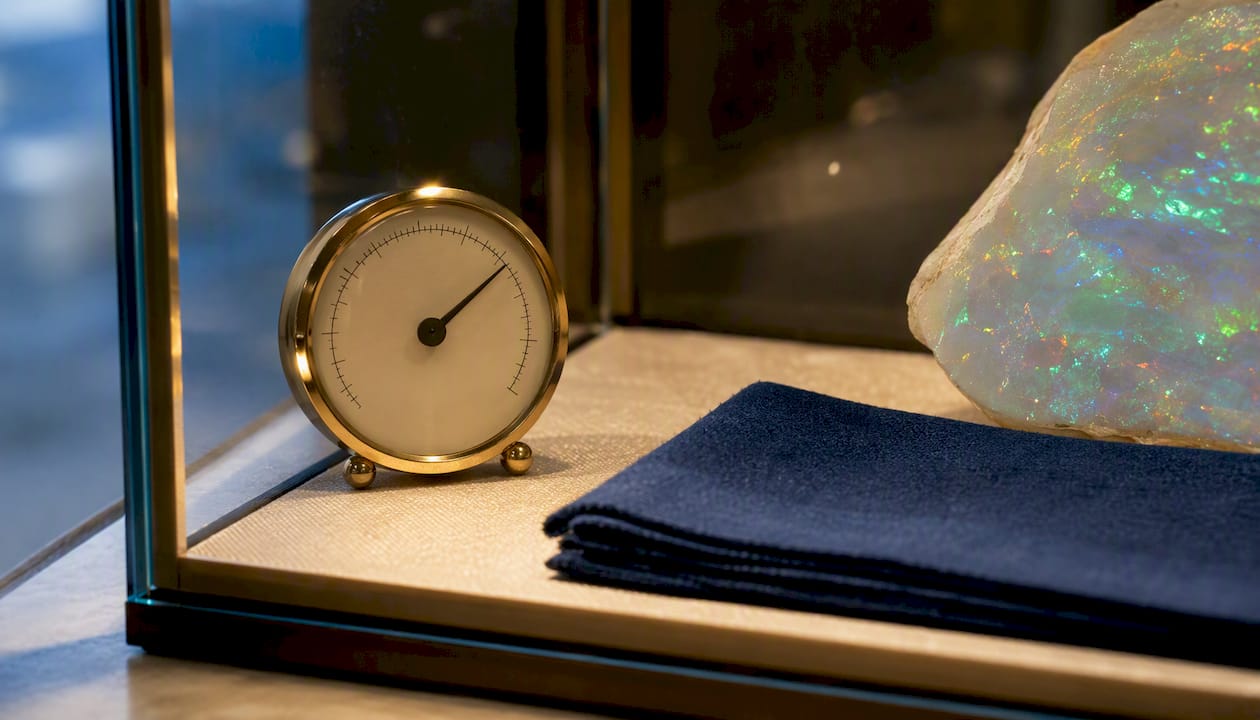
Pro Tip: Keep a small hygrometer near your display case. Wide humidity swings, not just absolute dryness, are what actually trigger crazing in vulnerable stones over time.
An Editor’s View on Sourcing Collector-Grade Opal
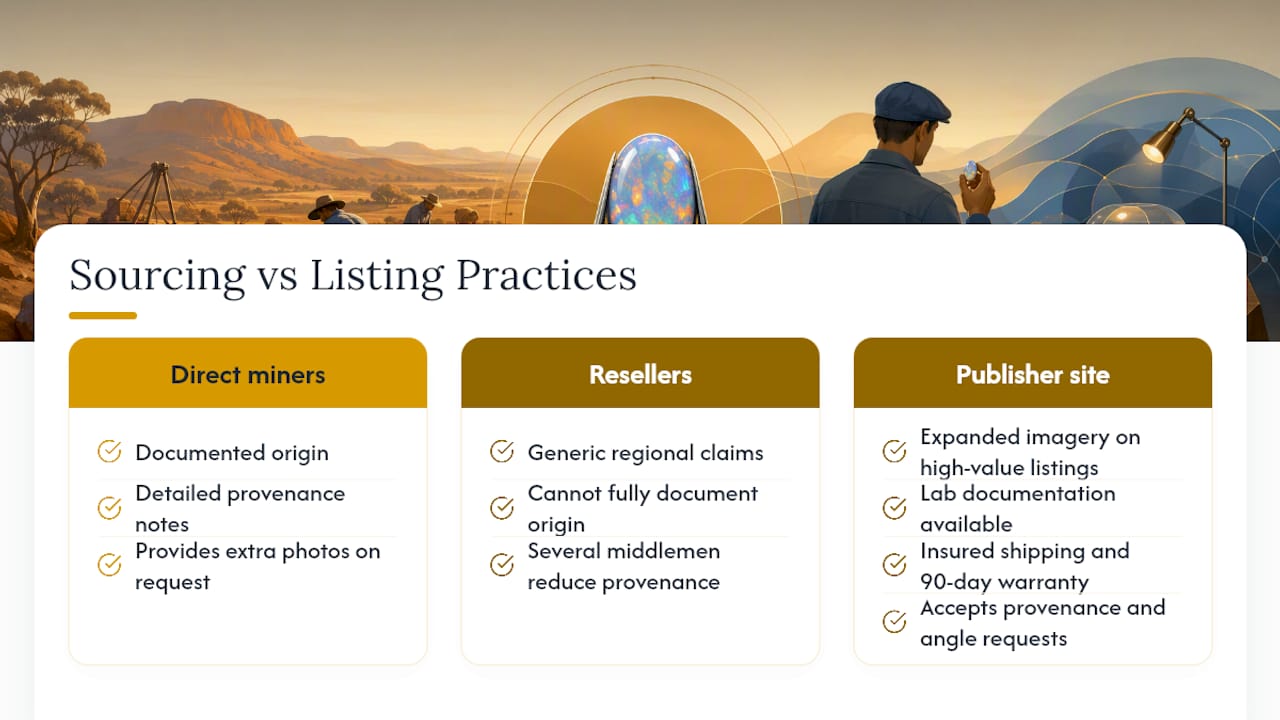
Renee has spent years watching the gap between what listings claim and what stones actually deliver, and the pattern is consistent: sellers who source directly from miners can document origin in ways that resellers several steps removed simply cannot. Australianopaldirect works from those direct-miner relationships, which shows up in the level of provenance detail attached to individual pieces rather than generic regional claims.
The publisher treats high-value listings differently than routine ones, with expanded imagery, available lab documentation, insured shipping, and a stated 90-day warranty on purchases. Collectors weighing a significant acquisition can request additional angles, provenance notes, or bespoke sourcing guidance directly, and reasonable documentation requests should never feel like an imposition on a seller confident in what they’re selling.
— Renee
Ready to Add a Collector-Grade Opal to Your Collection?
Some sellers work from direct-miner relationships rather than through layers of resellers, which can provide the kind of provenance clarity this guide recommends before paying collector-grade prices. Pieces may draw on ethically sourced, earth-mined material from Australian opal regions, sometimes backed by warranties and insurance on shipment.

Collectors researching specific attributes like pattern rarity can start with the rare opal pattern guide before browsing available stones, or go deeper on black opal specifically through the black opal buyer’s guide. If you already know the caliber of stone you want, browse the current collector opal and custom jewelry collection directly, request the imaging and provenance documentation outlined above, and reach out for bespoke sourcing if you’re hunting a specific body tone, pattern, or size that isn’t currently listed.
References for Grading and Valuation Standards
The Opal Association’s classification framework defines the N1 to N9 body tone and B1 to B7 brightness scales referenced throughout this guide. GIA’s opal buyer guidance establishes play-of-color as the primary valuation factor behind standard lab-report language and pricing principles.
FAQ
What Is the Best Grade of Opal?
The best grade combines B1 to B2 brightness with N1 to N4 body tone, full-face pattern coverage, and zero crazing. Black opal from Lightning Ridge most consistently hits every one of these marks at once, which is why it commands the steepest premiums in the collector market.
What Are the Different Grades of Opal?
Opal is graded on two core scales: body tone from N1 (black) through N9 (white), and brightness from B1 (brilliant) through B7 (dim). Pattern type, such as harlequin or broadflash, and stability factors like the absence of crazing layer on top of those two numeric scales to complete a professional grading picture.
What Type of Opal Is Most Valuable?
Black opal with a red or orange harlequin pattern and B1 brightness is generally the most valuable type, sometimes reaching thousands of dollars per carat at auction for museum-grade examples. Boulder opal with strong color and an intact ironstone backing follows close behind for collectors who value durability alongside beauty.
Which Type of Opal Is the Rarest?
Red harlequin black opal from Lightning Ridge is widely regarded as the rarest commercially available type, since it requires the rare pattern, the darkest body tones, and top-tier brightness to all occur in the same stone. Large, clean specimens over five carats in this category are rare enough that most collectors will encounter only a handful in a lifetime of searching.
Does Australianopaldirect Sell Collector-Grade Opal?
Yes, Australianopaldirect sources black, boulder, and crystal opal directly from Lightning Ridge, Coober Pedy, and Queensland miners, with provenance documentation and a 90-day warranty on purchases. Pricing for individual pieces and custom commissions is listed on the opal collection page rather than set at a single fixed rate.








