Why Gemstone Storytelling Matters for Collectors
Posted by AOD on 9th Jun 2026
Why Gemstone Storytelling Matters for Collectors
TL;DR:
- Gemstone storytelling combines cultural lore and scientific provenance to enhance a gem’s emotional and monetary value. It influences buyer perception more than technical details alone by creating compelling narratives rooted in history and verifiable facts. A balanced approach that merges romance with science builds trust, drives sales, and deepens collectors’ emotional attachment to their gemstones.
Gemstone storytelling is defined as the practice of weaving historical, cultural, and scientific narratives around gems to deepen their emotional resonance and perceived value. The importance of gemstone storytelling extends far beyond poetic description. It is the mechanism by which a Lightning Ridge black opal transforms from a mineral specimen into a living artifact, carrying the weight of Aboriginal legend, geological time, and personal heritage. Organizations like the Gemological Institute of America (GIA) and brands like Tanishq have long recognized that narrative is not decoration. It is the architecture of value itself.
What is gemstone storytelling and why does it matter?
Gemstone storytelling is the dual practice of combining emotional lore with documented scientific provenance to create a complete, credible account of a gem’s identity. Neither dimension works alone. A story without evidence reads as mythology. Evidence without story reads as a laboratory report. The most compelling gemstone narratives hold both in precise balance.
The emotional dimension draws from centuries of cultural meaning. Opals were revered by ancient Romans as symbols of hope and purity. Aboriginal Australians described them as the Creator’s footprints, left where a rainbow touched the earth. These are not marketing inventions. They are living chapters of heritage that collectors recognize as genuine layers of meaning.
The scientific dimension is equally non-negotiable. A complete gemstone narrative includes:
- Mineral species and variety: Is it a precious black opal, a crystal opal, or a boulder opal from Queensland?
- Origin authentication: Was it mined at Coober Pedy, Lightning Ridge, or Andamooka?
- Grading and treatment history: Does a GIA or independent report confirm the play-of-color grade and confirm no artificial enhancement?
- Inclusions as identity: What gemologists call “jardins” in emeralds, or the silica particle patterns in opals, are proof of natural origin rather than flaws to hide.
Together, these two dimensions build buyer confidence and justify premium pricing. The best value stories combine emotion and science, a principle GIA has demonstrated repeatedly through its analyses of legendary gems like the Hope Diamond and the Black Prince’s Ruby.
Pro Tip: When researching any gemstone purchase, request both a grading report and a written provenance statement. If a seller can provide only one, treat that as a signal worth investigating.
How does storytelling influence gemstone sales and buyer perception?
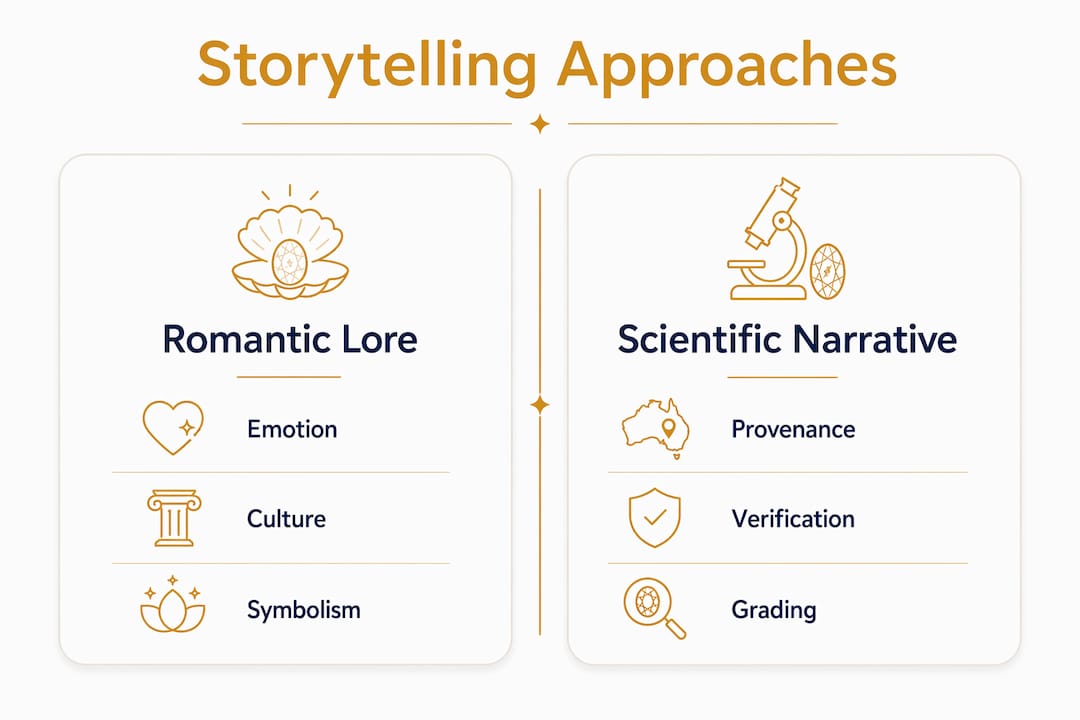
Narrative drives purchasing decisions in colored gemstones more directly than technical specifications alone. A survey of 33 retailers confirmed that storytelling is the primary factor converting emotional interest into actual sales. This finding matters because it reveals that buyers do not purchase a gem’s chemistry. They purchase its meaning.
“Jewelry is not just ornamentation. It is the emotional language through which personal identity speaks.” This is the principle behind Tanishq’s celebrated Hues campaign, which transformed gemstones into stories of personal voice rather than mere color.
The practical implications for collectors and enthusiasts are significant. Consider how narrative changes the experience of three comparable blue sapphires:
- Sapphire A carries a grading report noting “vivid blue, VS clarity, no heat treatment.” Technically impressive. Emotionally inert.
- Sapphire B is described as Kashmir origin, unheated, from a mine closed since the 1930s, with a documented chain of custody through two private European collections. The same stone now carries scarcity, history, and rarity.
- Sapphire C is the same Kashmir stone, but its seller also shares that it was gifted at a royal engagement in 1952, verified by auction house records. The price difference between A and C is not chemistry. It is story.
Retailers who understand this distinction use humor, lore, and layered knowledge to relax buyer tension around colored gemstone purchases. The over 100,000 daily searches for gemstone definitions and historical lore confirm that consumers arrive already hungry for narrative. They want to be told the story. The retailer’s job is to have one worth telling.
Romantic lore vs. scientific narrative: which approach works better?
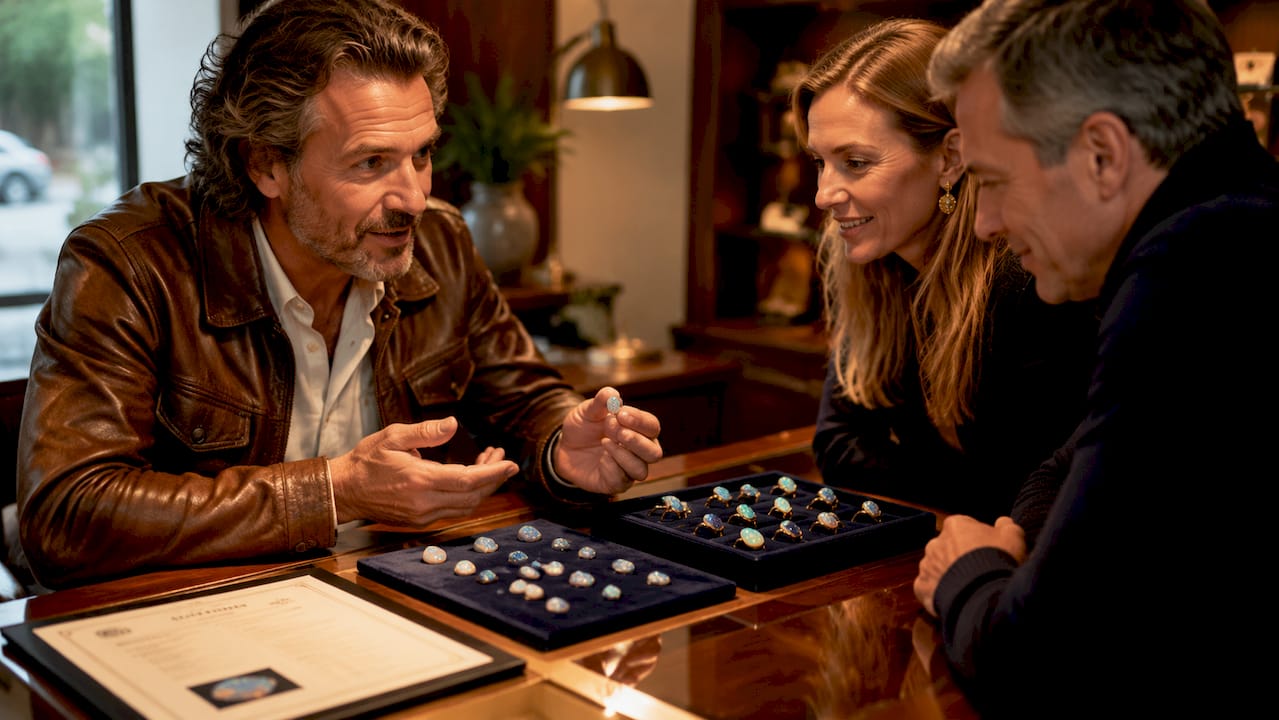
The most credible gemstone stories do not choose between romance and science. They use each to validate the other. Understanding this balance is central to understanding gemstone narrative significance for serious collectors.
| Storytelling approach | Strengths | Risks |
|---|---|---|
| Romantic lore only | Emotionally compelling, culturally rich, memorable | Unverifiable claims erode trust; perceived as marketing hype |
| Scientific narrative only | Credible, precise, defensible | Emotionally flat; fails to create desire or personal connection |
| Balanced narrative | Builds desire and confidence simultaneously | Requires genuine provenance; cannot be fabricated |
Romantic themes draw from history, legend, and symbolism. The opal’s kaleidoscopic play-of-color has inspired legends across cultures, from ancient Rome to the Dreamtime traditions of Australia’s First Nations peoples. These associations are not trivial. They are the reason certain gems command emotional premiums that no grading report can fully explain.
Scientific themes ground those associations in verifiable reality. GIA’s analyses of legendary gems demonstrate that structured storytelling, combining mineral species, grading, and treatment history, avoids buyer skepticism and supports premium pricing. For closed-mine and legacy stones, high-net-worth buyers expect documented chains of custody. Provenance marketing that relies on romantic exaggeration without verified facts actively undermines the value it attempts to create.
The risk of over-romanticizing is real and measurable. A seller who describes a common Ethiopian opal as “ancient” or “sacred” without documentation is not telling a story. They are creating liability. The collector who later discovers the stone is three years old and commercially mined does not simply feel disappointed. They lose trust in the entire category.
Pro Tip: Ask for the mine of origin and the year of extraction for any opal marketed as rare or heritage. Legitimate sellers at the level of luxury gemstone standards will have this documentation ready.
How to use gemstone storytelling in your own appreciation and buying decisions
Deepening your appreciation of gemstone narrative significance does not require a gemology degree. It requires the right questions and a willingness to research beyond the surface.
- Verify the origin claim. Ask whether the stone comes with a country-of-origin certificate from GIA, Gübelin, or SSEF. For Australian opals, ask specifically whether it was mined at Lightning Ridge, Coober Pedy, or Queensland, since each region produces a distinct character of stone.
- Ask about treatment history. Heating, fracture-filling, and coating all affect both value and story. An unheated ruby from Mogok carries a fundamentally different narrative than a heated stone of identical color.
- Research the cultural lore independently. Cross-reference a seller’s claims against published sources. The Smithsonian Institution, GIA’s education resources, and academic gemology texts are reliable starting points.
- Connect the gem to your personal heritage. The role of storytelling in jewelry is most powerful when the narrative intersects with the buyer’s own identity. An Australian opal gifted to mark a family milestone carries a story that compounds in meaning over generations.
- Treat inclusions as narrative, not defect. The silica banding patterns in a Lightning Ridge black opal, or the jardins in a Colombian emerald, are geological fingerprints. They confirm natural origin and make each stone unrepeatable.
The value of gemstone stories is not abstract. Consumers who understand provenance and lore consistently report higher satisfaction with their purchases and stronger emotional attachment to the pieces they own. That attachment is what transforms jewelry from an asset into an heirloom.
Key takeaways
Gemstone storytelling creates the most value when emotional heritage and scientific provenance are presented together, each reinforcing the credibility of the other.
| Point | Details |
|---|---|
| Define storytelling clearly | Gemstone storytelling combines cultural lore with verified provenance to build value and buyer confidence. |
| Science validates romance | Grading reports, origin certificates, and treatment history make emotional narratives credible rather than speculative. |
| Narrative drives sales | A survey of 33 retailers confirmed storytelling as the primary factor converting emotional interest into gemstone purchases. |
| Inclusions add authenticity | Jardins and silica patterns are proof of natural origin, not flaws, and strengthen a stone’s narrative identity. |
| Ask the right questions | Request mine of origin, extraction year, and treatment history to verify any gemstone story before purchasing. |
Why I believe storytelling is the most undervalued skill in gemstone collecting
I have spent years working with opals from Lightning Ridge and Coober Pedy, and the single most consistent observation I can share is this: the collectors who derive the deepest satisfaction from their pieces are never the ones who bought the highest-graded stone. They are the ones who know their stone’s story.
There is a particular black opal I encountered from Lightning Ridge, a stone with a rolling flash of crimson and violet that shifted like a slow tide. Its grading report was impressive. But what made it extraordinary was knowing it came from a seam worked by the same family for three generations, that the miner’s grandfather had found the first stone from that pocket in 1971, and that the current owner had documented every piece extracted since. That chain of custody was not just provenance. It was a living record of human effort and geological wonder meeting across time.
The market is slowly recognizing what serious collectors have always known. Buyers increasingly prioritize provenance confidence over surface sparkle. The consumer interest in narrative-driven content is not a trend. It is a return to the oldest reason humans have valued gemstones at all: because they carry meaning that outlasts the people who hold them.
My encouragement is simple. Do not settle for a stone without a story. And do not accept a story without evidence. The gems that will matter most to you in twenty years are the ones where both are present.
— Renee
Discover authentic opal stories at Australianopaldirect

Australianopaldirect has built its entire collection around the principle that every opal deserves a complete story. Each piece in the catalog is sourced directly from miners at Lightning Ridge, Coober Pedy, and Queensland, with documented provenance and transparent origin details. The Nature’s Light and Limited Edition collections present opals whose play-of-color, mining origin, and heritage context are described with the same care a collector would expect from a premium auction house. For those ready to move from appreciation to ownership, Australianopaldirect offers free shipping, complimentary insurance, and 90-day warranties, removing the uncertainty that often accompanies buying rare gemstones online.
FAQ
What is gemstone storytelling?
Gemstone storytelling is the practice of combining a gem’s cultural history, mythological associations, and scientific provenance into a unified narrative that deepens its meaning and perceived value. It is used by collectors, retailers, and gemological institutions like GIA to communicate why a stone matters beyond its physical properties.
Why does gemstone narrative significance matter for buyers?
Narrative significance matters because it directly influences purchase confidence and long-term satisfaction. A survey of 33 retailers identified storytelling as the primary driver of emotional connection and sales conversion in colored gemstones.
How do I verify a gemstone’s story?
Request a grading report from GIA, Gübelin, or SSEF, and ask for a documented country of origin and treatment history. For Australian opals specifically, confirm the mining region, since Lightning Ridge, Coober Pedy, and Queensland each produce stones with distinct and verifiable characteristics.
What is the role of storytelling in luxury jewelry?
In luxury jewelry, storytelling differentiates stones that are technically similar by adding layers of scarcity, heritage, and personal identity. High-net-worth buyers expect documented chains of custody and verified provenance, making story not just a marketing tool but a core component of value.
Can inclusions be part of a gemstone’s story?
Inclusions are among the most authentic elements of a gemstone’s narrative. Jardins in emeralds and silica banding patterns in opals serve as geological fingerprints that confirm natural origin and make each stone unrepeatable, transforming what might appear as imperfections into proof of authenticity.
Recommended
- Curated opal collection examples for discerning collectors - Australian Opal Direct
- Build a Gemstone Collection: The Expert Guide to Australian Opals - Australian Opal Direct
- Master opal collector terminology: 5 essential terms - Australian Opal Direct
- Luxury gemstone standards explained: Expert guide for collectors - Australian Opal Direct