The Largest Opal Ever Found: Olympic Australis
Posted by AOD on 15th Jul 2026
The Largest Opal Ever Found: Olympic Australis
TL;DR:
- The Olympic Australis is the largest gem-quality opal discovered, weighing between 17,000 and 17,700 carats. It remains uncut and unsold, valued mainly for its historical and cultural significance rather than market price. Different categories of opals, such as white, black, and nodule forms, have their own size records and classifications.
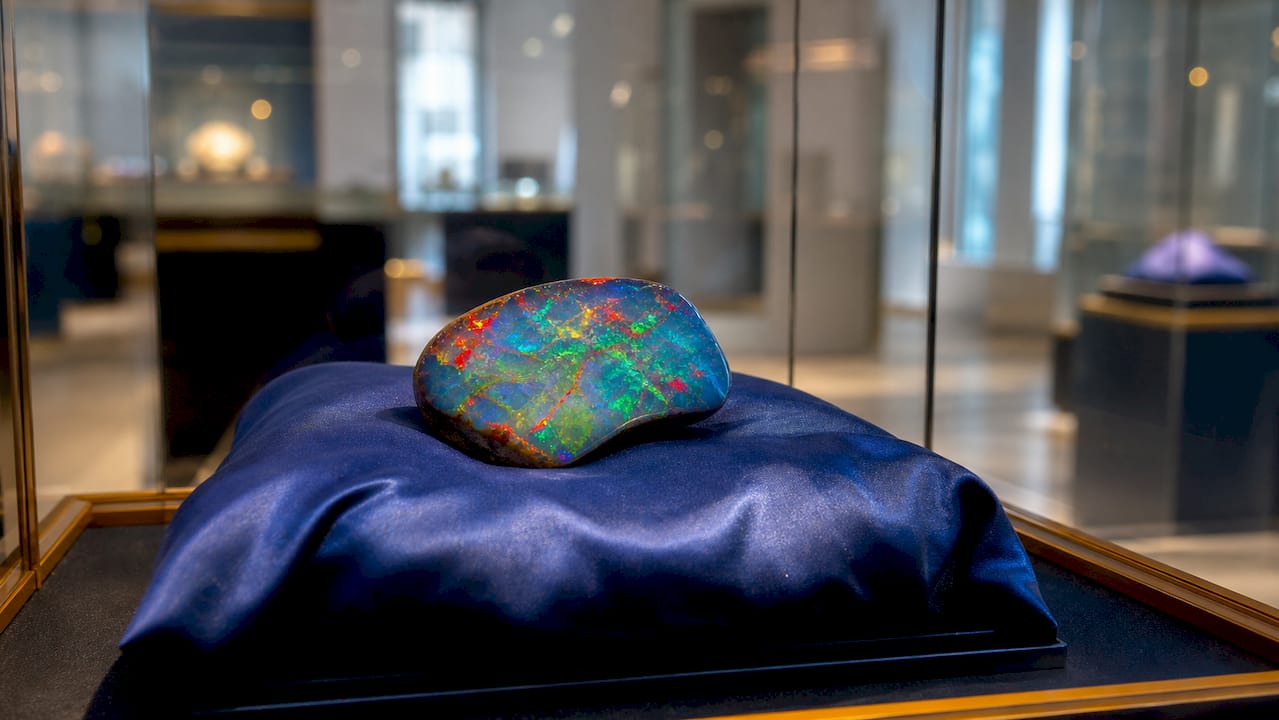
The largest opal ever found is the Olympic Australis, a gem-quality specimen weighing between 17,000 and 17,700 carats and measuring approximately 11 inches in length. Discovered on august 4, 1956, by miner John Dunstan in Coober Pedy, South Australia, this extraordinary stone remains uncut, unpolished, and unsold through any traditional jewelry channel. Its kaleidoscopic play-of-color and sheer scale place it in a category beyond ordinary gemstones. Other record-holding specimens, including the Jupiter Five Opal and Halley’s Comet Opal, each claim their own remarkable distinctions in the world of famous opal finds.
What makes the Olympic Australis the largest gem-quality opal?
The Olympic Australis holds the title of the world’s biggest opal by gem quality, a designation that refers to the potential of the raw material rather than a cut or polished stone. It weighs roughly 7.6 pounds (approximately 3.45 kg) and was purchased from a bag of rough stones, reflecting the informal discovery methods common in mid-century Coober Pedy mining.
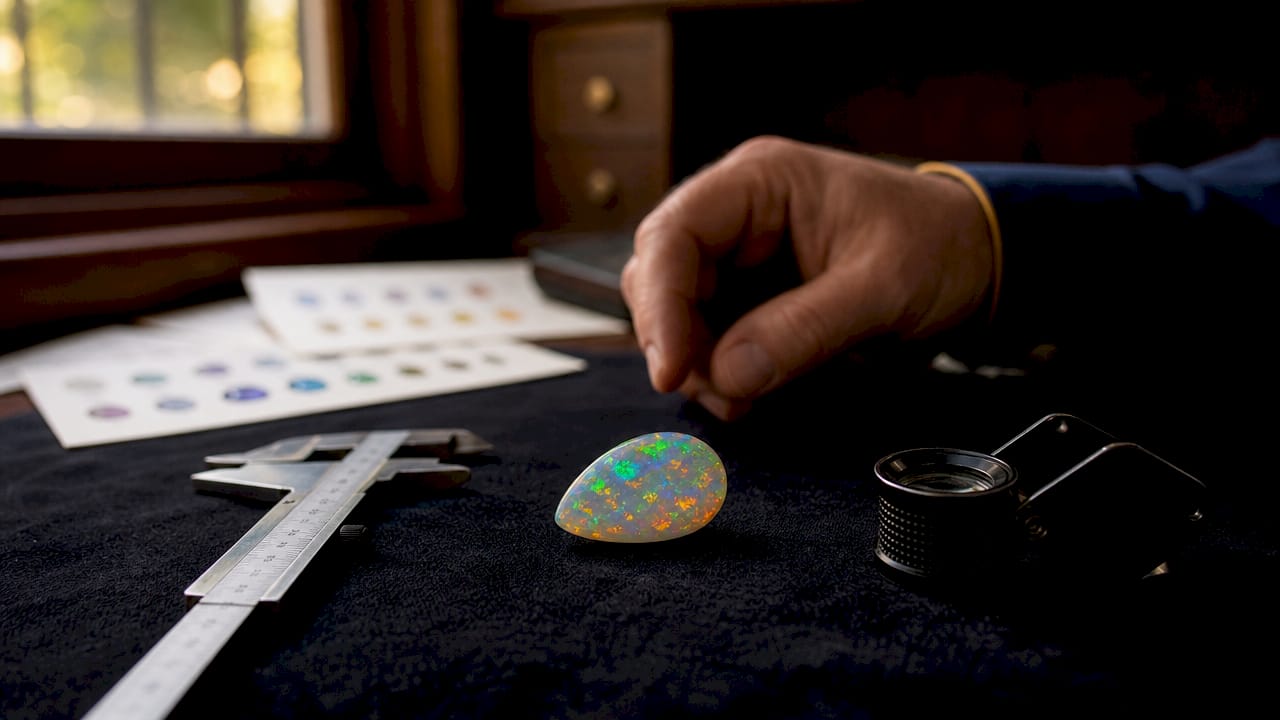
Its physical dimensions alone are staggering. At 11 inches long, the stone dwarfs most museum specimens. What elevates it beyond mere size is its color. Opals gain their signature play-of-color through the refraction of light within microscopic silica prisms, and the Olympic Australis displays this phenomenon across its entire uncut surface. Viewing it under natural light reveals shifting curtains of green, blue, and red that no cutting process could improve.
The stone has never entered the traditional jewelry market. Its valuation remains speculative, rooted in its status as a museum-grade, historic specimen rather than any standard gemological metric. That ambiguity is part of its mystique.
Key physical and historical facts about the Olympic Australis:
- Weight: 17,000–17,700 carats (approximately 3.45 kg)
- Length: Approximately 11 inches
- Discovery date: August 4, 1956
- Location: Coober Pedy, South Australia
- Discoverer: Miner John Dunstan
- Status: Uncut, unpolished, never commercially sold
- Classification: Largest gem-quality opal on record
Pro Tip: When reading about record opal weights, confirm whether the figure refers to a raw nodule or a gem-quality specimen. The distinction changes the record entirely.
How does the Olympic Australis compare to other famous large opals?
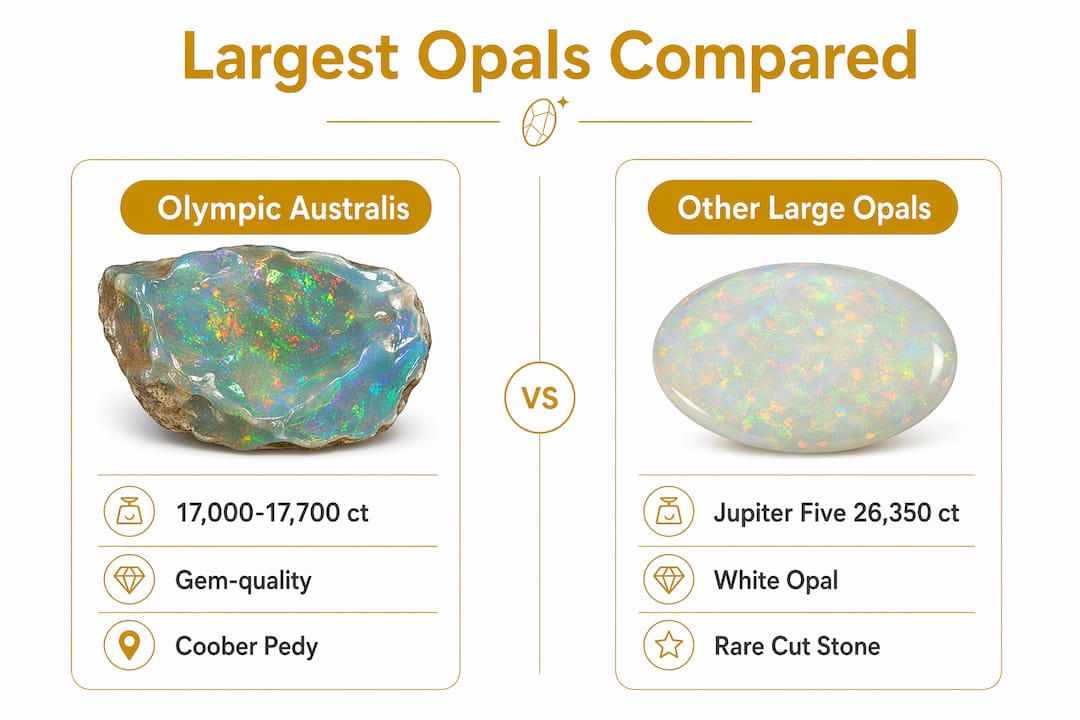
Size records in the opal world are more nuanced than a single number suggests. Classification distinctions between uncut black opal nodules, gem-quality white opals, and crystal opals mean that multiple stones can each claim a legitimate “world’s largest” title depending on the category.
Jupiter Five Opal
The Jupiter Five Opal holds the record as the largest single piece of white, gem-quality opal ever found. Discovered in july 1989 in the Jupiter Field at Coober Pedy, South Australia, it weighs 26,350 carats. That figure exceeds the Olympic Australis in raw weight, yet the Jupiter Five is classified specifically as white opal, while the Olympic Australis is recognized for its superior gem quality and color brilliance. The two stones occupy different record categories rather than competing directly.
Halley’s Comet Opal
Halley’s Comet is recognized as the largest uncut black opal nodule. Black opals, prized for their dark body tone that intensifies color play, form primarily at Lightning Ridge in New South Wales. The “uncut nodule” designation separates Halley’s Comet from gem-quality classifications, making it a record-holder in its own right without displacing the Olympic Australis.
| Opal Name | Weight (carats) | Type | Origin | Status |
|---|---|---|---|---|
| Olympic Australis | 17,000–17,700 | Gem-quality white opal | Coober Pedy, South Australia | Uncut, museum-grade |
| Jupiter Five | 26,350 | White opal | Coober Pedy, South Australia | Largest white opal on record |
| Halley’s Comet | Not publicly listed | Black opal nodule | Lightning Ridge, New South Wales | Largest uncut black opal nodule |
Understanding opal type distinctions is the only reliable way to interpret these records accurately. A collector who compares raw weights without checking classification will draw the wrong conclusions every time.
How are record-breaking opals formed?
The geological story behind the world’s largest opal discoveries spans tens of millions of years. Opal formation involves silica-rich water deposited in sandstone cavities, with repeated evaporation cycles creating layered silica deposits. This process unfolded between 65 million and 30 million years ago across the Australian opal fields, during a period when vast inland seas covered much of the continent.
Four geological conditions explain why Australia, and Coober Pedy in particular, produces specimens of this scale:
- Sandstone cavity abundance. The sedimentary geology of South Australia contains extensive fissures and voids where silica-rich groundwater pooled and slowly evaporated over geological time.
- Consistent silica concentration. The ancient seabed left behind silica-saturated layers. As water evaporated repeatedly, silica precipitated in uniform, stacked arrays that produce the prism-like structures responsible for color play.
- Stable burial conditions. Large specimens require undisturbed formation over millions of years. The arid, tectonically stable environment of central Australia preserved these cavities without the fracturing that destroys large formations elsewhere.
- Depth and pressure. Opals forming at moderate depths experience consistent pressure, which supports the growth of larger, more uniform silica structures. Shallow formations tend to produce smaller, more fragmented stones.
Australia currently produces approximately 90% of the world’s gem-quality opal by value, with annual sales estimated between $250 million and $300 million Australian dollars. That dominance is not accidental. It reflects a unique convergence of geology, climate, and ancient geography found nowhere else on Earth.
Pro Tip: Collectors visiting Coober Pedy should ask about the specific mining field where a stone originated. Different fields within the same region produce opals with distinct body tones and color patterns.
What determines the value of the largest opals?
Standard gemological metrics, including cut, clarity, and carat weight, do not fully apply to record-holding specimens like the Olympic Australis. The value of such stones is shaped by collector interest, cultural rarity, and historical significance rather than conventional jewelry market standards.
For enormous uncut opals, cutting is not a path to greater value. It is a path to destruction of the record itself. Once cut, the Olympic Australis would cease to be the largest gem-quality opal ever found. That status, irreplaceable and permanent, is the primary source of its worth.
“The collectible value of enormous opals is shaped more by their cultural rarity and historical significance than by market standards based on cut and clarity. They are never cut or sold through traditional jewelry channels, making their valuation speculative and rooted in their status as museum-grade, historic specimens.”
The factors that drive value for large uncut opals include:
- Play-of-color intensity. Vivid, broad-spectrum color across a large surface area commands the highest collector premiums.
- Body tone. Black opals with dark body tones amplify color play and are rarer than white or crystal opals.
- Provenance. A documented discovery story, like John Dunstan’s 1956 find, adds historical weight that no amount of color can replicate.
- Condition. Crazing (surface cracking from dehydration) destroys value rapidly. Uncracked specimens of large size are extraordinarily rare.
- Classification integrity. Stones with clear, verifiable records of type and origin command stronger collector confidence.
Understanding what affects opal value at the collector level requires separating the metrics used for jewelry-grade stones from those applied to museum-grade specimens. The two markets operate on entirely different logic.
What should collectors know about record-holding opal discoveries?
Record-holding opals shape the broader Australian opal market in ways that reach far beyond the stones themselves. They establish benchmarks for what is possible, inspire mining investment, and generate cultural prestige that elevates the entire category.
Collectors and enthusiasts should keep several principles in mind:
- Verify classification before comparing. “Largest opal” claims require a type qualifier. Always confirm whether a record refers to white opal, black opal, crystal opal, or a raw nodule.
- Understand raw versus cut value. Raw specimens of exceptional size often carry more collector value uncut. Cutting a large stone into smaller gems may yield more salable pieces but eliminates the record-holding status entirely.
- Provenance documentation matters. A stone with a verified discovery date, location, and chain of custody is worth significantly more than an equivalent stone with no history.
- Market trends follow iconic finds. Discoveries like the Olympic Australis and Jupiter Five generate sustained international interest in Australian opals, which influences pricing across the entire market for years afterward.
- Authenticity verification is non-negotiable. Synthetic and treated opals are common in the market. Collectors should request gemological certificates and source their stones through ethical buying practices that trace the stone from mine to sale.
Pro Tip: Ask any seller for the specific opal field and mining claim where a stone originated. Reputable sources, including direct-miner retailers like Australianopaldirect, can provide this information as a matter of course.
Key Takeaways
The Olympic Australis is the largest gem-quality opal ever found, weighing 17,000–17,700 carats, and its value rests on cultural rarity and historical significance rather than standard jewelry metrics.
| Point | Details |
|---|---|
| Olympic Australis record | Weighs 17,000–17,700 carats; discovered in Coober Pedy in 1956 by John Dunstan. |
| Classification matters | “Largest opal” claims differ by type: white, black, crystal, and raw nodule each have separate records. |
| Geological origin | Opals formed 65–30 million years ago through silica deposition in sandstone cavities across Australia. |
| Value drivers for large opals | Cultural rarity, provenance, and play-of-color intensity outweigh cut and clarity for museum-grade specimens. |
| Collector best practice | Always verify opal type, provenance documentation, and source authenticity before any acquisition. |
Why giant opals matter more than their weight suggests
I have spent years studying the opal market, and the question I hear most often from serious collectors is some version of: “Which one is really the biggest?” The answer is always more interesting than people expect.
The Olympic Australis is not just a large rock. It is a fixed point in geological history, a moment 30 to 65 million years in the making that surfaced in a South Australian mining town in 1956 and has never left human hands since. That permanence is what captivates me. Most gemstones are cut, set, sold, and reset dozens of times across centuries. This one has remained exactly as nature made it.
What I find underappreciated is how these record-holding stones function as anchors for the entire Australian opal market. When the Olympic Australis appears in international press, interest in Australian opals broadly rises. Collectors who will never own a 17,000-carat specimen still feel the pull of that story when they choose a Lightning Ridge black opal or a Coober Pedy crystal. The giant stones make the smaller ones feel more significant, more connected to something ancient and irreplaceable.
My honest advice to any collector: do not chase size as a primary metric. Chase provenance, color, and the story behind the stone. The Olympic Australis is extraordinary not because it is heavy, but because it is whole, documented, and alive with color. Those qualities exist in far smaller stones too, and they are what make opal collecting genuinely rewarding.
— Renee
Australianopaldirect and the legacy of Australian opal excellence
Australianopaldirect sources its collection directly from the same legendary fields, including Coober Pedy and Lightning Ridge, that produced the Olympic Australis and Jupiter Five. Every stone carries a traceable origin and the kind of documented provenance that serious collectors demand.

Whether you are drawn to the iridescent fire of a black opal or the soft luminescence of a white crystal, Australianopaldirect’s curated collection reflects the full spectrum of what Australian mining has to offer. The brand’s direct-miner relationships mean no middlemen, no inflated markups, and no ambiguity about where your stone came from. Explore the full opal collection and find a piece that carries its own chapter of geological history.
FAQ
What is the largest opal ever found?
The Olympic Australis is the largest gem-quality opal on record, weighing between 17,000 and 17,700 carats. It was discovered on august 4, 1956, in Coober Pedy, South Australia.
Is the Jupiter Five Opal heavier than the Olympic Australis?
The Jupiter Five Opal weighs 26,350 carats, exceeding the Olympic Australis in raw weight. However, it holds the record specifically as the largest white opal, while the Olympic Australis is recognized for gem quality and color brilliance across a different classification.
Why has the Olympic Australis never been cut or sold?
Cutting the Olympic Australis would eliminate its status as the largest gem-quality opal ever found. Its value rests on that irreplaceable record, along with its cultural and historical significance, making it a museum-grade specimen rather than a commercial jewelry stone.
Where do the world’s largest opals come from?
Australia produces approximately 90% of the world’s gem-quality opal by value. The most significant large opal discoveries, including the Olympic Australis and Jupiter Five, both originated in Coober Pedy, South Australia.
How can collectors verify the authenticity of a large opal?
Collectors should request gemological certificates, confirm the specific mining field of origin, and source stones through retailers who maintain direct-miner relationships and documented provenance chains.
Recommended
- Opal Origin Regions: A Collector’s Complete Guide - Australian Opal Direct
- 7 Most Famous Australian Opals Every Collector Should Know - Australian Opal Direct
- 7 Exquisite Examples of Rare Opals for Collectors - Australian Opal Direct
- 7 Types of Australian Opals Every Collector Should Know - Australian Opal Direct