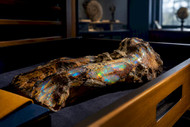
Collectors: Direct Miner Provenance. Wear or Keep Opalized Fossils
Posted by AOD on 26th Sep 2026
Collectors: Direct Miner Provenance. Wear or Keep Opalized Fossils

Opalized dinosaur fossils are collectible specimens in which ancient bone, tooth, or shell has been replaced by opal, prized as gemstones and jewelry pieces rather than as scientific curiosities alone. They are genuinely rare and collectible, but their worth rests on three pillars: the quality of the play-of-color, how much original anatomy survives, and how well the seller can document where the piece was found.
TL;DR:
- The value of opalized fossils depends primarily on the quality of the play-of-color, the rarity of the fossil type, and the specimen’s scientific significance.
- Genuine opalized fossils often contain both precious opal with rainbow flashes and areas of potch without color, with anatomical details visible in high-quality specimens.
- Certificates of authenticity rarely confirm fossils’ genuineness; buyers must verify provenance through detailed seller disclosures, photos, and provenance documentation.
- Protect high-value fossils by storing them in stable humidity, avoiding chemicals, and seeking periodic inspection from specialists, especially if mounted or set in jewelry.
- Reputable sellers often have direct miner relationships, offer insured shipping, and provide transparent provenance, with final purchases supported by detailed verification and insurance.
Table of Contents
- How to spot a genuine opalized fossil specimen
- What drives the value of opalized fossils
- Why certificates alone can’t confirm a fossil’s authenticity
- Caring for an opalized fossil without damaging it
- Choosing a seller and the checklist to run before you buy
- A collector’s take on chasing color, and conscience, in old bone
- How Australian Opal Direct helps you buy with confidence
- Where to go for further verification
- FAQ
How to spot a genuine opalized fossil specimen
The first thing a trained eye looks for is color behavior. Precious opal flashes rainbow fire, a true play-of-color caused by light bending through ordered layers of silica spheres, while potch is the common opal that shows body tone and translucency but no fire at all. Many opalized fossils contain both within a single piece, precious opal tracing the contours of old bone while potch fills the surrounding matrix.
Terminology matters when reading a listing. A specimen described as opal in host rock still carries its surrounding stone or fossil material, while opal on host rock refers to a thin veneer of precious opal sitting atop another material. Solid opal means the piece is opal through and through with no host attached.
Anatomical detail is the other tell. In the best specimens, the internal architecture of bone, including the honeycomb-like trabecular structure and the fine channels where nerves once ran, remains visible through translucent opal. Polishing can bring this detail into view beautifully, but aggressive polishing can also grind it away entirely, trading scientific integrity for shine.
- Precious opal shows a mobile play-of-color; potch shows body tone with no color flash.
- Opal in host rock, opal on host rock, and solid opal describe how much original material remains.
- Visible trabecular structure or nerve channels signal a specimen with real anatomical value.
- Common forms include bone fragments, teeth, shell material, and belemnites, each suited to different mounts or display cases.
Pro Tip: Ask for a photo taken with raking light across the polished face. It reveals surface texture and internal structure far better than a straight-on shot.
What drives the value of opalized fossils
Price in this category swings widely because so many variables stack on top of one another. The strength and evenness of the play-of-color usually carries the most weight, followed by how rare the fossil type is, the size and weight of opalized material present, transparency, and the physical condition of the piece, since cracks or over-polishing both reduce value.
Scientific importance adds another layer entirely. A fragment with clear anatomical detail from a well-documented deposit can command a premium over a similarly colorful piece with no identifiable structure, because it appeals to both gem collectors and natural history buyers at once.
- Play-of-color quality and evenness across the visible surface.
- Rarity of the fossil type, such as tooth, bone, or shell material.
- Size, weight, and transparency of the opalized portion.
- Condition, including cracks, stability, and prior polishing decisions.
- Documented scientific or anatomical significance.
Entry-level collectible opalized fossil pieces tend to start at prices that reflect their rarity and quality, while exceptional specimens have reached extraordinary heights. An opalized belemnite known as the Virgin Rainbow, one of the most celebrated examples ever found, has reportedly sold for a very high price, illustrating that the market can reach extreme values for the rarest finds.
Cutting a fossil into jewelry-ready cabochons can increase wearability and appeal to buyers who want a freeform opal cabochon set in a ring or pendant, but it often reduces the piece’s value as a scientific specimen. Factor insurance, secure shipping, and any conservation costs into your budget before you commit, since these expenses are easy to underestimate on a high-value purchase.
Why certificates alone can’t confirm a fossil’s authenticity
Formal opal certificates were never designed to cover fossils, and that gap catches many new buyers off guard. The Australian Opal Association’s own certification guidance limits Certificates of Authenticity to loose, natural, untreated opals, meaning a fossil or a finished piece of jewelry typically cannot receive one at all. That leaves provenance and seller transparency as the real safeguards.
Before you buy, work through a short sequence of checks:
- Ask the seller directly where and when the specimen was found, and whether they have a documented relationship with the miner.
- Request high-resolution photos of both the rough, uncut material and any polished faces.
- Ask whether any treatment, stabilization, or repair has been performed, and get that disclosure in writing.
- Request a polariscope reading, UV notes, or an independent lab report if one exists for the piece.
- Confirm the written return policy and any insurance terms before finalizing payment.
Watch for red flags: a “certificate” with no signature or issuing body, vague find-location claims, heavy alteration that has erased identifiable anatomy, or an unexplained composite where two materials have been joined without disclosure.
Pro Tip: A seller who freely shares unpolished, uncropped photos of the rough material is almost always more trustworthy than one who only shows a finished, backlit close-up.

Caring for an opalized fossil without damaging it
Opalized fossils face the same vulnerabilities as any opal, plus the added fragility of ancient bone or shell structure underneath. Dehydration can cause micro-cracking, sudden temperature swings invite thermal shock, and a hard knock or harsh chemical exposure can undo years of stability in an instant.
- Store pieces at a stable humidity level, cushioned on padded supports, away from direct sunlight or heat sources.
- Skip ultrasonic cleaners entirely, and avoid household chemicals; a soft, slightly damp cloth is usually enough.
- Have a specialist jeweler inspect mounted pieces periodically rather than attempting repairs yourself.
- If a specimen carries scientific value, favor conservation of anatomical detail over deeper polishing, and choose reversible mounting whenever the piece might later be studied.
- Insure high-value specimens individually and ship them only with tracked, insured couriers.
Choosing a seller and the checklist to run before you buy
Reputable sources for opalized fossils generally fall into a few categories: specialist opal retailers with direct miner relationships, vetted auction houses, museum deaccessions, and established private sellers with a track record. Each can be legitimate, but the burden of proof still sits with the buyer.
Before any purchase, request the following in writing:
- The find location and any documented chain of provenance from miner to seller.
- High-resolution images showing both the raw material and the finished, polished faces.
- Full disclosure of any treatment, stabilization, or repair work performed.
- A clear return policy and warranty terms.
- Insured shipping with tracking for the full declared value.
Decide early whether you want a display specimen preserved close to its original state or a piece destined for jewelry, since that choice shapes how much polishing is acceptable. Once you own the piece, arrange a post-purchase valuation and insurance policy promptly. For deeper reading on verifying origin, see our guide on how to authenticate Australian opals and our notes on opal provenance and ethical sourcing.
A collector’s take on chasing color, and conscience, in old bone

The pull of an opalized fossil is unlike any other gemstone experience. You are not just holding color and light, you are holding a record of something that lived and died long before humans existed, later filled cell by cell with silica until stone became a mirror for the sun. That duality, part relic and part gem, is why I think buyers owe these pieces more scrutiny than an ordinary opal.
Direct relationships with miners matter enormously here, not as a marketing phrase but as the only real way to trace a fossil back to a documented find site rather than a story invented after the fact. When a piece has genuine anatomical significance, I lean toward minimal polishing that respects the original surface rather than chasing maximum brilliance. Save the deeper polish and the bold freeform opal cabochon cuts for fragments with no scientific detail left to protect, and consider a custom setting only once you know which path, display or wear, the piece is meant for.
— Renee
How Australian Opal Direct helps you buy with confidence
Buying an opalized fossil sight unseen from a stranger online is a gamble most collectors would rather not take. Some sellers work directly with miners at source, which means the story behind a piece, its find location and the hands it passed through, can actually be documented rather than assumed.
Some purchases may come with a limited warranty and insurance on shipping, helping ensure a high-value opalized fossil travels protected and arrives backed by customer support rather than a vague promise. Some sellers offer custom hand-crafted opal jewelry, allowing customers to commission settings built around the specific shape and color of fossil fragments.
- Direct miner relationships support real, traceable provenance.
- Custom design turns a raw fossil fragment into a wearable opal ring or pendant.
- Every order ships insured, backed by a 90-day warranty.
Before committing to any piece, run it through the verification checklist above, then browse the current opal stones and jewelry collection to see what’s available or request additional photos of a specific specimen.
Where to go for further verification
For ongoing reference, the Australian Opal Association publishes classification terms and certification guidance that clarify what “play-of-color,” “opal in host rock,” and similar terms actually mean in a listing. Museums including the Australian Museum and the Australian Opal Centre hold benchmark specimens, such as an opalized pliosaur nicknamed Eric, that illustrate what exceptional preservation looks like. Peer-reviewed research on opalization at deposits like those near Lightning Ridge offers useful background on how these formations occur in the first place.
FAQ
What exactly is an opalized dinosaur fossil?
It is a fossil, typically bone, tooth, or shell, in which the original material has been replaced by opal through a slow mineral process, leaving behind a gem-quality specimen rather than plain fossilized rock. Collectors value these pieces for both their rarity and their visual character, including play-of-color where precious opal is present.
Can a certificate of authenticity confirm an opalized fossil is genuine?
Not typically. Certificates of Authenticity are generally issued only for loose, natural, untreated opals, and industry guidance from the Australian Opal Association indicates they usually cannot cover fossils or finished jewelry. Buyers should instead rely on documented provenance, seller transparency, and detailed photos of rough and polished material.
How much should I expect to pay for a collectible opalized fossil?
Entry-level collectible pieces tend to start at prices that reflect their rarity and quality, while rare, high-quality specimens can reach far higher figures depending on color, size, and scientific significance. One exceptional example, the opalized belemnite known as the Virgin Rainbow, sold for more than $1 million.
Is it better to keep an opalized fossil as a specimen or have it set as jewelry?
That depends on whether the piece carries scientific or anatomical significance worth conserving, in which case minimal polishing and a reversible mount are usually the safer choice. If the fragment has strong color but little identifiable structure, cutting it into a cabochon for a ring or pendant is a reasonable option.
What should I ask a seller before buying an opalized fossil?
Request the find location, any documented relationship with the miner, high-resolution photos of both raw and polished faces, and full disclosure of any treatment or repair. You should also confirm the return policy and insist on insured shipping before finalizing the purchase.








