6 Key Differences Between Opal and Topaz Jewelry Buyers Need
Posted by AOD on 21st Sep 2026
6 Key Differences Between Opal and Topaz Jewelry Buyers Need
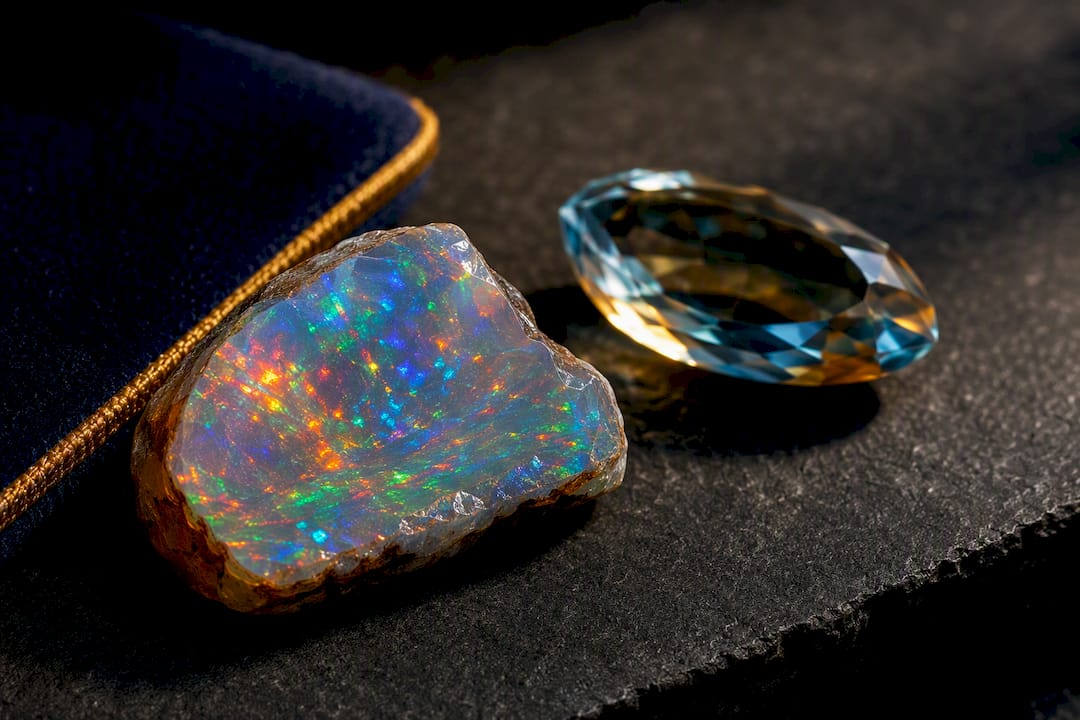
Choose opal if you want a stone that no other stone on earth can imitate, a shifting field of color that turns every angle into a different painting. Choose topaz if you want faceted brilliance, everyday scratch resistance, and a lower price for a stone that still looks precious. Opal demands gentler settings and more care; topaz demands a mindful jeweler because it can cleave on impact despite its hardness. Either way, ask for treatment disclosure and, for anything valuable, a lab report before you buy.
TL;DR:
- Opal’s unique play-of-color is caused by silica sphere diffraction, making each stone one-of-a-kind and difficult to match precisely.
- Topaz’s consistent color comes from impurities within its crystal lattice, allowing for reliable, identical cuts and easier pairing in jewelry.
- Despite its higher hardness, topaz can cleave along perfect crystal planes, meaning impacts can cause fractures more easily than with opal.
- Buyers should always request treatment disclosure and independent lab reports for high-value stones to verify authenticity and treatment history.
- Proper setting and careful handling are crucial, as opal needs gentle protection, while topaz must be secured against impact despite its toughness.
Table of Contents
- Opal vs Topaz Comparison at a Glance
- Why Does Opal Show Play-of-Color While Topaz Doesn’t?
- Which Gemstone Handles Daily Wear Better?
- Treatments and Authentication: What to Ask Before You Buy
- How Should You Clean and Store Opal and Topaz?
- What Actually Drives the Price of Each Stone?
- How to Choose Between Opal and Topaz for Your Purchase
- How Trusted Opal Sellers Protect Buyers
- The Real Question Isn’t Which Stone Is Better
- Where to Find Genuine, Well-Documented Opals
- Key Reference Sources
- FAQ
Opal vs Topaz Comparison at a Glance
Before you fall in love with a particular stone, it helps to see the two side by side. The differences run deeper than looks. They touch how the stone was formed, how it survives daily wear, and what actually drives its price.
- Composition: Opal is hydrated amorphous silica; topaz is a crystalline aluminum fluoro-silicate with a defined atomic lattice.
- Optics: Opal produces play-of-color through light diffraction across silica spheres; topaz shows fixed, faceted crystal color from impurities or color centers.
- Hardness (Mohs scale): Opal sits around 5.5 to 6; topaz sits near 8, making it far more scratch resistant.
- Structural risk: Opal can chip or craze; topaz has perfect cleavage, meaning a sharp knock can split it along a flat plane despite its hardness.
- Price signal: Fine black or crystal opal can command high prices per carat; most blue topaz is inexpensive, while natural imperial or pink topaz is genuinely rare and costly.
- Best jewelry uses: Opal favors pendants, earrings, and protected ring settings; topaz handles daily-wear rings reasonably well if the setting guards against impact.
Within each stone, variety matters as much as species. Black opal from Lightning Ridge and boulder opal from Queensland behave and price differently from milky crystal opal. Imperial topaz, prized for its warm orange-pink hue, has almost nothing in common price-wise with the widely treated blue topaz sold in mall jewelry counters.
Why Does Opal Show Play-of-Color While Topaz Doesn’t?
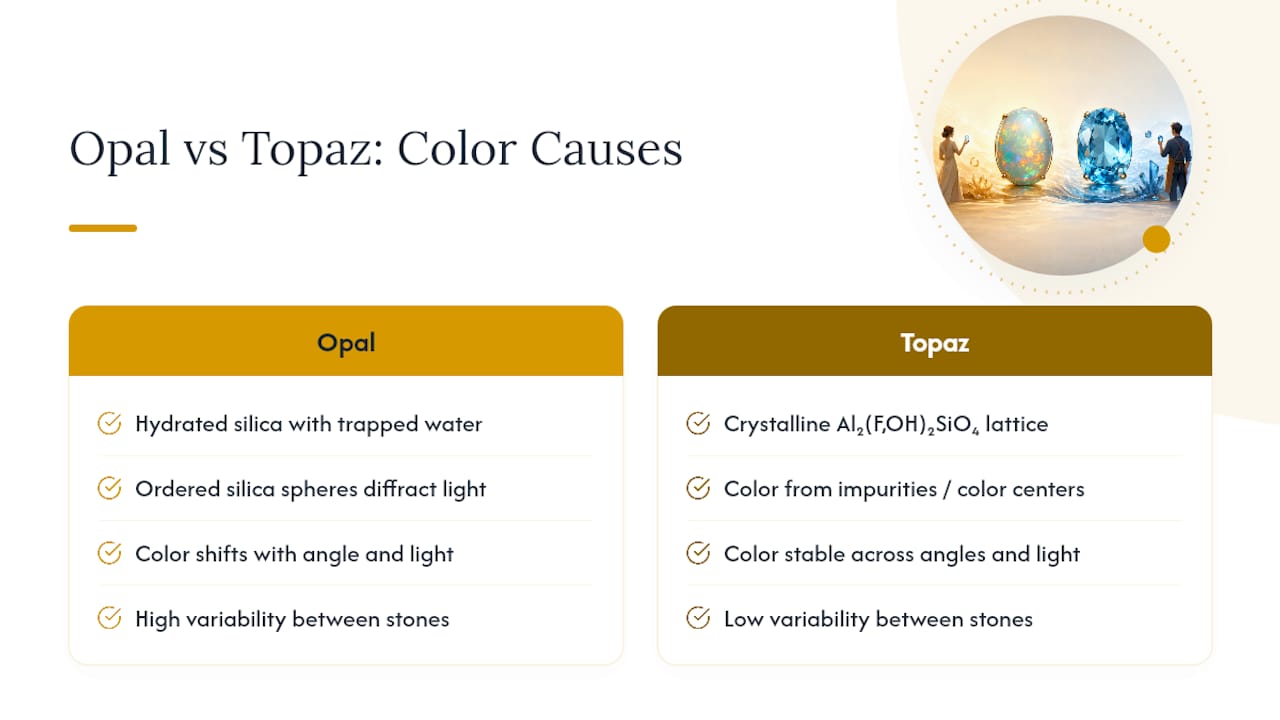
Opal’s magic comes from its structure, not its chemistry alone. It forms as hydrated silica, SiO₂ with water trapped inside, arranged as tiny spheres stacked in a semi-ordered pattern. When those spheres are uniform in size and neatly arranged, light bends and diffracts as it passes between them, splitting into the spectrum of color you see moving across the stone as you tilt it. Geoscience Australia describes this play-of-color as the direct result of that ordered silica sphere structure. No two opals arrange those spheres identically, which is why no two opals ever look quite the same, even from the same parcel of rough.
Topaz works on a completely different principle. It’s a crystalline mineral, Al₂(F,OH)₂SiO₄, with a fixed atomic lattice. Its color comes from trace impurities or “color centers” inside that lattice, not from diffraction. A blue topaz stays the same blue in every light and from every angle; an imperial topaz holds its warm orange glow consistently. That predictability is topaz’s strength. A jeweler cutting a matched pair of topaz earrings can rely on identical color and faceted brilliance from stone to stone.
Try that with opal, and you run into a real buying challenge. Because pattern and color intensity vary so much within a single stone, matching two opals for earrings or a set is genuinely difficult, and it’s part of why well-matched opal pairs sell at a premium. It also means photographs can mislead. A screen rarely captures how an opal’s color shifts in hand, which is one reason reliable opal quality checklists emphasize viewing the actual stone, or at minimum requesting video, before committing to a purchase. Topaz photographs far more predictably, since what you see under one light is close to what you get under most others.
Which Gemstone Handles Daily Wear Better?
Here’s where a lot of buyers get tripped up: hardness numbers don’t tell the whole durability story. That much is straightforward. What surprises people is that topaz’s higher hardness doesn’t make it immune to breaking.
Topaz has perfect cleavage, a plane of weakness built into its crystal structure. A hard knock against a table edge or a fall onto tile can split a topaz cleanly along that plane, even though the same impact might only scuff an opal. Hardness measures resistance to scratching, not resistance to a sharp blow, and that distinction matters more in a ring than in almost any other jewelry format because rings take the most impact of anything you wear.
Opal’s risks run differently. It can scratch more easily than topaz, chip at facet edges or along thin sections, and develop a network of fine surface cracks called crazing if it loses moisture too quickly.
For rings, both stones need thoughtful setting design, just for different reasons. Opal rings do best in bezel or halo settings that shield the edges and cushion the stone from direct knocks. Topaz rings do best with secure prongs and a setting profile that keeps the stone from taking a flat hit at a vulnerable angle. Pendants and earrings are the gentler option for either gem, since they take far less daily abuse than a ring worn on a working hand.
Treatments and Authentication: What to Ask Before You Buy
Nearly every colored gemstone sold today has some form of treatment history, and opal and topaz are no exception. What matters is disclosure, not the treatment itself.
Opal treatments to know:
- Doublets and triplets: a thin slice of precious opal glued to a backing (doublet) or capped with a protective layer of quartz or plastic (triplet), rather than a solid stone.
- Impregnation: wax, resin, or plastic used to stabilize porous opal or enhance its surface shine.
- Surface modification: minor polishing or coating treatments that can alter how the stone reflects light.
Topaz treatments to know:
- Irradiation and heat treatment: the source of most commercial blue topaz, since natural blue topaz in that saturation is genuinely rare.
- Coated “mystic” topaz: a thin film applied to colorless or pale topaz to create rainbow surface effects.
- Lab-grown material: less common than treated natural stone, but it exists and should be disclosed as such.
GIA has documented that opal is sometimes impregnated with oil, wax, or plastic, and that blue topaz color is very often the result of treatment rather than nature alone, which is exactly why disclosure wording matters so much at the point of sale.
Pro Tip: Ask the seller to state in writing whether an opal is solid, a doublet, or a triplet, and whether a topaz is natural, treated, or lab-grown. For any purchase above a few hundred dollars, request an independent laboratory report, from GIA or an equivalent gemological lab, rather than relying on a verbal assurance.
How Should You Clean and Store Opal and Topaz?
Care routines diverge here more than almost anywhere else in this comparison, and getting it wrong is the single most common way buyers damage either stone after purchase.
- Clean with warm, soapy water and a soft cloth for both stones. This is the default safe method recommended for most gemstone jewelry, opal and topaz included.
- Skip the ultrasonic cleaner for opal entirely. The vibration and moisture cycling can worsen crazing or loosen doublet and triplet assemblies.
- Be cautious with ultrasonic cleaning for topaz too, since cleavage planes make it more vulnerable to vibration stress than its hardness would suggest.
- Avoid sudden temperature swings for opal, including hot dishwater followed by cold rinse, since rapid changes stress the stone’s water content.
- Store opal away from direct heat and very dry environments, such as a car dashboard or a display case near strong lighting, to reduce the risk of crazing over years of ownership.
- Store topaz separately from harder stones like diamond or sapphire in your jewelry box, since even topaz can scratch against something harder if pieces rub together.
Setting choices matter just as much as cleaning habits. Opal rings benefit most from bezel or halo settings that keep the stone’s edge protected from daily knocks; pendants and earrings are lower-risk formats for opal overall. Topaz holds up well in most standard prong settings, provided the prongs are secure and the stone isn’t positioned to take a flat impact at its most exposed angle.
Pro Tip: If you tend to work with your hands, garden, or play sport while wearing your rings, lean toward topaz in a protective setting or shift opal to a pendant or earrings instead of a ring.
What Actually Drives the Price of Each Stone?
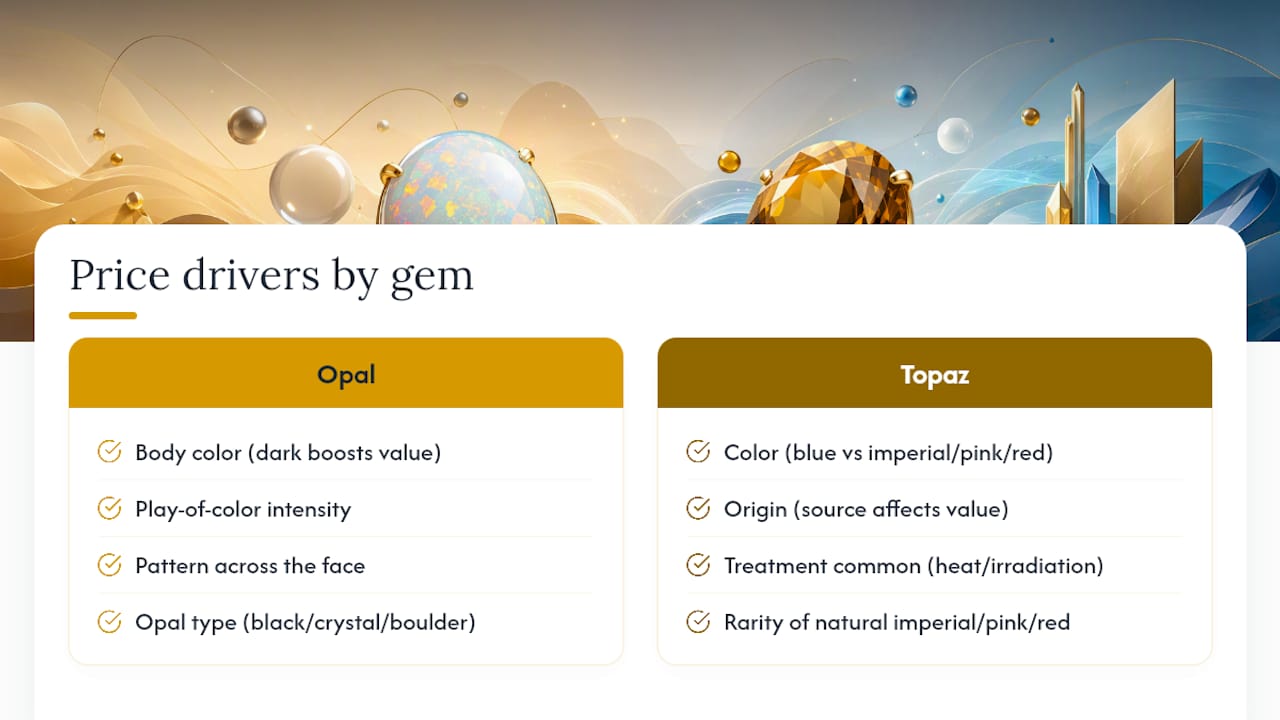
Opal pricing runs almost entirely on the stone itself rather than on carat weight alone. GIA identifies body color, play-of-color intensity, pattern, and opal type as the core value drivers, alongside size and provenance. Black opal from Lightning Ridge is considered among the most valuable due to its contrasting dark body color enhancing play-of-color; crystal opal and boulder opal from Queensland price differently again, based on their own body tone and pattern. Two opals the same size can differ in price by a wide margin because one flashes vivid reds and greens across its whole face while the other shows a faint, patchy flicker.
Topaz pricing splits sharply by color and origin. Most blue topaz on the market is heat or irradiation treated and widely affordable, which is exactly why it shows up in mall jewelry at accessible prices. Natural imperial topaz, along with rare pink and red material, is a different story entirely: genuinely scarce, and priced accordingly when it appears on the market.
If you’re buying for value retention, prioritize the quality variables that match your actual use. A gift meant to dazzle at a reasonable budget points toward well-cut blue topaz. A collector’s piece or a statement ring meant to be one of a kind points toward opal with strong pattern and vivid play-of-color, ideally with documented value factors behind the asking price.
How to Choose Between Opal and Topaz for Your Purchase
Run through this checklist before you commit to either stone:
- How will you wear it? Daily-wear rings favor topaz in a protective setting; opal shines in pendants, earrings, or occasional-wear rings.
- How much maintenance are you willing to do? Opal asks for more mindful care around heat, dryness, and cleaning method; topaz is more forgiving day to day.
- What’s your budget, and what matters more within it? Treated blue topaz stretches further; fine opal or rare imperial topaz both demand a premium for genuine rarity.
- Do you want a one-of-a-kind stone or consistent, matched brilliance? Opal delivers uniqueness by nature; topaz delivers repeatable, predictable sparkle.
- Do you need certification for insurance or resale? Valuable stones of either type should come with an independent lab report.
Before buying, ask the seller directly whether any treatment has been applied, what the return policy covers, whether insured shipping is included, and whether a certificate accompanies the piece. For anything you’re buying sight unseen, request detailed, well-lit photographs from multiple angles, and for higher-value purchases, insist on a lab report rather than a seller’s word alone. If you’re deciding between an opal ring and an opal pendant, guidance on selecting engagement stones walks through exactly this kind of setting-versus-lifestyle tradeoff.
How Trusted Opal Sellers Protect Buyers
A reputable opal seller earns trust through specifics, not slogans. Direct relationships with miners in fields like Lightning Ridge, Coober Pedy, and Queensland let a seller speak to a stone’s actual origin rather than a vague “ethically sourced” label. Detailed photography, ideally multiple angles and honest lighting, lets you judge play-of-color before you buy rather than after.
The protections that matter most sit behind the sale: insured shipping so a stone in transit isn’t your financial risk, clear written treatment disclosure stating whether a piece is solid opal or an assembled doublet or triplet, and a workable warranty and return policy if the stone doesn’t match its description on arrival.
Before you buy from any seller, ask three things: Can you name the specific mining region this stone came from? Will you state the treatment status in writing? What happens if an independent lab report contradicts your listing? A seller confident in their stones answers all three without hesitation, and authentication guidance for Australian opals gives you the specific questions to bring to that conversation.
The Real Question Isn’t Which Stone Is Better
Most comparisons frame this as a contest with a winner, and that’s the wrong lens. Topaz wins on scratch resistance and predictable cost. Opal wins on individuality and sheer visual reward. Neither fact makes the other stone inferior; it makes them suited to different lives.
What the conventional advice underplays is how much setting design changes the calculus. A topaz in a poorly designed setting can still cleave on one bad knock, and an opal in a proper bezel setting, worn thoughtfully, can last generations. I’d argue the hardness number gets far more attention than it deserves, and setting choice gets far less.
If you’re buying opal, the single highest-leverage decision you’ll make isn’t the stone’s color or pattern. It’s whether the seller will put treatment status in writing and stand behind it with a real return policy. Rarity without verification is just a story. Rarity backed by documentation, provenance, and a seller willing to answer hard questions is worth paying for.
— Renee
Where to Find Genuine, Well-Documented Opals
If this comparison has you leaning toward opal, the harder part is finding a seller who backs their stones with more than a good photo. A reputable opal seller often works with miners in Australian regions like Lightning Ridge, Coober Pedy, and Queensland, which can help verify the provenance story behind a piece. It’s a traceable relationship, cutting out the markup and guesswork that comes with buying through multiple middlemen.

Every piece is backed by insured shipping and a 90-day warranty, and treatment status is disclosed clearly, whether you’re browsing a custom hand-crafted opal design, a set from the opal jewelry sets collection, or a ring from the opal rings collection. Members of the Opal House Private Club get early access to limited-release pieces before they’re listed publicly. Whatever you choose, request the treatment disclosure in writing and, for a significant purchase, ask about an independent lab report before you check out. Browse the current collection and see which stone actually speaks to you.
Key Reference Sources
- GIA buyer guides on opal and topaz, covering quality factors, treatments, and lab reporting
- Gem-A’s gemstone jewelry care guide, covering cleaning methods safe for softer stones.
FAQ
Who Should Not Wear Opal?
Opal isn’t a good fit for anyone doing regular manual labor, contact sports, or frequent hand-heavy chores while wearing it on a ring, since its softer surface scratches and chips more easily than harder stones. It’s also a poor match for very dry or high-heat climates without extra care, since prolonged dryness can cause surface crazing over time. Pendants and earrings sidestep most of this risk if you love opal but live a hands-on lifestyle.
Is Opal Precious or Semiprecious?
Opal falls under the older term “precious gemstone” in traditional trade language, alongside diamond, ruby, sapphire, and emerald, though gemologists increasingly avoid the precious versus semiprecious split since it doesn’t reflect actual rarity or value well. Fine black opal can sell for far more per carat than many stones still labeled “precious,” which shows how outdated that old category really is.
How Do You Tell if a Stone Is Real Opal?
A home scratch test is unreliable and can damage a genuine stone, so GIA recommends examination by a qualified gemologist instead. Real opal shows a natural, often irregular play-of-color pattern rather than the uniform, printed-looking color sheet seen in plastic imitations, and a jeweler can confirm this along with checking for doublet or triplet construction. For a full walk-through of the visual and physical checks, see how to spot fake opal.
Is Topaz an Expensive Stone?
It depends entirely on which topaz you’re buying. Most blue topaz on the market is heat or irradiation treated and sold at accessible prices, while natural imperial, pink, and red topaz are genuinely rare and priced well above common blue material. Color type, not the name “topaz” alone, determines whether a piece is a budget find or a serious investment.








