Mohs 9 vs Lower Hardness: Sapphire or Opal for Everyday Rings
Posted by AOD on 31st Aug 2026
Mohs 9 vs Lower Hardness: Sapphire or Opal for Everyday Rings
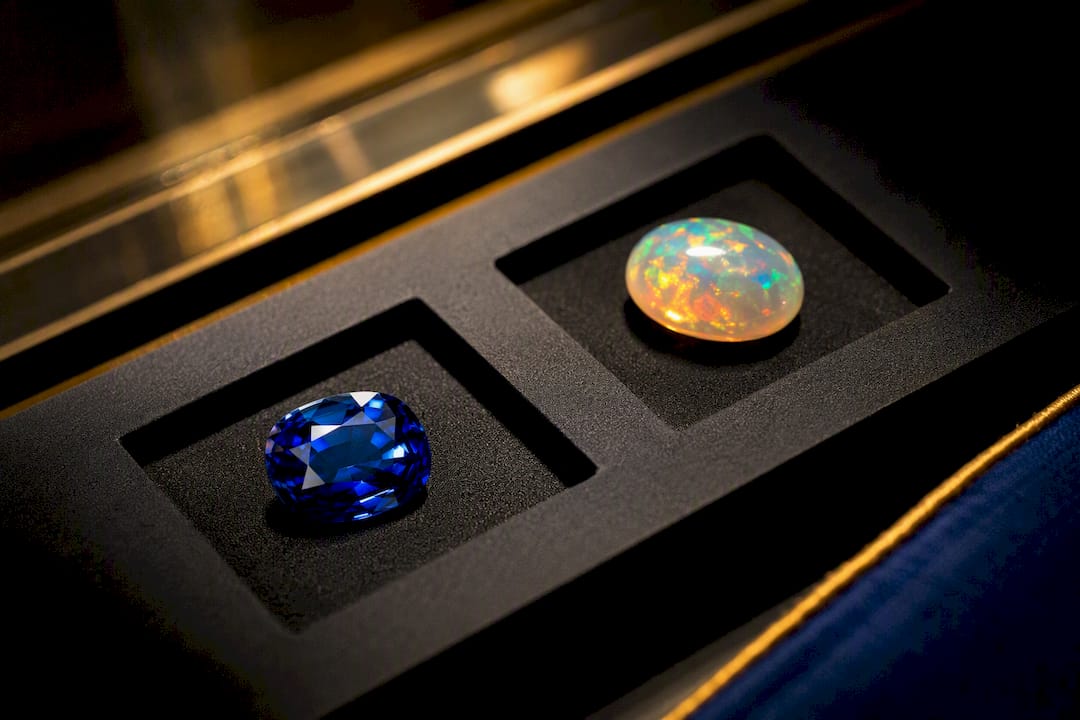
If you want an everyday, low-maintenance center stone, choose sapphire. If you crave a unique, living color that shifts with every glance and you’re willing to handle it thoughtfully, opal deserves your attention. The choice comes down to one number: Mohs hardness, and what it means for the life your jewelry actually lives.
TL;DR:
- Sapphire offers high scratch resistance and toughness, making it suitable for daily rings and high-impact jewelry pieces.
- Opal’s lower hardness and water content make it vulnerable to scratches, impact, and temperature changes, requiring careful handling and protection.
- The vivid play-of-color in opal is unique and depends on patterns and brightness, while sapphire’s brilliance results from precise faceting and high refractive index.
- For jewelry, choose sapphire for rings subjected to frequent wear and opt for opal in pendants or earrings with protective settings.
- Always verify if the gemstone is treated or composite before purchasing, and consider the origin and treatment status for long-term value.
Table of Contents
- Opal vs Sapphire at a Glance
- Durability: What Hardness and Toughness Mean for Daily Wear
- Appearance: Opal’s Play-of-Color vs Sapphire’s Brilliance
- Which Jewelry Pieces Suit Each Stone
- Care and Maintenance: What to Do and What to Avoid
- Price and Rarity: What Drives Value for Each Gem
- How to Choose Between Opal and Sapphire
- Why Genuine Australian Solid Opals Remain a Compelling Choice
- Final Recommendation and Next Step
- A Collector’s Case for Opal
- Explore Authentic Australian Opals
- Authoritative Sources and Further Reading
Opal vs Sapphire at a Glance
The gap between these two gems starts with hardness and ends with how you’ll wear them. Sapphire earns a 9 on the Mohs scale, while opal sits at a lower hardness, and that difference shapes nearly every recommendation that follows.
- Hardness: Sapphire resists scratches far better than opal, which has a lower hardness.
- Chip and crack risk: Opal is more vulnerable to impact; sapphire tolerates daily knocks.
- Best uses: Sapphire suits rings and bracelets; opal shines in pendants, earrings, or protected ring settings.
- Care: Sapphire tolerates most cleaning methods; opal needs warm soapy water only, never ultrasonic or steam cleaners.
Neither stone is “wrong.” They just answer different questions about how you live.
Durability: What Hardness and Toughness Mean for Daily Wear
Mohs hardness measures scratch resistance, not overall toughness. Sapphire rates high on this scale, while opal has a notably lower rating, and that difference determines whether a stone can survive years of keys, countertops, and handshakes without a dull, scuffed surface.
Scratch resistance and toughness aren’t the same thing, though. A stone can resist scratches yet still crack under a sharp blow, and opal’s structure adds extra fragility to the equation. Opal is amorphous silica containing roughly 1 to 6 percent water, which makes it prone to a condition called crazing, tiny internal cracks that appear when the stone dries out or endures sudden temperature swings. Some opals, known as hydrophane opals, absorb moisture readily and can change appearance or even crack if they dry out too fast after getting wet.
- Sapphire: High scratch resistance, good overall toughness, safe for rough daily use.
- Opal: Lower scratch resistance, moderate toughness, sensitive to heat, dryness, and chemicals.
That combination, softer material plus water content plus temperature sensitivity, is why opal asks for more consideration than most gemstones you’d consider for a ring.
Appearance: Opal’s Play-of-Color vs Sapphire’s Brilliance
Opal doesn’t have a color so much as a performance. Its play-of-color comes from microscopic silica spheres that diffract light into flashes of red, green, blue, and violet, arranged in patterns collectors name and prize: harlequin, pinfire, flash, and ribbon among them. Cut as cabochons rather than facets, opals are shaped to showcase that shifting color rather than to bend light into sharp points.
Sapphire works the opposite way. Its higher refractive index bends and reflects light through precise facets, producing the crisp, concentrated brilliance you see in a well-cut faceted stone. Compared side by side, an orange fire opal reads warm and glowing, almost lit from within, while an orange sapphire throws sharper, more geometric sparkle.
- Opal: Kaleidoscopic color shifts, cabochon cuts, best viewed in natural or angled light.
- Sapphire: Consistent hue, faceted brilliance, reads strong under direct or artificial light.
One stone paints with movement. The other cuts with precision.
Which Jewelry Pieces Suit Each Stone
Matching the gem to the piece matters as much as matching it to your taste. Here’s a practical breakdown:
- Daily-wear rings: Choose sapphire. Its hardness handles the friction and impact a ring endures from hand washing, typing, and everyday bumps.
- Pendants and necklaces: Opal performs beautifully here since pendants rarely strike hard surfaces.
- Earrings: Opal works well in drops or studs, where exposure to impact is minimal.
- Opal rings, if you insist: Ask for a bezel or halo setting that wraps protective metal around the stone’s edge, and consider wearing it only on lower-activity days.
If you’re weighing an opal for an engagement ring specifically, a protective setting isn’t optional. It’s the difference between decades of enjoyment and an early trip to the jeweler.
Care and Maintenance: What to Do and What to Avoid
Opal care runs on a short, strict list. Clean it with warm, soapy water and a soft cloth, and stop there. Ultrasonic cleaners, steam cleaners, harsh chemicals, and sudden temperature changes all threaten opal’s stability, and even prolonged sun exposure or a dry heating vent can encourage crazing over time.
Sapphire tolerates far more, including most standard jewelry cleaning methods, but one caveat applies broadly: many sapphires are heat-treated or fracture-filled to improve color and clarity, and those treated stones may need gentler handling than a fully natural sapphire would.
- Opal: Warm soapy water only. No ultrasonic, no steam, no extreme heat or dryness.
- Sapphire: Warm water and mild soap works for most stones; ask about treatments before using stronger methods.
- Storage: Keep opal away from direct sunlight and heating vents; store both stones separately from harder gems that could scratch them.
Pro Tip: Store opal jewelry in a soft pouch with a lightly damp cotton ball nearby, not touching the stone, to help maintain ambient moisture in dry climates. For a fuller routine, this opal care guide walks through the full cycle from cleaning to storage.
Price and Rarity: What Drives Value for Each Gem
Sapphire value climbs with color saturation, clarity, size, and whether the stone is untreated. A rich, evenly saturated blue or a rare color like padparadscha commands a premium, and origin, think Kashmir or Burma, sapphire, can multiply price well beyond a comparable stone from another source.
Opal value works on a different scale entirely. Play-of-color brightness, pattern rarity, and overall brilliance matter most, followed closely by whether the stone is solid opal or a layered doublet or triplet. Solid opals from recognized Australian fields typically command the highest prices.
- Sapphire: Color, clarity, carat weight, treatment status, and origin.
- Opal: Play-of-color intensity, pattern type, brightness, and whether it’s solid or composite.
- Always ask: Is the sapphire heat-treated? Is the opal solid, or a doublet or triplet? Request certification for high-value purchases of either stone.
How to Choose Between Opal and Sapphire
Run through this checklist before you commit to either stone:
- Ask yourself how you live. Do you cook, garden, or work with your hands daily? Lean sapphire. Do you swap jewelry often and treat pieces gently? Opal opens up.
- Set your budget honestly. Rare sapphires and top-grade solid opals both reach premium prices; know which value drivers matter most to you.
- Question the seller. Is the sapphire treated? Is the opal solid or composite? Does the piece come with a certificate or written disclosure?
- Follow the simple rule: if the stone needs to survive daily friction, choose sapphire. If you want unrepeatable color and can commit to careful wear, choose opal in a protective setting.
Why Genuine Australian Solid Opals Remain a Compelling Choice
Working directly with miners in fields like Lightning Ridge and Coober Pedy means Australianopaldirect can verify a stone’s origin and structure before it ever reaches a customer, cutting out the guesswork that composite stones introduce. Solid opal, cut from a single piece of natural material, holds up differently over time than a doublet or triplet bonded to backing layers.
- Direct-miner relationships support authenticity and fairer pricing.
- Solid opals resist wear better than layered composites over the long term.
- Look for sellers offering warranty coverage, insurance options, and clear treatment disclosure.
Final Recommendation and Next Step
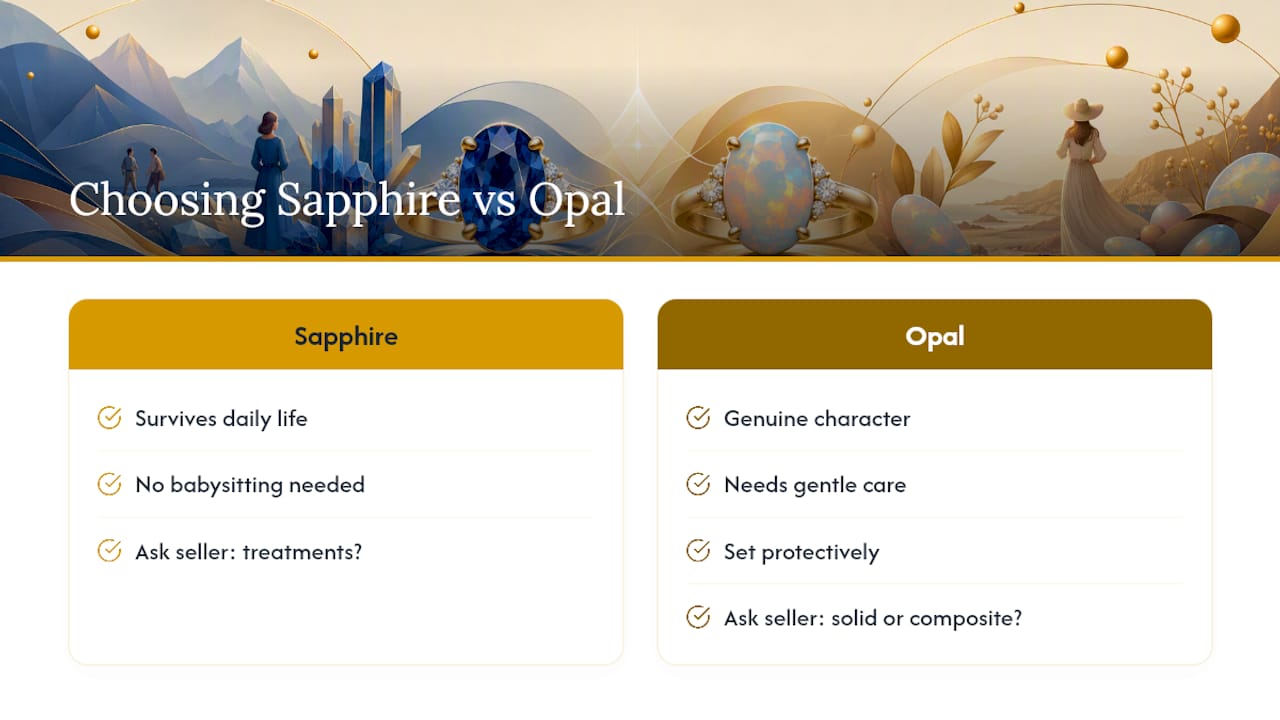
Choose sapphire for a ring that needs to survive daily life without babysitting. Choose opal, set protectively, if you want a stone with genuine character and you’re ready for gentle care. Either way, ask your seller directly whether the stone is treated, and whether an opal is solid or composite, before you buy.
A Collector’s Case for Opal
Sapphire wins on convenience, but opal wins on story. No two solid opals share the same pattern, which turns every piece into something closer to a small painting than a mass-produced gem. That romance comes with homework: know the care rules, and wear it with intention.
— Renee
Explore Authentic Australian Opals
Once you’ve weighed hardness against character, the next step is seeing genuine solid opal in person, not a photo, not a composite substitute. Australianopaldirect works directly with miners across Lightning Ridge, Coober Pedy, and Queensland, so every ring, pendant, and pair of earrings in the collection comes with verified origin, a 90-day warranty, and complimentary insurance on shipment.

Before you buy anywhere, ask the seller two questions: is this solid opal or a doublet/triplet, and is any treatment disclosed? Australianopaldirect answers both upfront, and its team also builds custom opal jewelry around a stone you choose yourself. Browse the current collection, compare a few solid opals against the durability notes above, and reach out with questions before you commit to a piece.
Authoritative Sources and Further Reading
- GIA, opal care and cleaning guidelines
- International Gem Society, opal and pearl care guide
- Azonomy, orange sapphire vs fire opal comparison








