Cleaning Opal Jewelry: Safe Steps to Protect Color and Shine
Posted by AOD on 14th Aug 2026
Cleaning Opal Jewelry: Safe Steps to Protect Color and Shine
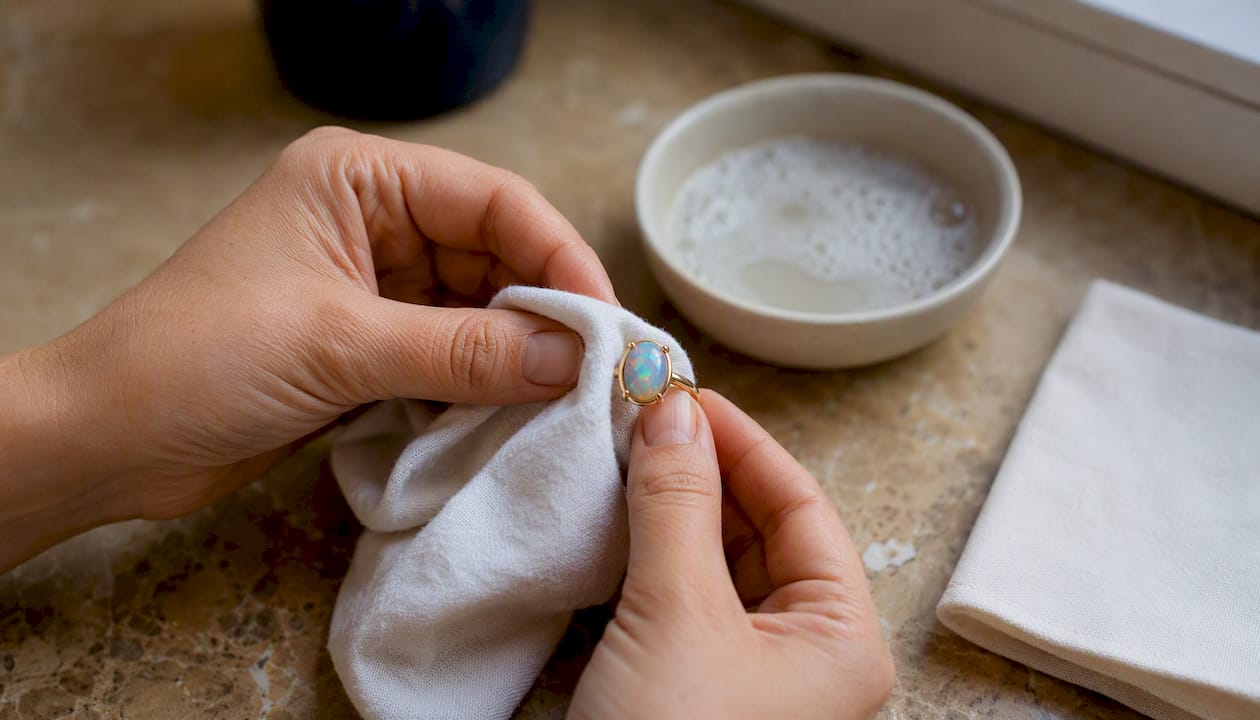
The safest way to clean opal jewelry is a gentle wipe with a soft cloth dampened in lukewarm, mildly soapy water, followed by an immediate pat dry. GIA confirms that warm, soapy water is the only universally safe cleaning method for opals, which rate in the range of moderate hardness on the Mohs scale and carry poor to fair toughness. That combination of softness and fragility means even a well-intentioned cleaning session can crack, cloud, or permanently dull a stone that took millions of years to form.
Follow these three steps right now if your piece needs attention:
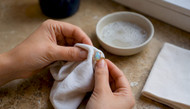
- Dampen a lint-free cloth with lukewarm water and one small drop of mild dish soap.
- Gently wipe the opal surface and metal setting, using no pressure.
- Pat completely dry with a second clean, dry cloth and let the piece air for a few minutes before storing.
Never use an ultrasonic cleaner, steam cleaner, bleach, ammonia, or vinegar on any opal. And before you clean at all, identify your opal type — solid, doublet, triplet, or porous — because each one demands a different level of caution.
Key Takeaways
The safest method for cleaning opal jewelry is a barely damp cloth with mild soap, immediate drying, and no ultrasonic cleaners, steam, or harsh chemicals — ever.
| Point | Details |
|---|---|
| Identify opal type first | Solid, doublet, triplet, and porous opals each require a different cleaning approach. |
| Gentle cloth method only | Use a barely damp microfiber cloth with one drop of mild soap; pat dry immediately after. |
| Hard avoidance list | Never use ultrasonic cleaners, steam, bleach, ammonia, vinegar, or hot water on any opal. |
| Crazing is irreversible | Cracks from thermal shock or dehydration cannot be repaired at home; see a jeweler promptly. |
| Australianopaldirect | Provides opal type documentation, complimentary insurance, and expert care guidance with every purchase. |
Table of Contents
- What type of opal do you own, and why does it matter?
- How to clean opal jewelry step by step
- What should you never use when cleaning opal rings or stones?
- Why does your opal look cloudy, and what can you do about it?
- How should you store opal jewelry and care for it daily?
- When should you see a jeweler, and what can they actually fix?
- A practical care routine backed by opal retailers and lapidaries
- The case for conservative care above all else
- Australianopaldirect: expert guidance for your opal pieces
- Useful sources for further reading
What type of opal do you own, and why does it matter?
Knowing your opal’s construction is the single most important step before cleaning opal jewelry. A solid opal is a single continuous piece of natural stone. A doublet is a thin slice of opal bonded to a dark backing material. A triplet adds a clear dome cap on top of that sandwich. Porous or hydrophane opals are naturally absorbent stones that drink up liquids almost instantly.
Visually, you can distinguish them this way:
- Solid opal: Consistent color play throughout; the back of the stone looks like natural rock or has a polished dome.
- Doublet: A flat, very thin opal layer visible from the side, with a dark (usually black plastic or ironstone) backing.
- Triplet: Like a doublet but with a glassy, slightly magnifying dome on top; the stone often looks unnaturally bright.
- Porous/hydrophane opal: Appears milky or translucent dry; may temporarily become more transparent when touched with a damp finger.
Each type responds to water and heat very differently. Doublets and triplets are layered objects bonded with adhesive — even brief soaking can allow moisture to seep between those layers, clouding the stone or causing delamination. Porous opals absorb water so readily that a damp cloth alone can temporarily alter their appearance. Solid opals tolerate brief, gentle contact with lukewarm soapy water, but they still dislike prolonged soaking or sudden temperature shifts.
| Opal Type | Safe to soak? | Vulnerable to moisture? | Preferred cleaning approach |
|---|---|---|---|
| Solid opal | No (brief contact only) | Moderate | Damp cloth, mild soap, pat dry |
| Doublet | Never | High | Barely damp cloth only |
| Triplet | Never | Very high | Barely damp cloth only |
| Porous/hydrophane | Never | Extreme | Dry or barely damp cloth only |
If you are unsure which type you own, treat the piece as water-sensitive until a jeweler confirms otherwise.
How to clean opal jewelry step by step
What you need
Gather these before you begin: a lint-free microfiber cloth, a second dry cloth, a small bowl of lukewarm water, and one drop of mild dish soap (something like Dawn Free & Clear works well). That is genuinely all you need.
Cleaning solid opals
- Mix one drop of mild soap into a small bowl of lukewarm water.
- Dip the corner of your microfiber cloth into the solution — you want it barely damp, not wet.
- Gently wipe the opal surface in small circular motions, spending no more than 20–30 seconds on the stone itself.
- Use a fresh damp corner of the cloth (plain water, no soap) to wipe away any soap residue.
- Pat the stone and setting dry immediately with the second cloth.
- Set the piece on a dry surface for 10–15 minutes before storing, so no trapped moisture lingers in the setting.
For rings, pay attention to the underside of the setting where water can pool against the stone. Tilt the ring and gently press the dry cloth into that channel.
Cleaning doublets, triplets, and porous opals
Skip the bowl entirely. Use only a barely damp cloth — one that has been dampened and then wrung out so it feels almost dry to the touch. Wipe the surface once, lightly, then dry immediately. Never let water sit on the surface or work into the seam between layers.
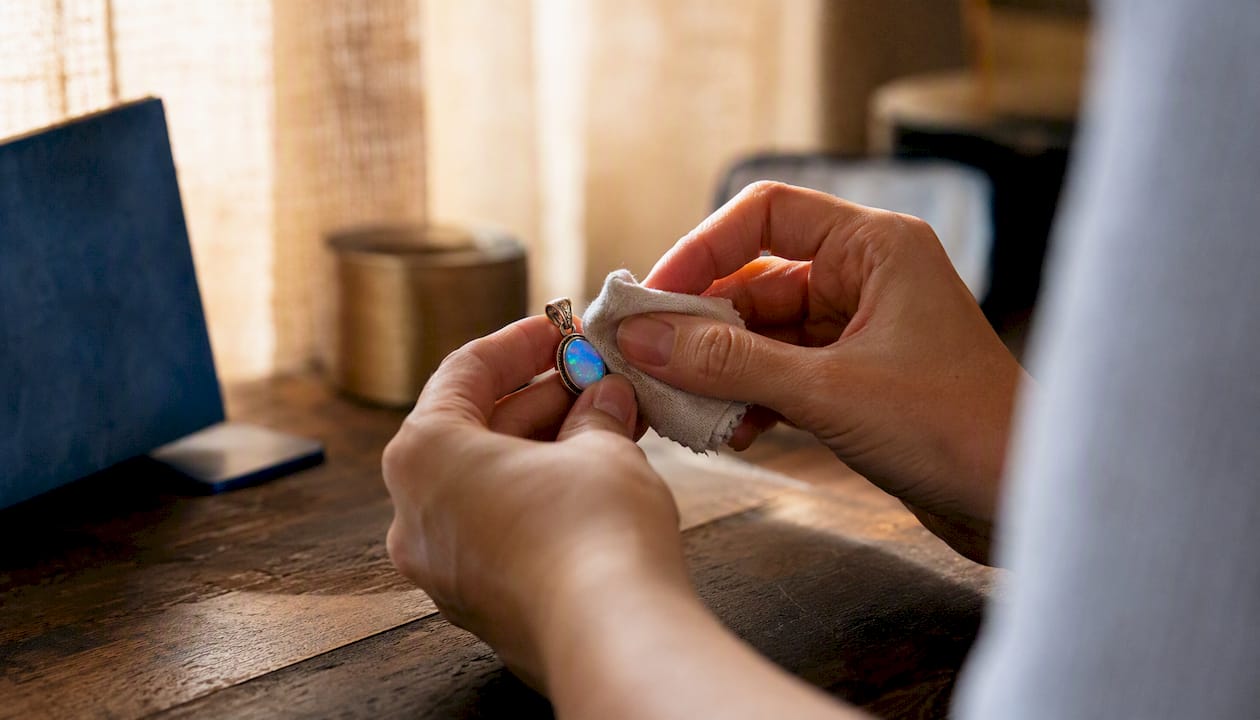
Pro Tip: After cleaning any opal, hold it up to a light source and look at the setting from the side. Any glint of trapped moisture will show as a faint shimmer in the gap between stone and metal. If you see it, press a dry cloth corner gently against the gap and let capillary action draw the moisture out before you store the piece.
What should you never use when cleaning opal rings or stones?
Some of the most common jewelry-cleaning tools are precisely the ones that cause irreversible harm to opals. The list below is not cautionary in a vague sense — each item on it has a specific mechanism of damage.
- Ultrasonic cleaners: The high-frequency vibrations that dislodge dirt from harder stones can fracture opal’s silica structure and cause internal cracking. Doublets and triplets are especially at risk because vibration loosens adhesive bonds.
- Steam cleaners: Intense heat and moisture together are a direct threat. Thermal shock can cause crazing — a network of fine surface cracks — and steam forces moisture into every micro-pore.
- Bleach and ammonia: Both attack the silica matrix and can permanently etch or dull the surface. Many commercial jewelry dips contain one or both.
- Vinegar and acidic cleaners: Household acids etch opal surfaces, dulling the play-of-color that makes the stone extraordinary.
- Abrasive powders or toothpaste: At 5–6.5 on the Mohs scale, opal scratches easily. Even a mildly abrasive paste leaves micro-scratches that scatter light and diminish brilliance.
- Hot water or sudden temperature changes: Thermal shock is one of the leading causes of crazing. Never rinse an opal under hot tap water or move it from a cold room to a hot one quickly.
- Perfumes, hairspray, and sunscreen: These leave chemical residues that build up on the surface and can penetrate porous stones over time.
Glued settings and older pieces with aged adhesive deserve extra caution. If the piece is an heirloom or has visible signs of prior repair, take it to a jeweler before attempting any home cleaning.
Why does your opal look cloudy, and what can you do about it?
Cloudiness in an opal is one of the most distressing things an owner can encounter, but the cause determines whether it is reversible. Crazing — a fine web of internal or surface cracks — forms when an opal loses moisture too quickly, experiences thermal shock, or is exposed to harsh chemicals. Once crazing appears, it is generally irreversible. No home treatment restores a crazed stone.
Cloudiness without visible cracking is a different matter. It can result from a surface film of oils or residue, from temporary dehydration in very dry conditions, or from moisture trapped between the layers of a doublet or triplet.
Inspect your piece carefully before attempting anything:
- Surface film: A gentle wipe with a barely damp cloth often resolves this immediately.
- Internal webbing or fine cracks: Visible under a loupe or bright light as a network of lines within the stone. This is crazing. Stop and consult a jeweler.
- Layer separation in doublets/triplets: A visible gap, milky haze, or color shift at the stone’s edge. Do not soak or apply any liquid — take it to a professional.
- Temporary dehydration cloudiness in solid opals: A brief, careful soak in distilled water for a few minutes sometimes helps, but results vary and the improvement may be temporary. Never use tap water, which contains minerals that can deposit on the surface.
Persistent cloudiness that does not clear after a gentle wipe warrants professional evaluation. A jeweler with opal experience can distinguish surface issues from structural ones and advise on whether opal polishing is appropriate.
How should you store opal jewelry and care for it daily?
Daily habits protect opals more than any cleaning routine. The stone’s beauty is preserved not just by what you do when you clean it, but by what you avoid while wearing it.
Daily wear habits:
- Remove opal jewelry before washing dishes, bathing, swimming, or exercising.
- Apply perfume, hairspray, and sunscreen before putting on opal pieces, never after.
- Put opal rings on last when dressing and take them off first when undressing.
Storage rules:
- Store each opal piece in its own soft pouch or padded compartment to prevent contact with harder stones that can scratch it.
- Keep pieces away from direct sunlight, heating vents, and sunny windowsills — prolonged heat and UV exposure accelerate dehydration.
- Avoid storing opals in airtight safes or very dry environments for extended periods. Opals contain structural water, and extremely dry conditions can slowly draw that moisture out, eventually causing crazing.
- For long-term storage in arid climates, place a small piece of damp cotton in a sealed bag with the jewelry. Check it monthly and refresh the moisture source. Do not use this approach in already-humid environments, where excess moisture can damage metal settings.
Pro Tip: A dedicated opal jewelry care routine takes less than two minutes a week — a quick wipe after wearing and a check of the setting for looseness. That small habit prevents the slow accumulation of oils and residue that eventually requires more aggressive intervention.
Quick dos and don’ts:
- ✓ Store separately in soft pouches
- ✓ Keep at stable room temperature and normal household humidity
- ✓ Remove before any water or chemical exposure
- ✗ Never store next to harder gemstones
- ✗ Never leave in direct sun or near heat sources
- ✗ Never store long-term in bone-dry conditions without humidity management
When should you see a jeweler, and what can they actually fix?
Home care has real limits, and recognizing those limits protects the piece. Use this checklist to decide when professional help is the right call:
- New or spreading cracks: Any visible crack or network of fine lines in the stone warrants immediate professional assessment, not more cleaning.
- Loose or shifting stone: If the opal moves in its setting, continued wear risks losing the stone entirely.
- Delamination in doublets/triplets: A visible gap, milky edge, or color shift at the stone’s perimeter means the adhesive bond has failed.
- Cloudiness that persists after gentle cleaning: A jeweler can determine whether the cause is surface, structural, or moisture-related.
- Damaged or worn prongs: Metal fatigue in the setting is a separate issue from the stone, but it puts the opal at risk.
What a jeweler can and cannot do:
- Can re-polish minor surface scratches on solid opals.
- Can re-glue or re-set doublets and triplets if delamination is caught early.
- Can tighten or replace prongs and inspect settings.
- Cannot reverse crazing — once the internal structure fractures, it stays fractured.
- Cannot restore color play lost to chemical etching or deep dehydration.
Before any work begins, ask your jeweler to confirm whether the stone is solid, doublet, or triplet; what the proposed repair involves; and whether the work carries any warranty. For valuable pieces, request written documentation for insurance purposes. Opal insurance coverage is worth arranging before damage occurs, not after.
Typical turnaround for a setting inspection and minor re-polish is a few days to a week at most specialist jewelers. Re-gluing a doublet or triplet may take slightly longer depending on the adhesive cure time.
A practical care routine backed by opal retailers and lapidaries
A consistent, low-effort schedule prevents most of the damage that makes professional repair necessary. Here is a routine that opal retailers and lapidaries consistently recommend:
- After every wear: Wipe the piece with a dry or barely damp microfiber cloth to remove skin oils and residue. Pat dry. This takes 30 seconds.
- Monthly: Perform the full gentle cleaning described above — lukewarm soapy water on a cloth, gentle wipe, rinse cloth, pat dry, air dry. Inspect the setting for looseness while you do it.
- Seasonally: In dry months, check your storage conditions and add a humidity source if needed. In humid months, remove the damp cotton from any storage bag. Inspect prongs and settings for wear.
When purchasing a new piece, ask the seller:
- Is this a solid opal, doublet, or triplet? Request written confirmation.
- What home care does the seller recommend for this specific stone?
- Does the piece carry a warranty, and does it cover setting damage?
- Is insurance or certification available?
Pro Tip: Pieces from caring for opal jewelry guides consistently note that the single most damaging thing owners do is clean too aggressively, too often. A weekly dry wipe and a monthly gentle clean is genuinely sufficient for regularly worn pieces.
The case for conservative care above all else
There is a temptation, when a beloved opal loses a little of its fire, to reach for something stronger — a soak, a commercial cleaner, a polishing cloth. That impulse is understandable. These stones are extraordinary, and watching their play-of-color dim feels like a small loss.
But the evidence from lapidaries, gemological authorities, and opal retailers points consistently in one direction: the most damaging interventions are almost always the aggressive ones. Crazing caused by thermal shock, delamination from soaking, and surface etching from household acids are all irreversible. A gentle wipe removes residue. Nothing removes a crack.
The conservative approach — dry wipe after every wear, monthly mild clean, professional inspection for anything structural — is not timid. It is the method that keeps an heirloom opal brilliant for generations. Balancing everyday wear with long-term preservation means accepting that some cloudiness requires a jeweler, not a home remedy, and that the most loving thing you can do for a remarkable stone is sometimes simply to leave it alone.
Australianopaldirect: expert guidance for your opal pieces
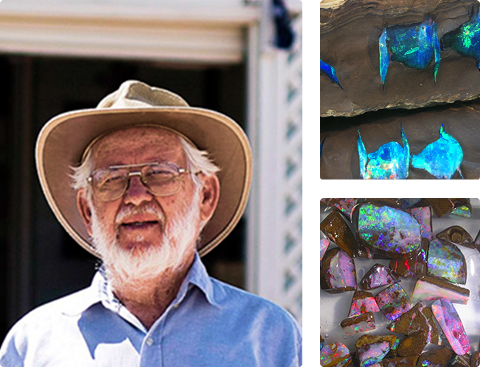
Owning a genuine Australian opal from Lightning Ridge, Coober Pedy, or Queensland means holding something rare and irreplaceable. Australianopaldirect works directly with miners to bring those stones to you with full transparency about their origin and construction — solid, doublet, or triplet — so you know exactly what care your piece needs from day one.

Every purchase through Australianopaldirect comes with complimentary insurance, free shipping, and a 90-day warranty, along with clear documentation of your stone’s type and provenance. If you are unsure whether your opal is solid or assembled, or if you want expert guidance on a specific piece, the team can help you identify it and point you toward the right care approach. Visit Australianopaldirect to browse the collection, request a custom piece, or get support for an opal you already own.
Useful sources for further reading
These sources informed the guidance in this article and are worth consulting if you want to go deeper on any specific aspect of opal care.
- GIA (Gemological Institute of America): — The global authority on gemological standards. GIA’s opal care guidance establishes the Mohs hardness range of 5–6.5 and confirms warm, soapy water as the only universally safe cleaning method.
- Opal Association of Australia / opal.org.au: — Industry body representing Australian opal miners and retailers. Their care resources address assembled opal vulnerability and the specific risks of moisture in glued settings.
- International Gem Society (IGS): — A respected gemological education resource covering opal construction, care, and the science behind play-of-color, useful for readers who want to understand the mineralogy behind the care rules.
- Australianopaldirect blog: Retailer-authored guides on luxury opal care and heirloom preservation written from direct experience with Australian stones from Lightning Ridge, Coober Pedy, and Queensland.
Recommended
- Caring for opal jewelry: preserve gemstones in 5 steps - Australian Opal Direct
- Opal jewelry care routine: keep Australian opals vibrant - Australian Opal Direct
- Opal polish explained: master care and shine for your gems - Australian Opal Direct
- Luxury Opal Care Essentials: Your Expert Guide - Australian Opal Direct