Science Backed Opal Crazing Care for Owners
Posted by AOD on 22nd Sep 2026
Science Backed Opal Crazing Care for Owners
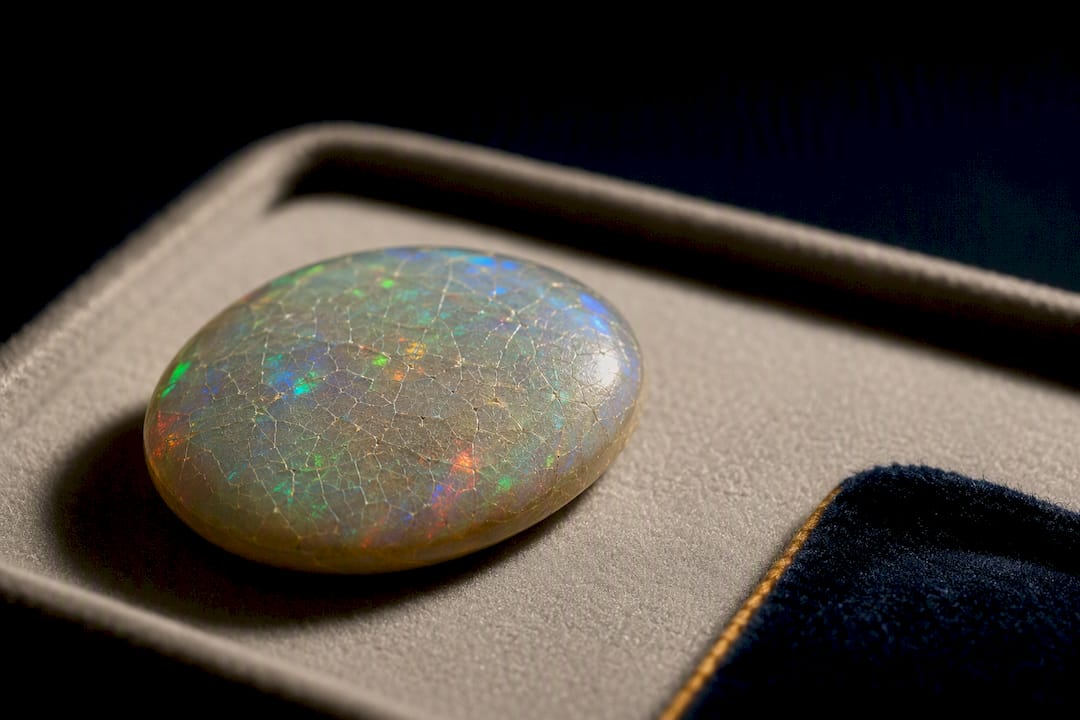
Prevent opal crazing by protecting your stone from sudden swings in temperature or humidity, keeping it in a stable, moderate-humidity environment, and never subjecting it to ultrasonic or steam cleaning. Crazing is almost always irreversible once it starts, so prevention is the only real cure. If you spot new cracks on a stone you already own, stop wearing it and have a gemologist evaluate it before the damage spreads.
TL;DR:
- Porosity, origin, and storage history determine whether an opal is vulnerable to drying-shrinkage or thermal cracking, which require different care approaches.
- Maintain stable, moderate humidity environments and avoid heat, UV, ultrasonic, and steam cleaning to prevent irreversible crazing.
- For stones stored in water, dry them slowly over months and monitor for new cracks before use or resale.
- Stabilization treatments like resin or oiling can improve stability but must be disclosed, as they alter the stone’s value and structure.
- Regular inspection and professional evaluation are essential if new cracks appear, especially on high-value or unproven stones.
Table of Contents
- What Opal Crazing Prevention Actually Protects Against
- Why Do Opals Craze? Two Different Mechanisms
- How to Store Opals Without Triggering Cracks
- How Do You Safely Dry a Wet Opal?
- Cleaning Methods That Protect Opals From Crazing
- Should You Stabilize or Treat a Fragile Opal?
- When Should You See a Gemologist About Crazing?
- How Australian Opal Direct Applies These Precautions
- A Collector’s Quick-Reference Checklist
- Bring Home an Opal That’s Already Proven Stable
- Where This Guidance Comes From
- FAQ
What Opal Crazing Prevention Actually Protects Against
Crazing shows up as a web of hairline cracks spreading across or just beneath the surface of the stone, sometimes tight and barely visible, sometimes coarse enough to feel under a fingernail. Collectors often call the worst cases “sugaring,” because the surface takes on a granular, frosted look that swallows the opal’s fire. The play-of-color that makes an opal worth owning in the first place dulls or disappears entirely in the crazed zones, because light can no longer travel cleanly through the silica spheres that create the color in the first place.
Crazing is not the same thing as a chip or a fracture. A chip is localized, mechanical damage, usually from an impact. Crazing is systemic. It originates from moisture loss or pressure changes deep in the stone’s structure, which is why it tends to spread rather than stay contained.
The consequences go beyond looks:
- Structural integrity drops, since a network of micro-cracks weakens the stone against everyday knocks.
- Resale and appraisal value falls sharply, often to a fraction of the original price.
- The damage compounds over time. A crazed opal is more vulnerable to further cracking than one that has never been affected.
Gemological guidance from GIA notes that opals are hydrated silica with water content that varies from stone to stone, which is precisely why some specimens are far more crazing-prone than others.
Why Do Opals Craze? Two Different Mechanisms
Opal crazing is not one phenomenon. Peer-reviewed research from Chauviré and colleagues, published through MDPI, identifies two distinct mechanisms behind cracking, and understanding which one applies to your stone changes how you should care for it.
Drying shrinkage happens in water-rich, porous opals. As internal moisture evaporates faster than the silica structure can adjust, the material contracts unevenly and cracks form along the stress lines. This is the mechanism behind most “opal dried out and cracked in storage” stories.
Thermal decrepitation works differently. In opals with closed, non-connected pores, trapped water has nowhere to go. Heat the stone, even gently, and that trapped moisture expands, building internal pressure until the structure fails. This is why jewelers warn against leaving opal rings on a sunny windowsill or near a stove top.
- Drying shrinkage: porous, permeable (hydrophane) opals, slow moisture loss, gradual onset.
- Thermal decrepitation: closed-pore opals, rapid heating, sudden onset.
The research team’s finding matters for anyone assessing risk: porosity, geological origin, and storage history together determine which mechanism a given stone is vulnerable to, which is why two opals from the same parcel can behave completely differently under identical conditions.
Counterintuitively, hydrophane opals, the porous type that can absorb water and change appearance, are sometimes less prone to drying-shrinkage cracking than expected, provided they’re dried slowly. Their permeability lets moisture escape gradually rather than building destructive internal stress.
How to Store Opals Without Triggering Cracks
Storage is where most preventable crazing actually happens, usually because an owner tucks a stone into a dry drawer or display case and forgets about it for years.
The core habits that matter most:
- Maintain moderate, stable humidity. A sealed box with a small piece of slightly damp cotton or a specialty gem-storage pad creates a micro-environment that buffers the stone against ambient dryness.
- Keep opals away from direct heat sources and prolonged UV exposure, including sunny windowsills, radiators, and stage lighting at events.
- For stones with a known history of instability or hydrophane behavior, use a sealed container with slightly damp material rather than open-air storage.
- For opals that have already proven stable over months of normal wear, breathable padded storage, like a soft-lined jewelry box, works fine and avoids overcomplicating the routine.
Wearing rules matter just as much as storage. Let a stone acclimate to room temperature before you put it on if it has been sitting in a cold car or a hot pocket. Remove opal jewelry before saunas, hot showers, dishwashing, gardening, or any activity involving heat or mechanical stress. Avoid walking straight from an air-conditioned building into summer heat with an opal ring on; that kind of rapid swing is exactly what thermal decrepitation research warns against.
Travel deserves its own habit. Pack opal jewelry in a small sealed pouch with a barely damp cloth for flights and long road trips, since airplane cabins and car interiors run drier and hotter than most homes.
Pro Tip: Keep a spare humidity indicator card, the kind used in camera bags, inside your opal storage box. It costs almost nothing and tells you at a glance if the micro-environment has drifted too dry.
Best-practice guides collected from gem-care specialists consistently point to the same short list: stable humidity, no direct heat or UV, and no ultrasonic or steam cleaning. If you take nothing else from opal preservation techniques, take that.
How Do You Safely Dry a Wet Opal?
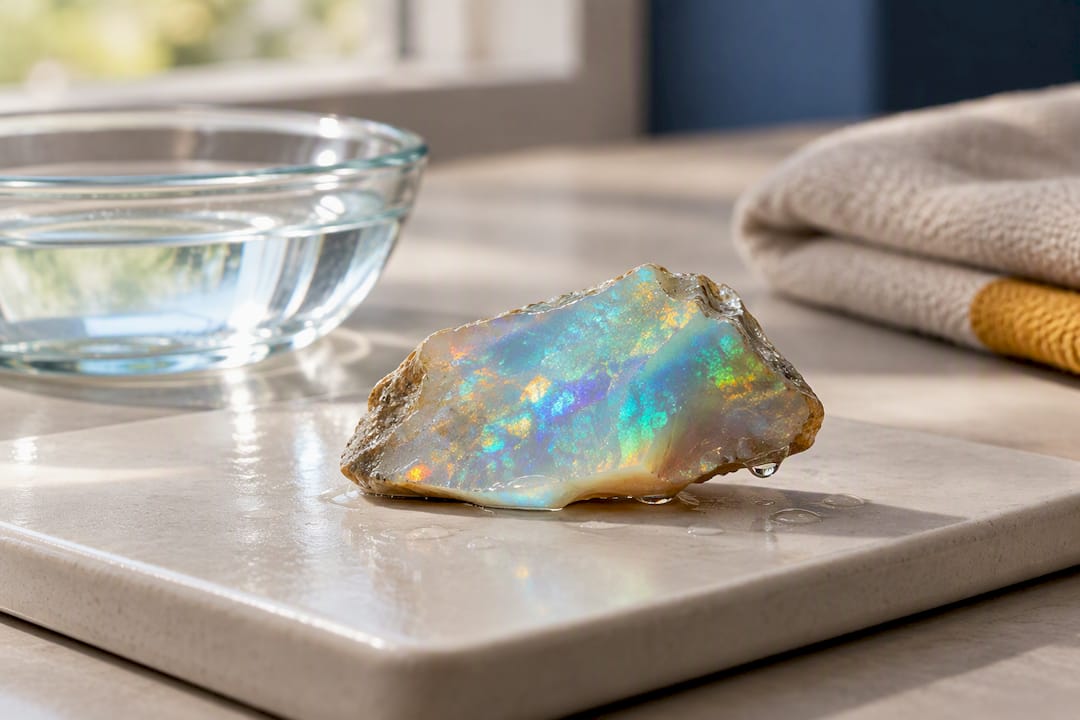
Some merchants store rough or freshly cut opal in water, and that practice itself is a signal worth understanding rather than ignoring. Water storage can protect an unstable stone temporarily, but it can also mask structural problems that surface the moment the stone dries out under a buyer’s care. Long-term immersion carries its own risks, including microbial growth and gradual changes to the stone’s internal chemistry.
If you’ve acquired an opal that was kept wet, dry it slowly and deliberately:
- Place the stone in a zip-lock bag with a small amount of the water it was stored in.
- Leave the bag at stable room temperature, away from heat vents or windows.
- Every few weeks, let a tiny bit of moisture escape by opening the bag briefly, then reseal it.
- Continue this gradual equilibration over several months, watching closely for any new lines or dulling.
- If the stone shows no change after this extended monitoring period, it has likely stabilized.
Stop the process immediately and consult a gemologist if you see new cracking during any stage. Temporary immersion for transport is reasonable; treating water as a permanent home for an unstable stone is not.
Cleaning Methods That Protect Opals From Crazing
Cleaning is where well-meaning owners cause the most accidental damage. Ultrasonic cleaners and steam cleaners are the two tools most consistently blamed for sudden crazing and outright breakage, because both introduce rapid vibration or heat that opal’s water-bearing structure cannot absorb safely.
- Skip ultrasonic and steam cleaning entirely, no exceptions.
- Avoid strong alkaline or acidic chemicals, including many household jewelry dips.
- Use tepid, deionized water with a mild, pH-neutral soap, and a soft cloth.
- Let the stone reach room temperature before immersing it in water of a similar temperature; a cold stone into warm water is its own thermal shock.
For anything beyond a gentle wipe, hand mounted stones over to an experienced lapidary rather than a general jeweler. Our cleaning guide for opal jewelry walks through the safe method step by step if you want a visual reference.
Should You Stabilize or Treat a Fragile Opal?
Stabilization treatments exist for a reason: some opals, particularly porous rough from certain fields, will not survive untreated. The main options are resin or Opticon impregnation, polymer treatments, oiling, and, for specific types, sugar or smoke treatments that darken the body tone.
- Resins and Opticon fill micro-fractures and porosity, adding stability and often improving clarity.
- Oiling is a lighter, often temporary fix that can mask surface crazing without addressing the underlying structure.
- Sugar and smoke treatments alter body color rather than structural stability, and apply mainly to specific opal types.
Every one of these treatments carries a trade-off. Filling stabilizes the stone but permanently alters it, and any reputable dealer discloses the treatment at the point of sale, since undisclosed treatment materially affects value. GIA’s own guidance on opal quality factors treats disclosure as non-negotiable for this reason.
Treatment makes sense for rough or fashioned stones that are structurally at risk and otherwise unwearable, not as a routine step for stable material. If a dealer offers you a treated stone, ask exactly what was done and get it in writing.
When Should You See a Gemologist About Crazing?
Get professional input the moment you notice new cracking on a stone that previously looked clean, especially on anything of meaningful value. Uncertain storage history is its own red flag. If you bought a loose opal without documentation of how it was cut, dried, and stored, treat it as higher risk until proven otherwise.
- New crazing on a previously stable stone.
- High-value stones with any visible instability.
- Rough or cut opals with no known seasoning history.
Gemologists and conservators have real diagnostic options beyond a loupe. Density and porosity measurements flag hydrophane behavior. Near-infrared spectroscopy and differential scanning calorimetry can estimate hydration and permeability, giving a data-backed read on instability risk, though adoption of these tools in everyday gem trade is still developing. Microscopy reveals crack patterns invisible to the naked eye.
Pro Tip: Photograph your opal under consistent lighting every few months. A dated photo record is the simplest, cheapest diagnostic tool you own, and it’s what a gemologist will ask for first.
How Australian Opal Direct Applies These Precautions
The sourced opals come through established relationships with miners across regions known for opal, with ethical sourcing practices incorporated into that chain. Newly cut opals get seasoned and observed before they ever reach a listing, the same conservative approach the heirloom preservation guide recommends for long-term owners. Purchases include insurance and a warranty period, providing some safety while settling into a care routine.
— Renee
A Collector’s Quick-Reference Checklist
Store stable humidity, skip direct heat, and never let an opal near an ultrasonic cleaner. Watch any newly cut stone for 12 to 24 months before trusting it as seasoned. Inspect regularly, clean conservatively, and when buying rough or unset stones, favor sellers who can speak to a stone’s seasoning history over ones who cannot.
Bring Home an Opal That’s Already Proven Stable
The single best form of opal crazing prevention is buying a stone that has already weathered the risky early months. The retailer seasons cut opals before offering them for sale, reducing the crazing risk tied to fresh-cut, unmonitored stones by the time they reach customers.

Our custom hand-crafted opal jewelry service pairs a seasoned, direct-sourced stone with a setting built to protect it from everyday knocks and temperature swings, rather than leaving you to source and mount a risky rough stone yourself. Browse opal rings, pendants and necklaces, or earrings if you’d rather start from an existing piece, and check our care routine guide for the maintenance habits that keep a stone stable for decades. Every piece ships with complimentary insurance and a 90 day warranty. For those who own a stone and want a second opinion on its condition, personalized evaluations can be requested via the site before deciding on cleaning, storage, or treatment.
Where This Guidance Comes From
- Chauviré et al., published through MDPI, on the physical mechanisms behind gem opal cracking.
- GIA’s opal care and quality-factor guidance on cleaning, handling, and chemical sensitivities.
- Gem Society and collector-sourced practical care guides on safe drying and storage protocols.
FAQ
Do Opals Need to Be Oiled?
Most opals do not need oiling, and it’s a treatment rather than routine care. Oiling can temporarily mask surface crazing on a fragile stone, but it doesn’t fix the underlying structural instability, and any dealer should disclose it if applied.
Who Should Not Wear Opals Daily?
Anyone whose routine involves frequent heat exposure, heavy manual work, or swimming and hot tubs should avoid wearing opal jewelry daily, since repeated thermal and mechanical stress raises crazing risk over time. Save daily wear for stones you’ve confirmed are stable, and switch to occasional wear for anything newly acquired or unseasoned.
What Happens if You Leave Opals in Water?
Treat water storage as temporary, never as a long-term solution.
How Do You Stop Opals From Drying Out?
Keep opals in a stable, moderate-humidity environment, ideally a sealed box with a slightly damp storage pad, and avoid direct heat or intense light. Combine that with never using ultrasonic or steam cleaning, and you address the two biggest drivers of drying-related crazing at once.








