Opal Clarity Guide: Levels, Value & Evaluation
Posted by AOD on 15th Jun 2026
Opal Clarity Guide: Levels, Value & Evaluation
TL;DR:
- Opal clarity refers to a stone’s transparency and internal flaws, influencing light diffraction and color play. Different opal types have ideal clarity levels, with black opals benefiting from opacity and crystal opals from transparency, affecting their market value accordingly. Evaluating clarity involves examining internal features under various lights and angles, considering each opal’s specific type and intended visual effect.
Opal clarity is defined as the degree of transparency and freedom from inclusions within a stone, and it directly shapes how light interacts with the gem’s interior to produce its celebrated play-of-color. According to the GIA’s Opal Buyer’s Guide, clarity depends on light passage and internal features, and it varies significantly by opal type. This opal clarity guide covers every level of the spectrum, from the velvet opacity of Lightning Ridge black opals to the glassy transparency of crystal opals from Coober Pedy, and explains exactly how each level affects beauty and market value. Whether you are building a collection or purchasing your first piece, understanding opal clarity is the single most important skill you can develop.
What is the opal clarity guide framework?
Opal clarity describes two measurable qualities: how much light passes through the stone, and how free the interior is from visible flaws. Gemologists at the International Gem Society recognize three primary clarity levels across the opal family: transparent, translucent, and opaque. Each level is not a flaw or a virtue on its own. It is a characteristic that either enhances or diminishes the stone’s specific optical identity.
The microstructure of opal, formed by tightly packed silica spheres suspended in water, diffracts incoming light to generate opalescence. Clarity affects how cleanly that diffraction reaches your eye. A stone clouded by inclusions or crazing scatters light unpredictably, muting the color play. A stone with ideal clarity for its type allows the full spectrum of diffracted color to radiate without obstruction.
Opal clarity levels also interact with the stone’s body tone, the background color visible beneath the play-of-color. This relationship is why clarity cannot be evaluated in isolation. The GIA emphasizes that transparency and clarity must always be assessed alongside play-of-color, body tone, and pattern to arrive at a complete quality picture.
How do clarity levels differ across opal types?
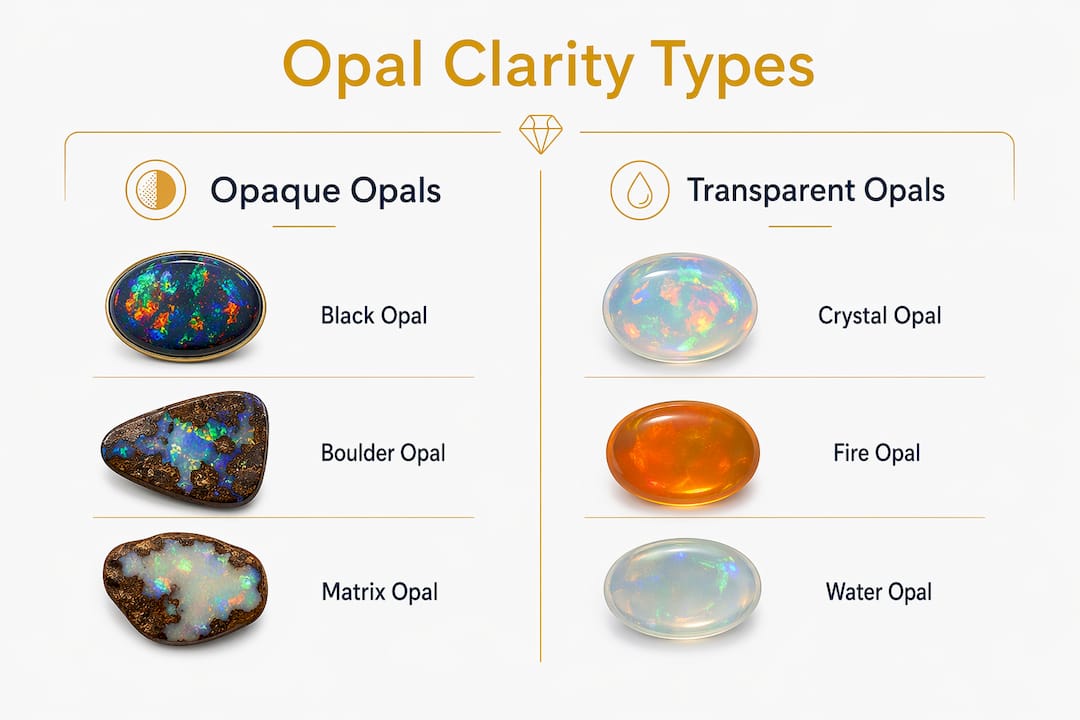
The five major opal varieties each occupy a distinct position on the clarity spectrum, and the “ideal” clarity level shifts with every type. The table below maps each variety to its typical clarity and explains why that level serves the stone’s optical character.
| Opal Type | Typical Clarity | Why It Works |
|---|---|---|
| Black Opal (Lightning Ridge) | Opaque | Dark body tone creates contrast that intensifies color play |
| White/Light Opal (Coober Pedy) | Translucent to opaque | Milky body diffuses light evenly across the surface |
| Crystal Opal | Transparent to semi-transparent | Clear body allows light to pass through and amplify color depth |
| Fire Opal | Transparent to translucent | Warm body color glows most vividly with high light transmission |
| Water Opal | Transparent | Colorless body maximizes light passage for a floating-color effect |
Black opals from Lightning Ridge carry the most opaque clarity of any major variety, and that opacity is precisely what makes them the most commercially valuable opal type in the world. The dark ironstone or potch background absorbs ambient light, forcing the diffracted colors to appear with extraordinary contrast and saturation. A black opal with transparent clarity would lose that contrast entirely and look washed out.
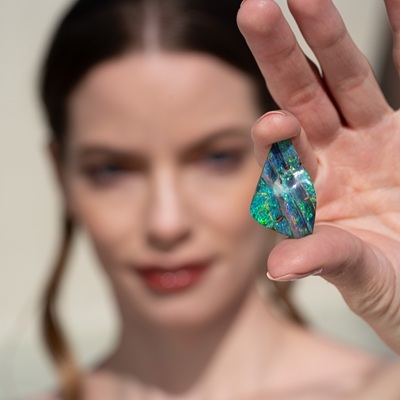
Crystal opals occupy the opposite end of the spectrum. Their transparency is prized by collectors because it allows light to enter from multiple angles, creating a three-dimensional color effect that seems to float inside the stone. Fire opals from Mexico, prized for their amber to cherry-red body color, depend on high transparency to let their warm hues glow like embers. Opaque fire opals lose the very quality that defines them.
How does clarity affect play-of-color and value?
Play-of-color is the spectral phenomenon produced when silica spheres diffract light into its component wavelengths. Clarity determines how much of that diffracted light reaches the observer without interference. The relationship is direct: clarity that suits the opal type amplifies play-of-color, while mismatched or flawed clarity suppresses it.
Here is how clarity influences value across the key dimensions:
- Color intensity: In crystal and water opals, high transparency allows light to interact with silica spheres at depth, producing colors that appear to shift and pulse as the viewing angle changes. Any internal cloudiness reduces this depth effect.
- Color range: Larger silica spheres produce red and orange colors, the rarest and most valuable hues in the opal spectrum. A crystal opal with perfect transparency but no red play simply lacks the sphere size to generate those wavelengths. Clarity cannot compensate for microstructure limitations.
- Background contrast: Opaque black opals achieve maximum color saturation because the dark background absorbs competing light. Clarity here means freedom from crazing and cracks, not transparency.
- Market pricing: Clarity grades like AA and AAA, as described by WithClarity’s opal scale, correspond to the top 33% and top 10% of opals by quality. These grades incorporate opacity, play-of-color strength, and freedom from inclusions together, not transparency alone.
Pro Tip: When comparing two opals of the same type, hold them against a neutral gray background under diffused natural light. This removes the distorting effect of artificial lighting and reveals the true relationship between clarity and color play.
The value impact of clarity is most pronounced in crystal opals, where even minor internal haziness can reduce the price significantly. In black opals, the presence of sand inclusions or matrix within the body tone can actually add character, provided they do not interrupt the color bar.
How to evaluate opal clarity in practice
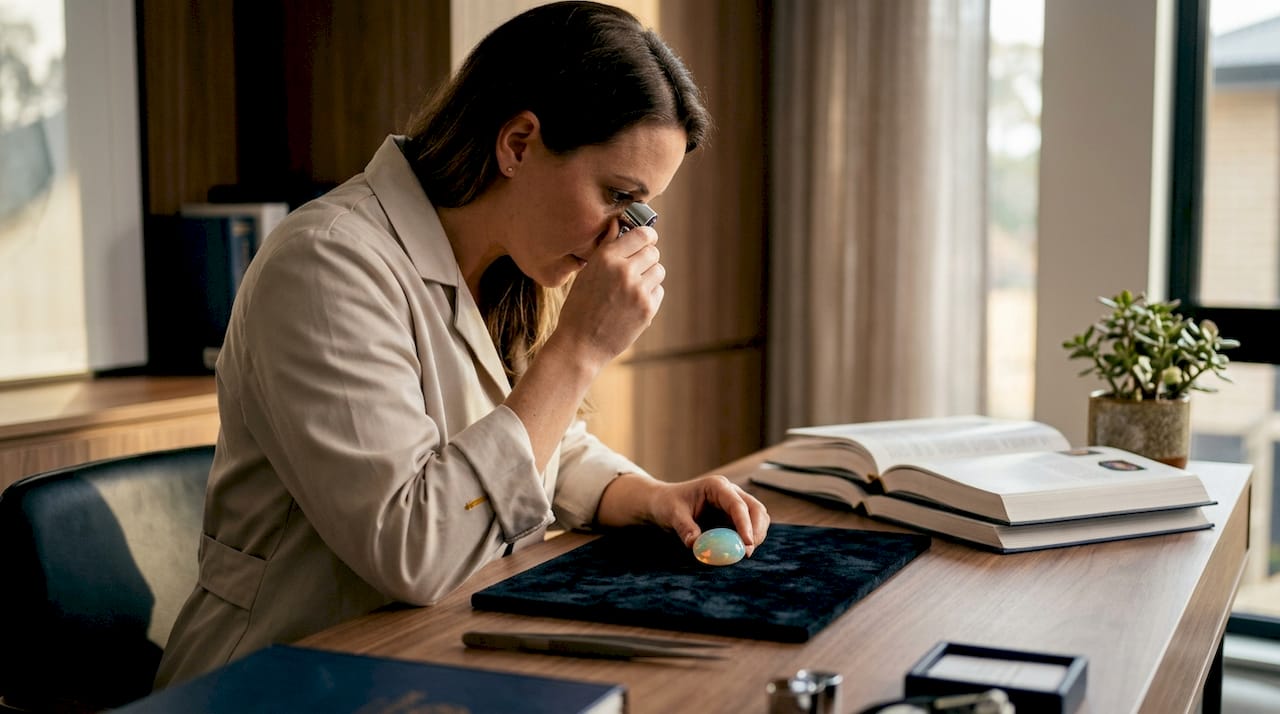
Evaluating opal clarity accurately requires more than a quick glance at the face-up view. A practical clarity assessment considers both light transmission and internal obstruction, and a face-up examination alone misses depth and angle nuances, especially in crystal opals. Follow these steps for a thorough evaluation:
- Identify the opal type first. Black, white, crystal, fire, and water opals each have different clarity ideals. Knowing the type tells you what clarity level to expect and what counts as a flaw versus a feature.
- Confirm solid versus composite construction. Composite opals such as doublets and triplets alter apparent clarity through their layered construction. A triplet’s quartz or glass cap can make a thin opal slice appear far more transparent than it truly is. Look for a visible seam at the girdle under magnification.
- Use multiple light sources. Examine the stone under diffused daylight, a focused LED, and a fiber-optic light. Each source reveals different internal features. Crazing, a network of fine surface cracks, becomes visible under raking light. Matrix inclusions appear under transmitted light.
- Rotate through multiple viewing angles. Tilt the stone 45 degrees in each direction from face-up. Internal clouds, sand patches, and color bars that are invisible face-up often reveal themselves at oblique angles.
- Check for common flaws. Visible inclusions like cracks, crazing, and matrix negatively impact clarity and value. Crazing is the most damaging, as it indicates structural instability. Sand inclusions are common in Queensland boulder opals and may be acceptable if they do not cross the color bar. Potch lines in black opals are natural and do not reduce value unless they interrupt the play-of-color.
Pro Tip: For crystal opals specifically, hold the stone up to a light source and look through it from the back. A truly transparent crystal opal will transmit light cleanly, and the color bar will appear to glow from within. Any internal haziness will show as a gray or white cloud blocking that transmission.
The opal gemstone selection process at Australianopaldirect incorporates all of these evaluation steps before any stone reaches the catalog, giving collectors confidence in what they are acquiring.
Common misconceptions about opal clarity
The most persistent misconception in opal collecting is that higher transparency always means higher quality. GIA and the International Gem Society are explicit on this point: higher transparency does not always equate to higher value. The correct clarity level depends entirely on the opal type and the visual effect it is meant to produce.
Several other misunderstandings regularly mislead buyers:
- “A clear opal will always show more color.” False for black opals. Opacity in a black opal from Lightning Ridge is a quality attribute, not a defect. The dark body tone is what creates the contrast that makes colors appear to leap from the surface.
- “Composite opals have better clarity than solid opals.” Composite opals can show clarity dominated by construction layers rather than intrinsic opal properties, requiring entirely different appraisal methods. The apparent glassiness of a triplet’s cap is not the opal’s own clarity.
- “No red play means poor clarity.” The absence of red or orange colors in a crystal opal with perfect transparency indicates a microstructure limitation, not a clarity flaw. Smaller silica spheres simply cannot diffract the longer red wavelengths. This is an inherent property of that particular stone, not damage or cloudiness.
“The clarity level that maximizes play-of-color expression varies by opal type. More clarity is not universally better.” — GIA Insight on Clarity Value
Understanding opal opacity as a positive attribute in the right context is one of the most important conceptual shifts a collector can make. Once you internalize that each opal type has its own clarity ideal, you stop penalizing black opals for their opacity and stop expecting crystal opals to behave like black ones.
Key takeaways
Opal clarity is type-specific: the ideal level ranges from opaque in black opals to fully transparent in crystal and water opals, and value is determined by how well clarity serves each stone’s play-of-color.
| Point | Details |
|---|---|
| Clarity is type-dependent | Opaque clarity enhances black opals; transparency defines crystal and fire opals. |
| Play-of-color drives value | Clarity matters only insofar as it amplifies or diminishes the stone’s color play. |
| Composites need separate evaluation | Doublets and triplets show construction-layer clarity, not the opal’s true internal quality. |
| Common flaws to watch | Crazing, cracks, and matrix inclusions reduce clarity and structural integrity. |
| Sphere size limits color range | Absence of red play in a clear crystal opal reflects microstructure, not a clarity defect. |
Clarity is only half the story
By Renee
After years of handling Australian opals from Lightning Ridge, Coober Pedy, and Queensland, I have come to believe that clarity is the most misunderstood quality factor in the entire opal world. Collectors new to the gem almost always arrive with a diamond-trained instinct: cleaner is better. That instinct serves you well in diamonds. In opals, it leads you to overlook some of the most extraordinary stones ever pulled from the earth.
The black opals that stop me cold are never the transparent ones. They are the dense, opaque stones where the color bar sits against a body tone so dark it seems to absorb the room. The colors do not just appear on those stones. They ignite. That effect is only possible because of opacity, not despite it.
Where I do apply strict clarity standards is with crystal opals. A crystal opal with internal haziness is genuinely compromised, because transparency is the entire point of the variety. I have passed on stones with beautiful color play simply because a faint internal cloud told me the stone would not age well or photograph cleanly. That discipline has served me well.
My practical advice: learn the clarity ideal for each opal type before you evaluate a single stone. Use the opal type selection guide at Australianopaldirect as a reference. Then evaluate every stone against its own standard, not a universal one. Opals reward that kind of attention. They are not passive gems. They respond to how carefully you look at them.
— Renee
Discover opals with verified clarity at Australianopaldirect
Every opal in the Australianopaldirect collection is sourced directly from Australian miners in Lightning Ridge, Coober Pedy, and Queensland, and evaluated for clarity before it is listed. That direct-miner relationship means no middlemen and no compromises on quality assessment.
Whether you are searching for the velvet opacity of a black opal ring, the glowing transparency of a crystal opal pendant, or the warm fire of a Queensland boulder opal set in gold, Australianopaldirect offers opal earrings, rings, and necklaces with full clarity documentation. Free shipping, complimentary insurance, and a 90-day warranty back every purchase. Explore the collection and find a stone whose clarity speaks directly to you.
FAQ
What does opal clarity mean in gemology?
Opal clarity refers to the degree of transparency and freedom from internal inclusions such as cracks, crazing, and matrix. The GIA defines it by how light passes through the stone and what internal features interrupt that passage.
Is transparent clarity always better in opals?
No. Transparent clarity is ideal for crystal, fire, and water opals, but opaque clarity is the preferred and most valuable characteristic in black opals from Lightning Ridge. The correct clarity level depends entirely on the opal type.
How do i spot a composite opal when evaluating clarity?
Look for a visible seam at the girdle under magnification and examine the stone under transmitted light. Composite opals such as doublets and triplets show clarity influenced by their construction layers, not the opal’s own internal quality.
What inclusions most affect opal clarity and value?
Crazing is the most damaging inclusion because it signals structural instability. Cracks and heavy matrix inclusions across the color bar also reduce clarity and value significantly, as outlined by opal quality grading standards.
Can a crystal opal have perfect clarity but still lack red color?
Yes. The absence of red or orange play in a transparent crystal opal reflects the size of its silica spheres, not a clarity flaw. Larger spheres are required to diffract red wavelengths, and their absence is a microstructure characteristic, not damage.
Recommended
- Opal Opacity Explained: Guide for Gemstone Buyers - Australian Opal Direct
- Grading opal quality: expert guide for collectors 2026 - Australian Opal Direct
- Why opal transparency is highly valued by collectors - Australian Opal Direct
- Opal Gemstone Selection Process: A Step-by-Step Guide - Australian Opal Direct