The Oldest Opal: History, Geology, and Ancient Discoveries
Posted by AOD on 16th Jul 2026
The Oldest Opal: History, Geology, and Ancient Discoveries
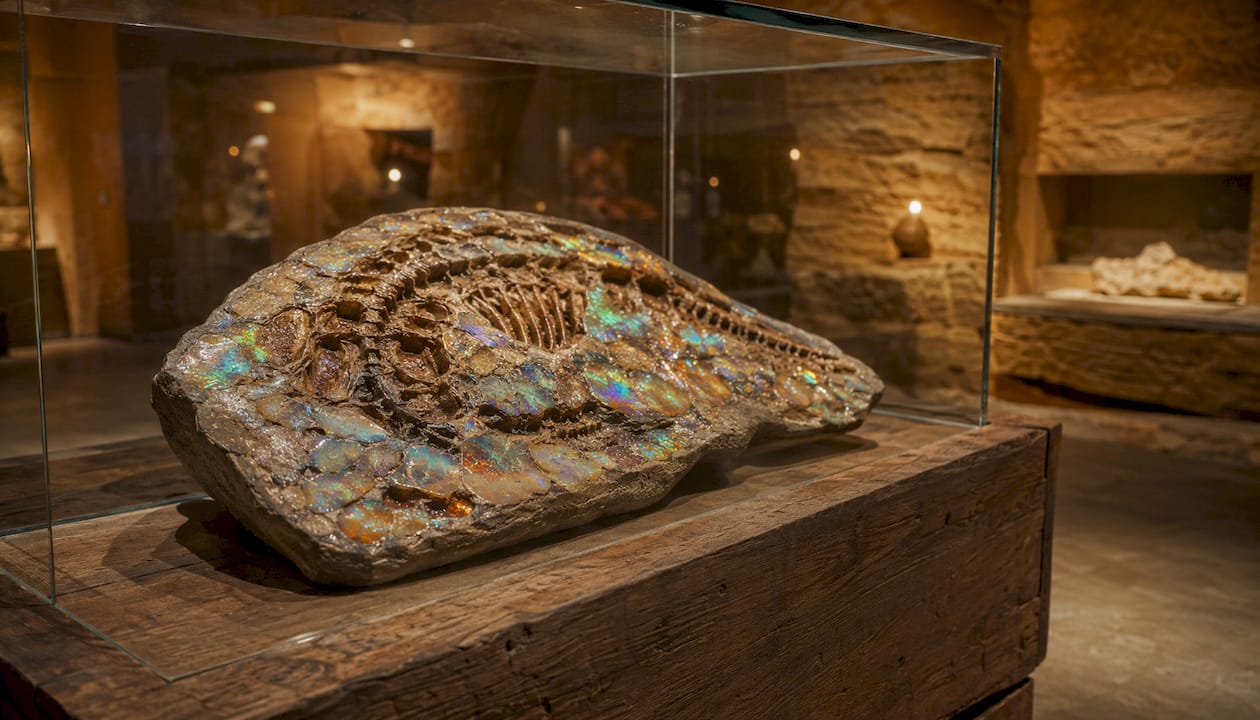
The oldest opal specimens on Earth date back approximately 65–100 million years, formed during the Cretaceous period when ancient inland seas retreated and left silica-rich solutions to crystallize inside the bones of dinosaurs and the shells of marine creatures. These geological marvels predate human civilization by an almost incomprehensible margin. Yet the story of opal and humanity is itself ancient: a flaked opaline tool recovered from Devil’s Lair in Western Australia was radiocarbon-dated to approximately 33,000 years ago, marking the oldest confirmed human use of opal. For commercial mining, the record belongs to Dubník in Slovakia’s Carpathian Mountains, where organized extraction began around 400 B.C.
Key dates at a glance:
- Opalized dinosaur fossils formed at Lightning Ridge, New South Wales during the Cretaceous period
- Opalized pearls formed at Coober Pedy, South Australia during the Cretaceous period
- Flaked opaline artifact used at Devil’s Lair, Western Australia, dated to approximately 33,000 years ago
- Commercial opal mining began in historic times at Dubník, Slovakia
- ~850 A.D.: Opals appear in Aztec burial ceremonies in Mexico
| Event | Approximate Date | Location |
|---|---|---|
| Opalized dinosaur fossils (Fostoria dhimbangunmal) | Cretaceous period | Lightning Ridge, Australia |
| Opalized pearls from ancient inland sea | Cretaceous period | Coober Pedy, Australia |
| Earliest human-used opal artifact | ~33,000 years ago | Devil’s Lair, Western Australia |
| Oldest recorded commercial opal mining | Historic era | Dubník, Slovakia |
| Aztec burial opal finds | ~850 A.D. | Mexico |
How opal forms and what varieties exist
Opal begins as water. Specifically, it originates when silica-rich water seeps through sedimentary rock, filling cracks, voids, and the cavities left by decaying organic matter. Over thousands to millions of years, the water evaporates and leaves behind a hardened silica gel. That gel, depending on the regularity of its internal sphere arrangement, becomes either the iridescent precious opal collectors prize or the more subdued common opal found worldwide.
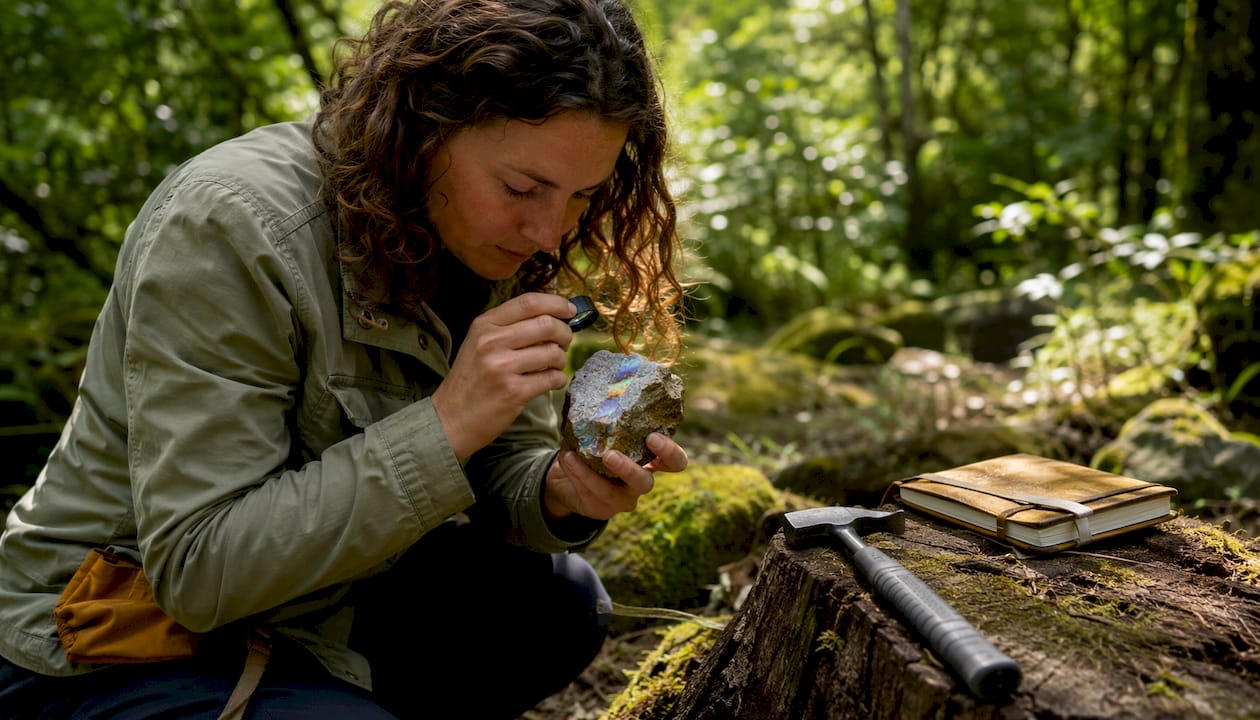
The distinction between precious and common opal comes down to structure. Precious opal contains silica spheres arranged in a near-perfect grid, which diffracts light into that kaleidoscopic play of color. Common opal lacks this ordered arrangement, producing a translucent or opaque stone without the spectral fire. A third category, fossil opal, forms when silica solutions replace organic material entirely, preserving the original shape of a shell, bone, or plant in breathtaking mineralogical detail.
| Opal Variety | Key Feature | Typical Formation Environment |
|---|---|---|
| Precious opal | Play of color from ordered silica spheres | Sedimentary rock, ancient seabeds |
| Common opal | No play of color, translucent to opaque | Volcanic and sedimentary environments |
| Fossil opal (opalized fossil) | Organic material replaced by silica | Ancient seabeds, Cretaceous deposits |
| Crystal opal | Transparent body with vivid color play | Deep sedimentary layers |
| Boulder opal | Ironstone host rock with opal veins | Queensland, Australia |
Geological events shaped where and when these deposits formed. The retreat of the Eromanga Sea, an ancient inland ocean that once covered much of central Australia, created the precise conditions for opal formation across Lightning Ridge, Coober Pedy, and Queensland. Volcanic activity in regions like Nevada’s Virgin Valley produced a different but equally fascinating opal chemistry, where hydrated silica settled into volcanic ash layers. The gemstone rarity factors that make Australian opals so coveted today trace directly to these ancient geological episodes.
Where are the oldest opal mining locations in the world?
The history of opal gemstones as a mined commodity stretches back more than two millennia, and the sites that shaped that history span three continents.
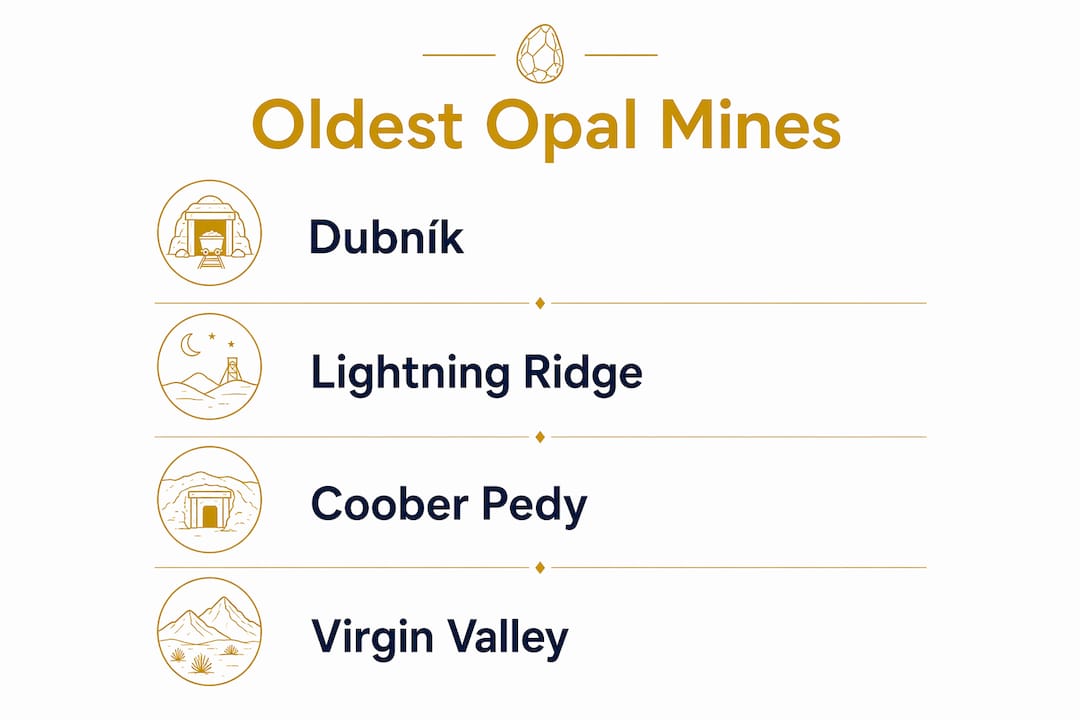
Dubník, Slovakia holds the title of the world’s oldest recorded commercial opal mining site. Extraction in the Carpathian Mountains began around 400 B.C., predating other major commercial operations by more than two thousand years. For centuries, Dubník supplied opals to European royalty and the Roman Empire, with the stones traveling trade routes as far as Constantinople. Mining continued until approximately 1922, when the deposits became commercially unviable. Today, Dubník operates as a heritage tourism site, its tunnels preserved as a monument to the ancient history of opal gemstones.
Lightning Ridge, New South Wales, Australia produces the world’s most coveted black opals, stones with a dark body tone that makes their color play appear almost luminous. The region’s deposits formed roughly 100 million years ago within Cretaceous sedimentary layers, and commercial mining began in the late 19th century. Lightning Ridge is also the site of extraordinary fossil discoveries, including the opalized remains of the dinosaur Fostoria dhimbangunmal.
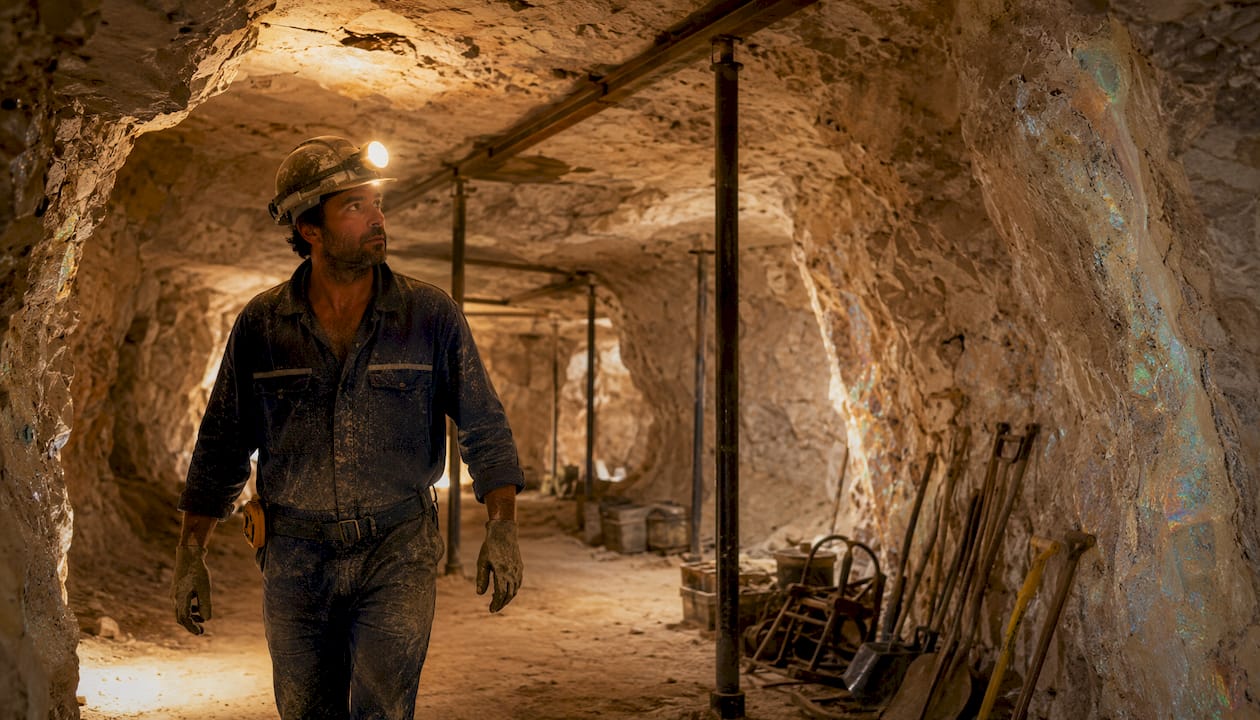
Coober Pedy, South Australia is the self-proclaimed opal capital of the world, supplying a large share of global precious opal production. Its deposits, also Cretaceous in origin, have yielded opalized pearls dating back 65 million years. The town itself is famous for its underground homes, built to escape the desert heat, and its miners have an unbroken tradition of unearthing geological wonders alongside commercial stones.
Virgin Valley, Nevada, USA is the most significant ancient opal discovery site in North America. The valley’s opals form within volcanic ash deposits and are notable for their vivid color, though they tend to crack as they dry due to high water content. The Virgin Valley has produced some of the most spectacular precious opals found on American soil, including the famous “Roebling Opal,” now housed at the Smithsonian Institution’s National Museum of Natural History in Washington, D.C.
Key milestones in the history of opal mining:
- Commercial mining begins in historic times at Dubník, Slovakia
- ~1 A.D.: Roman senator Nonius reportedly owns a prized opal the size of a hazelnut
- Late 1800s: Lightning Ridge and Coober Pedy mining operations begin in Australia
- 1906: The Roebling Opal is discovered at Virgin Valley, Nevada
- 1922: Commercial mining at Dubník, Slovakia ceases
- 1987: Opal is declared Australia’s national gemstone
| Mining Location | Country | Earliest Activity | Notable Feature |
|---|---|---|---|
| Dubník | Slovakia | ~400 B.C. | Oldest recorded commercial mining |
| Lightning Ridge | Australia | Late 1800s | Black opal, opalized dinosaur fossils |
| Coober Pedy | Australia | — | World’s largest precious opal producer |
| Virgin Valley | USA (Nevada) | Late 1800s | Roebling Opal at Smithsonian |
| Querétaro | Mexico | Pre-Columbian | Fire opal, Aztec ceremonial use |
Pro Tip: If you want to find ancient opals in the United States, Virgin Valley in Humboldt County, Nevada, allows recreational fossicking at select claims. The opals there sit in volcanic ash layers and can display extraordinary color, though they require careful stabilization after extraction to prevent cracking.
The earliest human use and cultural significance of opal
The oldest confirmed human use of opal predates agriculture, writing, and every ancient civilization we know by name. A flaked opaline tool recovered from Devil’s Lair cave in Western Australia dates to approximately 33,000 years ago. The artifact shows signs of deliberate shaping, and researchers noted its history of periodic color changes caused by moisture absorption, a property unique to opal among common tool-making minerals. This suggests early humans recognized opal as something distinct, even if their relationship with it was practical rather than ornamental.
For decades, some accounts claimed that opal artifacts dating to around 4,000 B.C. had been found in Kenya, which would have placed organized opal use in East Africa during the Neolithic period. Scientific reassessment has since found no confirmed opal artifacts from this period or region. The claims are now considered misidentifications, a reminder that the authentication of ancient opal requires rigorous mineralogical analysis, not just visual inspection.
A numbered timeline of key cultural milestones:
- ~33,000 years ago: Flaked opaline tool used at Devil’s Lair, Western Australia
- ~4,000 B.C.: Kenyan artifact claims later debunked by scientific reassessment
- ~1 A.D.: Roman writers including Pliny the Elder describe opal as the most precious of all gemstones
- ~850 A.D.: Opals appear in Aztec burial ceremonies in Mexico, likely sourced from Querétaro
- ~1000 A.D.: Arabic writers describe opal as falling from the sky in lightning, explaining its fire
- Medieval Europe: Opal is considered a stone of good fortune, said to carry the virtues of every gemstone whose color it reflected
- 1829: Sir Walter Scott’s novel Anne of Geierstein popularizes a superstition linking opal to bad luck, temporarily damaging its reputation in Western markets
- Late 1800s: Australian opal floods European markets, restoring the gemstone’s prestige and displacing Slovak sources
- 1932: The Smithsonian Institution acquires the Roebling Opal, cementing American institutional interest in opal’s geological heritage
- 1987: Australia officially declares opal its national gemstone, recognizing both its cultural weight and its economic importance
The Aztec connection deserves particular attention. Opals found in burial sites in Mexico, dated to approximately 850 A.D., reveal that Mesoamerican cultures assigned profound symbolism to the stone. They called it quetzalitzlipyollitli, meaning “the stone of the bird of paradise,” a name that captures the iridescent quality that has captivated every culture to encounter it. The cultural significance of opal in jewelry spans continents and millennia, yet the core fascination remains unchanged: no other gemstone contains a living, shifting light within itself.
Opalized fossils and their importance to paleontology
Opalized fossils represent one of the most extraordinary intersections of geology and biology on Earth. They form when silica-rich groundwater permeates organic material, such as bone, shell, or wood, before it fully decomposes. The silica gradually replaces the original substance molecule by molecule, preserving the structure in opal while the surrounding sediment hardens around it. The result is a fossil that retains the anatomical detail of the original organism but glows with the spectral fire of precious opal.
The Cretaceous period, spanning roughly 65–100 million years ago, produced the conditions most favorable for this process in Australia. The retreat of the Eromanga Sea left behind silica-saturated sediments across what are now the opal fields of Lightning Ridge and Coober Pedy. Creatures that died in or near this ancient sea, from marine reptiles and fish to terrestrial dinosaurs near the shoreline, were sometimes preserved in this extraordinary way.
| Fossil Find | Age | Location | Significance |
|---|---|---|---|
| Fostoria dhimbangunmal (dinosaur) | ~100 million years | Lightning Ridge, NSW | New species identified from opalized vertebrae |
| Opalized pearls | ~65 million years | Coober Pedy, SA | Rare marine relics from ancient inland sea |
| Opalized marine reptile bones | ~100 million years | Lightning Ridge, NSW | Evidence of Cretaceous sea life |
| Opalized shells and bivalves | ~65–100 million years | Multiple Australian sites | Paleontological record of Cretaceous fauna |
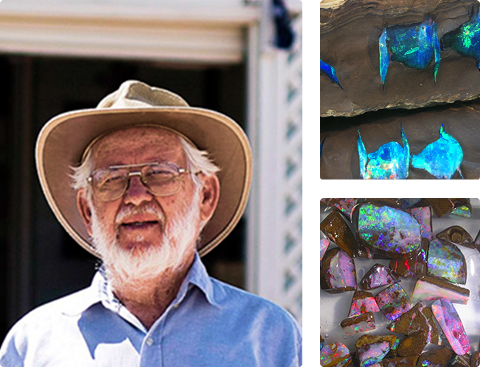
The discovery of Fostoria dhimbangunmal at Lightning Ridge stands as one of the most remarkable finds in Australian paleontology. Miner Bob Foster uncovered the opalized vertebrae at the Sheepyard opal field, and subsequent scientific study identified them as belonging to an entirely new dinosaur species, an ornithopod that lived approximately 100 million years ago. The fossils were not only scientifically significant but visually stunning, their surfaces shimmering with the color play of precious opal.
Opal miners now collaborate with paleontologists to preserve fossils found during extraction, a practice that has transformed Lightning Ridge into one of the world’s most productive sites for Cretaceous paleontological research. The partnership works because miners understand the terrain intimately and paleontologists provide the scientific framework to interpret what the earth reveals. Fossils recovered from the opal fields of New South Wales are studied at institutions including the Australian Museum in Sydney and the Australian Opal Centre at Lightning Ridge.
Pro Tip: Opalized fossils are legally protected in Australia. If you encounter what appears to be a fossil during recreational fossicking, report it to the relevant state geological authority rather than extracting it yourself. Properly documented fossils contribute far more to science and to the opal community’s reputation than undocumented specimens ever could.
Key Takeaways
The oldest opals on Earth formed during the Cretaceous period, approximately 65–100 million years ago, while the oldest confirmed human use of opal dates to approximately 33,000 years ago, from the flaked tool at Devil’s Lair, Western Australia.
| Point | Details |
|---|---|
| Geological age of oldest opals | Cretaceous-period opalized fossils date to approximately 65–100 million years ago. |
| Earliest human use | A flaked opaline artifact from Devil’s Lair, Western Australia, was radiocarbon-dated to approximately 33,000 years ago. |
| Oldest commercial mining | Dubník, Slovakia holds the record, with organized extraction beginning around 400 B.C. |
| Key fossil discoveries | Opalized dinosaur Fostoria dhimbangunmal (~100 million years) at Lightning Ridge; opalized pearls (~65 million years) at Coober Pedy. |
| US opal heritage | Virgin Valley, Nevada, is North America’s most significant ancient opal site, with the Roebling Opal now at the Smithsonian. |
Explore genuine opals from history’s most celebrated mining regions

Every opal in the Australianopaldirect collection comes directly from the fields that define this article: Lightning Ridge, Coober Pedy, and Queensland. These are not just names on a map. They are the same Cretaceous sedimentary layers that preserved dinosaur bones in iridescent silica, the same ancient seabeds that yielded 65-million-year-old pearls. When you wear an opal from these regions, you carry a fragment of deep geological time.
Australianopaldirect sources directly from miners, which means every stone arrives with verified provenance and no intermediary markups. The collection spans loose gemstones, custom-designed rings and pendants, opalized fossil pieces, and limited-edition sets. Explore the full range of genuine Australian opals and find a stone whose history stretches back further than you might have imagined.
Recommended
- Origin of Opals in Australia: History, Science, and Value - Australian Opal Direct
- Opal Origin Regions: A Collector’s Complete Guide - Australian Opal Direct
- How to Distinguish Opal Origins for Authentic Jewelry - Australian Opal Direct
- 7 Most Famous Australian Opals Every Collector Should Know - Australian Opal Direct