Buyers: Demand Written Lab Proof for Hydrophane Opal Before You Pay
Posted by AOD on 23rd Sep 2026
Buyers: Demand Written Lab Proof for Hydrophane Opal Before You Pay

Hydrophane opal is a naturally porous variety of opal that absorbs water and other liquids, temporarily altering its translucency, color play, and even its weight. That absorbency means any exposure to moisture, from a rainstorm to an ultrasonic cleaner, can shift the stone’s appearance and, in fragile pieces, widen existing microcracks. Before buying or wearing one, insist on written disclosure of hydrophane behavior and treat any drop test as a screening step, never as proof of what you’re holding.
TL;DR:
- Water absorption in hydrophane opal can cause dramatic changes in transparency, color play, and weight, lasting days to weeks after wetting.
- Identification relies on microscopic single-drop water tests and documented construction details; the drop test alone cannot confirm origin or treatment.
- Many hydrophane opals from Ethiopian deposits have higher porosity, but behavior varies significantly within individual stones regardless of locality.
- Treatments like oiling, resin impregnation, or dyeing are common and detectable through lab testing; proper documentation from sellers is essential for accurate valuation.
- Buyers should prioritize detailed written disclosures about construction, treatment history, and hydrophane behavior over home tests to avoid damage and misrepresentation.
Table of Contents
- What Makes an Opal Hydrophane?
- How to Identify Hydrophane Opal Without Damaging It
- What Happens to Hydrophane Opal When It Gets Wet
- Treatments That Alter Hydrophane Opal, and How Labs Catch Them
- Judging Value: A Buyer’s Checklist for Hydrophane Opal
- How Australian Opal Direct Documents Hydrophane Stones for Buyers
- Why the Standard Advice on Hydrophane Opal Falls Short
- Get Documented, Direct-Sourced Opal Without the Guesswork
- Where This Guidance Comes From
- Sources
- FAQ
What Makes an Opal Hydrophane?
Every opal is a hydrated form of silica, but not all opal absorbs liquid at the same rate. Hydrophane opal owes its thirst to microscopic pore structure. Its silica spheres are packed loosely enough to let water molecules travel into the stone rather than bead on the surface, and that structural quirk is what separates it from the denser precious and common opal varieties collectors are used to seeing from established Australian fields.
The distinction matters for how you talk about the stone and how a lab writes it up. The Laboratory Manual Harmonisation Committee, the body that coordinates standardized wording across major gem labs, defines hydrophane opal as opal that absorbs liquids to the point of changing its appearance and potentially its mass. That’s the phrase you want to see on a lab report, not a vague reference to “porous” or “unstable.”
Locality gets thrown around as shorthand for hydrophane risk, and there’s a kernel of truth in it. Classification guidance from the Australian Opal Association notes that hydrophane material can turn up from any deposit, though Ethiopian opal fields are known for producing a high percentage of it. Treat that as a probability, not a guarantee. A stone’s country of origin tells you what is statistically common in that deposit; it tells you nothing certain about the specific piece in front of you.
That gap between population-level tendency and individual-stone behavior is where a lot of buyers get misled. Research from GIA’s gem testing lab has shown that porosity can vary even within a single piece of rough, let alone across a parcel of cut stones from the same mine. A seller’s claim that “material from this region doesn’t absorb much” describes an average, not a promise.
A few practical contrasts are worth keeping straight when you’re comparing pieces:
- Precious opal shows play-of-colour, the shifting rainbow flash caused by light diffracting through ordered silica spheres.
- Common opal lacks that flash entirely and is valued mainly for body color and translucency.
- Hydrophane opal can belong to either category. What defines it isn’t color play, it’s absorbency.
- Body tone (how light or dark the background is) and play-of-colour are separate traits from hydrophane behavior. A stone can be dark, bright, and hydrophane all at once.
None of this makes hydrophane opal inferior. Some of the most striking jelly opal on the market is hydrophane. It just means the stone needs to be handled and disclosed differently than a dense, non-absorbent Lightning Ridge crystal.
How to Identify Hydrophane Opal Without Damaging It
The instinct to drop a stone in water and watch what happens is understandable, but it’s the riskiest way to answer the question. Gemologists have a safer version of that same test, and knowing the difference protects both your stone and your money.
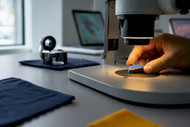
GIA’s published screening method places a single drop of water on the opal’s surface and watches for absorption and optical aberration under a brightfield microscope. The distortion you see, a kind of localized cloudiness or lensing where the water sinks in, indicates porosity. It does not, on its own, prove where the stone came from or whether it has been treated. As GIA researcher Nathan Renfro has pointed out, a water reaction answers only one of three separate questions a buyer needs answered: is it porous, has it been treated, and where did it originate. Conflating those three is how buyers end up overpaying for a stone that reacted to water but turned out to be dyed, oiled, or misrepresented on locality.
Here’s the safer path if you’re evaluating a stone yourself or asking a seller to do it for you:
- Request microscope documentation first. Ask for brightfield images showing the single-drop test rather than performing an immersion test yourself.
- Check for construction disclosure. Solid opal, doublets, and triplets behave differently in moisture. Adhesives and backing layers in assembled stones can be affected by liquid even when the opal layer survives intact.
- Ask for a spot refractive index reading. A quick RI check helps confirm the material is opal at all, before you worry about hydrophane behavior specifically.
- Get the hydrophane observation in writing. A one-line note on the invoice (“this stone is hydrophane and should be kept dry”) protects you if the stone changes after purchase.
- Never soak a mounted or valuable stone to test it. GIA’s own research warns that immersion and wetting can enlarge existing microcracks, meaning the test itself can cause the damage you’re trying to detect.
Watch for red flags while you shop: sellers who dodge questions about hydrophane behavior, product photos that look inconsistent in transparency from one angle to the next, or no return policy on a stone described as “natural, untreated.” A reputable seller shouldn’t hesitate to answer any of these questions directly.
Pro Tip: If a seller offers to “test it in front of you” with a full soak rather than a single drop under magnification, that’s a sign they’re not following lab-standard practice. Ask for documentation instead, and walk away if they can’t produce it.
What Happens to Hydrophane Opal When It Gets Wet
The visible change is often dramatic. A stone that looks milky or semi-opaque dry can turn nearly transparent once saturated, and the play-of-colour pattern can shift, brighten, or in some cases fade almost entirely, a phenomenon gemologists call reverse hydrophane. Britannica’s summary of the material describes exactly this range, from nearly opaque to nearly transparent depending on water content, which is part of why hydrophane opal photographs so inconsistently online.

The change isn’t just visual. In controlled testing, GIA researchers found that hydrophane opal slices gained a measurable percentage of their weight in water, and it took several days to a week for the slices to return to their original weight and appearance.
A week is a long time to wait and see if your ring is still wearable. That recovery window is the single most underappreciated fact in hydrophane care. A stone that got splashed at a sink on Monday may not look, weigh, or behave normally again until the following week, and there’s no reliable way to speed up the process without risking further stress on the stone.
A few behaviors to expect if your hydrophane opal gets wet:
- Temporary increase in transparency or translucency, sometimes dramatic.
- Play-of-colour may intensify, dim, or shift pattern until the stone dries out.
- Weight gain that’s measurable in a lab setting, even if imperceptible by hand.
- Recovery timelines measured in days, not minutes, and inconsistent from stone to stone.
Because porosity is uneven even within a single piece of rough, one stone’s week-long recovery tells you nothing certain about the next one. A dry cycle that goes smoothly once is not proof the stone will handle a second soaking the same way. Treat every wetting event as a stress test, not a demonstration of durability. If you want a deeper look at how water content interacts with opal structure more broadly, Australian Opal Direct’s guide to water content in opal walks through the mechanics in more detail.
Treatments That Alter Hydrophane Opal, and How Labs Catch Them
Because hydrophane opal absorbs liquid so readily, it’s also unusually easy to treat, and unusually easy to treat badly. Understanding what a treatment does to the stone, and how it gets detected, is essential before you agree to a price.
Oiling is the oldest trick in the book. It fills surface porosity with oil to improve transparency, but GIA’s treatment research found that oiling often destroys play-of-colour in the process, trading a brighter, clearer look for a duller color display.
Opticon treatment, a resin commonly used to stabilize porous gem materials, can increase transparency while preserving play-of-colour, which makes it harder to spot with the naked eye and more likely to be misrepresented as untreated.
Dyeing and impregnation carry their own risks. Britannica notes that light-colored hydrophane stones are sometimes dyed to imitate rarer, more valuable varieties, a practice that can fool casual buyers who don’t know to look for it.
None of these treatments are necessarily dealbreakers. Treated stones can be sold honestly at treated-stone prices. The problem is misrepresentation, not treatment itself.
Detection usually requires instruments beyond a loupe. FTIR and Raman spectroscopy can identify the spectral signatures left behind by oil and Opticon, even when the treatment is invisible to unaided inspection. That’s part of why a lab report carries more weight than a seller’s verbal assurance.
A complete invoice or lab report for hydrophane opal should disclose:
- Whether the material is natural or synthetic.
- Construction: solid, doublet, or triplet.
- Full treatment history, including oiling, resin impregnation, or dyeing.
- A specific hydrophane observation, not just a general “handle with care” note.
- Basic care instructions tied to that specific stone’s behavior.
If a seller can’t produce that level of detail, ask why. A missing answer is itself information.
Judging Value: A Buyer’s Checklist for Hydrophane Opal
There’s no universal price chart for hydrophane opal, and that’s not a dodge, it’s a documented fact of the market. Value depends on brightness and pattern of play-of-colour, transparency, cut, size, condition, and whether treatment has been disclosed. Two stones that look similar in a photo can be priced hundreds of dollars apart once you account for those variables.
That variability cuts both ways. Some collectors avoid hydrophane material altogether because of the care burden, which depresses demand and price for otherwise fine stones. Natural, untreated hydrophane strands and beads, when properly documented, can still carry real jelly opal value precisely because untreated examples with confirmed provenance are less common than the broader hydrophane supply suggests. Rarity of honest documentation, not just rarity of the material, drives part of the price here.
Before you commit to a purchase, whether it’s a loose stone or a finished piece, work through this checklist:
- Confirm natural versus synthetic in writing, not verbally.
- Ask for construction details. Solid opal carries different risk than a doublet or triplet.
- Request locality information, understanding it’s a probability indicator, not a guarantee of behavior.
- Get the treatment history, including any oiling, resin, or dye.
- Insist on a specific hydrophane observation rather than generic care language.
- Ask about care guidance tailored to that stone, including whether it can be worn in the shower or washed with soap and water.
- Confirm return terms in case the stone’s appearance changes after your first exposure to moisture.
- Weigh whether an independent lab report is worth the cost. For a modest strand of beads, a reputable seller’s written disclosure may be enough. For a high-value single stone or a piece intended as an investment, an independent report with microscope images and spot RI data is worth the extra step.
Transparency itself is a trait collectors chase, sometimes without realizing hydrophane behavior is part of why a stone reads as translucent in the first place. If that’s a quality you’re drawn to, it’s worth understanding why transparency carries the appeal it does before you assume every clear jelly opal behaves the same way underwater. It’s also worth reviewing a broader opal quality checklist alongside this one, since color, cut, and clarity assessments still apply on top of hydrophane-specific questions.
How Australian Opal Direct Documents Hydrophane Stones for Buyers
Buyers shopping online face a specific problem: you can’t run a brightfield microscope test through a product photo. That’s why documentation has to do the work that a jeweler’s loupe would do in person.
A stone’s behavior in water is a fact about that specific piece, not a marketing claim about the mine it came from. The only honest way to communicate that fact to an online buyer is in writing, before the sale, not after a return request.
Australian Opal Direct sources directly from miners connected to established Australian fields, including Lightning Ridge, Coober Pedy, and Queensland, which keeps provenance close to the point of origin rather than several steps removed through intermediaries. For buyers weighing an online purchase, the practical workflow looks like this: review detailed product imagery, ask for construction and treatment details before purchase, and rely on the warranty and return terms as a backstop if a stone’s appearance shifts after normal wear. Readers curious about how opacity terminology applies to their own stone can also check the guide to opal opacity for additional context on how translucency is described industry-wide.
Why the Standard Advice on Hydrophane Opal Falls Short
Most consumer guides treat the drop test like a verdict: water goes in, absorption happens, case closed. That’s backwards. The test tells you a stone is porous. It tells you nothing about whether that porosity is natural, whether the color display you’re paying for will survive a Tuesday afternoon rainstorm, or whether the seller has been straight with you about treatment.
The bigger failure in conventional advice is treating hydrophane opal as a single predictable category tied to locality. GIA’s own lab work shows porosity varies within a single piece of rough. If porosity isn’t consistent within one stone, it certainly isn’t consistent across an entire mining region. Buyers who lean on “Ethiopian opal behaves this way” as a substitute for stone-specific disclosure are trading a real answer for a rough average.
What should come first, before pattern, before price, before even play-of-colour, is documentation. A written hydrophane observation, a construction disclosure, and honest treatment history protect you more than any home test ever will. The stone itself is secondary to the paperwork that describes it accurately.
— Renee
Get Documented, Direct-Sourced Opal Without the Guesswork
Australian Opal Direct sells genuine Australian opal sourced through direct-miner relationships, cutting out the layers of resale that make disclosure harder to trace. For details on shipping, insurance, and warranty, please consult their website.

If you’re specifically weighing a hydrophane piece, whether it’s a jelly opal pendant or a set of natural beads, contact customer service before you buy and ask for the same documentation this guide recommends: construction, treatment history, and a direct hydrophane observation. Browse custom hand-crafted opal jewelry to start a conversation about a piece built around a stone whose behavior has already been disclosed to you in writing, or explore opal rings if you already know the cut and setting you want.
Where This Guidance Comes From
The identification, treatment, and disclosure standards in this guide draw on a small set of authoritative sources worth knowing by name if you want to dig deeper:
- GIA’s Gems & Gemology journal, for the single-drop screening method, immersion risk warnings, and treatment detection research on oiling and Opticon.
- LMHC Information Sheet #13, for standardized report wording labs use to disclose hydrophane behavior.
- Australian Opal Association classification guidance, for terminology around porosity, locality prevalence, and construction disclosure.
FAQ
How can you tell if an opal is hydrophane?
The lab-standard method places a single drop of water on the stone’s surface and checks for absorption and optical distortion under a brightfield microscope. A visible cloudy or lensing reaction indicates porosity, but it’s a screening test only, not confirmation of origin or treatment status.
What is the price of hydrophane opal?
There’s no universal price for hydrophane opal since value depends on play-of-colour brightness, pattern, transparency, size, cut, condition, and treatment disclosure. Compare similar stones side by side rather than expecting a fixed rate, and always weigh documented, untreated pieces against undocumented ones separately.
What is Australia’s rarest opal?
Black opal from Lightning Ridge is widely regarded as the rarest and most valuable Australian opal type, prized for the way its dark body tone makes play-of-colour appear especially vivid. Rarity within any category still depends on individual stone quality, so two black opals can carry very different values.
What is the rarest type of opal stone overall?
Among opal varieties generally, black opal and certain fire opal deposits are considered the scarcest, though rarity claims vary by market and mining region. Hydrophane opal isn’t inherently rarer, it’s a behavioral category that can appear across many opal types and localities, including material from Ethiopian deposits, which are known for producing a high percentage of hydrophane material.
Can you wear hydrophane opal jewelry every day?
Yes, but with more caution around water exposure than a standard precious opal requires. Avoid submerging the piece in dishwater, pools, or the shower, since even brief wetting can change transparency and color play for about a week before the stone returns to its original appearance.








