Explaining Competitive Jewelry Pricing for Smart Buyers
Posted by AOD on 27th Jun 2026
Explaining Competitive Jewelry Pricing for Smart Buyers

TL;DR:
- Jewelry pricing is driven by costs, sales channel markups, and what buyers perceive as credible value.
- Transparent sourcing and clear cost breakdowns help consumers evaluate whether prices reflect true quality and craftsmanship.
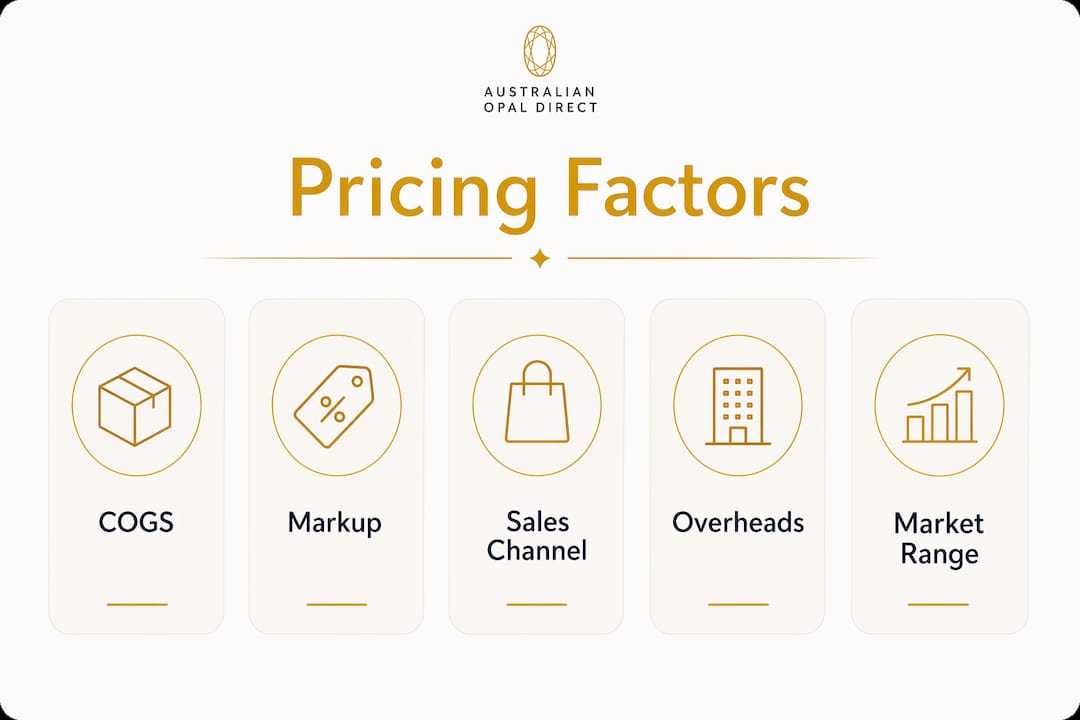
Competitive jewelry pricing is defined by three interlocking forces: the cost of goods sold (COGS), the markup multiplier applied by each sales channel, and the price range that buyers in a given market perceive as credible. Understanding these forces separates informed buyers from those who pay too much or dismiss quality pieces as overpriced. Brands like Erawan Atelier and Branvas have published detailed pricing frameworks that reveal just how many cost layers sit between raw materials and the final retail tag. Australianopaldirect applies this same logic to its curated opal collections, sourcing directly from Australian miners to keep those layers lean and transparent.
What are the main cost components in jewelry pricing?
Every retail jewelry price begins with COGS, which covers materials, labor, and overhead. Materials include the metal, gemstones, and findings. Labor covers the hours a craftsperson spends setting, polishing, and finishing each piece. Overhead adds studio rent, equipment, and utilities to the total.
Beyond COGS, several additional cost layers accumulate before a piece reaches a buyer:
- Packaging and presentation: Boxes, pouches, and branded inserts add a small but real cost per unit.
- Fulfillment and shipping: Carrier fees, insurance, and handling time raise the cost of every order.
- Payment processing fees: The advertised rate of 2.9% plus $0.30 per transaction understates the true cost. Effective processing rates run between 3.2% and 4.2% once chargebacks, refunds, and card mix are factored in. That gap quietly erodes margins on every sale.
- Returns and reserves: Jewelry return rates online require brands to hold cash reserves against refunds.
- Customer acquisition cost (CAC): Paid advertising, email marketing, and influencer partnerships all cost money to bring a buyer to the product page.
Branvas describes this as a pricing stack formula: add every cost layer to COGS, then apply a multiplier to reach the minimum viable retail price. A piece with an $80 COGS does not simply double to $160. It must absorb packaging, shipping, processing, and CAC before any profit appears.
Pro Tip: Request an itemized cost breakdown from any jeweler you are considering. Brands that can explain their pricing stack clearly are far more likely to deliver consistent quality and honest value.

How do sales channels influence competitive jewelry pricing?
The sales channel a jeweler uses determines the markup multiplier applied to COGS. Retail jewelry pricing commonly uses a keystone-plus model, with retail prices set at 4–6 times COGS and wholesale prices at 2–3 times COGS. That gap exists because each channel carries different cost obligations.
| Sales channel | Typical multiplier | Key cost drivers |
|---|---|---|
| Wholesale | 2–3x COGS | Trade discounts, volume minimums, retailer margin |
| Retail (brick and mortar) | 4–6x COGS | Rent, staff, display, shrinkage |
| Direct-to-consumer (DTC) ecommerce | 4–5x COGS | CAC, platform fees, returns, processing |
| Marketplace (Etsy, Amazon) | 4–6x COGS | Platform commission, advertising, fulfillment |
Wholesale buyers expect to pay 40–60% of the recommended retail price, which means a jeweler’s COGS must stay below 25% of the intended retail price for the math to work. When COGS exceeds that threshold, the wholesale channel becomes unprofitable.
DTC ecommerce absorbs costs that a wholesale buyer never sees. The brand pays for every click, every return, and every chargeback directly. E-commerce is the highest-potential channel for 41% of jewelry traders in 2026, which means competition is intensifying and pricing pressure is rising. That competitive pressure does not translate to lower prices automatically. It often means brands must price more carefully to survive.
Two jewelers selling visually identical rings may list them at very different prices. Channel economics explain that difference far more often than material quality does. A DTC brand absorbs its own marketing costs; a wholesale brand passes those costs upstream to the retailer.
What does “competitive” pricing mean to consumers and the market?
Competitive pricing is not synonymous with the lowest price. Competitive benchmarking means identifying the credible price range that target buyers accept as normal for a given category. Prices above that range require stronger differentiation. Prices below it may signal exploitable value gaps or, more often, hidden quality compromises.
Erawan Atelier frames this clearly: a price is competitive when it sits within the range buyers find believable for the craftsmanship and brand story on offer. A Lightning Ridge black opal ring priced at $300 raises suspicion. The same ring at $1,200 from a brand with documented sourcing and artisan credentials reads as fair value.
Several factors shape what buyers perceive as credible:
- Craftsmanship narrative: Buyers pay more when they understand the skill involved in setting a fragile opal without damaging its play-of-color.
- Ethical sourcing: Knowing a stone was earth-mined in Coober Pedy and not synthetic adds verifiable value.
- Brand reputation and transparency: Clear return policies, warranties, and direct-miner relationships reduce buyer risk and justify higher price points.
- Emotional resonance: Opals carry centuries of cultural meaning. That story is part of the price.
StartForge advises brands to set a non-negotiable price floor and trigger a pricing review whenever material costs shift by 10–15% from the last price set. That discipline protects both the brand’s margin and the buyer’s trust. A brand that discounts erratically signals instability, not generosity.
Pro Tip: When comparing jewelry prices online, check whether the brand publishes its sourcing story, warranty terms, and return policy. Those details are part of the price. A lower sticker price without those assurances is rarely the better deal.
How can tiered multiplier strategies help manage jewelry pricing amid cost volatility?
A flat multiplier applied to total COGS breaks down when commodity prices move. Gold, for example, can shift dramatically within a single quarter. Applying a 5x multiplier to a total cost that includes volatile metal prices produces retail prices that spike unpredictably and price buyers out of the market.
StartForge’s tiered approach solves this by applying different multipliers to each cost category. Metals receive a lower multiplier of 1.2–1.5x because their market price already reflects rarity and demand. Labor receives a higher multiplier of 2–3x because skilled artisan time is the most defensible cost in fine jewelry. Findings and components fall somewhere between.
| Cost category | Multiplier range | Reason |
|---|---|---|
| Precious metals | 1.2–1.5x | Market-priced commodity; lower markup prevents price spikes |
| Gemstones | 1.5–2x | Rarity and quality grading justify moderate markup |
| Labor | 2–3x | Skilled craftsmanship is the primary value driver |
| Findings and components | 1.5–2x | Standardized parts; moderate markup appropriate |
A practical example: a ring with $40 in metal, $30 in opal, $20 in labor, and $10 in findings produces a COGS of $100. A flat 5x multiplier yields a $500 retail price. The tiered approach yields $56 for metal, $54 for opal, $50 for labor, and $18 for findings, totaling $178 in weighted costs. Applied multipliers then produce a retail price closer to $450, with far more stability when gold prices rise because the metal component carries the lowest multiplier.
Quarterly pricing reviews keep retail prices aligned with current material costs without shocking repeat buyers. Brands that review pricing on a fixed schedule maintain credibility and avoid the margin erosion that comes from ignoring commodity markets.
What are common pitfalls consumers should avoid when evaluating jewelry prices?
Price comparison errors are the most common mistake buyers make in the competitive jewelry market. Understanding the pitfalls protects you from both overpaying and dismissing genuinely fair prices.
- Comparing wholesale prices to DTC retail prices: A piece sold through a retailer carries the retailer’s markup on top of the brand’s wholesale price. Comparing that retail price to a DTC brand’s direct price is not an apples-to-apples comparison. The final retail price reflects many small costs layered together, and channel structure is the largest variable.
- Ignoring processing and return fees: Most buyers never see these costs, but they shape every price tag. Payment processing fees and chargebacks affect a brand’s ability to offer genuinely competitive prices. A brand absorbing high chargeback rates must price higher to survive.
- Treating a higher price as overpricing: Higher prices often reflect lower sales volume, higher craftsmanship standards, or ethical sourcing practices that carry real costs. A handcrafted opal pendant from Lightning Ridge is not priced against mass-produced synthetic alternatives.
- Overlooking brand reputation and warranty terms: A 90-day warranty, complimentary insurance, and a clear return policy have monetary value. A lower-priced piece without those protections may cost more in the long run.
Assessing opal jewelry prices against what customers perceive as credible value is the most reliable method for informed buying. Price alone tells you very little. Price in context tells you everything.
Key Takeaways
Competitive jewelry pricing is determined by COGS, channel-specific markup multipliers, and the credible price range buyers accept for a given category and brand.
| Point | Details |
|---|---|
| Cost stack drives the base price | Materials, labor, overhead, processing, and CAC all layer onto COGS before any markup applies. |
| Channel multipliers vary widely | Wholesale runs 2–3x COGS; DTC ecommerce runs 4–5x COGS to cover marketing and platform fees. |
| Competitive means credible, not cheapest | Prices must fall within the range buyers find believable for the craftsmanship and sourcing on offer. |
| Tiered multipliers stabilize pricing | Applying lower multipliers to metals and higher ones to labor prevents retail price spikes during commodity volatility. |
| Context beats sticker price | Warranty terms, ethical sourcing, and brand transparency are part of the value equation, not extras. |
What I have learned about reading jewelry prices as a buyer
Buyers consistently focus on the wrong number. The sticker price is the last thing set and the least informative signal of value. What matters is the cost structure behind it and the channel it traveled through to reach you.
I have watched buyers dismiss a $1,400 opal ring as overpriced while paying $900 for a synthetic stone from a marketplace seller with no return policy and no sourcing documentation. The $1,400 piece had a documented Lightning Ridge origin, a 90-day warranty, and a craftsperson’s hours embedded in every millimeter of the setting. The $900 piece had none of that.
The brands that communicate their pricing honestly, including the costs they absorb so buyers do not have to, are the ones worth trusting. Explaining competitive jewelry pricing is not about finding the lowest number. It is about reading the full story behind the price and deciding whether that story is worth what is being asked.
Australianopaldirect does this well. The direct-miner model removes the wholesale layer entirely, and the brand’s transparency about sourcing regions like Coober Pedy and Queensland gives buyers the context they need to evaluate price against genuine value.
— Renee
Authentic opal pricing, explained by Australianopaldirect
Australianopaldirect sources its opals directly from Australian miners, which removes the wholesale markup layer that inflates prices at most jewelry retailers. Every piece in the collection carries a clear provenance, from the fire-lit depths of Lightning Ridge to the ancient sediment beds of Coober Pedy.

Buyers who understand the cost structures behind jewelry pricing will recognize the value in that model immediately. Transparent sourcing, complimentary insurance, free shipping, and a 90-day warranty are not marketing extras. They are built into the price from the start. Browse the full opal collection to see how competitive pricing looks when the middlemen are removed and the craftsmanship speaks for itself.
FAQ
What is competitive jewelry pricing?
Competitive jewelry pricing is a retail price set within the credible range buyers accept for a given category, based on COGS, channel markup multipliers, and perceived value. It does not mean the lowest price available.
Why do two similar rings have very different prices?
Channel economics explain most price differences between similar pieces. A ring sold through a retailer carries a wholesale markup plus a retail markup, while a DTC brand absorbs its own marketing and processing costs instead.
What is a keystone-plus markup in jewelry?
Keystone-plus means setting a retail price at 4–6 times COGS, which is the standard model for covering operational costs, marketing, and profit in the jewelry industry.
How do payment processing fees affect jewelry prices?
Effective payment processing rates run 3.2%–4.2% after chargebacks and card mix, which is meaningfully higher than the advertised 2.9%. Brands build that true cost into retail prices to protect their margins.
What should I check before comparing jewelry prices online?
Check the sales channel, sourcing documentation, warranty terms, and return policy before comparing prices. A lower sticker price without those protections rarely represents better value.
Recommended
- What Is Collector’s Jewelry? A Definitive Guide - Australian Opal Direct
- What defines high jewelry? The key elements of true luxury - Australian Opal Direct
- Why limited edition jewelry holds lasting value and allure - Australian Opal Direct
- How to Price Opal Jewelry for Authentic Luxury Buyers - Australian Opal Direct