365 nm Test for Australian Collectors: What Opal's UV Glow Proves
Posted by AOD on 2nd Oct 2026
365 nm Test for Australian Collectors: What Opal’s UV Glow Proves

Yes, many opals will react to ultraviolet light, and long-wave UV near 365 nanometers is the practical wavelength collectors reach for when hunting or verifying stones. The response varies widely by opal type: hyalite and some common opal glow readily, while boulder and black opal often stay dark. Fluorescence is a useful clue, never a verdict on authenticity.
TL;DR:
- Long-wave UV at 365 nanometers balances safety and effectiveness, activating fluorescence in many opal types but not in black or boulder opal.
- Fluorescence varies by opal type, with hyalite and common opal reliably glowing green or yellow-green, while precious and black opal often remain inert.
- Surface coatings, dust, or treatments can cause misleading glows, so isolating the stone and checking it in complete darkness improves test accuracy.
- UV fluorescence cannot confirm authenticity, as synthetic or treated opals can mimic or hide natural responses, making lab testing essential for high-value pieces.
- Safety precautions such as UV-rated goggles and brief exposure are necessary because long-wave UV emissions can approach occupational exposure levels.
Table of Contents
- Which UV wavelengths reveal opal fluorescence
- Which opal types fluoresce and what to expect
- Step-by-step field test for observing opal fluorescence
- Safety and regulatory notes for UV torch use
- What fluorescence can and cannot prove
- Why this guide reflects field-tested practice
- A collector’s take on where UV testing actually fits
- Where to find authenticated opals worth collecting
- Where to go for deeper technical reading
- FAQ
Which UV wavelengths reveal opal fluorescence
Not every ultraviolet lamp speaks the same language to a gemstone, and opal is particular about which wavelength it answers. Long-wave UV, centered around 365 nanometers, strikes the balance collectors want: it activates fluorescence in many opal varieties while remaining the safer end of the UV spectrum to work with in the field. Short-wave UV at 254 nanometers and mid-wave at 310 nanometers tend to be overkill for opal hunting. Short-wave lamps are also the riskier tools, generally reserved for mineralogical lab work rather than a night out scouting for nodules.
There is a practical reason short-wave sometimes gets recommended anyway: it can trigger green fluorescence tied to uranium-bearing minerals, which has nothing to do with opal itself and can be mistaken for a promising find.
- Long-wave 365 nm UV offers the best balance of activation and safety for most opal hunting.
- Short-wave 254 nm UV is largely unnecessary for opal and carries greater exposure risk.
- Mid-wave 310 nm rarely adds useful information for opal identification.
Lamp construction matters as much as wavelength. Older mercury-vapor lamps can leak extra emission peaks beyond their rated wavelength, which muddies the color you see and makes one lamp’s “green” different from another’s. Modern LED 365 nm sources are built around a narrower, more consistent band, which is why a filtered LED torch has become the standard recommendation for anyone trying to compare results across stones or nights.
Which opal types fluoresce and what to expect
Opal is not one material behaving one way under a black light. It is a family of related silica gems whose fluorescence depends on structure, trace elements, and the particular deposit it came from.
- Hyalite and some varieties of common opal often glow a vivid green or yellow-green, among the most reliable fluorescent responses in the opal world.
- Precious opal, the kind prized for its play-of-color, is inconsistent: some pieces fluoresce faintly, others not at all.
- Boulder opal and many black opals are frequently inert under long-wave UV, showing little or no reaction regardless of their visual beauty in daylight.
A related wrinkle is phosphorescence, the afterglow that lingers once the UV source is switched off, which is a separate phenomenon from fluorescence itself. Laboratory-documented cases describe photochromic-treated opal where UV exposure induced an orange-red color that faded completely within a few minutes once the light source was removed. That kind of reversible color shift, sometimes called tenebrescence, is a reminder that what you see under the lamp is not always what the stone looked like before you turned it on, and it will not necessarily stay that way afterward.
Coatings, resin backing, and even dust or oils on the surface can throw off a reading, too, producing a glow that belongs to the treatment rather than the gem.

Step-by-step field test for observing opal fluorescence
A reliable UV check does not require a laboratory, but it does reward a bit of discipline. The same stone can look wildly different depending on how dark the room is, how old your filter is, and how close you hold the lamp.
Gear worth having on hand:
- A 365 nm LED-filtered torch, preferred over mercury-vapor units for its steadier, narrower output.
- A blackout space or a genuinely dark outdoor setting, since even faint ambient light washes out subtle fluorescence.
- UV-rated safety goggles meeting AS/NZS 1337.1 or UV400 standards.
- Spare batteries, since lamp output can drop as cells drain.
- A dark cloth to shield glare and reflections from nearby surfaces.
Pro Tip: Let your eyes adjust to darkness for a full two minutes before scanning. Faint fluorescence is easy to miss if you rush straight from a lit room.
Follow this sequence:
- Darken the area completely, blocking stray light from windows, phones, or headlamps.
- Warm up the lamp if the manufacturer recommends it, since some LED units stabilize output after a short run-in.
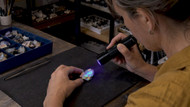
- Scan the stone at the distance and angle recommended for your lamp, usually a few inches, moving slowly rather than sweeping fast.
- Note any immediate fluorescence, including its color and relative brightness.
- Time any afterglow once the lamp is removed, recording both the color and how many seconds or minutes it persists.
If nothing lights up, check your filter for age or scratches, since a worn filter can leak visible purple light near 395 nanometers that masks a true fluorescent response. Host rock around the specimen can also fluoresce on its own, so isolate the opal where you can. A gentle wash and re-test will tell you whether a glow belongs to the gem or to a surface coating.
Safety and regulatory notes for UV torch use
Ultraviolet radiation is not a novelty effect; it is classified as a hazard to skin and eyes, and prolonged exposure is linked to cancer risk at the group one level in broader radiation classifications. ARPANSA guidance notes that 365 nm emissions at close range can approach occupational exposure limits, which is a reason to treat even a “safe” long-wave torch with some caution rather than casual overuse.
- Wear AS/NZS-compliant UV400 eye protection every time you switch the lamp on.
- Keep exposure sessions short and maintain reasonable distance from skin and eyes.
- Never point a UV torch at another person’s or an animal’s eyes, and keep children away from active units.
High-output transilluminators and germicidal-grade lamps may fall under controlled apparatus rules in some jurisdictions, which matters because those units carry exposure risks well beyond a typical hobby torch and are not appropriate for casual opal hunting.
What fluorescence can and cannot prove
A glowing stone is a clue, not a certificate. Fluorescence alone cannot confirm an opal is natural, and plenty of genuine opal, especially black and boulder material, stays completely dark under UV anyway.
- Synthetic and treated opals can mimic a fluorescent response or, just as easily, hide the one you would expect from a natural stone.
- Green fluorescence under short-wave UV is a common false positive, often pointing to uranium-bearing inclusions or coatings rather than anything about the opal itself.
- Wavelength-specific testing and spectral comparison can help separate a genuine signal from a surface artifact, but that level of distinction usually belongs in a lab.
When a stone’s value, provenance, or insurance paperwork is on the line, formal authentication carries more weight than any torch test, UV or otherwise.
Why this guide reflects field-tested practice
- Australian Opal Direct works directly with opal miners in long-established mining regions, which keeps authenticity and pricing grounded in the source rather than a chain of resellers.
- The site maintains educational material on opal fluorescence and the broader optics behind play-of-color, built for collectors who want to understand a stone before they buy it.
- Readers researching gemstone luminescence more broadly may also find the optics context in this guide to gemstone brilliance useful background.
A collector’s take on where UV testing actually fits
UV testing earns its place as a quick triage tool, especially scanning rough at night when a fluorescing nodule can catch your eye from several feet away. It is not a search method that finds everything; boulder and black opal will often sit there inert no matter how good your torch is, so treat a dark result as inconclusive rather than disqualifying.
The sounder habit is layering evidence: play-of-color in daylight, heft and specific gravity checks, and a lab report for anything expensive enough to matter. Respect land access rules during night hunts, and handle lamps with the same care you would any tool that can hurt an eye if used carelessly.
— Renee
Where to find authenticated opals worth collecting
Fluorescence testing can narrow your search, but nothing replaces buying from a source that documents where a stone actually came from. Custom hand-crafted opal jewelry at Australian Opal Direct draws on direct relationships with miners in established opal regions, which keeps authentication closer to the source rather than several resellers removed.
- Listings are backed by documentation tracing stones back toward their mining origin, not just a generic certificate of sale.
- Some purchases may include warranty and insurance options that provide additional buyer protection beyond a UV torch check.
- Readers unsure about a stone’s background are welcome to reach out to customer service for guidance before committing.
Browse the current collection or get in touch if you would rather talk through a specific piece before you buy.
Where to go for deeper technical reading
- GIA lab notes documenting UV-reactive opal and reversible color changes under ultraviolet exposure.
- ARPANSA guidance on UV apparatus classification and occupational exposure benchmarks.
- Mineral fluorescence reference charts and symposium papers covering uranium-related green fluorescence in silica minerals.
FAQ
Do real opals glow under UV light?
Many genuine opals fluoresce under long-wave UV, often in green, yellow-green, or bluish-white tones, though the response depends heavily on the opal type. Boulder opal and many black opals commonly show little or no reaction, so an inert result does not mean a stone is fake.
How can I tell if my opal is real?
UV fluorescence is one small data point among several, including play-of-color, weight, and surface structure, and a fuller authenticity checklist covers the others in detail. For valuable or uncertain pieces, a gemological lab report remains the most reliable route.
What does it mean if stones glow under UV light?
A glow under UV means the mineral contains structural features or trace elements that absorb ultraviolet energy and re-emit it as visible light. The specific color offers clues about composition, such as green fluorescence sometimes pointing to uranium-related activators rather than the base gemstone itself.
Is opal blacklight reactive?
Some opal varieties, particularly hyalite and certain common opal, react strongly to long-wave blacklight with a visible green or yellow-green glow. Precious, boulder, and black opal are far less predictable and frequently show no reaction at all.