Opal Stories and Symbolism: A Cultural Deep Dive
Posted by AOD on 24th May 2026
Opal Stories and Symbolism: A Cultural Deep Dive
TL;DR:
- Opal has a rich history spanning ancient Greece, Rome, and Aboriginal cultures, symbolizing prophecy, love, hope, and purity. Its play-of-color is linked to themes of transformation, creativity, and emotional healing, evolving through modern spiritual interpretations. Despite myths of bad luck, opals’ symbolism and rarity continue to make them meaningful in personal, cultural, and scientific contexts, including discoveries on Mars.
Few gemstones carry as much narrative weight as the opal. From ancient prophecy chambers to modern meditation circles, opal stories and symbolism have shaped how cultures across the world perceive beauty, fate, and the divine. The common belief that opals bring bad luck is one of the most persistent myths in gemstone lore, and it obscures a far richer history. Less than 5% of opals mined are commercially viable, which alone speaks to their extraordinary rarity. What you will find here is the full picture: where opal’s meanings were born, how they shifted, and what they mean today.
Table of Contents
- Key takeaways
- Opal stories and symbolism through the ages
- Modern symbolism: transformation, healing, and intuition
- What each opal variety represents
- October’s gem: birthstone history and gifting traditions
- Science, Mars, and the enduring wonder of opals
- My take on why opal’s shifting meanings still matter
- Discover opals that carry their own story
- FAQ
Key takeaways
| Point | Details |
|---|---|
| Opal symbolism spans millennia | Ancient Greeks, Romans, and Aboriginal Australians all assigned profound meaning to opals, long before modern gemology. |
| The “unlucky opal” myth is literary fiction | Sir Walter Scott’s 1829 novel popularized the curse, not any ancient tradition or cultural consensus. |
| Play-of-color drives spiritual meaning | Opal’s shifting colors are directly linked to modern interpretations of transformation, intuition, and emotional healing. |
| Color variety shapes symbolic meaning | White, black, and fire opals each carry distinct symbolic associations, though these are largely modern frameworks. |
| October birthstone status is formalized | Opal’s birthstone designation was officially codified in 1912, cementing its role in gifting and anniversary traditions. |
Opal stories and symbolism through the ages
No gemstone has traveled a more dramatic arc through human history than the opal. Its stories begin in antiquity, where civilizations with no contact with each other independently arrived at the same conclusion: this stone was extraordinary, perhaps even divine.
In Greek mythology, opals were said to grant their bearer the gift of prophecy. One legend holds that the stone was formed from the tears of Zeus after his victory over the Titans, with joy and relief crystallizing into kaleidoscopic brilliance inside the earth. The Romans elevated opal further still. Pliny the Elder wrote admiringly of the gem in the first century CE, describing it as a stone that united “the fire of the carbuncle, the brilliant purple of the amethyst, and the sea-green of the emerald.” To Roman society, opal represented love, hope, purity, and fidelity simultaneously. Senators carried opals as talismans, and the emperor Augustus reportedly valued a single opal above entire provinces.
Arabic and Eastern legends offered a different but equally celestial origin story. Arabic poets believed opals fell from heaven during thunderstorms, carrying lightning inside their depths. This was not mere metaphor. The Arabic word for opal translates loosely to “stone of a thousand fires,” a name that speaks directly to what the naked eye actually sees.
Perhaps the most spiritually resonant origin story comes from the oldest continuous culture on earth. Aboriginal Australian legends describe the Creator descending from the heavens on a rainbow and touching the earth, causing the stones at that very spot to burst into the colors of light. This Dreamtime story directly connects opal to creation, peace, and the sacred bond between sky and earth. It is not an accident that Australia produces the world’s finest opals. For Aboriginal communities, these stones were never merely decorative. They were sacred.
Medieval Europe took a darker turn. Superstition replaced reverence, and the opal’s shifting colors began to unsettle rather than inspire. But the most damaging blow came from literature. Sir Walter Scott’s 1829 novel featured an enchanted opal that brought disaster to its wearer, a fictional conceit that readers across Europe absorbed as fact. Opal sales reportedly dropped sharply in the years following publication.
“Opals were once considered the luckiest of all gems, a symbol encompassing the virtues of every gemstone whose color they reflected.” — Pliny the Elder
The revival came in the Victorian era, driven by a single, powerful patron. Queen Victoria wore opals openly, gifted them to her daughters on their weddings, and made them fashionable across the British Empire and beyond. What one novel had dimmed, a queen reignited.
Modern symbolism: transformation, healing, and intuition
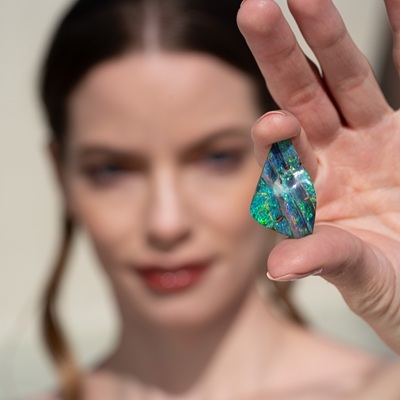
The opal’s contemporary symbolic identity is inseparable from its most defining physical feature: the play-of-color. When light enters an opal, it diffracts through microscopic silica spheres arranged in a precise lattice structure, producing that signature cascade of shifting hues. Modern interpreters have read this optical phenomenon as a living metaphor. A stone that shows you one color and then another, depending on how you hold it or where the light falls, naturally evokes themes of transformation, multiplicity, and emotional depth.
Contemporary opal symbolism centers on several interconnected qualities:
- Hope and optimism: The unpredictable beauty of an opal mirrors the unexpected brightness that can emerge even in difficult moments.
- Creativity and inspiration: Artists and writers have long been drawn to opals as muses, the stone’s visual complexity mirroring the creative mind’s own range.
- Emotional healing: Opal is believed to surface and process buried feelings, making it a stone of emotional honesty rather than suppression.
- Intuition and spiritual awareness: Its reflective quality is read as a mirror for the inner self, amplifying perception beyond the rational.
- Authentic self-expression: Because each opal is genuinely unique, the stone is frequently associated with the courage to be distinct.
Within crystal healing traditions, opal amplifies emotions and strengthens intuition, which is why it appears so frequently in meditation practice and personal ritual. Practitioners often place opals in their field of vision during reflection, using the play-of-color as a focal point for awareness exercises.
Pro Tip: If you use opal in meditation, try holding the stone in natural light and observing how its colors shift as your perspective changes. Many practitioners find this visual exercise a powerful prompt for examining how their own emotions and perceptions are equally fluid.

The most convincing explanation for why opal symbolism resonates so widely is that its meanings are anchored to something real and visible. The shifting colors are not imagined. They are scientifically verifiable. This grounding in observable reality gives opal’s spiritual meaning a credibility that purely abstract gem symbolism lacks.
What each opal variety represents
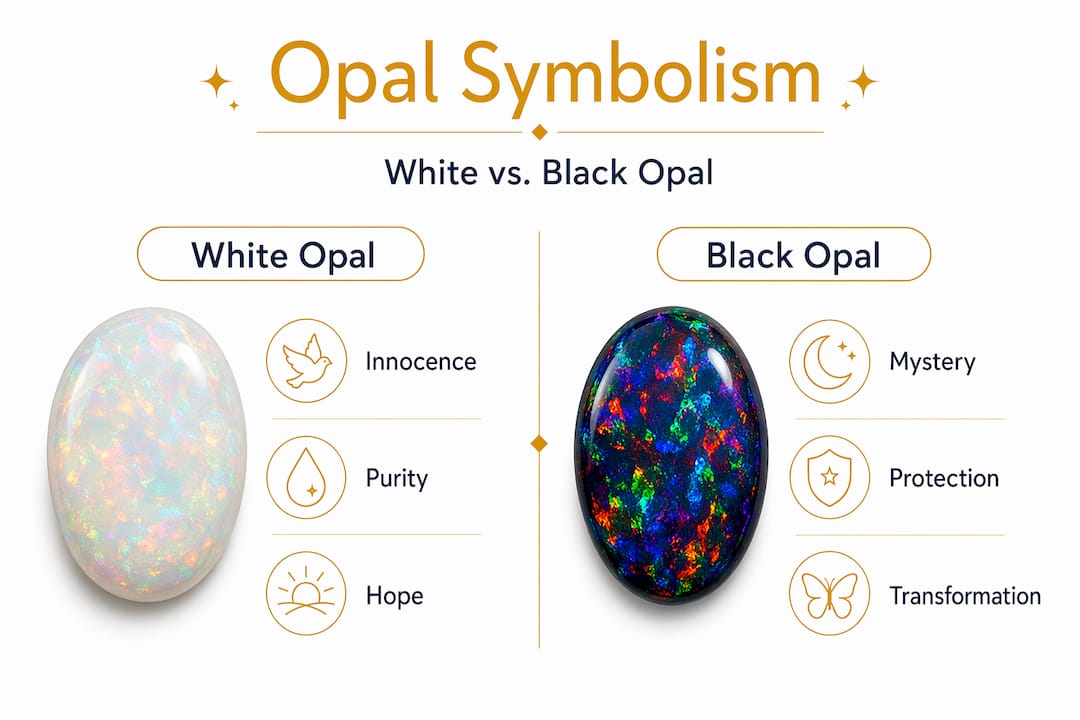
Not all opals speak the same symbolic language. The variety and dominant color of an opal shape the meanings most commonly assigned to it. The table below captures the primary symbolic associations for each major type.
| Opal type | Primary symbolism | Common use |
|---|---|---|
| White opal | Innocence, purity, hope | Bridal jewelry, gifting, new beginnings |
| Black opal | Passion, mystery, grounding | Collectors, statement pieces, protection |
| Fire opal | Energy, enthusiasm, creativity | Artistic expression, confidence, vitality |
| Blue opal | Calm, communication, clarity | Reflection, healing, emotional expression |
| Green opal | Renewal, growth, abundance | Nature-inspired contexts, fresh starts |
These color-based associations are primarily a modern framework, born from the intersection of crystal spirituality and gemstone marketing rather than from ancient codified tradition. Treating them as absolute or universal would be historically inaccurate. That said, they function as useful and resonant heuristics for people drawn to particular opal types.
Black opal deserves special attention here. Found almost exclusively in Lightning Ridge, New South Wales, black opal carries a dark body tone that makes its play-of-color explode with vivid contrast. The symbolic weight of passion and mystery is not arbitrary. Visually, the stone commands a room. Its symbolism follows directly from its presence.
Pro Tip: When selecting an opal for its symbolic meaning, let your instinctive visual response guide you. The color that arrests your attention first is often the one carrying the emotional resonance most relevant to you at that moment.
You can explore opal symbolism by type in greater depth at Australianopaldirect, where white, black, and fire opals are presented with both their visual qualities and their cultural context.
October’s gem: birthstone history and gifting traditions
Opal’s status as a culturally significant stone was formalized in a very specific moment. In 1912, the National Association of Jewelers in the United States officially designated opal as the birthstone for October, a recognition that codified centuries of informal association into a lasting tradition.
That tradition carries significant practical weight today. Opal appears in:
- Birthday gifts for anyone born in October, where it carries layered meanings of hope, creativity, and protection
- 14th wedding anniversary jewelry, where its rarity and beauty parallel the depth of a long-term partnership
- Bridal jewelry, particularly in cultures that prize its association with purity and new beginnings
- Personal milestone pieces, chosen for transformation and renewal at life’s turning points
The cultural momentum behind opal as a gifting stone owes much to Queen Victoria’s influence in the 19th century and has continued into the present era through celebrity culture. In May 2026, Taylor Swift was photographed wearing a historic opal and diamond suite previously owned by Elizabeth Taylor, valued at $125,000. The moment was more than a celebrity story. It was a visible reminder that opal continues to carry cultural authority at the highest levels.
For collectors and gift-givers, the opal’s symbolic richness makes it unusually communicative as a jewelry choice. Selecting an opal is not merely an aesthetic decision. It is a statement about what you believe the recipient deserves: beauty that is rare, complex, and entirely their own.
Science, Mars, and the enduring wonder of opals
Understanding the opal’s structure does not reduce its mystery. It deepens it. An opal forms when silica-rich water seeps into cracks in the earth, deposits microscopic spheres of hydrated silica, and then evaporates over millions of years. When those spheres are uniform in size and precisely arranged, they diffract light into the spectrum we see as play-of-color. The physics is elegant. The result is staggering.
What makes this particularly compelling in 2026 is that the story of opal has extended beyond Earth entirely. Scientific American reported in May 2026 that hydrated silica crystals on Mars closely resemble Earth’s opals, a discovery with profound implications both for geology and for the symbolic imagination.
| Discovery | Significance |
|---|---|
| Opal-like minerals found on Mars | Suggests liquid water activity, expanding opal’s origin story to planetary scale |
| Uniform silica sphere arrangement causes play-of-color | Explains why opal’s visual effect is scientifically unique among gemstones |
| Less than 5% of mined opals are viable | Reinforces rarity as a foundational quality, not a marketing claim |
The science and the symbolism here are not in tension. They illuminate each other. A stone that may have formed on Mars, that captures light through physics precise enough to have taken millions of years to align, and that has inspired prophets, emperors, and Aboriginal Dreaming stories simultaneously, does not need mythology to seem extraordinary. It already is. The science simply confirms what storytellers have always known.
For those interested in the optical science behind opals, Australianopaldirect offers a detailed exploration of why play-of-color defines Australian gems and what to look for when evaluating a stone.
My take on why opal’s shifting meanings still matter
I have spent years thinking about why certain gemstones accumulate meaning across cultures that never communicated with each other, and opal is the clearest example I have found. The Greek, Arabic, and Aboriginal Australian stories did not borrow from each other. They arrived independently at the same conclusion because the stone itself invited it.
What strikes me most about opal stories and symbolism is how closely they track the stone’s visual behavior. A gemstone that changes depends on who is looking and from what angle. Of course, it became a symbol of prophecy, transformation, and emotional depth. The stone was always demonstrating those qualities. Humans were simply narrating what they saw.
The “unlucky opal” chapter is the most instructive part of the whole history. One novel, published in 1829, nearly undid centuries of reverence. That fragility tells us something important: symbolism is not fixed. It is socially constructed and genuinely vulnerable to narrative. The good news is that it is also recoverable, as Queen Victoria proved, and as contemporary culture continues to demonstrate.
My personal view is that the best reason to wear an opal is not its birthstone status or its historical lore, though both are genuinely fascinating. It is the benefits of opal jewelry in lived experience: wearing something that is provably unique, that cannot be replicated, and that carries centuries of human wonder in its structure. That is rare in any material sense of the word.
I would also add this: how a stone was sourced matters as much as what it symbolizes. An opal extracted responsibly from the earth, through traceable, ethical supply chains, carries a different kind of integrity than one whose origins are unknown. Symbolism that is grounded in honest sourcing resonates more deeply than symbolism borrowed from a story.
— Renee
Discover opals that carry their own story
For anyone moved by the rich history of opal meaning and significance, owning a genuine piece of that history is entirely possible.
Australianopaldirect sources its opals directly from the celebrated mining regions of Lightning Ridge, Coober Pedy, and Queensland, working with miners whose relationship with the land mirrors the Dreamtime stories that gave opal its first sacred meaning. Every piece in the collection, from opal rings and earrings to pendants, is selected for its play-of-color, rarity, and craftsmanship. Each stone arrives with its provenance intact and its symbolism earned rather than borrowed. If you are searching for a gift that speaks in the language of centuries, or a personal piece that reflects your own emotional complexity, Australianopaldirect is where that search ends.
FAQ
What is the original symbolic meaning of opal?
In ancient Rome and Greece, opal symbolized love, hope, purity, and fidelity. Roman writers described it as a stone encompassing the virtues of every other gemstone, and Greek legends linked it to the gift of prophecy.
Why is opal considered bad luck, and is that accurate?
The “bad luck” myth traces to Sir Walter Scott’s 1829 novel, not to any ancient tradition. Historically, opal was regarded as one of the luckiest stones, and Queen Victoria actively reversed the superstition through public endorsement.
What does opal represent in spiritual practice today?
Opal is strongly associated with emotional healing, intuition, creativity, and transformation. Its play-of-color is read as a visual metaphor for personal growth, and it is widely used in meditation and crystal healing traditions.
Why is opal the October birthstone?
Opal was officially designated the October birthstone in 1912 by the National Association of Jewelers in the United States, formalizing a cultural association that had existed informally for centuries.
What does black opal symbolize compared to white opal?
Black opal symbolizes passion, mystery, and grounding, while white opal is associated with innocence, purity, and hope. These are modern interpretive frameworks rather than ancient codes, though they reflect genuine visual and emotional differences between the two varieties.
Recommended
- Meaning of Opal Colors: Complete Guide for Collectors - Australian Opal Direct
- Significance of Opal in Jewelry – Meaning, Rarity, Impact - Australian Opal Direct
- Opal Symbolism and Meaning – Unlocking Rarity and Energy - Australian Opal Direct
- Opals in Indigenous Culture: Spiritual Meaning and Legacy - Australian Opal Direct