12 Opal Engraving Ideas Matched to Safe Placement
Posted by AOD on 3rd Sep 2026
12 Opal Engraving Ideas Matched to Safe Placement
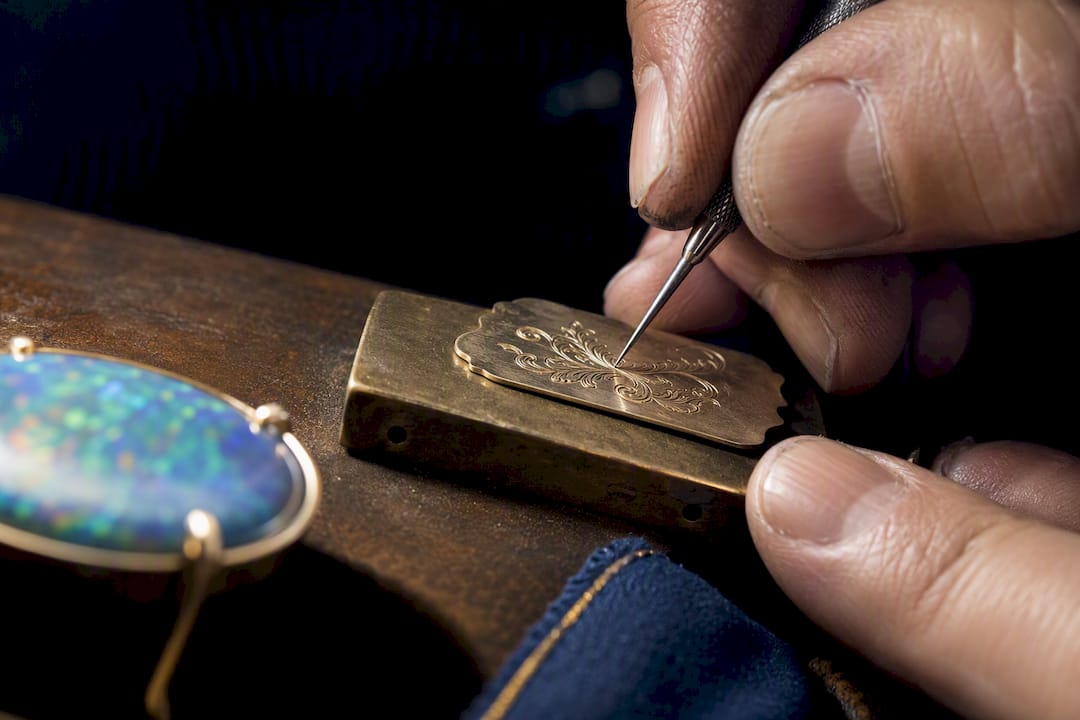
You can personalize opal jewelry with confidence, but the safest path is engraving the surrounding metal or trusting a low-power laser to an experienced opal jeweler rather than a general engraver. Opal’s fragility is real, and cracking or crazing is the risk you’re managing, not avoiding entirely. Once you understand that trade-off, an entire world of engraving ideas opens up, from hidden dates inside a band to constellations etched onto a pendant’s reverse.
TL;DR:
- Engraving opal jewelry is safest when performed by an experienced jeweler using low-power laser or metal-based methods, avoiding direct carvings on the gem.
- Placement of engravings should prioritize metal surfaces like the back of a pendant or inside a ring band to minimize risk of cracking or crazing.
- Design simplicity, larger font sizes, and bold motifs ensure engravings remain clear and preserve the opal’s play-of-color over time.
- Proper preparation includes professional cleaning, stabilization, and testing on scrap material before any engraving to prevent damage.
- Long-term care involves avoiding heat, direct sunlight, and ultrasonic cleaning, with regular checks of settings and secure mounting to maintain integrity.
Table of Contents
- Opal Engraving Ideas: Categorized by Mood and Placement
- Where to Place Engravings: Safest Surfaces and Why
- Engraving Techniques: Laser, Hand Tools, and Safer Alternatives
- Design Tips: Fonts, Size, and Keeping the Play-of-Color Alive
- Working With a Jeweler: A Commissioning Checklist
- Getting the Opal Ready: Cleaning and Stabilization Before Engraving
- Caring for an Engraved Opal Piece Long-Term
- A Publisher’s Perspective on Custom Engraving Requests
- Further Reading on Opal Engraving Safety
Opal Engraving Ideas: Categorized by Mood and Placement
Opal engraving ideas work best when you match the concept to the surface that can actually hold it. A tiny fingerprint outline needs a different canvas than a full sentence, and knowing that before you sit down with a jeweler saves you a redesign later. Here’s how the most requested engraving prompts break down by category and by where they belong.
Dates and initials
- Full date, numeric format in standard format works cleanly on a pendant’s back or a wide band interior.
- Initials with a linking symbol suit narrow ring interiors and typically fit well within available space.
- Anniversary shorthand such as a year reads well even at a very small scale.
Coordinates and places
- Latitude and longitude pairs tell a specific story but are lengthy. Reserve them for a bezel plaque or the flat reverse of a pendant, not a ring’s interior.
- Abbreviated place codes compress the idea for smaller surfaces.
Short phrases and micro-quotes
- Two to four word phrases carry the most emotional weight per character: “still here,” “always yours,” “one light,” “born of fire” (a nod to opal’s own volcanic-adjacent origin story in some deposits).
- Single words like “breathe,” “grounded,” or “wander” fit almost any band width.
Symbols and motifs
- Hearts, infinity loops, wave lines, and simple constellations translate well into engraving because they’re built from continuous strokes rather than fine detail.
- A child’s doodle or a handwritten signature can become a silhouette engraving, but it typically needs simplifying first, as what reads as charming at full size can turn into an illegible smear at 3 millimeters.
Secret codes
- Morse code sequences turn a name or a short phrase into a rhythmic line of dots and dashes, which suits a bezel or the inside of a band.
- A heartbeat or soundwave line, pulled from an actual recording, makes a striking design on a flat metal tag.
- A fingerprint outline, simplified to its dominant loops, works as a discreet mark on the underside of a pendant.
The rule that ties all of it together: the more literal and detailed the idea, the more metal surface it needs, and the further it should sit from the opal itself.
Where to Place Engravings: Safest Surfaces and Why
Placement decides whether your engraving idea is a five-minute job or a five-alarm risk. Opal’s water content, typically between three and 21 percent depending on the deposit, means any direct heat or pressure on the stone carries a chance of crazing (fine surface cracks) or an outright fracture.
- Interior of the ring band: the most requested spot for a reason. It hides sentimental text from view, protects it from wear, and keeps every tool away from the stone entirely.
- Back of a pendant: gives you far more room than a ring interior, since you’re not constrained by finger circumference.
- Bezel, plaque, or removable tag: engraving the metal setting rather than the opal itself lets you go deeper and bolder without touching the gem.
- Direct stone engraving: reserved for rare, specialist cases, and only ever with a low-power laser under expert control.
Quick fact: Interior ring-band engravings are usually limited to a character count that keeps text legible at that scale, which is why short phrases and initials dominate this category.
A hidden message inside the band or on a removable tag beats a visible stone engraving nearly every time. You get the personalization without gambling on the opal’s structural integrity.
Engraving Techniques: Laser, Hand Tools, and Safer Alternatives
Not all engraving methods carry the same risk, and knowing the difference lets you evaluate a jeweler’s proposal instead of just trusting the sales pitch.
Laser engraving is the closest thing to an industry standard for opal work because it applies no physical pressure. The laser burns or vaporizes a microscopic layer rather than gouging it. That said, laser heat has to be managed carefully. Machine suppliers who work with hydrated gemstones consistently flag the need for low power settings, slower pass speeds, and active cooling to prevent heat buildup that can trigger crazing.
Hand engraving and rotary tools demand real skill, but they introduce direct mechanical contact. That’s why most reputable jewelers apply these tools to the metal setting rather than the opal, saving the hand-cut detail for a bezel or a plaque where a slip costs you a redo, not a ruined stone.
Carving the stone directly is rare and highly specialized. Surface marking on opal is technically possible, as some hobbyist tests on low-value or non-gem opal have shown, but the outcomes are unpredictable even at low laser power.
Safer alternatives sidestep the stone entirely: engraved metal plaques, attached tags, inlay work, and enamel fill all deliver full personalization with zero risk to the gem.
Pro Tip: Ask any jeweler proposing to engrave your opal directly whether they’ll first test the exact settings on a scrap piece of similar opal. If they hesitate or say it’s unnecessary, that’s your answer.
Design Tips: Fonts, Size, and Keeping the Play-of-Color Alive
Small surfaces punish complicated design choices, so simplicity isn’t a compromise here. It’s the entire strategy.
- Choose simple fonts with a tall x-height (the height of lowercase letters) and avoid thin serifs, which blur into illegibility at micro scale.
- Keep letters no smaller than roughly 1 to 1.5 millimeters tall on a ring interior or small plaque, below that threshold, even laser engraving starts losing definition.
- Filling engraved strokes with a dark pigment or epoxy sharpens contrast dramatically against polished metal, but keep any fill technique confined to metal surfaces. Opal’s porous, hydrated structure doesn’t take well to fillers or dyes seeping into surface cracks.
- Simplify motifs aggressively. A detailed drawing becomes an unreadable scribble at 5 millimeters. A reduced silhouette survives.
- Shallow engraving preserves more of the surrounding surface and, on metal, holds up better over decades. Deep engraving directly on a gem risks disrupting the internal structure that produces play-of-color, opal’s signature flash of rainbow light.
If your design idea can’t be reduced to a clean, bold outline, it belongs on the metal, not the stone.
Working With a Jeweler: A Commissioning Checklist
A good jeweler will welcome these questions. A cagey answer to any of them is worth pausing over.
- Ask about opal-specific experience. Not general engraving experience, opal experience specifically.
- Ask what method they’re planning and why they’ve chosen it for your stone type.
- Request a test engraving on a similar scrap piece before touching your jewelry.
- Confirm power and cooling controls if laser engraving is involved.
- Clarify warranty terms in case the engraving process damages the stone.
Expect deliverables like before-and-after test photos, a written risk disclosure for direct stone work, and the option of a removable tag or metal plaque if you’d rather avoid the stone entirely. Reviewing a custom opal jewelry workflow beforehand helps you walk into that conversation already speaking the right language.
Pro Tip: A jeweler who refuses to discuss unsetting the stone, when the design calls for it, is often avoiding a step that adds time and cost to their side, not protecting your opal.
Getting the Opal Ready: Cleaning and Stabilization Before Engraving
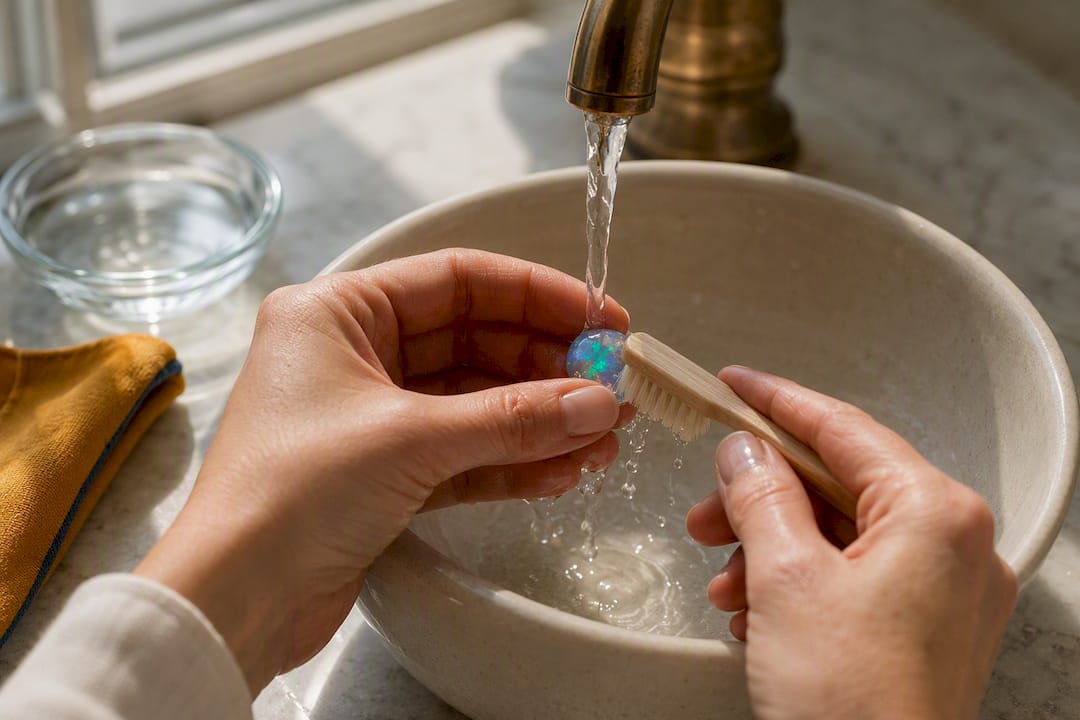
Preparation matters as much as the engraving technique itself. Opal should be professionally cleaned before any engraving work begins, using a soft brush and mild soapy water rather than ultrasonic cleaners, which can stress an already delicate structure through vibration. Skip solvents and steam cleaning entirely; both introduce heat or chemical exposure the stone doesn’t need right before a precision procedure.
Stabilization is the other half of the equation. Some opal, particularly boulder opal or stones that have been treated to reinforce a thin or porous structure, tolerates handling better than untreated solid opal. A jeweler experienced with the material will often check hydration and structural soundness before recommending direct engraving at all, and may steer you toward the reverse side of the stone or the metal setting if the opal shows any sign of existing surface weakness.
This is also the moment to settle your design. Deciding on placement, wording, and font size before the stone is in the machine avoids last-minute changes that force rushed adjustments to laser settings or hand tools. A rushed test pass is exactly the kind of shortcut that turns a manageable risk into a cracked stone.
Caring for an Engraved Opal Piece Long-Term
Your engraving’s longevity depends on how you treat the piece afterward, not just how it was made. Opal should never sit in direct sunlight for extended periods or take a sudden temperature swing, both stress the hydrated structure and can worsen any hairline crazing that formed during engraving, however minor.
Clean an engraved piece with a soft cloth and lukewarm water, avoiding ultrasonic cleaners for the life of the piece, not just the prep stage. If your engraving sits on a metal bezel or tag rather than the stone, you have more cleaning flexibility, another reason that placement choice pays off for years, not just on delivery day.
Store engraved opal jewelry separately from harder gemstones that could scratch the surface, and have the setting checked periodically if the piece sees daily wear, since a loosened bezel puts more strain on the stone during normal movement. Engraved text on metal typically holds its sharpness far longer than any direct stone marking, another quiet argument for keeping your most detailed ideas off the opal itself and onto the setting around it. If your engraving was done inside a band, periodic polishing elsewhere on the ring won’t touch it, so the hidden message stays crisp indefinitely.
A Publisher’s Perspective on Custom Engraving Requests
Australianopaldirect works with custom-designed opal jewelry regularly, and the guidance here reflects lessons pulled from those conversations, paired with published editorial guides on the craft. Custom orders often include protections such as shipping and warranty, which are worth asking about with any jeweler handling your stone. For engraved or personalized pieces, gentle cleaning and periodic setting checks matter more than usual, since a loosened prong stresses an already delicate gem.
— Renee
Further Reading on Opal Engraving Safety
- Trade and supplier guidance on laser settings for hydrated gemstones informed the technical cautions throughout this piece.
- Forum-level hobbyist reports on test engravings gave real-world context for the unpredictability of direct stone marking.
- Jewelry engraving idea guides shaped the categorized prompts and placement recommendations above.








