Jewelry Retailing Workflow 2025: Your Operations Guide
Posted by AOD on 27th Jun 2026
Jewelry Retailing Workflow 2025: Your Operations Guide

TL;DR:
- Effective jewelry retail workflows in 2025 integrate automation of inventory, sales, and customer engagement to improve efficiency and meet customer expectations. Proper implementation of master data, phased automation, and omnichannel synchronization are essential for success, while starting with front-end features without clean data leads to errors. AI enhances online discovery and personalization, but a well-managed inventory system and disciplined data practices underpin operational excellence.
A jewelry retailing workflow is defined as the integrated automation and synchronization of inventory, sales, and customer engagement processes that drive efficiency and meet modern consumer expectations. Retailers who master this operational framework in 2025 gain a measurable edge: automated fulfillment workflows reduce manual store tasks by 80% and cut customer status inquiries by over 60%. The industry term for this discipline is retail operations management, though jewelry professionals increasingly use workflow automation to describe the same practice. With 45% of consumers now using AI tools to evaluate businesses before visiting a store, the jewelry retailing workflow 2025 is no longer optional. It is the foundation of every profitable retail operation.
What are the essential tools for improving jewelry retail workflows in 2025?
The core of any modern jewelry retail operation is a jewelry-specific ERP (Enterprise Resource Planning) system paired with a point-of-sale platform. Generic retail software fails here. Jewelry ERPs must synchronize stock, pricing, and customer history in real time to prevent overselling and costly errors. They must also handle nuances like multi-karat bundles, live gold-rate pricing, and making-charge calculations that standard platforms ignore entirely.
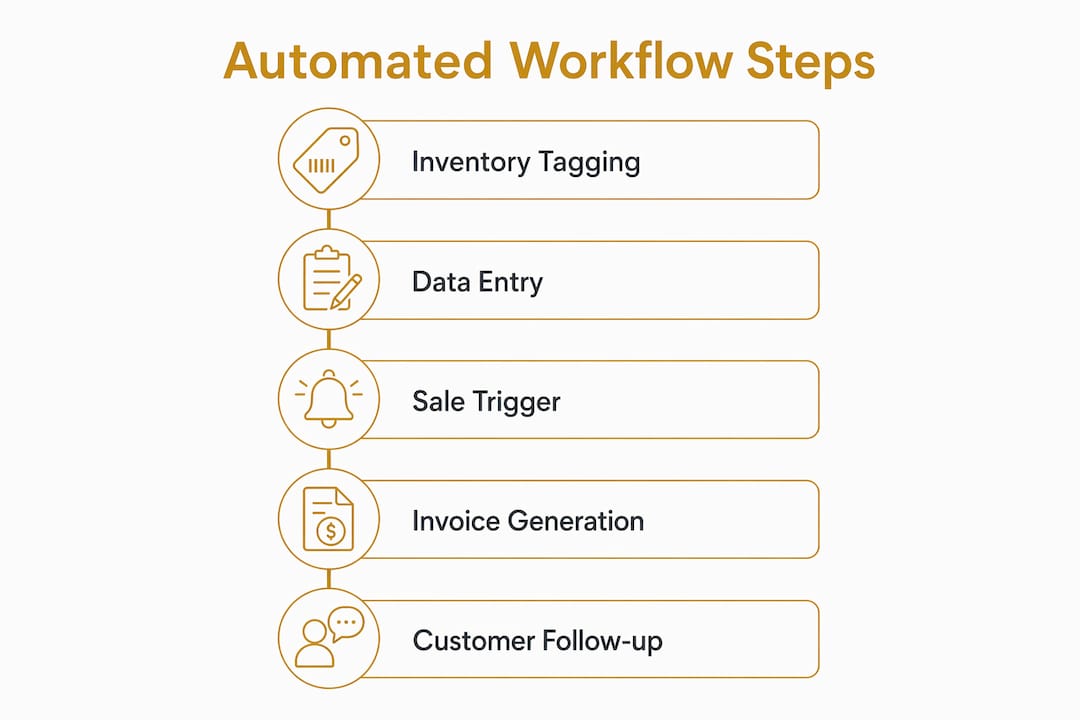
Beyond ERP, automation platforms built on trigger-based logic handle the repetitive work. A sale triggers an invoice. An invoice triggers a fulfillment update. A fulfillment update triggers a customer notification. Each step fires automatically, removing the human bottleneck that slows most small and mid-size jewelry stores.
Hardware matters just as much as software. Barcode and RFID tagging systems give retailers real-time visibility into every piece on the floor and in the back room. Without physical tagging, even the best ERP produces unreliable data.
| Feature category | Basic automation tools | Full ERP integration |
|---|---|---|
| Inventory tracking | Manual updates with alerts | Real-time RFID or barcode sync |
| Pricing | Fixed price lists | Live metal-rate pricing |
| Customer history | Basic CRM notes | Unified purchase and service records |
| Multi-store support | Limited or none | Centralized hub with branch visibility |
| Implementation time | 2–4 weeks | 10–14 weeks |
AI-enabled systems now extend beyond operations into marketing and customer engagement. They power personalized product recommendations, automate follow-up sequences, and flag slow-moving SKUs before they become a capital problem. Retailers who use AI for opal jewelry marketing online report stronger engagement and higher conversion rates from digital channels.
Pro Tip: Before selecting any ERP or automation platform, confirm it supports live metal-rate pricing and multi-location stock views. A platform that cannot handle these two features will create more manual work, not less.
How to implement an automated jewelry retail workflow: step by step
Implementation follows a clear sequence. Skipping steps early creates compounding errors that are expensive to fix later. Follow this order:
-
Complete master data setup. Configure purity grades, tax rules, making-charge formulas, and supplier records. Skipping master data is the single most common cause of delayed ERP go-lives. This phase typically takes one to two weeks.
-
Conduct a full physical stock-take. Weigh, photograph, barcode, and record every piece. Physical stock tagging is the biggest operational hurdle in any tech implementation. Budget time and staff accordingly before launch day.
-
Launch simple workflows first. Start with customer follow-up sequences and invoice automation. These deliver fast wins and build staff confidence. Basic automation workflows take 2–4 weeks to implement and operate reliably.
-
Digitize invoicing and fulfillment. Connect your POS to your fulfillment system so every sale updates stock automatically. This step eliminates the manual reconciliation that consumes hours each week.
-
Expand to multi-store ERP integration. Once single-location workflows are stable, roll out to additional branches. Multi-store ERP integrations require 10–14 weeks for full operation. Rushing this phase creates data mismatches across locations.
-
Train staff on UX and exception handling. Technology fails when staff revert to manual workarounds. Train every team member on the system’s logic, not just its buttons.
Pro Tip: Assign one internal “workflow owner” per location. This person owns data quality, flags errors early, and becomes the bridge between your tech platform and your floor team. Without this role, adoption stalls within 90 days.
What inventory management strategies maximize efficiency in 2025 jewelry retailing?
Modern inventory management in jewelry retail has shifted from depth to width. The old model stocked deep quantities of few SKUs. The new model stocks wider assortments with fewer units per SKU to improve flexibility and customer choice. This shift frees capital for design variety rather than locking it in slow-moving stock.

The display-led model takes this further. Retailers show curated in-store samples supported by backend inventory or just-in-time manufacturing. Customers see the full range of designs without the retailer carrying every variation in physical stock. This approach works especially well for custom and high-value pieces, where the emotional experience of selection matters more than immediate availability.
Volatile categories demand tighter holding periods. Retailers managing lab-grown diamonds now target holding periods under 60–90 days to avoid unsellable stock as prices shift. The same discipline applies to any category where market pricing moves faster than your reorder cycle.
For retailers managing luxury jewelry investment pieces like Australian opals, display-led models also protect the rarity narrative. Showing a curated selection of Lightning Ridge black opals or Queensland boulder opals, backed by deeper backend stock, preserves the sense of exclusivity that drives premium pricing.
Common inventory errors that automation prevents:
- Overselling a piece listed on both the showroom floor and an online channel
- Failing to update pricing when gold rates shift mid-day
- Carrying duplicate SKUs created by inconsistent data entry
- Missing reorder triggers on fast-moving styles
- Holding excess stock in one location while another branch runs short
Pro Tip: Audit your SKU list before going live on any new platform. Duplicate and orphaned SKUs corrupt your inventory reports from day one. A clean catalog is worth more than any feature your software offers.
How does AI and omnichannel integration transform jewelry retail operations?
AI improves product discovery and customer confidence, complementing the physical store experience rather than replacing it. The first layer of a customer’s purchase journey now happens online, through AI-powered search, recommendation engines, and generative product descriptions. The store closes the sale emotionally. Retailers who understand this division of labor build systems that serve both moments well.
Omnichannel synchronization means your POS, ecommerce platform, and social marketplace listings all draw from one inventory source. When a piece sells in-store, it disappears from your website and Instagram shop within seconds. A real-time data hub prevents the overselling mismatches that damage customer trust and create costly returns.
“The future of jewelry retail depends on a unified omnichannel ecosystem powered by AI for product discovery and personalized experiences, with physical stores as key emotional touchpoints.” — Omni Talk, 2026
Personalization is where AI creates the clearest advantage. Retailers who connect purchase history, browsing behavior, and service records can surface the right piece to the right customer at the right moment. This is not a luxury feature. With 45% of consumers evaluating businesses with AI tools before they walk through the door, retailers who lack a strong, personalized web presence lose customers before the conversation starts.
Retailers who sell ethically sourced jewelry benefit from AI-powered content that surfaces provenance stories, mining origins, and certification details. These details build the customer confidence that converts browsers into buyers.
Key operational benefits of omnichannel integration:
- Single inventory source eliminates channel-specific overselling
- Unified customer records support personalized follow-up across touchpoints
- Automated returns processing reduces staff time per transaction
- Real-time sales data informs reorder decisions without manual reporting
Key Takeaways
A well-built jewelry retail workflow combines master data accuracy, phased automation, and omnichannel synchronization to reduce manual work, protect margins, and meet the expectations of AI-informed customers in 2025.
| Point | Details |
|---|---|
| Automate in phases | Start with invoicing and follow-ups before expanding to full ERP integration. |
| Master data comes first | Configure purity, tax, and pricing rules before any system goes live. |
| Shift inventory strategy | Move from deep SKU stocking to wider assortments with faster turnover cycles. |
| AI supports, stores close | Use AI for discovery and personalization; rely on in-store experience to finalize sales. |
| Omnichannel requires one source | All channels must draw from a single real-time inventory hub to prevent errors. |
Why I think most jewelry retailers automate in the wrong order
Most retailers I speak with want to start with the customer-facing technology. They want the AI recommendations, the personalized emails, the beautiful omnichannel experience. That instinct is understandable. It is also exactly backwards.
Every impressive front-end feature depends entirely on the quality of the data feeding it. A recommendation engine built on a messy SKU catalog recommends the wrong pieces. A personalized email built on incomplete purchase history feels generic. The unglamorous work of stock-taking, barcoding, and master data configuration is not a prerequisite you endure before the real work begins. It is the real work.
The retailers who get this right treat their catalog as a living document. They assign ownership, set data standards, and audit regularly. The ones who skip it spend months troubleshooting errors that trace back to a single afternoon of rushed data entry before go-live.
The other mistake I see consistently is treating omnichannel as a technology project rather than an operational commitment. You can connect your POS to your ecommerce platform in an afternoon. Keeping that connection accurate requires daily discipline, clear ownership, and a team that understands why the data matters. Technology enables the workflow. People sustain it.
For retailers working with rare, high-value pieces like Australian opals, this discipline pays double. Every piece has a story, a provenance, and a price that reflects both. Losing track of a single Lightning Ridge black opal in a system error is not just an inventory problem. It is a customer trust problem.
— Renee
Australianopaldirect and the art of purposeful jewelry retail
Australianopaldirect sources genuine Australian opals directly from miners in Lightning Ridge, Coober Pedy, and Queensland, cutting out the intermediaries that inflate prices and obscure provenance. Every piece in the collection carries a clear story of origin, craftsmanship, and rarity.
For jewelry retailers and collectors who want to understand what a well-managed, ethically grounded inventory looks like in practice, Australianopaldirect offers a compelling model. The curated collections, from Nature’s Light to Limited Edition Opals, reflect the display-led philosophy that modern retail demands: fewer pieces, each chosen with intention, each backed by deep knowledge of the stone’s origin and value. Explore the full collection at Australianopaldirect and see how direct-miner relationships translate into both product quality and operational clarity.
FAQ
What is a jewelry retailing workflow?
A jewelry retailing workflow is the integrated system of processes covering inventory management, sales, invoicing, and customer engagement that a jewelry retailer uses to run daily operations efficiently.
How long does jewelry retail automation take to implement?
Basic automation workflows take 2–4 weeks to implement. Multi-store ERP integrations require 10–14 weeks for full operation, depending on catalog size and location count.
What is the biggest obstacle in jewelry ERP implementation?
Physical stock-taking and tagging is the most resource-intensive step. Every piece must be weighed, photographed, and barcoded before the system can operate accurately.
How does AI affect the jewelry retail customer experience in 2025?
AI drives the first layer of product discovery online, improving recommendations and customer confidence. Physical stores remain the primary place where emotional purchase decisions are made and closed.
What inventory model works best for jewelry retailers in 2025?
The display-led model, which shows curated in-store samples backed by backend inventory or just-in-time manufacturing, optimizes capital use and supports a wider range of designs without overstocking.
Recommended
- Custom Opal Jewelry Workflow: Create Bespoke Designs Easily - Australian Opal Direct
- How to Display Opal Jewelry for Luxury Appeal - Australian Opal Direct
- Step by Step Opal Matching Process for Jewelry Makers - Australian Opal Direct
- How to Market Opal Jewelry for Maximum Impact Online - Australian Opal Direct