Educational Opal Facts List: Your Complete Gem Guide
Posted by AOD on 23rd May 2026
Educational Opal Facts List: Your Complete Gem Guide
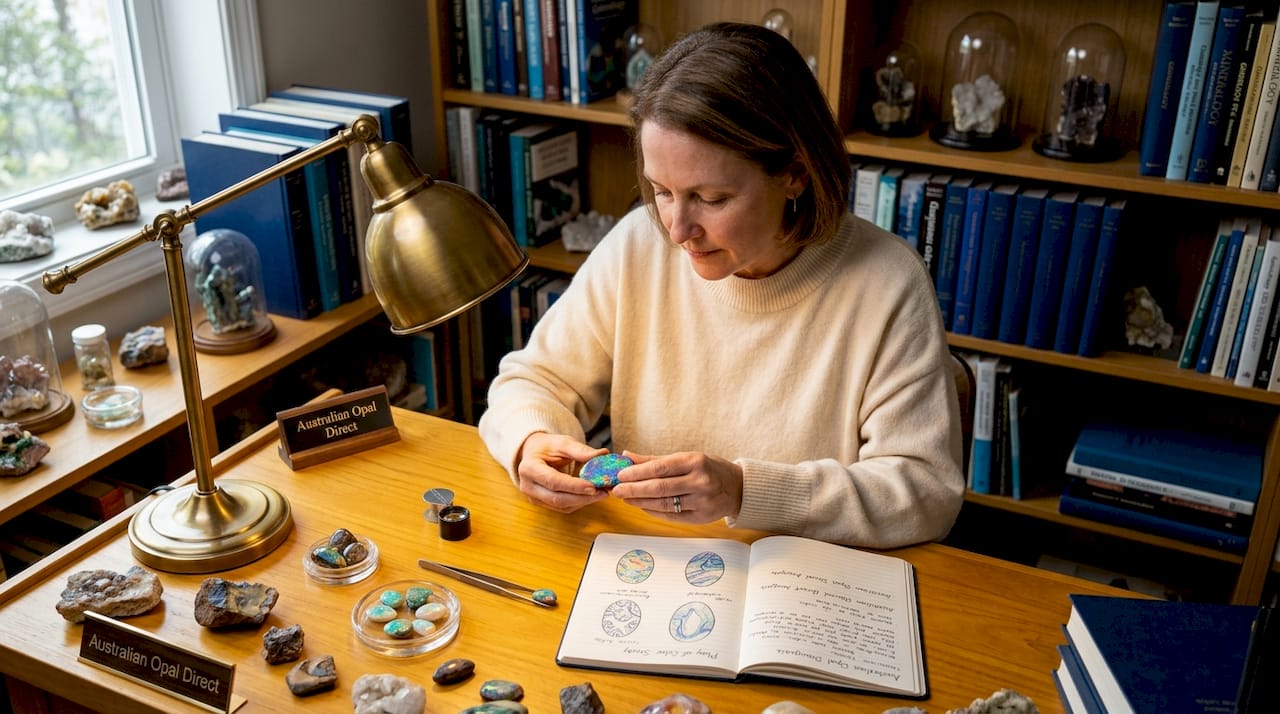
TL;DR:
- Opal’s captivating play-of-color results from microscopic silica spheres diffracting light, creating unique spectral displays. Its water content, typically 3 to 10%, significantly influences durability and care, especially for Ethiopian hydrophane opals. The highest-value black opals originate from Lightning Ridge, Australia, exhibiting vivid contrasts against their dark backgrounds.
Few gemstones command the kind of breathless admiration that opal does. Unlike diamonds or sapphires, which rely on a single optical attribute for their appeal, opal performs. Colors dance and flicker across its surface as the light shifts, making every stone a living, individual spectacle. This educational opal facts list walks through everything a curious collector or first-time buyer genuinely needs to know: the science behind that mesmerizing display, the major varieties, where the finest stones come from, how to keep them looking magnificent, and how to make a smart buying decision with real confidence.
Table of Contents
- Key takeaways
- 1. The scientific foundation of opal: composition and structure
- 2. The play-of-color phenomenon explained
- 3. Opal’s position on the Mohs hardness scale
- 4. A clear taxonomy of opal types
- 5. Global origins and what they mean for quality
- 6. Opal care: protecting a living stone
- 7. Buying considerations: matching the right opal to your needs
- 8. The right setting makes all the difference
- My perspective on what the facts don’t fully capture
- Discover authentic Australian opals at Australianopaldirect
- FAQ
Key takeaways
| Point | Details |
|---|---|
| Opal’s color comes from physics | Microscopic silica spheres diffract light, producing the play-of-color unique to precious opal. |
| Water content matters | Opal contains 3 to 10% water; managing moisture is the single most important care factor. |
| Australia dominates supply | Australia produces roughly 95% of the world’s precious opal, setting the global quality standard. |
| Not all opals are equal | Black, boulder, fire, and assembled opals differ significantly in value, durability, and care needs. |
| Setting choice affects longevity | Bezel settings offer far better protection for opal rings and bracelets than prong settings do. |
1. The scientific foundation of opal: composition and structure
Opal is hydrated silica, carrying the chemical formula SiO2·nH2O. That small “n” in the formula represents something genuinely consequential: 3 to 10% water locked inside the stone’s microscopic architecture. This water is not decorative chemistry. It directly influences how the stone behaves under heat, dryness, and physical stress.
Unlike quartz or sapphire, opal is amorphous, meaning it lacks a crystalline atomic structure. Instead, it forms as irregular nodules or seams in volcanic or sedimentary rocks, which is why opal is almost always cut as a cabochon rather than faceted. The rounded, domed form showcases its optical character far better than angles and facets ever could.
- Chemical formula: SiO2·nH2O (hydrated silica)
- Water content: 3 to 10% by weight
- Crystal system: Amorphous (non-crystalline)
- Typical forms: Nodules, seams, and irregular masses within host rock
Pro Tip: When examining any opal for purchase, tilt it slowly under a single-point light source. The way colors bloom and recede tells you more about quality than any fixed-angle photograph can.
2. The play-of-color phenomenon explained
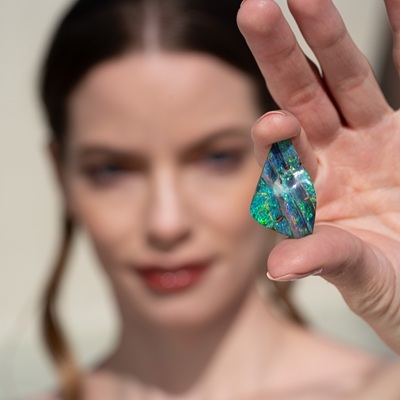
Play-of-color is opal’s signature, and understanding its mechanics deepens appreciation considerably. The GIA describes this as a diffraction effect produced by submicrocrystalline silica sphere arrangements stacked in orderly grids inside the stone. When white light enters, these spheres bend and scatter different wavelengths, casting spectral colors across the surface that shift as the viewing angle changes.
The size of the spheres determines which colors appear. Smaller spheres produce violet and blue; larger ones generate red and orange. Stones showing full-spectrum red-to-violet play-of-color are the rarest and most coveted. A stone showing only blue and green, while still beautiful, sits lower on the value scale purely because of sphere geometry.
This is why evaluating opal requires examining color shift under varying angles and lighting rather than judging it in a fixed position. A photograph captures one moment in a perpetual performance.
3. Opal’s position on the Mohs hardness scale
Opal registers 5.5 to 6.5 on the Mohs scale, placing it near glass in hardness. For context, quartz sits at 7 and sapphire at 9. This means common quartz dust, present on most household surfaces, can scratch an opal if the stone is wiped carelessly. It is a real-world vulnerability that shapes every care decision an opal owner makes.
Hardness should not be confused with fragility in other respects. Opal can withstand moderate daily wear when properly set and handled. The key is understanding that its softness demands mindfulness, not avoidance.
4. A clear taxonomy of opal types
The world of opal is richer and more nuanced than most buyers initially realize. Here is a clear breakdown of the principal varieties:
| Opal Type | Body Tone | Play-of-Color | Notable Trait |
|---|---|---|---|
| Precious opal | Varies | Present | Defined by play-of-color |
| Common opal | Varies | Absent | Opaque, no spectral display |
| Black opal | Dark (N1–N4) | Vivid | Highest contrast, most valuable |
| White/light opal | Light (N7–N9) | Moderate | Most widely traded variety |
| Boulder opal | Dark ironstone | Vivid | Natural rock backing intact |
| Fire opal | Orange to red | Rare | Transparent warm body color |
| Crystal opal | Transparent | Vivid | Body tone clear or semi-clear |
Doublets and triplets are assembled stones rather than solid opals. A doublet bonds a thin slice of opal to a dark backing material to enhance color contrast. A triplet adds a dome of clear quartz or glass on top for protection. Both are legitimate products at accessible price points, but they require specific care: prolonged water exposure can seep into the glue layer and cloud the stone.
Pro Tip: Always ask whether a stone is solid, doublet, or triplet before purchasing. Reputable sellers disclose this immediately. If the question is met with hesitation, treat that as a signal.
5. Global origins and what they mean for quality
Geography is not a footnote in opal gemstone information. It is central to value.
Australia produces roughly 95% of the world’s precious opal and holds the title of official national gemstone. Three mining regions define Australian production:
- Lightning Ridge, New South Wales: The source of black opal. Black opal from Lightning Ridge is the rarest and most valuable variety, prized for its dark body tone and explosive color contrast against that dark background.
- Coober Pedy, South Australia: The world’s primary source of white and crystal opal. Underground mines produce pale, luminous stones with delicate plays of pastel color.
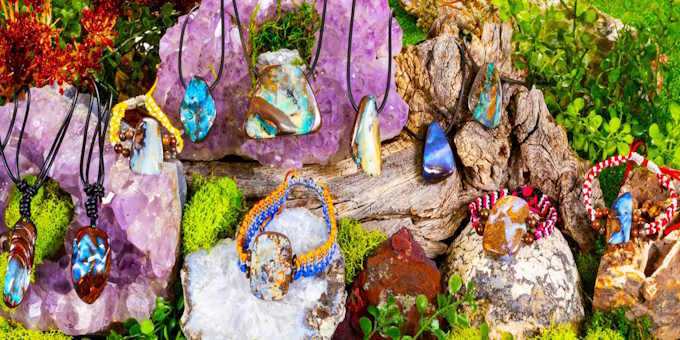
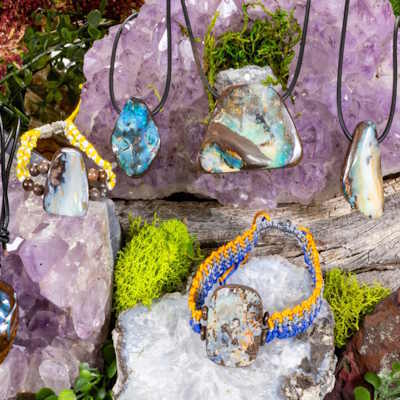
- Queensland: Home to boulder opal, where precious opal forms in thin seams within ironstone boulders. The natural backing becomes part of the finished stone, offering both visual depth and structural support.
Beyond Australia, two sources merit attention. Ethiopian Welo opal is hydrophane in nature, meaning it absorbs water and can temporarily shift in color and transparency when wet. This behavior is fascinating scientifically but demands careful ownership. Mexican fire opal, formed in ancient volcanic deposits, carries a rich amber-to-red body color and rarely displays play-of-color. Its appeal is the warm, glowing transparency itself.
Understanding opal origins sharpens purchasing instincts considerably. Origin directly correlates with rarity, optical character, and long-term value.

6. Opal care: protecting a living stone
Of all the interesting opal trivia out there, the most practically useful is this: most opal damage comes from moisture mismanagement, not wear. Dehydration causes crazing, a network of fine internal cracks that permanently alters color and structural integrity. Equally, hydrophane Ethiopian opals absorb water and can change appearance when wet, so submerging them even briefly is inadvisable.
Here are the core care principles every opal owner needs to practice:
- Clean with mild soap and a soft cloth only. No ultrasonic cleaners, no steam cleaners, no jewelry dips.
- Avoid sudden temperature changes. Moving directly from a cold environment to intense heat stresses the stone’s water content.
- Store opal away from direct sunlight and heat sources. A small pouch inside a moderately humid environment is ideal.
- Remove opal rings and bracelets before gardening, gym sessions, or any activity involving hard impacts or chemical exposure.
- If storing for extended periods, placing a damp cloth nearby in the storage container helps maintain ambient moisture.
For a thorough walk-through of opal care guidelines, including storage scenarios specific to different opal types, Australianopaldirect offers detailed guidance that goes well beyond the basics.
7. Buying considerations: matching the right opal to your needs
Synthesizing opal properties and benefits into a smart buying decision requires weighing several factors simultaneously. This comparison cuts through the noise:
| Opal Type | Durability | Care Sensitivity | Best Use | Price Range |
|---|---|---|---|---|
| Black opal (solid) | Good | Moderate | Collector, special occasion | High to very high |
| Boulder opal (solid) | Very good | Low to moderate | Daily wear, rings | Mid to high |
| White opal (solid) | Moderate | Moderate | Pendants, earrings | Accessible to mid |
| Crystal opal (solid) | Moderate | Moderate | Earrings, pendants | Mid |
| Doublet/Triplet | Lower | High (avoid water) | Fashion, occasional wear | Low to accessible |
| Ethiopian opal | Moderate | High (hydrophane) | Pendants, earrings | Accessible to mid |
Opal’s value and durability vary significantly by type, and understanding these differences prevents buyer regret. For daily-wear rings, boulder opal is the most forgiving choice. Its natural ironstone backing adds structural stability that solid white opal simply does not have. For someone prioritizing investment value, nothing in the opal world rivals Lightning Ridge black opal.
Budget-conscious buyers who still want genuine play-of-color should consider high-quality doublets or solid white opal from Coober Pedy. The visual experience is real; the price reflects the stone’s assembled or common-variety status rather than any lack of beauty.
Pro Tip: The opal jewelry selection guide at Australianopaldirect maps personal style preferences to specific opal types and settings, making it a practical tool for first-time buyers who want to shop with confidence.
8. The right setting makes all the difference
Bezel settings protect opal far better than prong settings, particularly for rings and bracelets. A bezel wraps the stone’s perimeter in a collar of metal, absorbing lateral impacts that would otherwise chip or crack the relatively soft gem. Prong settings leave the girdle exposed, which works beautifully for hard stones like diamonds but introduces unnecessary risk for opal.
For earrings and pendants, prong settings carry less risk since those pieces rarely experience hard impacts. The choice of metal matters less than coverage. Whether gold or silver, the physical protection the setting provides is the determining factor for opal longevity.
My perspective on what the facts don’t fully capture
I’ve spent years examining opals across price points and origins, and I’ve come to believe that most people approach opal evaluation the wrong way. They look at a single color and decide whether it’s “good” or not. That misses the entire point.
What I’ve learned is that play-of-color pattern matters more than the dominant hue. A stone that shifts from green to red across a rolling, harlequin-style pattern is exponentially more interesting and valuable than a stone showing a single flat wash of blue, regardless of how vivid that blue might be. GIA’s own play-of-color guidance supports this: pattern diversity under angle changes signals superior sphere organization inside the stone.
My other hard-won insight involves the care misconception I see constantly. People treat opal either too casually, as if it were as resilient as a diamond, or so anxiously that they never wear it. Neither extreme serves the stone well. Opal wants to be worn, gently and regularly. The natural oils from skin contact actually help maintain surface condition. What opal does not want is soaking, steam, hard knocks, or prolonged storage in bone-dry conditions.
Australian black opals remain the benchmark in my mind, not out of sentiment but out of optical reality. The dark body tone creates a visual depth that lighter stones simply cannot replicate. When colors flash against that darkness, the contrast is unmatched by anything else in the gem world.
— Renee
Discover authentic Australian opals at Australianopaldirect
For those who have moved through this educational opal guide and feel genuinely ready to find a stone of their own, Australianopaldirect is the place to begin seriously looking.

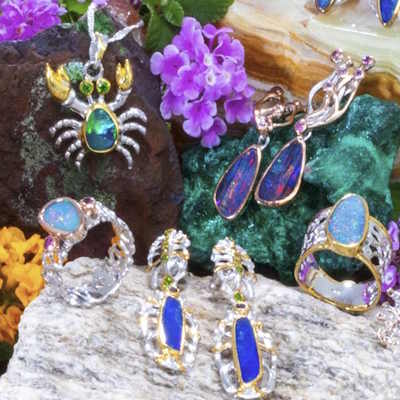
Australianopaldirect sources directly from miners in Lightning Ridge, Coober Pedy, and Queensland, which means every piece carries a verifiable origin story. The collection spans opal earrings, rings, and necklaces in gold and silver settings, with custom design options for buyers seeking something singular. Every purchase comes with free shipping, complimentary insurance, and a 90-day warranty, so first-time buyers are genuinely protected. Whether you are building a collection or buying a meaningful gift, the depth of selection and direct-miner transparency make the experience as trustworthy as the stones themselves.
FAQ
What causes opal’s play-of-color?
Play-of-color results from the diffraction of light through orderly stacks of microscopic silica spheres inside the stone, producing shifting spectral colors that change with viewing angle.
What is opal’s hardness on the Mohs scale?
Opal rates 5.5 to 6.5 on the Mohs scale, softer than quartz, which means it can be scratched by common environmental abrasives and requires mindful handling.
Is Ethiopian opal safe to wear in water?
Ethiopian Welo opal is hydrophane and absorbs water, which can temporarily alter its appearance and potentially affect its structure. It should be kept away from prolonged moisture exposure.
Why is Australian black opal considered the most valuable?
Black opal from Lightning Ridge has a naturally dark body tone that dramatically intensifies play-of-color contrast, making the spectral display more vivid than any other opal variety. Its rarity and optical character place it at the top of the market.
What is the difference between a doublet and a solid opal?
A solid opal is a single, naturally occurring stone, while a doublet bonds a thin opal slice to a dark backing material. Doublets are more affordable but require extra care, particularly around water exposure.
Recommended
- Build a Gemstone Collection: The Expert Guide to Australian Opals - Australian Opal Direct
- Opal Value Explained: A Complete Collector’s Guide - Australian Opal Direct
- Meaning of Opal Colors: Complete Guide for Collectors - Australian Opal Direct
- Value Factors of Opal: What Drives Worth - Australian Opal Direct