Defining custom gemstone design for Australian opal jewelry
Posted by AOD on 10th May 2026
Defining custom gemstone design for Australian opal jewelry
TL;DR:
- Australian opal is a living canvas, shaped over millions of years with a unique play-of-color phenomenon caused by microscopic silica structures. Designing custom opal jewelry requires understanding its fragility and orienting it to maximize visual impact while ensuring protection through appropriate settings like bezels. Successful pieces are built around the stone’s specific characteristics, avoiding industry shortcuts that can cause damage and ensuring long-term beauty and durability.
Opal is unlike any other gem a designer will ever hold. Yet one of the most common mistakes made in custom gemstone design is approaching Australian opal with the same assumptions used for sapphires, diamonds, or rubies. That misalignment, treating opal as just another beautiful stone, leads to designs that crack under pressure, settings that smother the play-of-color, and pieces that fail long before they should. What follows is a practical, experience-grounded guide to designing custom opal jewelry that honors both the extraordinary science inside every stone and the vision of the person wearing it.
Table of Contents
- What makes Australian opal unique for custom designs
- Core principles of defining a custom gemstone design
- Comparing key setting options for custom opal jewelry
- Integrating custom gemstone design into the creative journey
- Our perspective: Rethinking custom gemstone design for opals
- Discover unique opals and design support
- Frequently asked questions
Key Takeaways
| Point | Details |
|---|---|
| Opal’s unique beauty | Australian opal’s play-of-color and structure require special design considerations. |
| Choose protective settings | Bezel settings usually offer better protection for fragile opals than prongs. |
| Avoid common pitfalls | Never apply excessive pressure or ignore opal fragility during setting. |
| Collaboration is key | Designers and collectors should work together at each stage for best results. |
| Specialist support matters | Expert guidance ensures your custom opal jewelry is stunning, durable, and valuable. |
What makes Australian opal unique for custom designs
Now that we’ve established the unique design demands of opal, let’s break down what truly sets the stone apart.
Australian opal is not simply a colorful gem. It is a living canvas, shaped over millions of years as silica-rich water seeped through ancient seabeds and dried into layered structures of breathtaking complexity. The stones mined from Lightning Ridge, Coober Pedy, and Queensland carry within them a visual phenomenon that no other gemstone replicates with such intensity: play-of-color.
Play-of-color refers to the way spectral colors shift, scatter, and ignite across an opal’s surface as the viewing angle changes. This is not surface gloss or refractive sparkle. It is a structural optical event, produced when light interacts with orderly stacks of microscopic silica spheres arranged in precise patterns within the stone. GIA research confirms that opal’s defining visual phenomenon is play-of-color, the result of light interaction with orderly stacks of spheres, and that most opals are cut as cabochons because this curved, polished form maximizes that effect better than any faceted shape could.
This matters enormously in design. Unlike a brilliant-cut diamond, where faceting is integral to the gem’s visual impact, an opal’s beauty lives in its face-up display, meaning that how you orient, mount, and expose the stone to light determines everything the viewer experiences.
Key factors collectors and designers value most in Australian opals:
- Pattern and play-of-color direction: Rolling flash, pinfire, harlequin, and other patterns each carry different visual weight and require different orientation decisions in the setting.
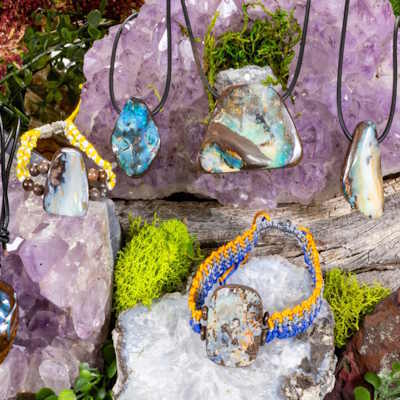
- Body tone: Black opals from Lightning Ridge, crystal opals from Coober Pedy, and Queensland boulder opals each offer a distinct backdrop against which the color display reads.
- Transparency: Semi-crystal and crystal opals allow light to pass through the stone, creating a luminous, almost supernatural glow when set appropriately.
- Saturation and brightness: A bright opal with vivid, saturated hues commands a premium precisely because light conditions in daily wear vary so dramatically.
- Surface integrity: Opal rates only 5.5 to 6.5 on the Mohs hardness scale, making surface preservation both a cutting priority and a design consideration.
“The opal is the most tender of gemstones. It asks not to be forced, only to be held.” This sentiment, shared among experienced stone setters, captures why every design decision must start with respect for the material rather than convenience of the craft.
Understanding these qualities is not background knowledge. It is the active foundation of every good custom opal design decision.
Core principles of defining a custom gemstone design
With a grasp on opal’s material uniqueness, it’s time to look at what defining a truly custom design involves, both technically and creatively.
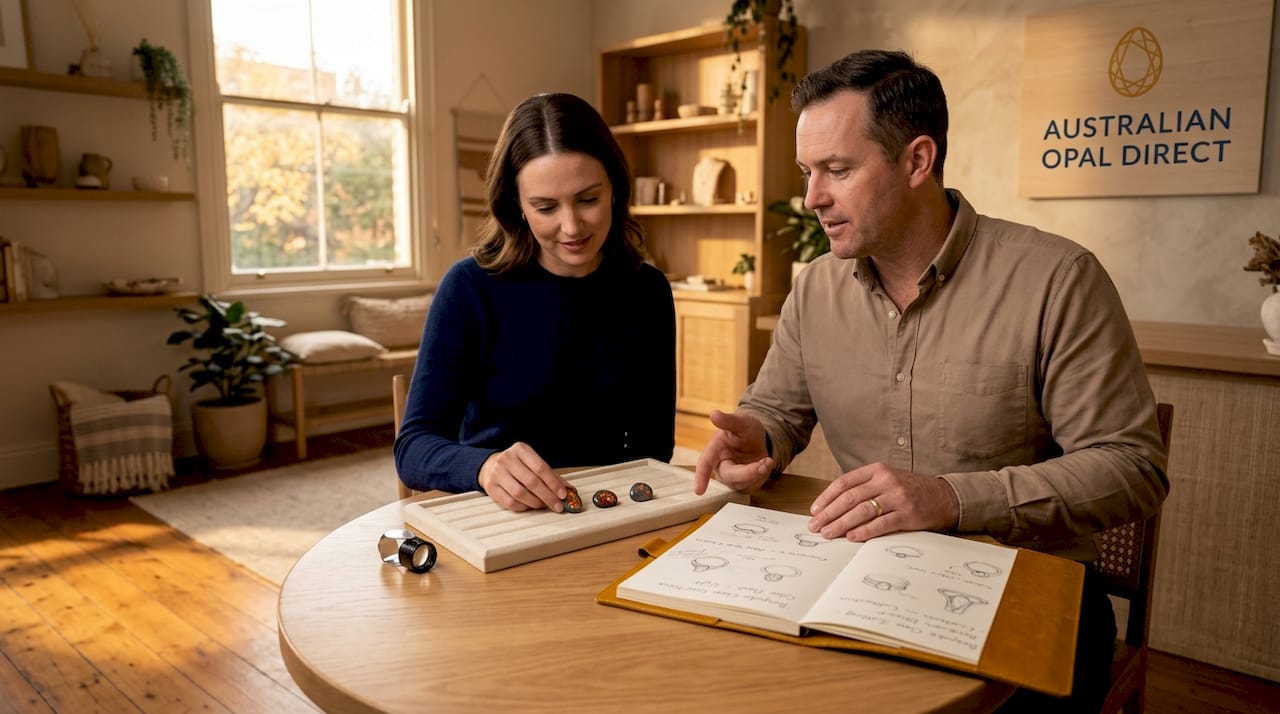
Designing custom opal jewelry is a layered process that demands attention to fragility, visual preservation, and the wearer’s lifestyle from the very first conversation. Designing custom opal jewelry well requires moving through several deliberate steps, each informed by the specific stone in hand rather than a generic template.
Step-by-step: How to define a custom opal design
- Assess the individual stone first. Every opal is unique. Before any sketching or CAD rendering begins, study the stone’s dimensions, profile, body tone, play-of-color direction, and any natural fissures or inclusions. This assessment dictates everything that follows.
- Define the wearer’s lifestyle and usage. A ring intended for daily wear demands different protective architecture than a pendant worn on occasion. High-activity wearers need deeper, more enclosed settings; collectors who wear pieces rarely may prioritize maximum visual exposure.
- Choose a metal that complements, not competes. Gold, whether yellow, rose, or white, interacts differently with opal’s body tone. Yellow gold warms black opal’s depth; white gold or platinum allows crystal opal’s luminosity to read as cooler and brighter.
- Determine the setting style based on opal’s fragility. Rock & Gem Magazine notes that prong settings can create uneven pressure around an opal, while a bezel provides a strong and even foundation. However, it also warns that a common bezel mistake is pushing the metal too hard, which can scratch or chip the stone.
- Establish the orientation of the play-of-color. The best play-of-color direction must face upward toward the viewer. Misorienting the stone in the setting is an irreversible error.
- Collaborate directly on proportions. The height of the setting, the depth of the bezel wall, and the profile of the piece all affect how much of the stone is visible, protected, and lit correctly.
- Plan for long-term maintenance. Discuss with the client how opal responds to prolonged water exposure, harsh chemicals, and sudden temperature change. This conversation shapes decisions about stone coating, backing, and storage.
Following a complete opal jewelry workflow guide ensures nothing is overlooked and every creative decision connects back to the stone’s specific needs.
Pro Tip: When taking initial measurements of an opal for custom setting, always measure the stone’s actual base, not its visual face. Opals are frequently irregular in shape, and a setting built to the face measurement alone will often fail to seat the stone securely.
“Custom design for opal is not about building the jewel around the idea. It is about building it around the stone.”
This philosophy separates extraordinary opal jewelry from pieces that look beautiful in photography but fail in practice.
Comparing key setting options for custom opal jewelry
Having outlined the essentials of custom design, let’s zoom in on one of the most critical, misunderstood decisions: selecting a setting style.
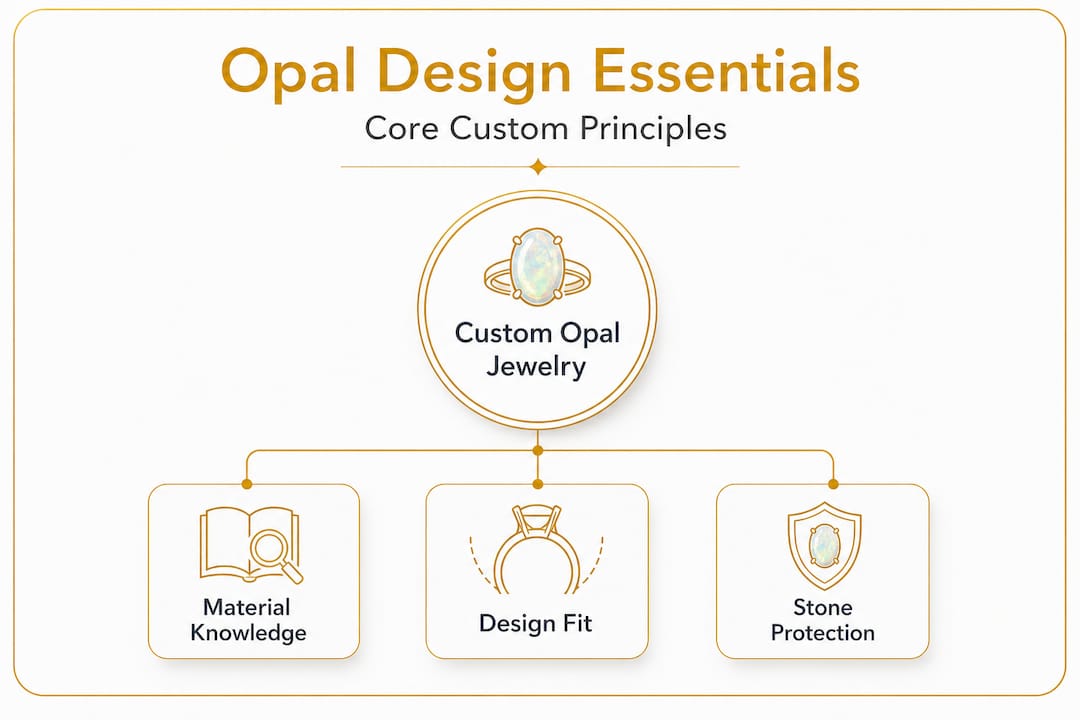
Setting selection is where many otherwise strong designs fall short. For designing custom opal rings and other high-contact jewelry, the choice between bezel, prong, and hybrid settings carries real consequences for both durability and beauty.
| Setting type | Protection level | Visual exposure | Risk with opal | Best use case |
|---|---|---|---|---|
| Full bezel | High | Moderate | Low if fitted correctly | Daily wear rings, bracelets |
| Partial bezel | Moderate to high | Moderate to high | Low to moderate | Dress rings, pendants |
| Prong (claw) | Low to moderate | High | High (uneven pressure) | Occasional wear only |
| Hybrid (bezel with prong accents) | Moderate to high | High | Low if well executed | Showcase pieces, special occasions |
| Tube or channel | Very high | Low | Very low | Inlay work, accent stones |
Rock & Gem Magazine’s guidance confirms that prong settings create uneven pressure around the opal, while a correctly fitted bezel provides even support that distributes force safely across the stone’s perimeter. The critical qualifier is correctly fitted. A bezel that is too tight concentrates stress. One that is too loose allows the stone to shift and abrade against the metal over time.
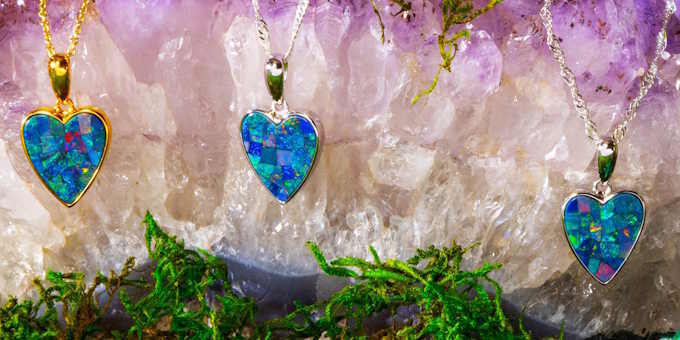
Hybrid settings, when thoughtfully designed, offer a compelling middle ground. The bezel wall provides structural protection while open gallery windows or accent prongs allow light to enter from the sides, enhancing the play-of-color without sacrificing stability.
Pro Tip: For opal rings that will be worn daily, always specify a slightly raised bezel profile to protect the dome of the stone from direct impact. Even a 0.5mm rise above the stone’s highest point reduces the risk of surface damage dramatically in real-world wear conditions.
For pendants and earrings, where the stone experiences less mechanical stress, designers can afford to be bolder with more open settings. Even in these lower-risk pieces, however, the bezel edge must be finished smoothly to avoid micro-abrasion on the opal’s surface.
Integrating custom gemstone design into the creative journey
Understanding the choices is only the first step; next, let’s see how these decisions play out through the real creative and crafting journey.
The opal jewelry design process is not a straight line from idea to finished piece. It is a responsive, collaborative journey that adapts to the stone, the client, and the demands of the craft at each stage. Both designers and collectors benefit from understanding this arc clearly.
Design stages and key opal considerations:
| Design stage | Key opal considerations |
|---|---|
| Initial concept | Stone selection, body tone, intended wear frequency |
| Technical specification | Setting type, metal choice, orientation of play-of-color |
| Wax model or CAD review | Seat depth, bezel wall height, stone profile fit |
| Setting | Pressure distribution, polishing sequence, stone protection |
| Quality review | Surface integrity, color display, structural security |
| Client handover | Care instructions, storage guidance, insurance recommendation |
The commissioning opal jewelry process works best when the collector enters the conversation with an openness to guidance rather than a rigid brief. Opal’s individuality means that the stone itself often redirects creative decisions in ways that improve the final outcome.
How designers and clients collaborate most effectively:
- Share inspiration images that focus on style and mood rather than demanding exact replication of another piece.
- Bring the stone to early design conversations whenever possible so proportions and colors can be assessed in person.
- Discuss lifestyle honestly. A ring that cannot be worn daily due to design fragility is a beautiful object but a failed commission.
- Allow the GIA’s foundational research on opal’s internal structure to inform orientation decisions, not just visual preference.
- Trust the goldsmith’s assessment of how much bezel wall a specific stone genuinely needs based on its edge thickness and surface profile.
When this collaboration functions well, the result is a piece that carries the client’s vision, honors the opal’s singular character, and endures through decades of wear. That combination is rare in commercial jewelry but entirely achievable in a thoughtfully executed custom commission.
Our perspective: Rethinking custom gemstone design for opals
There is a quiet but costly assumption running through much of the custom jewelry industry: that skill in design transfers cleanly from one gemstone type to another. With diamonds, rubies, and sapphires, this is largely true. With Australian opal, it is not.
Every repair bench tells this story in chipped stones and cracked cabochons. A setting beautifully executed for a ruby fails an opal because the assumptions baked into its architecture, prong placement, bezel height, seat depth, were borrowed from a different material reality. The opal paid the price.
The deeper issue is that customization for opal must begin before the first sketch is drawn. It begins in the conversation about what kind of opal the client is working with, how it was formed, where it came from, and what it genuinely needs to survive and shine. Treating each stone as a specific geological object rather than a category placeholder is the shift that separates good opal jewelry from great opal jewelry.
Industry shortcuts fail here because opal doesn’t forgive them. A slightly too-tight bezel on a sapphire is invisible. On an opal, it becomes a fracture within months of wear. A prong positioned over a hidden natural fissure that would hold a diamond indefinitely can catastrophically crack an opal on the first significant impact.
We have seen collections of pieces returned for repair where every single failure traced back to a design decision made in the first hour of conception. Micro-adjustments, the bezel wall raised by half a millimeter, the seat cut to accommodate the opal’s irregular base exactly, the metal hardness chosen to flex slightly rather than hold rigidly, these are the details that protect both the stone and the investment.
The uncomfortable truth is that many designers underestimate the value of opal insurance coverage not because they distrust the stone, but because they trust their own design too much. No custom opal piece, however expertly made, is beyond the reach of accident. Protecting the work matters as much as creating it.
Start with science. Understand the stone. Then let the aesthetics follow. That sequence, and only that sequence, produces custom opal jewelry that earns its place in a collection for generations.
Discover unique opals and design support
Ready to bring your vision to life? Here’s where truly unique custom opal jewelry begins.
At Australian Opal Direct, every stone is ethically sourced directly from the legendary fields of Lightning Ridge, Coober Pedy, and Queensland, with no middlemen diluting the story or inflating the price. Whether you are a designer seeking loose stones with exceptional play-of-color for a commissioned piece, or a collector ready to step into a fully custom creation, the expertise and curated inventory here supports every stage of that journey. From design consultation resources to premium finished jewelry with complimentary insurance and a 90-day warranty, this is where knowledge of the stone and love for the craft meet in one trusted place.
Frequently asked questions
What is the main benefit of using a bezel setting for opal jewelry?
A bezel setting distributes pressure evenly around the opal’s perimeter, providing a strong, even foundation that protects the fragile stone from the chipping and cracking that uneven prong pressure can cause.
Why are most opals cut as cabochons instead of faceted shapes?
Cabochon cuts maximize opal’s play-of-color by presenting the stone’s face-up surface as a smooth, curved dome that allows the spectral color display to shift and bloom as the viewing angle changes.
How should collectors participate in defining a custom opal jewelry design?
Collectors should communicate their vision, lifestyle, and wear frequency honestly at the outset, while remaining open to expert guidance on protective setting choices that preserve both the stone’s beauty and its long-term integrity.
What are signs of poor opal setting design?
Visible uneven pressure marks, loose movement of the stone within its setting, surface chips near the bezel edge, or loss of play-of-color in certain lighting angles all indicate a setting that was not properly fitted to the specific opal it holds.
Recommended
- How to Design Custom Opal Jewelry for Unique Creations - Australian Opal Direct
- Custom Opal Jewelry Workflow: Create Bespoke Designs Easily - Australian Opal Direct
- How to Craft Opal Rings: Create Luxury Gemstone Jewelry - Australian Opal Direct
- Master the Opal Jewelry Design Process Step by Step - Australian Opal Direct