Tottie Bryant, Indigenous Miners and Coober Pedy's Opal History
Posted by AOD on 2nd Sep 2026
Tottie Bryant, Indigenous Miners and Coober Pedy’s Opal History
Coober Pedy is an opal town born from a single find in February 1915, when prospector Willie Hutchison spotted color glinting in the desert dust and staked one of the earliest claims. What followed is layered: Aboriginal families worked and shaped the fields for generations, European migrants built a town beneath the ground to escape the heat, and Coober Pedy became home to the largest opal ever unearthed.
TL;DR:
- Aboriginal families and local Indigenous language roots played a key role in shaping the town’s name and early community structure.
- The shift to mechanized mining in the 1970s dramatically increased output but also significantly raised environmental hazards with thousands of unmarked shafts.
- Underground housing became common after World War I, driven by both heat avoidance and postwar migrant communities, including many from Europe.
- The most famous opal, the Olympic Australis, was discovered in 1956, showcasing the field’s potential for producing large, high-quality gems.
- Efforts to recognize Aboriginal contributions are growing, with recent reports highlighting the community’s historically underrepresented role in the town’s development.
Table of Contents
- The Origins of Coober Pedy History (1915 to the 1920s)
- What Role Did Aboriginal People Play in the Opal Fields?
- From Hand Shafts to Machines: How Mining Changed
- Underground Living and a Melting-Pot Mining Town
- Which Opal Finds Made Coober Pedy Famous?
- Where to Explore Coober Pedy’s History Today
- A Quick Reference Timeline of Coober Pedy’s History
- Why We Tell Coober Pedy’s History This Way
- See Coober Pedy’s Opals for Yourself
- Sources and Further Reading on Coober Pedy History
The Origins of Coober Pedy History (1915 to the 1920s)
The opal that built Coober Pedy surfaced almost by accident. Word moved fast in a landscape with almost nothing else to talk about, and claims were pegged within weeks. Miners staked ground before anyone had built so much as a shed to sleep in.
Life on the field in those first years tested even hardened bushmen. There was no reliable water source, temperatures regularly climbed past 40 degrees Celsius, and the only shelter from that heat was the ground itself. Early prospectors dug rudimentary dugouts, borrowing a trick some had learned in the trenches of World War I, and quickly discovered that a few feet of sandstone kept a room cool no matter what the surface was doing. This wasn’t comfort so much as survival, and it set the pattern for how the town would eventually house itself.
The settlement did not carry its now-famous name from day one. A progress committee formalized the town’s identity in 1920, choosing a name drawn from the local Aboriginal language rather than inventing something imported from outside. That naming decision, made by a handful of residents trying to put a young opal camp on the map, still shapes how the town understands itself.
Early milestones from this founding decade include:
- 1915: Willie Hutchison’s opal discovery and the first claims staked in the district.
- Mid-1910s: Early dugouts dug into hillsides as protection from extreme heat, influenced by returned soldiers’ trench experience.
- 1920: The town’s progress committee formally adopts the name Coober Pedy.
- 1920s: Small but steady claim activity establishes the field as a legitimate opal source, distinct from Lightning Ridge and other emerging Australian fields.
The Coober Pedy Historical Society’s timeline traces the region’s story back even further, past John McDouall Stuart’s 1858 exploration and into the area’s ancient geology, giving the 1915 discovery a much deeper backdrop than most quick histories acknowledge.
What Role Did Aboriginal People Play in the Opal Fields?
The name itself carries the answer. Linguists and local historians trace “Coober Pedy” to the Kokatha phrase kupa piti, commonly translated as “white man’s hole” or “white fella’s quarry,” a description Aboriginal people gave to the pale-skinned miners burrowing into their country. That translation is not incidental. It reflects a relationship that predates the 1915 rush and continued long after, one that mainstream tourist narratives have historically underplayed.
Antakirinja and Kokatha people held longstanding ties to the Coober Pedy region well before opal drew outside interest, and their involvement in the industry itself is documented from at least the 1940s onward. Academic research into Aboriginal engagement in the opal fields between roughly 1940 and 1980 found that small-scale mining offered something rare for the era: workplace autonomy and a hybrid economy that let families combine wage work with cultural and seasonal obligations. That autonomy, more than the promise of a single big find, is what drew many Aboriginal miners to the fields.
One name stands out in that record. In 1946, Tottie Bryant made a significant opal discovery that helped reinvigorate mining activity at a time when the field badly needed it. Her find is one of the clearest documented instances of Aboriginal opal discovery from the period, and it deserves the same recognition given to the town’s European prospectors.
Key threads worth remembering:
- The name Coober Pedy derives from Kokatha language, not from English or European sources.
- The local Aboriginal community later adopted the name Umoona for community institutions, including the health service and land council.
- Tottie Bryant’s 1946 find remains a landmark moment in the field’s Aboriginal history.
- Recent reporting, including coverage from ABC News, has pushed to recover what one 2024 piece called the “very, very untold history” of Aboriginal opal miners in the district.
From Hand Shafts to Machines: How Mining Changed
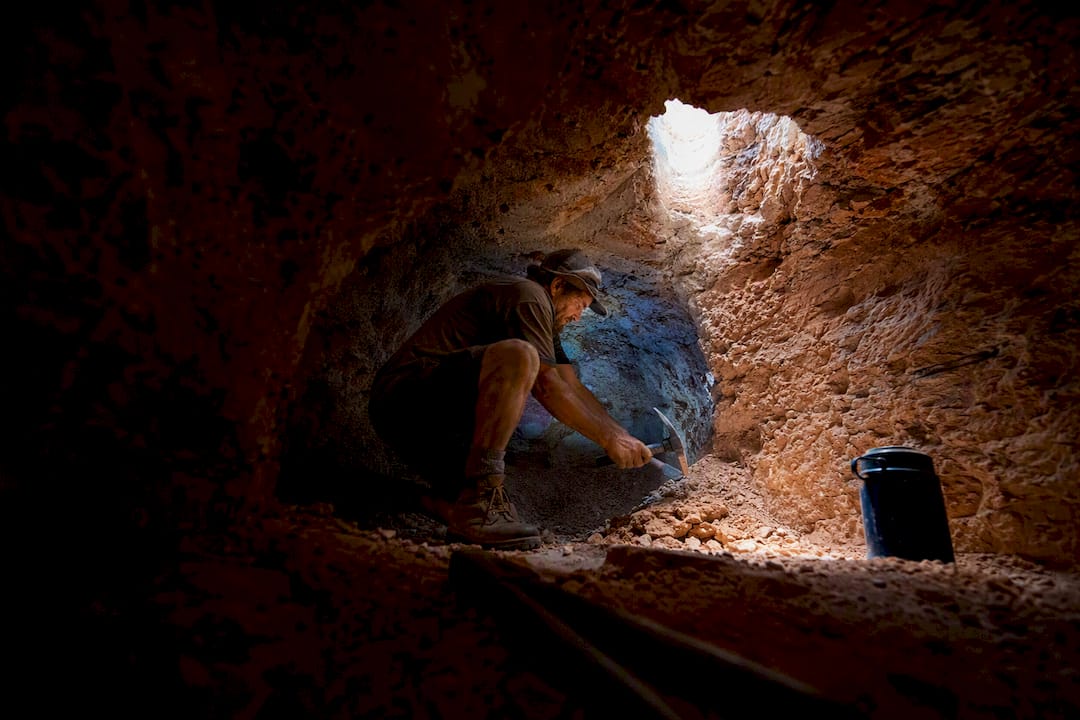
Coober Pedy’s earliest miners worked with almost nothing but muscle. A hand-dug shaft, a windlass, and a bucket were the standard toolkit: one person dug at the bottom, another hauled dirt to the surface, and the whole operation moved at the pace of shovel and rope. Noodling, sorting through discarded mullock for overlooked opal, gave even miners without their own claim a shot at a find.
That changed decisively in the 1970s. Mechanized equipment, including Calweld drills and specialized tunneling machines, let miners bore shafts and remove waste rock far faster than hand labor ever could, and mechanical vacuums began clearing tunnels that once took days to excavate by hand.
The shift reshaped the field in three ways:
- Output rose sharply as mechanized crews worked ground that hand-digging would have taken years to cover.
- Operations consolidated around miners who could afford machinery, squeezing out some of the smaller noodling operators who had worked the fringes for decades.
- Risk multiplied as the sheer number of shafts across the district climbed into the hundreds of thousands.
Coober Pedy’s opal fields are honeycombed with a very large number of mine shafts, a density that has made unmarked, unfenced holes a genuine hazard across the district. That legacy pushed local authorities to eventually restrict new mining within residential zones, a regulatory response to a problem the boom years never anticipated.
Underground Living and a Melting-Pot Mining Town
Digging a home into the ground was not Coober Pedy’s invention. Miners at Burra, South Australia, lived in dugouts as far back as the 1850s. What Coober Pedy did was popularize the practice on a larger scale, largely because returned World War I soldiers who had spent years living in trenches saw no reason to fear an underground room. If a dugout kept artillery off your head in France, it could certainly keep desert heat off your head in South Australia.
That logic held even more strongly after World War II, when a wave of European immigrants, many from Italy, Greece, and Croatia, arrived to work the opal fields and found dugout living both practical and familiar from stonework traditions back home. The result was a genuinely multicultural mining town stitched together from returned soldiers, postwar migrants, and Aboriginal families who had worked the country long before any of them arrived.
That mix produced a town with a character all its own:
- Underground churches, hotels, and even a golf course, all built to escape the heat rather than as novelty.
- A population drawn from dozens of nationalities, still visible in local surnames and community events.
- A reputation for eccentric self-reliance, born from decades of a community solving its own water, power, and housing problems in isolation.
Pro Tip: If you’re researching family or town history in Coober Pedy, don’t assume dugout construction dates only from the mining boom. Some of the oldest excavated rooms in town predate the 1946 revival of the field and were later expanded, so a single dwelling can carry multiple decades of layered history in its walls.
Which Opal Finds Made Coober Pedy Famous?

No discovery defines the town’s reputation more than the Olympic Australis, unearthed in 1956 and still recognized as one of the largest and most valuable gem opals ever found. Its size and quality turned it into a symbol of what the field was capable of producing, well beyond anything the early hand-diggers of 1915 could have imagined.
Fossils tell a parallel story. Opalized remains, including the plesiosaur specimen nicknamed “Eric,” reveal that the same geological conditions that formed the region’s gem opal also preserved ancient marine life in extraordinary detail.
- Australia produces roughly 95% of the world’s precious opal, and Coober Pedy is the largest single producer by mass.
- Lightning Ridge, by contrast, is often associated with higher per-carat value for its black opal, a mass-versus-value distinction serious collectors learn to weigh carefully.
- Opalized fossils like Eric demonstrate the field’s scientific value stretches well beyond jewelry.
Where to Explore Coober Pedy’s History Today
The Umoona Opal Mine and Museum remains the most direct way to walk through the town’s layered story, combining mining displays, fossil specimens, and a genuine underground dugout open to visitors. The Coober Pedy Historical Society maintains a detailed public timeline stretching from the region’s ancient geology through the 1915 discovery and into later 20th century milestones, a resource genuinely useful for anyone doing serious research rather than a casual read.
The District Council of Coober Pedy also plays a quieter preservation role, maintaining heritage infrastructure and historical water supply systems that kept the early town alive.
- Visit the Umoona Opal Mine and Museum for hands-on exhibits and an underground dugout tour.
- Consult the Coober Pedy Historical Society’s timeline for dated, sourced milestones.
- Contact the District Council directly for heritage records and infrastructure history.
A Quick Reference Timeline of Coober Pedy’s History
| Date | Milestone |
|---|---|
| Pre-1915 | Ancient geological conditions form the opal deposits and preserve marine fossils across the region. |
| 1858 | John McDouall Stuart explores the surrounding country, decades before opal draws settlers. |
| February 1915 | Willie Hutchison discovers opal; early claims are staked soon after. |
| 1920 | The town’s progress committee formally adopts the name Coober Pedy. |
| 1946 | Tottie Bryant’s opal find helps revive activity on the field. |
| 1956 | The Olympic Australis, among the largest gem opals ever found, is unearthed. |
| 1970s | Calweld drills and mechanized tunneling transform the scale of mining. |
| 1970s | The Aboriginal community adopts the name Umoona for local institutions. |
Why We Tell Coober Pedy’s History This Way
Most retellings of Coober Pedy flatten a genuinely complicated story into a single image: white prospectors, a lucky find, a quirky underground town. That version leaves out Tottie Bryant, leaves out the Kokatha language that gave the town its name, and leaves out the decades of Aboriginal work that kept the field productive between booms. We think a collector who understands provenance owes the same attention to a stone’s human history as to its brightness or pattern.
That’s also why direct relationships with working miners matter to us. A miner who can tell you which shaft, which field, and often which family a stone came from is passing along the same oral history the Coober Pedy Historical Society works to preserve. Readers who want the technical side of that provenance can go deeper in our Coober Pedy opal guide and our notes on the role miners play in opal sourcing.
— Renee
See Coober Pedy’s Opals for Yourself
Australianopaldirect works directly with miners on the Coober Pedy field, so every stone in the collection carries a documented history rather than a vague label. That direct relationship is what lets us skip the markup layers a traditional jeweler adds and pass along stones with real provenance attached, from field to setting.

If the history in this article caught your attention, the stones themselves carry it forward. Browse our curated Coober Pedy opal collection to see the color patterns that made this field famous, or read our complete collector’s guide for a closer look at what separates a fine Coober Pedy opal from the rest. Every purchase includes documented sourcing and a 90-day warranty, so you can buy with the same confidence you’d want from a stone with this much history behind it.
Sources and Further Reading on Coober Pedy History
- District Council of Coober Pedy: official town history records








