The Role of Jeweler in Design Process Explained
Posted by AOD on 11th Jun 2026
The Role of Jeweler in Design Process Explained

TL;DR:
- Jeweler’s role combines visionary creativity with expert craftsmanship to transform raw ideas and materials into wearable art. Collaboration between designers and bench jewelers ensures both aesthetic appeal and structural durability, with technology like CAD streamlining the process. Client involvement and rigorous testing help produce high-quality, customized jewelry that balances artistic vision with practicality.
The role of jeweler in design process is the critical fusion of visionary creativity and expert craftsmanship that transforms raw ideas and precious materials into exquisite, wearable art. A jeweler’s responsibilities span conceptual sketching, technical production drawing, client consultation, and hands-on fabrication, making this role far more layered than most customers or aspiring designers realize. Whether working with a kaleidoscopic Lightning Ridge black opal or a delicate gold filigree setting, the jeweler stands at the intersection of imagination and physical reality. Understanding this interplay enriches every commission, from the first sketch to the final fitting.
How do the jewelry designer and bench jeweler collaborate to create a piece?
The designer shapes the soul of a piece while the bench jeweler acts as the pragmatic craftsperson who ensures durability, comfort, and structural integrity. These two roles are distinct yet deeply interdependent, and the finest jewelry emerges when both parties communicate openly from the very first concept meeting through to the final fitting. Clients benefit most when this collaboration is tight and continuous rather than sequential.
The jewelry designer functions as the visionary. Their work centers on aesthetics, proportion, trend awareness, and the emotional story a piece should tell. They produce hand sketches, mood boards, and early CAD concepts that capture the spirit of the commission. Effective communication is critical at this stage because translating a client’s emotional brief into a workable visual concept requires both artistic sensitivity and precise listening.
The bench jeweler, by contrast, operates in the physical world of metal physics, stone setting tolerances, and wearability. Their expertise covers cutting, soldering, stone setting, and engraving, and their training typically spans years of hands-on practice before they work independently on fine jewelry. When a designer proposes a dramatically thin band to showcase a large opal, the bench jeweler will flag whether that structure can survive daily wear without cracking or bending.
The negotiation between creativity and feasibility is where the most interesting design decisions happen. A designer might envision a floating bezel that appears to suspend a Queensland boulder opal in mid-air. The bench jeweler will calculate whether the metal walls are thick enough to hold the stone securely during impact. The result is often a refined version of the original concept that preserves the visual drama while adding the structural reinforcement that makes the piece last a lifetime.
- The designer leads on aesthetics, proportion, and client storytelling.
- The bench jeweler leads on metal behavior, stone security, and wearability testing.
- Both roles require mutual respect and willingness to revise ideas based on practical feedback.
- Successful jewelry creation depends on early and constant collaboration to merge artistic vision with physical practicality.
Pro Tip: If you are commissioning a bespoke piece, ask your jeweler to introduce you to both the designer and the bench jeweler. Understanding who holds each responsibility gives you clearer channels for feedback and prevents miscommunication mid-production.
What technologies and techniques do jewelers use during the design process?
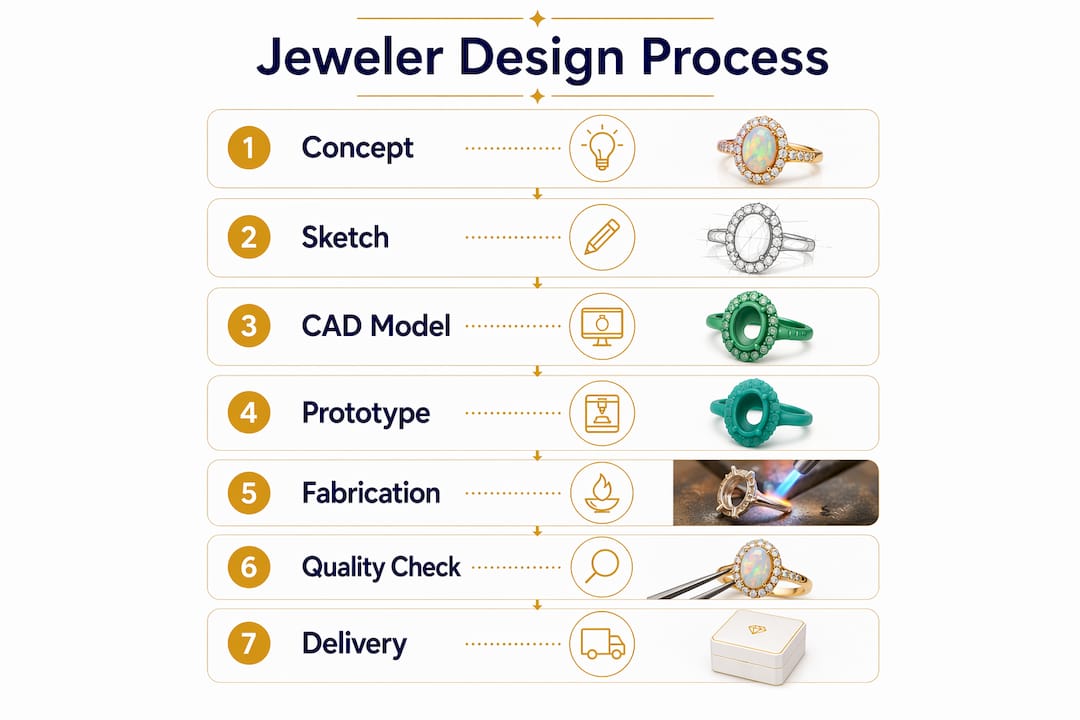
Modern jewelry creation techniques have shifted dramatically with the adoption of computer-aided design software. CAD reduces prototyping time by 40% and, when paired with clear collaborative processes, achieves up to 95% client retention. That figure reflects a fundamental shift: clients who can visualize a piece in three dimensions before metal is cut are far more confident in their decisions and far less likely to request costly post-production changes.

CAD software allows jewelers to produce precise 3D models with tolerances that would be impossible to achieve through hand drawing alone. Technical production drawings must show top, front, and side views with tolerances of 0.01mm in the digital file and plus or minus 0.1mm for the physical piece. These standards, current as of March 2026, govern how manufacturers interpret a design for casting, setting, and finishing.
Prototyping follows the CAD stage and takes two primary forms, each serving a different purpose.
| Prototype type | Material | Primary purpose | Limitation |
|---|---|---|---|
| Resin or wax model | 3D printed polymer or carved wax | Visual proportion check, client approval | Cannot test weight, balance, or snagging |
| Metal master model | Sterling silver or base metal | Full wearability and structural testing | Higher cost and production time |
| CAD render | Digital 3D visualization | Client presentation and color review | No physical feedback |
| Precious metal cast | Gold, platinum, or silver | Final production piece | Irreversible; errors are costly |
Metal master models are critical for assessing balance and snagging risks that resin or wax prototypes cannot reveal, preventing costly mistakes before precious metals are used. A resin model of an opal pendant might look perfect on screen, but only a metal master will show whether the bail catches on fabric or whether the stone sits level under its own weight.
Quality control extends beyond prototyping. Manufacturers run artificial sweat and salt spray tests to confirm that the finished piece matches the master in both appearance and durability. High production standards also require detailed specification of stone types, measurements, and metal quality so that every piece in a run matches the custom original. For one-of-a-kind commissions, these tests confirm that the piece will perform as beautifully in daily life as it does in a display case.
How do jewelers engage clients in the design process?
Client engagement is the foundation of bespoke jewelry, and the first consultation sets trust through listening and honest feasibility discussion. A jeweler who rushes past this stage risks building a piece that is technically accomplished but emotionally wrong for the person who will wear it every day. The consultation is not logistical. It is relational.
A structured client engagement process typically follows these steps:
- Initial consultation. The jeweler asks about lifestyle, daily activities, metal sensitivities, and aesthetic preferences. A client who works with their hands needs a lower-profile setting than someone who wears jewelry primarily for formal occasions. These details directly shape the design brief.
- Sketch and concept review. The jeweler presents hand sketches or early CAD renders for the client to respond to. Specific feedback at this stage, such as “the band feels too wide” or “I want the opal to face more toward the viewer,” is far more useful than general approval.
- Iterative CAD refinement. Most commissions involve one to three rounds of refinements combining hand sketches and CAD model iterations before the brief is considered ideal. Rushing into production before this stage is complete risks expensive changes after metal has been cast.
- Prototype presentation. The client reviews a resin or wax model in person, checking scale, proportion, and comfort before the final metal version is produced.
- Final fitting and aftercare. The jeweler checks sizing, finish, and stone security at collection. Aftercare guidance, including cleaning methods and inspection schedules, forms part of the relationship rather than an afterthought.
Jewelers who communicate design limitations early help clients avoid unrealistic expectations, leading to better satisfaction and fewer changes post-production. Transparency at the consultation stage is not a constraint on creativity. It is the condition that makes genuine creativity possible. You can explore the full custom opal design process to understand how these steps translate into a finished piece.
What practical challenges do jewelers face in fabrication?
Turning a luminous design into a durable, wearable piece of jewelry is where the artisan’s skill faces its most demanding tests. The physics of metal, the fragility of certain gemstones, and the unpredictability of daily wear all push back against even the most carefully conceived design. Bench jewelers solve these challenges not by compromising the vision but by finding technical paths that honor it.
The most common fabrication challenges include:
- Over-delicate structures. Thin prongs, narrow bands, and unsupported spans look striking in renders but can deform or snap under normal pressure. Bench jewelers calculate minimum metal thicknesses based on alloy type and expected stress points before any metal is cut.
- Stone setting risks. Opals, with their characteristic play-of-color and relatively softer hardness compared to diamonds, require settings that protect the stone’s edges without obscuring its fire. Bezel settings and protective halos are common solutions for active wearers.
- Weight and balance. A pendant that looks symmetrical in a CAD render may hang at an angle when worn because the stone’s density differs from the metal surrounding it. Only physical prototyping reveals this issue.
- Surface finish durability. High-polish finishes show scratches faster than brushed or hammered textures. Jewelers advise clients on finish choices based on lifestyle, not just aesthetics.
Pro Tip: Ask your bench jeweler to show you a metal master prototype before approving the final production piece. The few days this adds to your timeline can prevent weeks of frustration if a structural issue surfaces after casting.
Quality control processes, including artificial sweat and salt spray testing, confirm that the finished piece will maintain its integrity across years of wear. These tests are not bureaucratic formalities. They are the final proof that the jeweler’s craft has met the standard the design demanded. For aspiring designers, understanding these constraints early transforms them from obstacles into creative parameters that sharpen rather than limit the work. You can read more about luxury jewelry standards to see how these principles apply at the highest level of the craft.
Key takeaways
The role of jeweler in design process requires the designer’s conceptual vision, the bench jeweler’s physical expertise, and the client’s clear communication to work in concert from the first sketch to the final fitting.
| Point | Details |
|---|---|
| Designer and bench jeweler roles are distinct | Designers lead on aesthetics; bench jewelers lead on structural integrity and wearability. |
| CAD technology transforms efficiency | CAD reduces prototyping time by 40% and significantly improves client approval rates. |
| Metal master models prevent costly errors | Resin prototypes check proportions; only metal masters reveal balance, snagging, and weight issues. |
| Client consultation drives satisfaction | Jewelers who ask lifestyle questions and communicate limitations early deliver better outcomes. |
| Iterative refinement is standard practice | Most bespoke commissions require one to three rounds of design revision before production begins. |
Why the jeweler’s role changed how I think about jewelry
When I first started paying close attention to bespoke jewelry commissions, I assumed the designer was the dominant creative force and the bench jeweler was essentially an executor. That assumption dissolved quickly once I understood how many design decisions actually happen at the bench rather than on the drawing board.
The most striking insight is that the bench jeweler’s constraints are not limitations on creativity. They are the conditions that make creativity honest. A design that cannot survive daily wear is not a finished design. It is a beautiful sketch that has not yet been tested against reality. The jewelers I most respect are the ones who push back on ideas early, not because they lack imagination, but because they respect the person who will wear the piece for decades.
For aspiring designers, the practical lesson is this: spend time at the bench before you spend time at the CAD workstation. Understanding how metal behaves under a torch, how a stone shifts in its setting, and how a clasp feels after a hundred openings will make your designs more honest and more wearable. The custom opal jewelry workflow at Australianopaldirect reflects exactly this philosophy, where the design process is treated as a conversation between vision and craft rather than a one-way transmission from designer to maker.
The emotional dimension of jewelry, particularly pieces built around Australian opals with their ancient, fire-lit play-of-color, demands that both the designer and the bench jeweler bring their full skill to the work. When they do, the result is not just a piece of jewelry. It is a small, wearable record of human creativity at its most precise and most poetic.
— Renee
Discover bespoke opal jewelry at Australianopaldirect
Australianopaldirect brings together the full spectrum of jeweler design responsibilities under one trusted roof, from the first consultation through to the final fitting of your custom piece.

Every custom opal commission at Australianopaldirect begins with a genuine conversation about your lifestyle, aesthetic vision, and the unique character of the opal you have chosen. Whether you are drawn to the deep celestial fire of a Lightning Ridge black opal or the warm, rolling color of a Queensland boulder opal, the team works through each design stage with the same collaborative care this article describes. Ethically sourced, earth-mined, and crafted with precision, every piece reflects the full artistry of the jewelry design process. Begin your own design story at australianopaldirect.com.
FAQ
What is the role of a jeweler in the design process?
The role of jeweler in design process covers conceptual design, technical drawing, client consultation, prototyping, and hands-on fabrication. Designers focus on aesthetics and vision while bench jewelers translate those concepts into structurally sound, wearable pieces.
How does a jewelry designer differ from a bench jeweler?
A jewelry designer creates the visual concept and emotional narrative of a piece, while a bench jeweler executes the physical construction using skills like soldering, stone setting, and engraving. The designer provides the concept and the bench jeweler provides the durability.
How many design revisions does a bespoke commission typically involve?
Most bespoke commissions involve one to three rounds of refinements combining hand sketches and CAD iterations before production begins. Rushing this stage increases the risk of costly changes after metal has been cast.
Why is CAD software important in jewelry design?
CAD software allows jewelers to produce precise 3D models, share visual presentations with clients, and reduce prototyping time by 40%. It also enables technical drawings with tolerances of 0.01mm, which manufacturers require for accurate production.
How do jewelers test jewelry quality before delivery?
Jewelers use metal master prototypes to test weight, balance, and snagging before casting in precious metal. Manufacturers also run artificial sweat and salt spray tests to confirm that the finished piece matches the master in both appearance and long-term durability.
Recommended
- Custom Opal Jewelry Workflow: Create Bespoke Designs Easily - Australian Opal Direct
- How to Design Custom Opal Jewelry for Unique Creations - Australian Opal Direct
- Master the Opal Jewelry Design Process Step by Step - Australian Opal Direct
- What defines high jewelry? The key elements of true luxury - Australian Opal Direct