How to Brief Custom Opal Designs: Your Clear Guide
Posted by AOD on 26th May 2026
How to Brief Custom Opal Designs: Your Clear Guide
TL;DR:
- Custom opal designs require detailed briefs that specify stone dimensions, origin, and protective setting techniques to prevent damage. Clear, written communication about aesthetic intent, technical specs, and durability needs ensures the jeweler can craft a personalized piece that meets expectations. Proper preparation, including sourcing from reliable suppliers like Australianopaldirect, facilitates a collaborative process resulting in lasting, beautifully designed opal jewelry.
Custom opal designs are among the most personal and technically demanding pieces a jeweler can create. Yet knowing how to brief custom opal designs is a skill most enthusiasts never formally learn, and the gap between a dream piece and a disappointing result often comes down to exactly that. Opals are not simply beautiful. They are geologically complex, emotionally resonant, and physically fragile in ways that demand a different level of precision than almost any other gemstone. A vague brief leads to costly revisions, delays, and sometimes irreversible damage to a stone that nature spent millions of years forming.
Table of Contents
Key takeaways
| Point | Details |
|---|---|
| Prepare before you brief | Gather opal dimensions, ring size, setting preferences, and inspiration references before meeting your jeweler. |
| Lead with story, follow with specs | Share the meaning behind your piece first, then support it with measurable technical details. |
| Avoid ambiguous language | Descriptors like “delicate” or “blue stone” cause production errors without precise measurements. |
| Review prototypes carefully | Check 3D renderings or sketches before approving final production to catch misalignments early. |
| Match briefing style to complexity | Simple pieces suit verbal briefs; complex opal designs benefit from written specs or CAD files. |
How to brief custom opal designs: what to prepare first
Before you sit down with a jeweler, preparation is everything. A briefing session is only as useful as the information you bring into it. Custom opal jewelry design requires a detailed conversation about the client’s vision alongside careful setting techniques, because opals score just 5.5 to 6.5 on the Mohs hardness scale. That makes them significantly softer than diamonds, sapphires, or rubies, and their vulnerability to pressure, heat, and improper mounting must shape every decision you make.
Start by understanding the stone you are working with. Whether you already own the opal or plan to source one, you need to know its dimensions (length, width, and depth in millimeters), its body tone (white, dark, or crystal), and its predominant play-of-color. If you are selecting the stone through a specialist like Australianopaldirect, you will have access to verified provenance details, region of origin, and gemological documentation. That information is not decorative. It belongs in your brief.
Beyond the stone itself, gather the following before your first briefing session:
-
Inspiration images: Collect 5 to 10 references that reflect your desired aesthetic, whether that means vintage filigree, modern minimalism, or nature-inspired organic forms.
-
Precise measurements: Know your ring size, wrist circumference, or desired pendant dimensions before you arrive.
-
Metal preferences: Decide whether you favor 18k yellow gold, sterling silver, rose gold, or platinum, and understand how each interacts with opal’s color palette.
-
Setting style ideas: Research whether you are drawn to bezel settings, which wrap the opal’s edges in protective metal, or prong settings, which maximize light exposure but offer less physical protection.
-
Budget and timeline: Knowing both in advance prevents the jeweler from designing toward a price point that does not match your expectations.
Pro Tip: Bring the actual opal to your briefing if you already own it. A skilled jeweler will assess its exact dimensions, condition, and fragility in person, which directly informs the setting design. Master jewelers typically recommend a stone-first approach rather than forcing stones into preset mountings.
The step-by-step briefing process
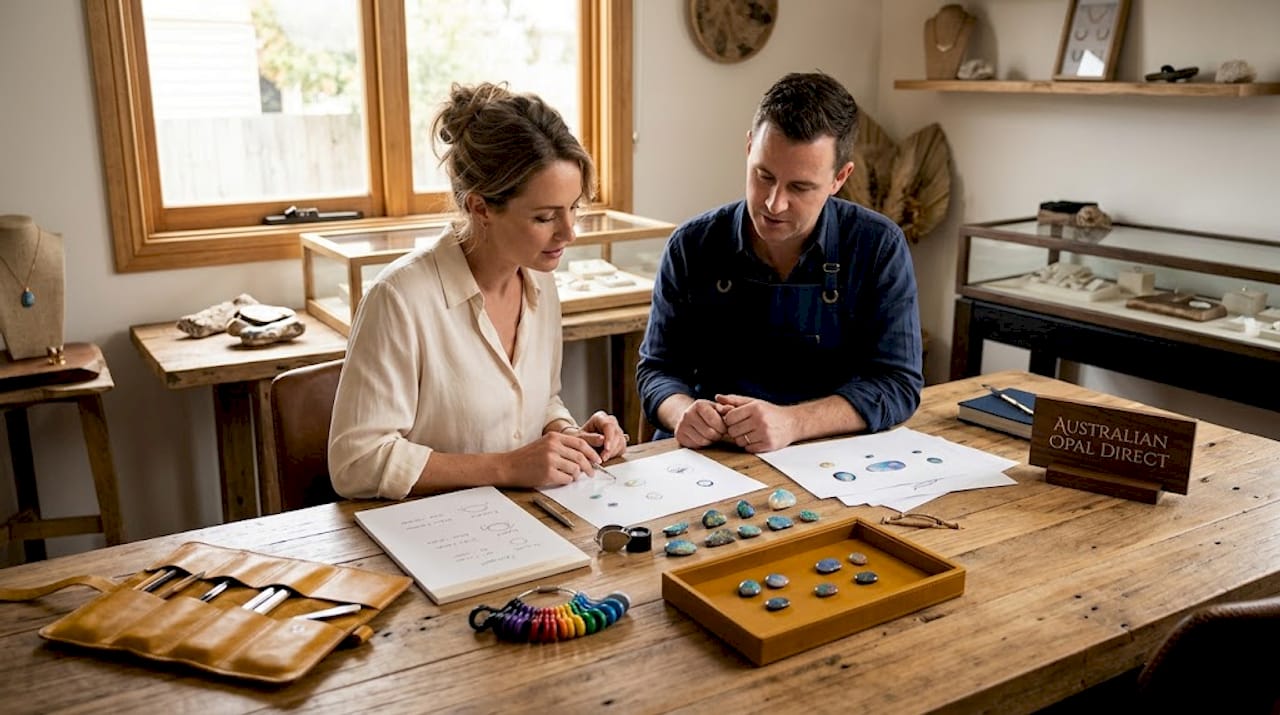
Once your preparation is solid, the actual briefing becomes a structured conversation rather than a guessing game. Think of your design brief as a translation document. It converts your emotional and aesthetic vision into the technical language a craftsperson can manufacture with confidence.
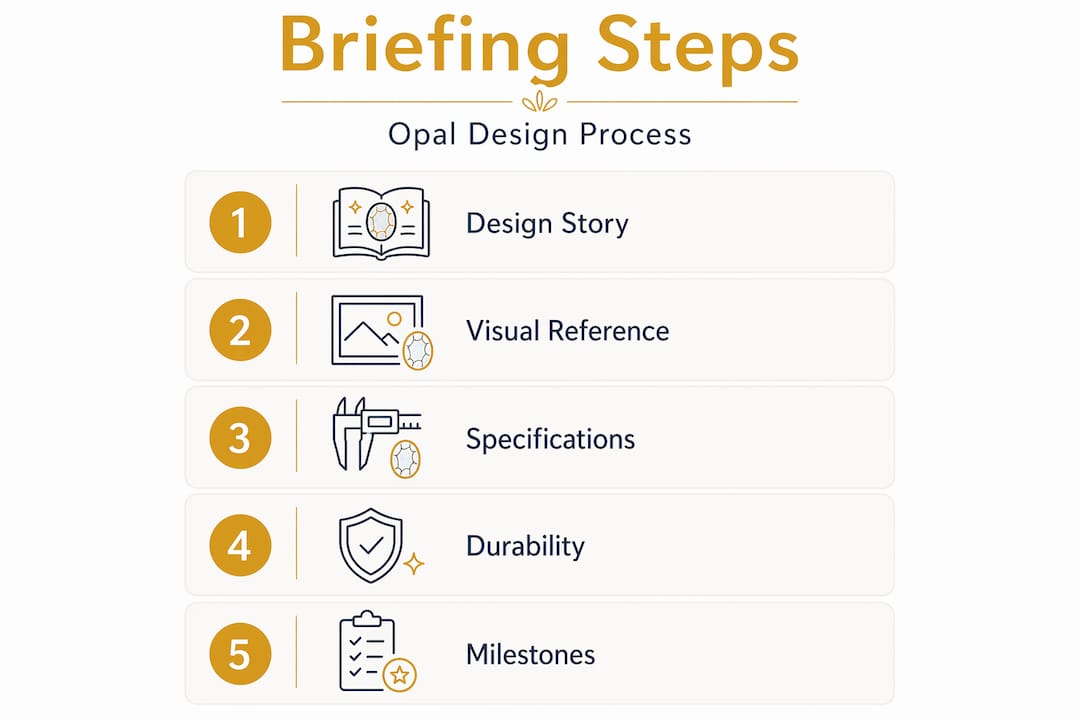
Step 1: Open with your design story. Tell your jeweler why this piece matters. Is it a milestone anniversary gift? A piece honoring a passed relative? A daily-wear ring that needs to survive a busy lifestyle? This context shapes every structural and aesthetic decision that follows. Custom opal pieces often span several weeks of production, and a jeweler who understands your intent makes better micro-decisions throughout that process.
Step 2: Describe your aesthetic with visual references. Bring your inspiration images and explain specifically what draws you to each one. Do not say you love “the whole look.” Point to the metal texture, the stone orientation, the profile height, or the way light catches a particular setting edge. Specificity at this stage prevents broad misinterpretation later.
Step 3: Provide exact technical specifications. A comprehensive design brief includes design intent, technical specs, gemstone and setting details, production model, budget, and timeline. For opal pieces specifically, your technical section should include:
| Specification | Example Detail |
|---|---|
| Stone type and origin | Black opal, Lightning Ridge, Australia |
| Stone dimensions | 14mm x 10mm x 4mm |
| Setting style | Full bezel, 18k yellow gold |
| Metal finish | High polish on top, brushed on band |
| Ring size | US size 7 |
| Budget range | $1,800 to $2,400 |
| Production timeline | 6 to 8 weeks from design approval |
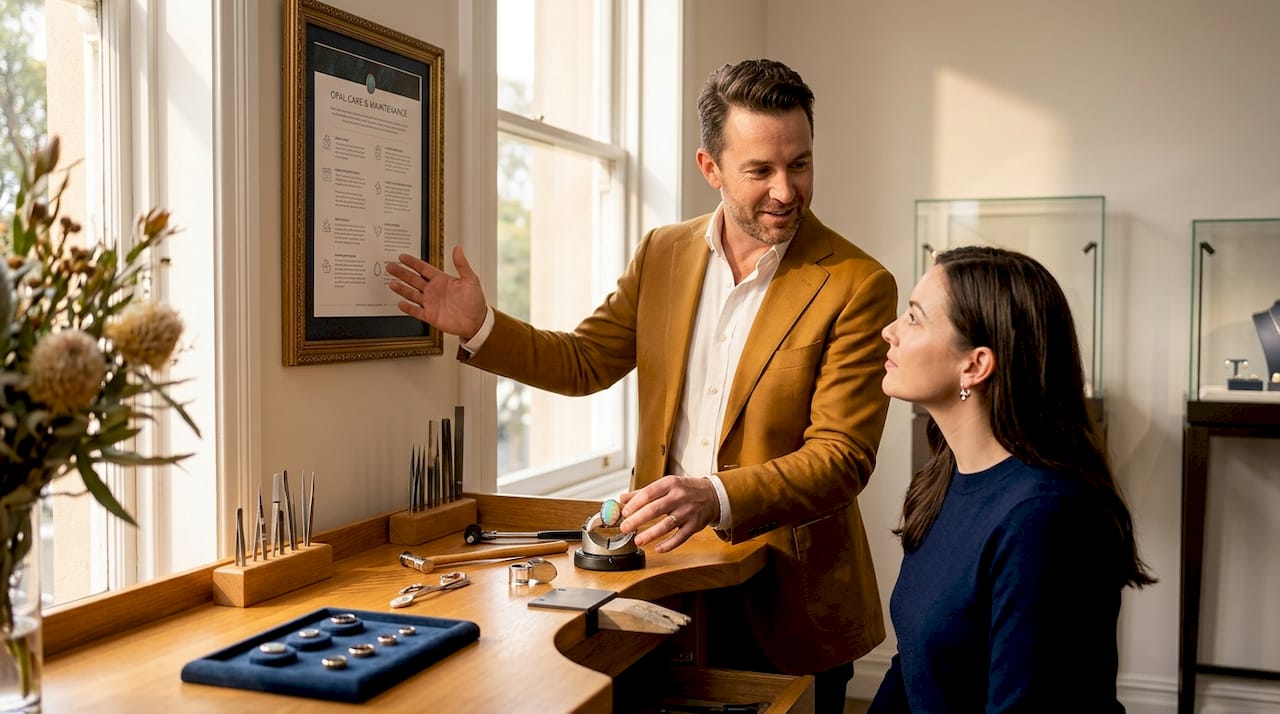
Step 4: Discuss durability and care expectations. Opals require specialized setting techniques like bezel or doublet constructions to protect their vulnerable edges. Tell your jeweler how the piece will be worn. A ring worn daily needs deeper edge protection than a pendant worn occasionally. This single conversation point can determine whether your piece survives years of wear or chips within months.
Step 5: Establish communication milestones. Agree on when you will review sketches, 3D renderings, and prototypes. Clear communication on timelines reduces production stress and keeps expectations aligned across every stage. Request written confirmation of all agreed specifications before the jeweler begins work.
Pro Tip: Ask your jeweler to send you a written summary of the brief after your meeting. Compare it against your own notes. Any discrepancies are far easier to resolve before production begins than after.
Common pitfalls when briefing opal jewelry designs
Even well-intentioned clients fall into predictable traps when briefing opal pieces. Recognizing these pitfalls before you sit down with a jeweler can save you significant time and money.
The most widespread mistake is relying on ambiguous language. Ambiguous descriptors like “blue stone” or “delicate band” are the documented cause of failed custom jewelry projects. When you say “I want something delicate,” your jeweler might interpret that as a 1.5mm band. You might have imagined 2.5mm. That difference feels small until the piece arrives and looks nothing like what you envisioned.
A second common error is neglecting opal-specific technical data. Unlike diamonds or rubies, opals carry unique structural vulnerabilities that must be addressed in the brief itself. Forgetting to specify protective setting requirements or failing to mention that the piece is intended for daily wear can lead to a mounting style that leaves the stone exposed and prone to chipping.
Watch out for these additional pitfalls:
-
Treating a sketch as a finished brief. Sketches are starting points. Successful manufacture requires measurable technical specs alongside any visual references.
-
Skipping written documentation. Verbal agreements are forgotten or misremembered. Every specification should exist in writing, signed off by both parties.
-
Overlooking aftercare discussions. Opals are porous and sensitive to chemicals, sudden temperature changes, and prolonged sunlight. Your brief should include a conversation about maintenance expectations and what warranty or repair service the jeweler offers.
-
Ignoring stone orientation. The direction in which an opal’s color fires can look dramatically different depending on how the stone is oriented in the setting. Confirm orientation before design is finalized.
“Ambiguity in design briefs is the single biggest barrier to custom jewelry production efficiency and quality.” — Erawan Atelier
Verifying your design before final production
Approval before production is not a formality. It is your last clear opportunity to catch misalignments between your vision and the jeweler’s interpretation. Treat it with the same care you brought to the briefing session itself.
Most reputable jewelers will provide one or more of the following before beginning final production:
-
Hand sketches or technical drawings: Review these for proportion, stone orientation, profile height, and setting edge coverage.
-
3D CAD renderings: These give you a photorealistic view of the piece from multiple angles. Verifying prototypes reduces costly errors and confirms that client expectations are met before metal is cast.
-
Wax or resin prototypes: For complex pieces, a physical prototype allows you to assess scale and weight before irreversible production decisions are made.
During your review, check the following with care:
-
Stone position and orientation within the setting
-
Edge protection coverage, particularly for bezel settings around delicate opal edges
-
Band or chain proportions relative to the stone size
-
Surface finish consistency across all metal sections
-
Any engraving or personalization details for exact spelling and placement
Pro Tip: When reviewing 3D renderings, view the piece in both warm and cool light simulations if your software allows. Opal’s play-of-color shifts dramatically under different lighting conditions, and the setting’s reflective surfaces will read differently under each.
Request any changes in writing, referencing the specific specification from your original brief. This keeps revision conversations precise and prevents the common scenario where a correction in one area inadvertently alters another.
Comparing briefing approaches for custom opal pieces
Not every opal project requires the same briefing style. The right approach depends on your experience level, the complexity of the design, and the production method your jeweler uses.
| Briefing Approach | Best For | Advantages | Risks for Opal |
|---|---|---|---|
| Verbal brief with sketch | Simple designs, experienced jewelers | Fast, low-effort, conversational | High misinterpretation risk for setting specs |
| Written brief with measurements | Most custom opal projects | Precise, documented, revisable | Requires client to research specs in advance |
| CAD file-based briefing | Complex or experienced designers | Maximum precision, exact stone fit | Requires technical software knowledge |
| Hybrid: visual plus written specs | Recommended for opal designs | Balances creativity with technical rigor | Minimal, provided both elements are complete |
For most people learning how to design opal pieces for the first time, the hybrid approach offers the best balance. It lets your inspiration images carry the aesthetic conversation while your written specs handle the technical requirements that protect the stone and guide production. You can explore opal design fundamentals to build your technical vocabulary before sitting down with your jeweler.
What I have learned about briefing opal designs
I have seen more custom opal projects go sideways than most people realize, and the cause is almost never the jeweler’s craftsmanship. It is the brief. Clients arrive with beautiful inspiration boards and genuine passion, but when the jeweler asks, “What dimensions is your stone?” or “What setting depth do you need?” the room goes quiet.
In my experience, people consistently underestimate how much the opal itself drives the design decisions. The stone is not an accessory to the setting. It is the architecture around which everything else must be planned. When I see a project brief that lists the stone selection as an afterthought, I know the production process is going to require multiple correction rounds.
The brief that saved the most challenging project I encountered was one where the client brought a written document listing every specification from stone origin to metal karat to the exact millimeter of bezel wall height. It felt excessive at first. By the end of production, it felt like the smartest decision that client ever made. Not a single revision was needed.
My honest advice: the gap between inspiration and specification is where custom opal projects either flourish or fail. The opal gifting and customization process begins with selecting the right stone, and every decision in your brief flows outward from that choice. Get the stone details locked in first, document everything, and treat your jeweler as a creative partner rather than an order-taker. That relationship, built on clear communication and mutual respect, is what produces pieces that last a lifetime.
— Renee
Start your custom opal design with Australianopaldirect
Knowing the theory behind a great brief is one thing. Having the right stone to build that brief around is another matter entirely.
Australianopaldirect sources genuine earth-mined opals directly from Australia’s most celebrated regions, including Lightning Ridge, Coober Pedy, and Queensland. Each stone comes with provenance documentation and gemological details, giving you the precise measurements and quality data your brief demands from the start. Whether you are exploring your first custom piece or adding to a curated collection, the team at Australianopaldirect offers expert guidance to match you with stones that inspire great design. Visit Australianopaldirect to explore available stones and begin your custom design consultation today.
FAQ
What should I include in a custom opal design brief?
A complete brief includes stone dimensions, body tone, setting style, metal type and karat, finish preference, ring or pendant size, budget, and production timeline. Structured briefs that translate creative vision into concrete manufacturing instructions consistently achieve better outcomes than sketch-only approaches.
Why is opal briefing different from briefing other gemstone jewelry?
Opals require specialized setting techniques to protect their soft, porous structure. Because bezel settings and protective metalwork must be specified explicitly, an opal design brief needs more technical detail around stone protection than a diamond or sapphire brief typically requires.
How do I avoid misunderstandings with my jeweler?
Document every agreed specification in writing after your briefing session, confirm the written summary matches your intentions, and establish clear milestones for reviewing sketches and prototypes before production begins.
What is the best setting style to specify in my opal brief?
Bezel settings are widely recommended for opal pieces because the surrounding metal wall protects the stone’s vulnerable edges while still showcasing its play-of-color. For daily-wear pieces especially, specifying a bezel or modified bezel is a sound default that your jeweler can refine from there.
How long does custom opal design production typically take?
Custom opal pieces generally take six to ten weeks from brief approval to final delivery, depending on design complexity and whether wax prototypes are required. Setting clear timeline expectations during the briefing stage keeps production running without unnecessary delays.
Recommended
-
How to Design Custom Opal Jewelry for Unique Creations - Australian Opal Direct
-
Custom Opal Jewelry Workflow: Create Bespoke Designs Easily - Australian Opal Direct
-
How to Design Custom Opal Rings for Luxury Jewelry Lovers - Australian Opal Direct
-
Master the Opal Jewelry Design Process Step by Step - Australian Opal Direct