Crafting Opal Branding Stories That Captivate Buyers
Posted by AOD on 19th May 2026
Crafting Opal Branding Stories That Captivate Buyers

TL;DR:
- Authentic opal branding relies on deep stories rooted in geology, culture, and human connection rather than superficial facts.
- Effective narratives focus on customer transformation, regional origins, and artisanal craftsmanship to build lasting loyalty.
In the opal jewelry market, beauty alone no longer separates one brand from another. Every retailer shows stunning photography, lists mine origins, and promises rarity. The brands that win long-term loyalty are the ones that make a buyer feel something before they ever see a price tag. Crafting opal branding stories with genuine depth, rooted in geology, heritage, and human connection, is the discipline that separates forgettable retailers from revered ones. This guide walks brand strategists through every stage of that process, from story discovery to cross-channel execution to measurable results.
Table of Contents
- Key takeaways
- Crafting opal branding stories from the gem’s own heritage
- Building a storytelling framework for opal jewelry brands
- Executing opal brand stories across every channel
- Common pitfalls in opal brand storytelling
- Measuring whether your opal branding stories work
- My perspective on what opal storytelling actually demands
- Discover the story behind every Australian opal
- FAQ
Key takeaways
| Point | Details |
|---|---|
| Stories outperform facts | People remember stories 22 times more than facts, making narrative your most powerful brand asset. |
| Customer is the hero | Position the buyer as the protagonist; the brand acts as the catalyst enabling their transformation. |
| Authenticity drives sales | A jewelry brand using authentic storytelling as a content engine saw 114% sales growth in six weeks. |
| Consistency builds identity | Storytelling becomes brand identity only when it reflects behavior and culture at every touchpoint. |
| Measure and refine | Track perception shifts, engagement rates, and sales data to iterate stories that genuinely resonate. |
Crafting opal branding stories from the gem’s own heritage
Before a single word of copy is written, a brand strategist must understand what makes opal unlike any other gem on earth. Opal does not merely reflect light. Its microscopic silica spheres diffract it, producing that signature play-of-color: living fire that shifts from violet to copper to emerald depending on the angle. That physical phenomenon is not a selling point. It is a metaphor waiting to be activated.
Opal’s symbolism and cultural roots
Ancient Romans called opal opalus, believing it held the power of every gem it seemed to contain. Indigenous Australians carried Dreamtime origin myths explaining that the Creator descended to earth on a rainbow, and where foot met stone, opal formed. Arabic folklore credited opal with celestial origin, claiming it fell from the sky during lightning storms. These are not historical footnotes. They are ready-made story architecture that connects modern buyers to something far older and more profound than a product page.
Uncovering your brand’s “snowflake stories”
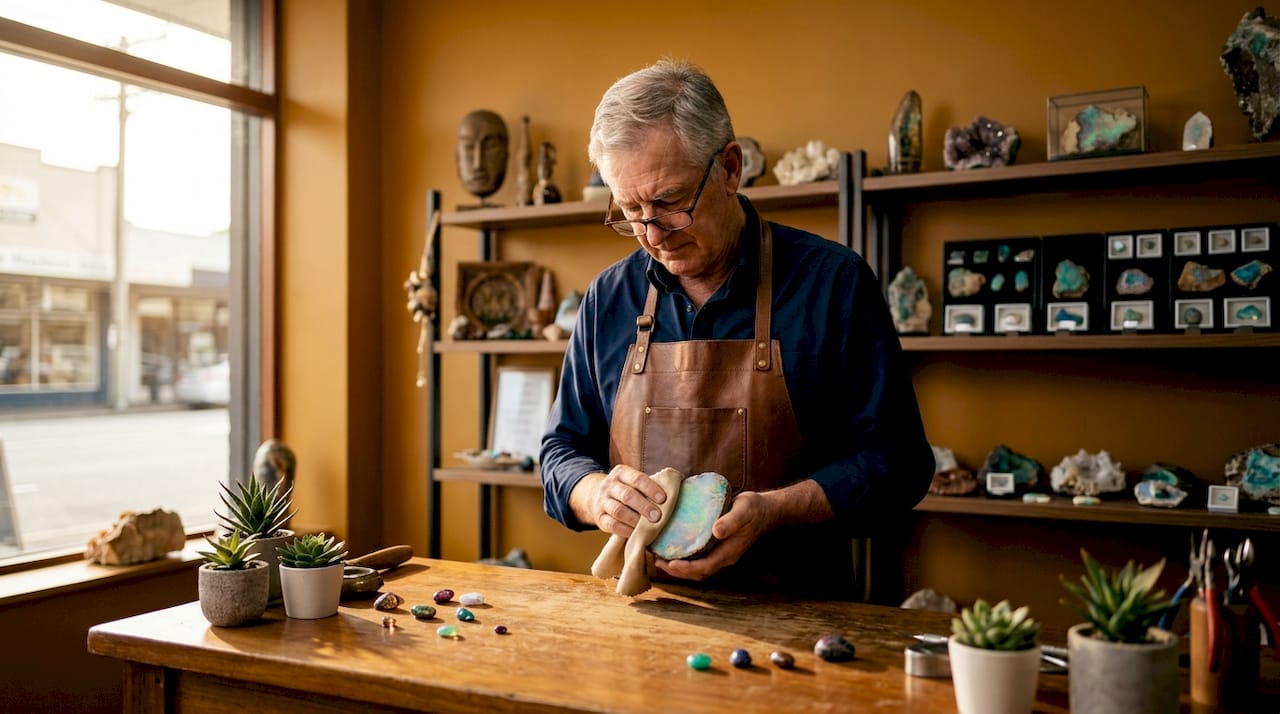
Generic storytelling leans on adjectives: rare, breathtaking, one of a kind. Authentic opal branding techniques require what researchers call “snowflake stories”, the narratives only your brand can tell, uncovered by listening deeply to employees, miners, and long-time customers rather than running a typical brainstorm session.
Ask your team the questions that open unexpected doors: What was the strangest stone ever pulled from a Lightning Ridge seam? Which customer wore an opal pendant to a milestone that changed their life? Which artisan has been cutting stones for forty years and still gets surprised by what emerges? Those conversations are where authentic brand narratives live, not in a brand brief.
- Map your opal sources to their specific regional heritage: Lightning Ridge blacks, Coober Pedy whites, Queensland boulder opals each carry distinct geological and cultural stories.
- Document the human chain from miner to cutter to designer to customer. Every handoff is a narrative opportunity.
- Archive unusual stones, rejected cuts, and the decisions behind them. Imperfection stories often resonate more deeply than polished success narratives.
Pro Tip: Interview your most tenured craftsperson on camera without a script. The unguarded answers almost always contain the most powerful brand story material you will find all year.
Building a storytelling framework for opal jewelry brands
With source material gathered, the next challenge is structure. A story without architecture is just anecdote. The framework below applies the principles of customer-centric brand storytelling to the specific context of opal jewelry.
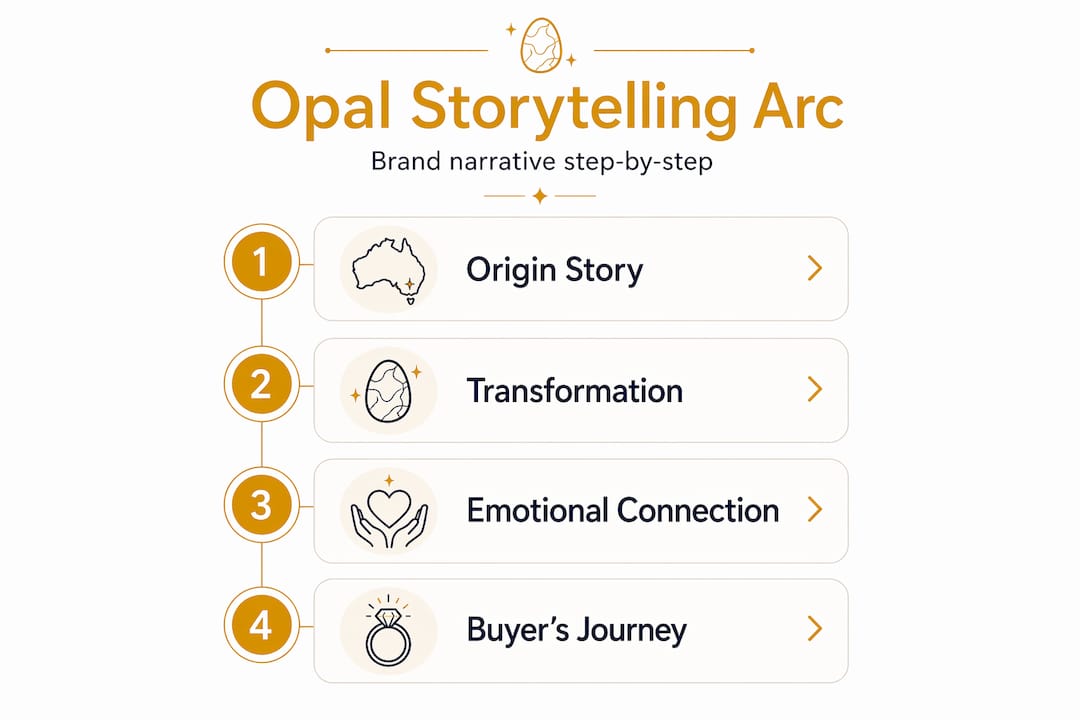
The four-part opal narrative arc
-
Protagonist. The customer is the hero, not the brand. Frame every story around their desire, identity, or aspiration. A collector who spent thirty years searching for a black opal with a full spectral play-of-color is a far more compelling protagonist than any company mission statement.
-
Tension. What is at stake? Perhaps the protagonist cannot find a stone that feels genuinely hers among mass-produced alternatives. Perhaps she questions whether the provenance claims she reads online are real. Tension is the reason the story needs to exist.
-
Turning point. This is where the brand enters. Not as savior, but as catalyst. A direct relationship with Australian miners, a custom design consultation, or the moment a Coober Pedy white opal catches the light in a way the buyer never expected. The brand creates the conditions for change without claiming credit for the transformation itself.
-
Transformation. What is different for the customer now? This is where the story earns its emotional close. Transformation is not “she bought a ring.” It is “she finally owned something that felt as complex and irreplaceable as the relationship she was celebrating.”
Pro Tip: Write one master transformation story for your brand and use it as the filter for every piece of content you create. If a campaign idea does not serve that transformation, it probably does not serve your brand either.
Aligning this arc with your mission, vision, and values keeps storytelling from drifting into marketing noise. When the brand’s commitment to ethical sourcing, direct-miner relationships, and artisan craftsmanship are consistently woven into every narrative, the story becomes identity rather than messaging.
Executing opal brand stories across every channel
Story discovery and framework are preparation. Execution is where most brands either lose their nerve or lose their thread.
Sourcing stories internally and from customers
The most reliable story sources are already inside your organization. Craftspeople, designers, and the founders who first walked a mine in Coober Pedy carry material that no competitor can replicate. The journey from raw stone to finished jewelry — stone selection, rough shaping, cabochon grinding, polishing, and final setting — offers scene after scene of authentic content. Each stage has its own tension: will this rough stone yield a full-spectrum play-of-color, or will the first cut reveal a flaw?
Customer testimonials are equally potent. The buyer who wore her opal pendant through a difficult year of change, or the collector who received a custom-designed boulder opal ring as a retirement gift after four decades of work, carries a story that is already complete. You are not creating those stories. You are amplifying and honoring them.
| Story Type | Source | Best Channel |
|---|---|---|
| Miner origin narrative | Direct mine relationships | Website “Our Story” page, long-form email |
| Craftsperson spotlight | Artisan interview (video or written) | Instagram Reels, YouTube, blog |
| Customer transformation | Testimonial collection survey | Email campaigns, product pages |
| Stone provenance | Mining region documentation | Product detail pages, social captions |
| Cultural mythology | Historical and indigenous research | Brand editorial, catalog copy |
- Social media: Opal lends itself to short-form visual narrative. A fifteen-second video of play-of-color shifting under studio light, paired with one sentence from a customer’s story, is more effective than a product feature carousel.
- Website narratives: Product pages should not read like specifications. Each stone description is an opportunity to state its origin, its character, and the transformation it enables.
- Email campaigns: Long-form storytelling thrives in email. A series that follows one stone from the Coober Pedy mine to a finished pendant to its new owner creates the kind of sustained narrative that builds loyalty over time.
Transparency about craftsmanship and provenance is not just good ethics. It is a marketing asset that most competitors cannot match because they do not have the direct-miner relationships that make it credible.
Common pitfalls in opal brand storytelling
Even experienced marketers make predictable errors when opal branding techniques are applied without discipline.
- Over-promotional framing. When the brand becomes the hero of every story, readers feel sold to rather than invited in. The moment a narrative sounds like an advertisement, it loses the authenticity that made storytelling worth doing.
- Generic luxury language. Words like exquisite, unmatched beauty, and extraordinary quality appear on every competitor’s website. They add no information and create no memory. Specificity creates resonance. “A Lightning Ridge black opal exhibiting vivid red play-of-color across ninety percent of its face” is not generic.
- Inconsistency across touchpoints. A brand that tells a heritage story on its website and runs discount-focused social ads the same week is undermining its own narrative. Consistency between behavior, culture, and messaging turns storytelling into lasting brand identity.
- Treating storytelling as a campaign. Authentic brand storytelling generates dramatic sales growth when treated as a continuous content engine rather than a single launch event. The story must keep being told, refined, and expanded as the brand grows.
“The brands that endure are not those with the biggest budgets but those whose stories live in their culture, their customer service, and their product decisions, not just their marketing copy.”
Feedback loops matter here. Monitor how customers describe your brand in reviews, social mentions, and direct messages. If they are using your language, your story has taken root. If they are using a different vocabulary entirely, that is intelligence. It tells you where the narrative needs to shift.
Measuring whether your opal branding stories work
Measuring storytelling effectiveness requires both quantitative and qualitative signals. Neither alone tells the full picture.
A narrative-focused rebrand can shift brand perception in concrete, trackable ways. One cultural institution’s story-led repositioning produced a 15-point increase in creative perception and a 10-point rise in relevance scores within two years, demonstrating that storytelling investments register in brand health metrics, not just engagement dashboards.
| Metric Type | What to Measure | How to Measure |
|---|---|---|
| Quantitative | Sales conversion rate, repeat purchase rate, average order value | E-commerce analytics, CRM data |
| Quantitative | Email open rates, social engagement rate, video watch time | Platform analytics |
| Qualitative | Brand perception shifts (creative, relevant, trustworthy) | Pre/post brand surveys |
| Qualitative | Customer language in reviews and testimonials | Sentiment analysis, manual review audit |
For opal jewelry specifically, track which story types generate the most engagement, stone origin stories versus customer transformations versus craftsperson spotlights. The one that performs best on social is not necessarily the one that converts best on a product page. Channel-specific story performance data is how you build an opal marketing strategy that compounds over time rather than resets with each campaign.
When a jewelry brand deployed authentic storytelling as its primary strategy, the results were decisive: sales increased by 114% in six weeks. That outcome was not the product of a single viral post. It was the result of consistent narrative deployed systematically across channels, each story reinforcing the last.
My perspective on what opal storytelling actually demands
I’ve spent enough time working with heritage brands to know that the biggest mistake is treating authenticity as a tone of voice rather than a commitment. You can write beautifully about a Coober Pedy mine and still feel hollow to a collector who has done her research. What separates the brands that earn genuine loyalty is that their story shows up in the details that were never meant to be marketing: the way a customer inquiry is answered, the handwritten note tucked inside a package, the willingness to say “this stone is not the right fit for what you described.”
I’ve seen human brand architects thrive precisely because AI cannot replicate cultural taste and emotional nuance. An algorithm can generate opal descriptions. It cannot feel the weight of a stone that took fifty million years to form or understand what it means to a buyer to own something that genuinely cannot be reproduced. That gap is where opal brands have an extraordinary opportunity, if they choose to inhabit it honestly.
My advice: do not wait until your story is perfectly polished to start telling it. The most compelling brand narratives I have encountered were works in progress, updated as the company learned more about itself and its customers. Start with the truest thing you know, and keep discovering from there.
— Renee
Discover the story behind every Australian opal
For brand strategists who want to see masterful opal brand identity in practice, Australianopaldirect offers a compelling study. Every piece in the collection carries its own provenance, from the black opals of Lightning Ridge to the boulder opals of Queensland, and the brand’s direct-miner relationships make that transparency credible rather than performative.
Whether you are building a new opal brand strategy or refining an existing one, the depth of heritage and craftsmanship documented at Australianopaldirect provides both inspiration and a practical reference point. Explore the custom opal jewelry workflow to see how authentic creation narratives translate into brand content, and visit Australianopaldirect to experience a brand that has built its identity on the story of the stone itself.
FAQ
What makes opal storytelling different from other jewelry branding?
Opal’s play-of-color, geological origins, and deep cultural mythology give it richer narrative material than most gems. Effective opal brand storytelling draws on all three layers simultaneously, creating stories that are scientific, historical, and personal at once.
How do you find authentic stories for an opal jewelry brand?
Authentic stories emerge from deep conversations with miners, craftspeople, and customers rather than from marketing briefs. The most powerful narratives are already embedded in the brand’s history and people. The strategy is to discover them, not invent them.
How long does it take for storytelling to affect brand perception?
Research shows that a story-led repositioning can produce measurable shifts in brand perception within two years. A jewelry brand that treated storytelling as a continuous content engine saw 114% sales growth in just six weeks.
Should the opal brand be the hero of its own story?
No. Effective brand storytelling positions the customer as the protagonist and the brand as the catalyst for their transformation. When the brand casts itself as hero, the story becomes promotional rather than resonant.
Which channels work best for opal brand narratives?
Short-form visual content performs strongly on social media, while long-form provenance stories thrive on email and website product pages. The most effective opal marketing strategies match story format and depth to the channel’s native behavior rather than repurposing identical content everywhere.
Recommended
- Custom Opal Jewelry Workflow: Create Bespoke Designs Easily - Australian Opal Direct
- How to Display Opal Jewelry for Luxury Appeal - Australian Opal Direct
- How to Craft Opal Rings: Create Luxury Gemstone Jewelry - Australian Opal Direct
- How to Design Custom Opal Jewelry for Unique Creations - Australian Opal Direct